Viktor Blåsjö

1.4K posts

Viktor Blåsjö banner
Viktor Blåsjö

Viktor Blåsjö

@viktorblasjo

History of mathematics; implications for historiography and philosophy of science, teaching; polemics thereof. https://t.co/PRXx35JEIP

Utrecht University Katılım Haziran 2016
730 Takip Edilen3.7K Takipçiler
Viktor Blåsjö retweetledi
Grant Sanderson
Grant Sanderson@3blue1brown·
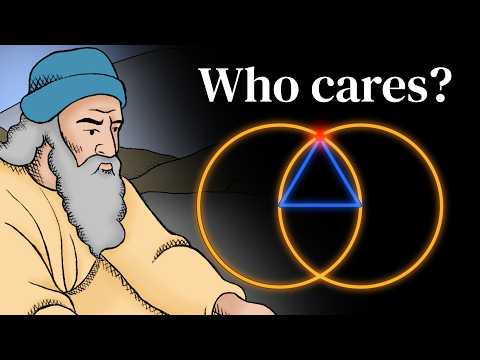
There is a lot about Euclid’s Elements that is easily misunderstood. Some proofs seem to have logical gaps. Some constructions seem pointless, others seem needlessly convoluted. Each of these provides a window into how the ancient Greeks thought about math and the philosophical role that geometry played. In the fifth and final of a series of guest videos I've been posting, @BenSyversen delves into a question anybody who has had to do ruler and compass constructions in a geometry class may have wondered: What's the point? youtu.be/M-MgQC6z3VU
YouTube video
YouTube
English
36
110
1.5K
156.4K
Viktor Blåsjö retweetledi
Photorin
Photorin@weltbuch·
Very comprehensive takedown of Galileo by @viktorblasjo I don't think anyone has tried to frame a rebuttal, which I would find interesting because I don't share the anti-philosophy biases of the author arxiv.org/abs/2102.06595
English
0
1
8
604
Viktor Blåsjö retweetledi
TeX Users Group
TeX Users Group@TeXUsersGroup·
Viktor Blåsjö's review of the book "Form & Number: A History of Mathematical Beauty" by Alan J. Cain, is now live at tug.org/books/reviews/…
English
0
3
10
813
Grant Sanderson
Grant Sanderson@3blue1brown·
I just put up a new video, which was a collaboration with Terence Tao about the cosmic distance ladder. You can find the full video on YouTube, and here's a bit of extra footage that didn't make it into the final.
English
89
590
5.7K
305.9K
Viktor Blåsjö
Viktor Blåsjö@viktorblasjo·
@mmeijeri @yvanspijk @YoeriGeutskens "The term 'focus' for these points [foci of conic sections] was introduced by Kepler ... I know of no ancient or medieval term." Toomer, Diocles on Burning Mirrors, p. 15. Even though the Greeks certainly knew about the concept, both theoretically and practically.
English
0
0
3
65
Viktor Blåsjö
Viktor Blåsjö@viktorblasjo·
@dodecahedra Certainly. The "rigor" I don't like is for example proving the FTC using the Intermediate Value Theorem and such things. A purely intuitive proof of the FTC is much more useful in a calculus context, whereas the "rigorous" proof in that context only obscures the key idea.
English
0
0
1
66
William Rose
William Rose@dodecahedra·
@viktorblasjo And to say this finite truncated trumpet has volume L is to say the sum of the finite number of thin discs can be made arbitrarily close to L by taking the discs thin enough. This kind of discussion is good, IMO. So score one for the rigor that makes this discussion possible!
English
1
0
0
86
Viktor Blåsjö retweetledi
William Rose
William Rose@dodecahedra·
Yesterday we got a new @viktorblasjo podcast all about Torricelli's trumpet, infinite geometric objects, and myths of math history. Entertaining, informative, hilarious, & way more detail than you probably want on parsing passages from the 17th century. intellectualmathematics.com/blog/torricell…
English
1
1
7
1.1K
Viktor Blåsjö
Viktor Blåsjö@viktorblasjo·
@dodecahedra Yes, I agree that Hobbes's argument basically doesn't work for this kind of reason. He is perhaps trying to say that infinitesimal methods generally assume non-Archimedean quantities, not referring to the specific slices used in any particular proof such as that of Torricelli.
English
1
0
1
75
William Rose
William Rose@dodecahedra·
In short, I don't think the Blåsjö interpretation of Hobbes's quote makes sense either since the Archimedean property only applies if the infinitesimal elements (thin discs) being added indefinitely are the same. But they are not the same, so hard to see Hobbes making that error.
English
1
0
1
284
Viktor Blåsjö retweetledi
Steven Strogatz
Steven Strogatz@stevenstrogatz·
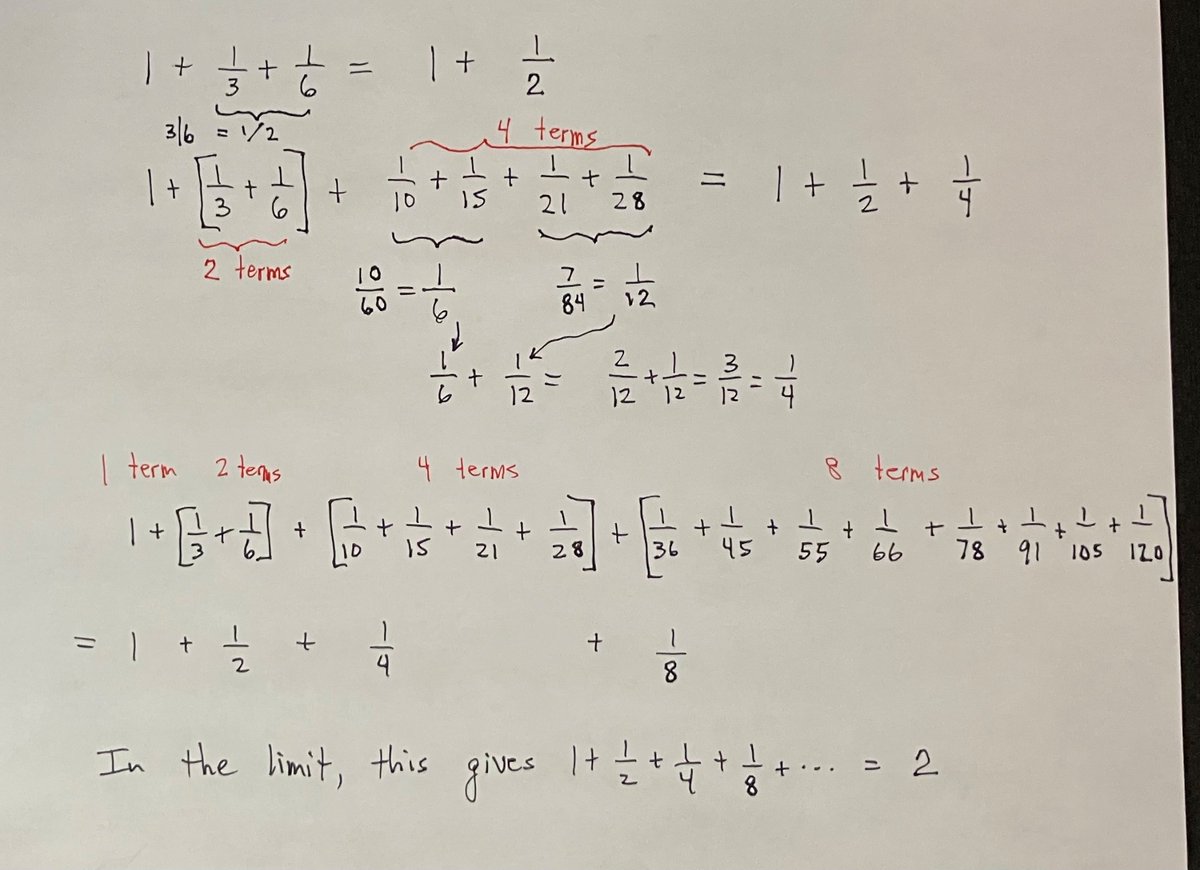
Today I learned (ht @viktorblasjo) how Huygens summed the reciprocals of the triangular numbers. He regrouped the series and showed that it equals the geometric series 1+1/2+1/4+... = 2, like so!
Steven Strogatz tweet media
English
13
95
706
45.2K
Viktor Blåsjö
Viktor Blåsjö@viktorblasjo·
@VisualAlgebra When integrating a separable diff eq, incorporate the initial condition as bounds of integration.
English
1
0
4
1.9K
Matt Macauley
Matt Macauley@VisualAlgebra·
Lots of good guesses here, but I haven’t seen the right answer so far. Here’s a hint: it involves differential equations!
English
29
1
42
11.4K
Matt Macauley
Matt Macauley@VisualAlgebra·
I’m teaching a topics grad class in Algebraic Systems Biology. There are 8 math students and 6 from other depts (Phys, Chem, BioE, and Med Biophys). This week I covered a mathematical topic. All non-math students had seen it, but 1/8 math students had. Can you guess the topic?
English
58
21
378
82.2K
Viktor Blåsjö
Viktor Blåsjö@viktorblasjo·
@MBarany Yes, the confrontational approach is crude and imperfect (certainly including my contributions) but still better and more fruitful than the milquetoast bland fest some seem to prefer.
English
0
0
1
93
Viktor Blåsjö
Viktor Blåsjö@viktorblasjo·
@mmeijeri Indeed. Numerical calculations of areas and volumes by multiplying numbers were certainly commonplace in practical economic contexts. Formal mathematics often hides its intuitive or applied origins, then as now. Høyrup is good on this.
English
1
0
1
50
Martijn Meijering
Martijn Meijering@mmeijeri·
@viktorblasjo I sometimes wonder if any non-mathematical historians believe the ancient Greeks were unaware of the similarities between numbers and other types of quantities like lengths and areas. Surely any educated Greek must have had some vague notion of area equals length times width?
English
1
0
0
52
Snezana Lawrence
Snezana Lawrence@snezanalawrence·
Newton, guess where and on what account? A little surprise today when I saw him in such company.
Snezana Lawrence tweet media
English
1
0
6
365
Viktor Blåsjö
Viktor Blåsjö@viktorblasjo·
@Helenreflects Way beneath the ambition of Leibniz. Galileo couldn't quit his shitty university professorship fast enough when his fame took off. Newton too grew way too elite for a provincial Cambridge job and quit. And these were much better universities!
English
0
1
4
256