Vincent Lim

52 posts

Vincent Lim banner
Vincent Lim

Vincent Lim

@vincentkslim

California, USA Katılım Ocak 2015
200 Takip Edilen52 Takipçiler
Vincent Lim retweetledi

Sebastien Bubeck
Sebastien Bubeck@SebastienBubeck·
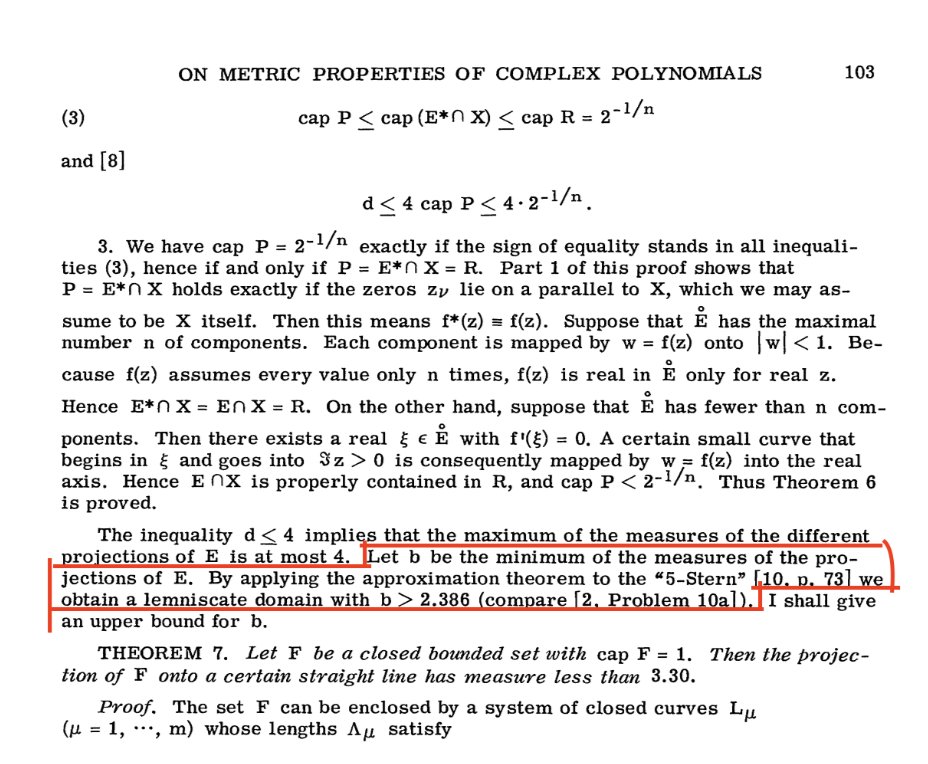
My posts last week created a lot of unnecessary confusion*, so today I would like to do a deep dive on one example to explain why I was so excited. In short, it’s not about AIs discovering new results on their own, but rather how tools like GPT-5 can help researchers navigate, connect, and understand our existing body of knowledge in ways that were never possible before (or at least much much more time consuming). Note that I did not pick the most impressive example (we will discuss that one at a later time), but rather one that illustrates many points at play that might have eluded people who see literature search as an embarrassingly trivial activity. Meet Erdős' problem #1043 erdosproblems.com/forum/thread/1…. This problem appeared in a paper by Erdős, Herzog, and Piranian in 1958 [EHP58]. It asks the following beautiful question: consider a set in the complex plane defined by being the pre-image of the unit ball under a complex polynomial with leading coefficient 1. Is there at least one direction in which the width of this set is smaller than 2? (2 is of course the best one can hope for, if the polynomial is a monomial then this set is the unit ball and so the width is 2 in all directions.) This problem didn't stand for very long: just three years later, Pommerenke wrote a paper [Po61] solving problem #1043 (with a counterexample), and that's what GPT-5 surfaced when asked this question. So what's the big deal? Well, a couple of things: 1) [EHP58] does not contain a single problem, but in fact sixteen. [Po61] says in the introduction that it will solve a few problems from [EHP58] but does NOT discuss problem #1043. In fact my understanding is that experts (at least in combinatorics) who knew both about [Po61] and problem #1043 did not know that the solution to the latter could be found in the former. This is quite clear on erdosproblems.com itself since problems (1038, 1039, 1045, 1047) all have a reference to [Po61], yet #1043 was not listed as having any connection to [Po61]. Another evidence that this had been at least partially forgotten is that on Mathscinet (MR0151580) the review of [Po61] attempts to give all the problems that are solved there and does not mention #1043 either. 2) The solution to #1043 can actually be found in the middle of the paper, sandwiched between the proof of Theorem 6 and the statement Theorem 7, as an off-hand comment, see picture. To find this you need to know this paper really well, and read it fully and carefully. I'm sure many people in the 1960s knew about it, but it seems like 60 years later there is a much smaller set of people that were aware of this brief comment in the middle of a 1961 paper. That's where the power of a "super-human search" lies, and this is way way beyond any search index capability (obviously; in fact it’s beyond the capabilities of the previous generation of LLMs). You need to read and understand the paper. 3) But there is more: the paper says that the proof follows by invoking [10, p. 73]. This is very important, because in math it's not so much about the result itself but rather about the understanding that comes with it (and with its proof). So what is [10]? Well it's the previous paper by the author, which was written in German ... and here again something truly accelerating happens: GPT-5 translated the paper and explained the proof in modern language. I believe that this is indeed very much accelerating. This is just one example, and each example has its own interesting story. I have seen similar moments where GPT-5 makes connections between very different fields, where the same results were proven in completely different languages (e.g., game theory versus high-dimensional geometry), sometimes 20 years apart. This is not about AI discovering new knowledge, this is about AI making all of the scientific literature come ALIVE — linking proofs, translations, and partially forgotten results so existing ideas can be understood and built upon more easily. When that happens, science moves forward with greater context and continuity. In my view it's a game changer for the scientific community. *About the confusion, which I again apologize for, I made three mistakes: i) I assumed full context from the reader, in the sense that I was quoting a tweet that was itself quoting my tweet from October 11, and that latter tweet was clearly stating that this is only about literature search; but it is totally understandable that this nested quoting could lead to lots of misreadings and I should have realized that. ii) The original (deleted) tweet was seriously lacking content, and this is probably the biggest problem. By trying to tell a complex story in just a few characters I missed the mark. I will not do that again, and rather, like I have always done, explain as many details as I can. This is vital given the stakes of the AI debate at the moment. iii) When I said in the October 11 tweet that “it solved [a problem] by realizing that it had actually been solved 20 years ago”, this was obviously meant as tongue-in-cheek. However, I now recognize that this moment calls for a more serious tone.
Sebastien Bubeck tweet media
English
187
222
1.7K
616.7K
Vincent Lim
Vincent Lim@vincentkslim·
@cHHillee do these changes not come with performance implications (I’m assuming Python is a far slower language), eg more function call overhead and whatnot? Or perhaps do these constant factors not matter
English
0
0
2
832
Horace He
Horace He@cHHillee·
I think this is an interesting question :) The most obvious one is that end users of PyTorch primarily use PyTorch in python, and having more things be in Python allows us to avoid the "two language problem", making it easier for end users to understand the library or make modifications. Maybe the less obvious one is that in my experience, Python ends up being much more productive to write ML code in. Anecdotally, many of the folks I talk who work in ML frameworks seem to think that that Python is about 2-5x more productive than C++. Curious what some other people think (cc: @ezyang or @jekbradbury)
English
2
0
32
3.5K
Horace He
Horace He@cHHillee·
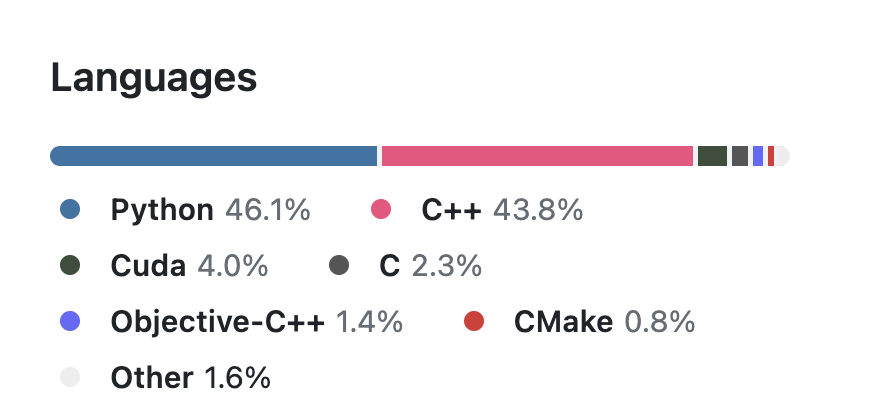
Fun fact: PyTorch's codebase recently flipped back to having more Python than C++, for the first time since nearly its inception back in 2017! There's still plenty of "borgification" in PyTorch, but recent PyTorch 2.0 has allowed us to do much more in Python :) (1/4)
Horace He tweet media
English
7
72
727
123K
Vincent Lim retweetledi
mok
mok@mokshith·
These are new waters for us as a company but I'm finally excited to share the news! The world is transforming right beneath our feet because of generative AI. We think this partnership will bring that transformation to the world, 10x faster. Read more: sievedata.com/acquisition
English
6
2
38
7.6K
Vincent Lim retweetledi
Posts Of Cats
Posts Of Cats@PostsOfCats·
would you give him a hug?
English
362
16.8K
135.3K
4.5M
Vincent Lim retweetledi
Kaushik Shivakumar
Kaushik Shivakumar@19kaushiks·
Wouldn’t it be nice if ChatGPT could find your missing keys for you? Our latest research from @berkeley_ai + @GoogleAI suggests that robots can use large language models (LLMs) to find hidden objects faster. 🧵👇
English
5
34
161
58.5K
Vincent Lim retweetledi
path.eth 🛡️
path.eth 🛡️@Cryptopathic·
I think the situation at @LastPass may be worse than they are letting on. On Sunday the 18th, four of my wallets were compromised. The losses are not significant. Their seeds were kept, encrypted, in my lastpass vault, behind a 16 character password using all character types.
English
1
1.5K
5.7K
3.2M
Vincent Lim retweetledi
Eric Feigl-Ding
Eric Feigl-Ding@DrEricDing·
⚠️THERMONUCLEAR BAD—Hospitals completely overwhelmed in China ever since restrictions dropped. Epidemiologist estimate >60% of 🇨🇳 & 10% of Earth’s population likely infected over next 90 days. Deaths likely in the millions—plural. This is just the start—🧵
English
10.7K
43.5K
97.5K
54.5M
Vincent Lim retweetledi
Tessa Lau
Tessa Lau@tessalau·
As winter approaches, here's a story about why hardware is hard. ❄️🥶 About a year ago, we started getting reports from the field about undesirable behavior when our robots were turned on. They would behave unpredictably.
English
70
724
4.1K
1.1M
Vincent Lim retweetledi
SkiHeavenly
SkiHeavenly@skiheavenly·
A reminder that wind hold is always for your safety:
English
55
146
1.2K
0
Vincent Lim retweetledi
Horace He
Horace He@cHHillee·
Eager mode was what made PyTorch successful. So why did we feel the need to depart from eager mode in PyTorch 2.0? Answer: it's the damn hardware! Let's tell a story about how the assumptions PyTorch were based off of became untrue, and why PyTorch needed to evolve. (1/10)
English
17
195
1.3K
0
Vincent Lim retweetledi
mok
mok@mokshith·
Introducing Tasmania - a better YouTube video search engine. Every result links to a specific moment in the video, so you can pinpoint the exact part of a video that made it surface in the results! tasmania.sievedata.com
English
24
67
701
0
Vincent Lim retweetledi
mok
mok@mokshith·
1/ Today we’re excited to unveil Sieve (@sievedata), a cloud native platform for processing, searching, and running all sorts of AI models on video. sievedata.com/blog/launch
English
27
44
214
0
Vincent Lim retweetledi
Antonio Loquercio
Antonio Loquercio@antoniloq·
We train a robot 🐕 to traverse complex terrains with a monocular RGB camera from its own real-world experience! To do so we propose Cross-Modal Supervision (CMS), an algorithm to supervise vision using proprioception. Project Page: tinyurl.com/4sr5d6z3 1/5
English
6
53
324
0
Vincent Lim retweetledi
Alejandro Escontrela
Alejandro Escontrela@alescontrela·
This is easily one of the most impressive developments in the locomotion space this year! The fact that this small, cheap legged robot can rival the behavior of its larger, 10x more expensive competitors is nothing short of fascinating. Congrats @antoniloq + @ashishkr9311!
Antonio Loquercio@antoniloq

We train a robot 🐕 to traverse complex terrains with a monocular RGB camera from its own real-world experience! To do so we propose Cross-Modal Supervision (CMS), an algorithm to supervise vision using proprioception. Project Page: tinyurl.com/4sr5d6z3 1/5

English
1
2
8
0
Vincent Lim retweetledi
allkpop
allkpop@allkpop·
[Breaking] Nightmare in #Itaewon. Current status is that over 50 people have collapsed and possible multiple fatalities due to overcrowding during the Halloween festivities. Stay tuned for more info.
English
1.4K
40.9K
77.6K
0
Vincent Lim retweetledi
Ryan Hoque
Ryan Hoque@ryan_hoque·
Evaluating progress in robotic manipulation is challenging due to the cost & diversity of robots—but what if we had shared access to a remote robot over the Internet? I’m in Japan all week and will be presenting our work w/ @GoogleAI tomorrow at 11:20 AM JST at #IROS2022! (1/3)
Ryan Hoque tweet media
English
2
19
89
0
Vincent Lim retweetledi
Yahav Avigal
Yahav Avigal@yahavigal·
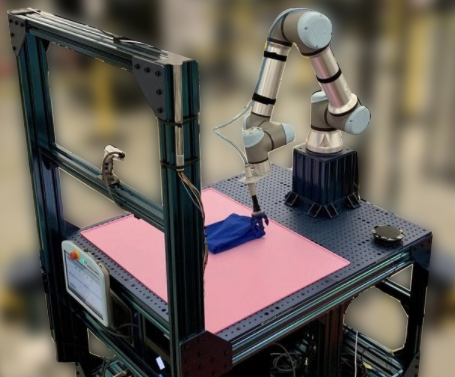
Does anyone enjoy folding laundry? Robots are often too slow; We’re presenting a paper @IROS2022 on how to speed up folding by an order of magnitude. SpeedFolding uses novel perception and action primitives to fold 30-40 garments per hour. (1/8)
English
24
94
370
0