່
382 posts

່
@Voice
Voice gives AI soul 🔮 Portal to voice AI experiences
Katılım Ekim 2014
1.9K Takip Edilen17K Takipçiler

Olivia Moore just explained why the open office is about to die.
Not because of culture shifts. Not because of remote work.
Because AI runs on voice. And voice requires walls.
Moore: “I do think the way that we work and when we work and how we work is going to change in the AI era.”
She’s not predicting the future. She’s describing what’s already happening while most companies are still rearranging desk layouts.
Moore: “Voice dictation has blown up in enterprises.”
Think about what that sentence actually means.
Talking to AI is faster than typing to it. Not marginally faster. Dramatically faster.
Your hands were never the right interface. Your voice was.
Moore: “It started with vibe coding where engineers would just talk into a mic and it would produce software for them in Cursor.”
Engineers figured it out first. They stopped typing code and started speaking it into existence.
Output didn’t just increase. It multiplied.
The keyboard became a bottleneck overnight.
Moore: “Now it’s spread to sales, marketing, and business.”
This is the part that should keep every executive up at night.
It’s not just developers anymore.
Every department is discovering that voice is the fastest path between intent and execution.
The entire workforce is about to start talking to machines all day.
Moore: “That is not well suited to an open office where everyone can hear what everyone else is saying.”
Here’s the collision nobody planned for.
The most productive way to use AI requires talking out loud.
The most common office design requires everyone to be quiet.
Those two realities cannot coexist.
Fifty people in one room dictating prompts simultaneously. That’s not a workspace. That’s an acoustic disaster killing the output it was designed to produce.
Moore: “I think there’s going to be some cultural and even environmental changes that are going to happen to adapt to the AI world.”
She’s being diplomatic.
What she’s really describing is the complete physical restructuring of the workplace.
Walls going up. Private rooms. Acoustic isolation becoming a competitive advantage.
The open office is dead. It just doesn’t know it yet.
Every company still pouring money into wide open collaborative floors is investing in architecture that actively fights the way humans will work for the next decade.
The ones who figure this out first don’t get a marginal edge.
They get a workforce operating at a speed their competitors physically cannot match.
Not because of better models.
Because of better walls.
English
່ retweetledi

Kelsey Plum becomes the first female pro athlete to launch a verified AI “digital twin” that fans can voice call to interact with her, per @FastCompany
“It’s where we are in society… I think you’re either gonna get with it or get lost.”

English
່ retweetledi

ok WOW.
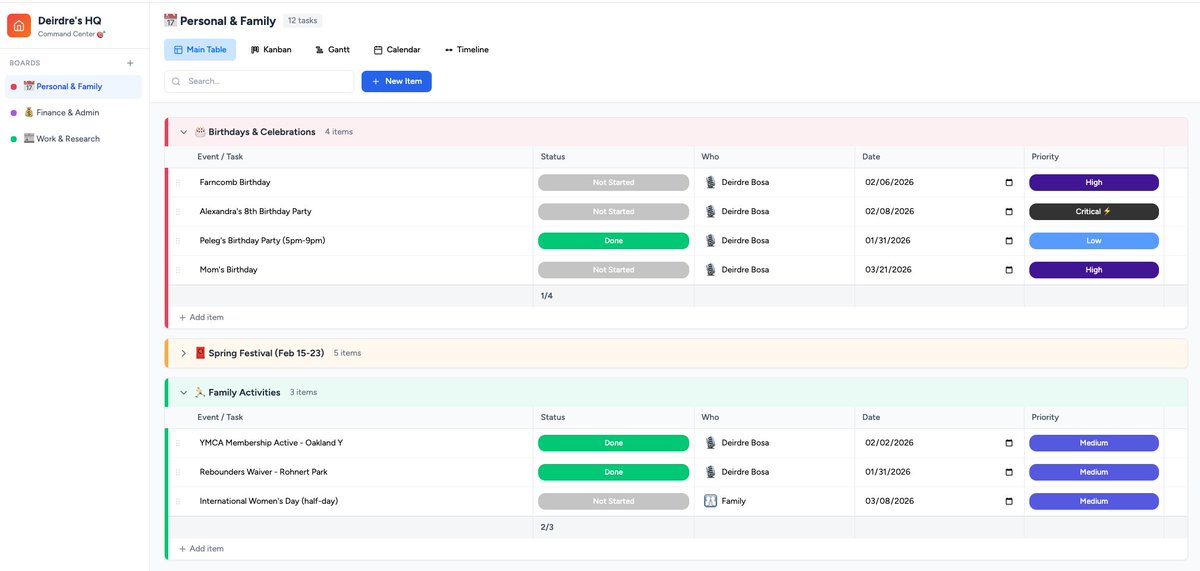
Woke up this morning and said, for fun, lets try to recreate monday. com w Claude cowork. it wont work or anything, but we can just show our audience that its plausible.
1 hour later... I literally have my own monday. com that's plugged into my calendar & gmail and surfaced a kids bday that was not anywhere on my radar and I need to get a gift for. Can imagine next step being: order gift and have it delivered by Sunday.
2026 is WILD.

English
່ retweetledi

@HuggingModels Open source voice models are now at the level of cutting-edge models from 5 months ago
Open source always catches up fast
English
່ retweetledi

NVIDIA just dropped PersonaPlex-7B 🤯
A full-duplex voice model that listens and talks at the same time.
No pauses. No turn-taking. Real conversation.
100% open source. Free.
Voice AI just leveled up.
huggingface.co/nvidia/persona…
English
່ retweetledi

Today, we're announcing significant new traction in our voice AI research and development partnerships.
Over the past few months, we’ve quietly been expanding our focus on providing frontier voice AI training data to research labs looking to imbue emotion understanding and cutting edge expressivity into their foundation models.
We believe some of the most exciting possibilities for deeper speech and emotion understanding will come to fruition this year. By training today’s frontier models to understand the nuances voice interaction—rife with subtle tones of frustration or satisfaction, “aha” moments, chuckles, sighs, backchannels, and interruptions—we believe that labs will unlock new possibilities for voice AI to become a primary interface within many applications.
In our experience working with leading research labs and AI-first enterprises, a consistent pattern we’ve seen is a greater need for high-quality datasets and evaluation pipelines than for new algorithms or architectures. Researchers spend up to 80% of their time curating the data they need to diagnose model issues, fix failure modes, and improve model behavior.
That’s why Hume is now focused on building the data and evaluation infrastructure needed to train next-generation voice models across industry. With the right training, we hope that deeper voice understanding and empathy can be translated not just into more efficient interfaces but into better alignment of AI with human well-being.
Read more below hume.ai/blog/data-blog…
English
່ retweetledi

Lessons I've learned this year from running an early stage VC firm and being a human trying to do it all (all in the latest newsletter linked below):
Don’t be too conservative: TLDR: 2025 kicked me in the teeth. We made 13 investments, met thousands of companies and feedback for myself from 30,000 feet is that we were a little too conservative. We passed a lot on great founders based on price. A few keep me up at night. Every other year that we have been investing, giving the first term sheet to a team meant a lot and our chances of winning the deal were over 90%. That was not the case this year. Moving first meant your chances were around 60%. Every blue-chip decided to swim at seed on top of the thousands of early stage funds I still know nothing about. Don’t get me wrong, I love competition, but this job is largely a math problem. Our model is 10% ownership and typically for sub $2M checks which means $30M+ post breaks our model. Not that I believe we settled at all for the deals we did do, but we walked on a handful of what I still believe to be great companies because they were priced sky high and we wouldn’t match. Sure, we lose for other reasons like not moving quickly enough/being late to the deal but price was a real pain this year. Most early stage funds decided to take 5% ownership and to do the deals, which again, if you do the math, in some cases with a large enough exit, it can return a fund, but I’m not convinced this is worth it most of the time.
The best funds in the world have humble beginnings: I went on many walks with GPs at a handful of the best firms in the world today. A very common theme from all of them: they had very humble beginnings that they never talk about publicly. More specifically, many that manage billions spent a few years stitching together SPVs because no LPs believe in them yet to invest in a fund. You only ever hear the beginning of their story on podcasts to be some flashy first deal that exited massively. They skipped Chapter One. I think of my $5M fund I raised back in 2021, look at the $75M in AUM and candidly feel like a pathetic loser that will never cross the chasm. No father to anchor me, no signal from a wealthy family that grew up in Atherton. The truth is, it takes time. We are in incredible companies that need time to bake. Never be discouraged by the journey or your starting place in line. Don’t quit.
No one knows what the “perfect” founder looks like: Every year I survey the portfolio, rank the companies from who is performing best and who isn’t doing well. Every year this shifts dramatically. Some years it seems obvious: top CS degrees, technical, chip on shoulder. Others make no sense. Non-technical PM founder, no childhood trauma, decent IQ and very high EQ, total dog in them.
The world is headed where it’s headed, and no one knows where that is: My favorite part of this timeline we are living in is the amount of content you can absorb online. The smartest people on any given topic write incredible blog posts, sit for long interviews and let you inside of their mind. Even better, not a single “expert” is aligned on the future of AI, enterprise adoption of it, are data centers being overbuilt, if we are in a bubble, etc. Stay the course, whichever yours may be.
SF is the probably best place to build, if you are in build mode: If (when) I had a billion + in net worth, would SF be my top choice of places to live? Probably not. But its the very best place to be when you are still at the peak of your career, right on cutting edge of your potential and want to accomplish incredible things. I moved back five months ago and the density of brilliant minds and your access to anyone on any topic at any moment is unbeatable. I wasted countless total days of my life on planes traveling to CA. Best way to be on a fast track (though there is no real fast track) is to get here and get in the mix on a daily basis and let things compound. Access to the best investors, the best founders, best LPs, all here. If you will do whatever it takes to win, I highly recommend the “sacrifice”.
The bigger house won’t solve a single problem: I have journal entries from when I was 12 years old, living in a tiny 1200 sf home with 7 people, dreaming of the white picket fence, the big house on a few acres, THE home to host everyone I love. Earlier this year I moved my family from a home we lived in for five years that we loved, modest 3,800 sf (for Nashville), .25 acres, cute. I was having more financial success from a few personal investments and wanted something to show for it, the thing I dreamed about. We find this house across town, 8,000 sf on an acre, right next to my favorite coffee shop. This is it I told myself. I hired movers that ended up breaking 50% of our personal items, had a horrible 5 day move in. We were under tornado watch on day 6 and had to wake up our 10 month old and move him to the basement multiple nights. The house was new construction and very loud, appliances that made no sense for someone that actually cooked (tiny fridge for one, appliances that were so fancy you had to read a 500 page manual to get the over on), etc. It’s a complete mess somewhere at all times. You either spend all of your time cleaning or hiring people who never leave your house. It was a revolving door of people doing things, too many stairs for a small child and poorly insulated. It was so clear we made a huge mistake. We left our home because I wanted “more”. Needless to say, we moved to SF. I don’t know that we ever would have left Nashville if I didn’t tear us from a home that we loved, but I do think it was the right thing. No big huge fancy houses in SF or ever again! You don’t need them.
The unexpected beauty of being with someone for almost 10 years: I think my husband and I can honesty say this was the most challenging year of our lives together. It’s been almost 10 years. We are both growing our own companies, moved twice, one huge move to SF with a one year old and my parents. Raising even a single child is a huge endeavor, especially when he wakes up one minute after 5am. We disagreed on a few important things this year when we are usually very aligned on values. I used to think when we first started dating that at any big intersection where we weren’t aligned perhaps we weren’t meant to be. Dating is such a funny thing, constantly evaluating the other partner on marriage material, do we have a real future together, etc. But when you make that commitment, and you spend years of trials of miles together, these forks in the road are an incredible opportunity to get to know each other again. Kids are a gift but they also ruin the closeness you had for a period of time. There are no late nights staying up talking about things anymore. I’ve had numerous moments this year where I’ve never been more sure that the one thing I’ve gotten really right in my life is who I married. 10 years grants you this silent understanding and acceptance - you have so many years of compounding proof of we will figure this out together. What a sacred gift in this life, especially when most things are so fleeting.
Daily inputs will take you anywhere you want to go: I am extremely hard on myself and feel like a pathetic idiot who has accomplished nothing in my life and so I challenged myself to sit down and make a list of things I haven’t accomplished in the past that I put everything into. The short answer: almost nothing. In college, I ran 80 miles per week to go to the NCAAs and break the 5k and 6k record at my college. I did both in three years. Every job I’ve ever really wanted I’ve gotten. Every fund I’ve gone out to raise, I’ve raised. One thing I have yet to do is run a sub 3 hour marathon, but I did run 3:09 in Boston and I’ll take that for now. Sure, some small things don’t workout, but anything I’ve put countless hours, days, months into without quitting have worked out. You are what you manifest - AND what you work at daily.
English
່ retweetledi

Voice AI is going to explode in 2026. Here’s what I’m seeing:
1. Dictation has completely changed how I work
I go on walks where I dictate to Otter for 40min. I built an app this weekend while lifting weights. The productivity gain is real.
2. Phone booths everywhere
I visited the offices of two large AI companies last week. They have phone booths everywhere. I watched someone walk into one, dictate, then walk right back out. That’s it.
3. Microphones at every desk
I visited Wispr Flow’s headquarters in October (see pic). Every single employee had a $60 microphone on their desk and can whisper tasks all day long to AI. You cannot hear them even if you’re at the neighboring table.
4. OpenAI says typing is the bottleneck
Alexander Embiricos, head of product for Codex, just went on the @lennysan podcast that the “current underappreciated limiting factor” to AGI-level productivity isn’t model capability, it’s human typing speed.
We are literally being held back by our fingers.

English
່ retweetledi

Voice AI just got a massive upgrade! 🚀 Gemini 2.5 Flash Native Audio model allows you to build more natural live voice agents 🤖
Improvements include:
- Improved function calling
- 90% adherence to complex instructions
- Cohesive, multi-turn conversations
PLUS: We're launching Live Speech Translation beta in Google Translate (real-time, style-preserving translation in your headphones for 70+ languages) 🤯
@GoogleAIStudio @googleaidevs
English
່ retweetledi

ElevenLabs has raised more than $300 million in all, soaring to a $6.6 billion valuation in October to become one of Europe’s most valuable startups.
Full story: forbes.com/sites/iainmart…
📸: Cody Pickens for Forbes

English

@farrowhardy1 Appreciate you laying out this new possibility, Hardy 🫡 Best wishes with Longacre!
English

Here's what I'd build for Home Services if in tech:
-Parts Purchasing (most of industry is still phone calls to check if part is available)
-Fleet Sourcing/Purchasing
-Warranty/Rebates/Returns for Parts (these are a pain but can be easily automated)
Rohit Mittal@rohitdotmittal
when vertical AI companies work, they work really well permitflow just raised $54M series B for construction permitting AI this is the playbook thats actually working right now pick a massive legacy industry ($1.6T construction) find the workflows everyone hates (permitting, inspections, licensing) build AI agents that understand the domain deeply sell to customers who value time over cost they didnt build "general purpose AI for construction" they built a permitting agent. then an inspections agent. then a licensing agent. vertical AI wins by going narrow first
English