Felix Hildebrandt

1.3K posts

Felix Hildebrandt banner
Felix Hildebrandt

Felix Hildebrandt

@voulex

👨‍💻 DLT software engineer, nodes, articles & research ⚡️ prev @lukso_io & @slockitproject ⛓️ fhildeb {.eth | .lens } , 🗞️ https://t.co/nYR8WqiQI1

Berlin Katılım Ağustos 2017
22 Takip Edilen1.5K Takipçiler
Felix Hildebrandt
Felix Hildebrandt@voulex·
@InternLukso Not gone, just exploring what else brings joy right now. Fewer screens, more human and hands-on things. Coding started to feel a bit generic, and I missed the sense of immediate impact and appreciation.
English
0
0
8
112
LUKSO Intern
LUKSO Intern@InternLukso·
@voulex ‘If I ever step back in….’: where did you go? 😏 We need you out here… building. educating. connecting. :))
English
1
0
5
150
Felix Hildebrandt
Felix Hildebrandt@voulex·
When I look at the current state and last decade of Web3, the only true Product-market fits have been speculation (ICOs/investments) and DeFi – broadly speaking: fear & greed. It's daunting 😢 If I ever step back in, it’ll be in the sense of social/messaging tech or protocols.
English
3
0
23
720
Felix Hildebrandt retweetledi
vitalik.eth
vitalik.eth@VitalikButerin·
In 2026, I plan to be fully back to decentralized social. If we want a better society, we need better mass communication tools. We need mass communication tools that surface the best information and arguments and help people find points of agreement. We need mass communication tools that serve the user's long-term interest, not maximize short-term engagement. There is no simple trick that solves these problems. But there is one important place to start: more competition. Decentralization is the way to enable that: a shared data layer, with anyone being able to build their own client on top. In fact, since the start of the year I've been back to decentralized social already. Every post I've made this year, or read this year, I made or read with firefly.social, a multi-client that covers reading and posting to X, Lens, Farcaster and Bluesky (though bluesky has a 300 char limit, so they don't get to see my beautiful long rants). But crypto social projects has often gone the wrong way. Too often, we in crypto think that if you insert a speculative coin into something, that counts as "innovating", and moves the world forward. Mixing money and social is not inherently wrong: Substack shows that it's possible to create an economy that supports very high-quality content. But Substack is about _subscribing to creators_, not _creating price bubbles around them_. Over the past decade, we have seen many many attempts at incentivizing creators by creating price bubbles around them, and all fail by (i) rewarding not content quality, but pre-existing social capital, and (ii) the tokens all going to zero after one or two years anyway. Too many people make galaxy-brained arguments that creating new markets and new assets is automatically good because it "elicits information", when the rest of their product development actions clearly betray that they're not actually interested in maximizing people's ability to benefit from that information. That is not Hayekian info-utopia, that is corposlop. Hence, decentralized social should be run by people who deeply believe in the "social" part, and are motivated first and foremost by solving the problems of social. The Aave team has done a great job stewarding Lens up to this point. I'm excited about what will happen to Lens over the next year, because I think the new team coming in are people who actually are interested in the "social": even back when the decentralized social space barely existed, they were trying to figure out how to do encrypted tweets. I plan to post more there this year. I encourage everyone to spend more time in Lens, Farcaster and the broader decentralized social world this year. We need to move beyond everyone constantly tweeting inside a single global info warzone, and into a reopened frontier, where new and better forms of interaction become possible.
Lens@LC

Today, we’re proud to share that @masknetwork will steward the next chapter for Lens, bringing the strongest onchain SocialFi foundation to life through intuitive, consumer-ready applications.

English
918
654
4.2K
615K
Felix Hildebrandt
Felix Hildebrandt@voulex·
TLDR: AI agents become front-end executors, while smart accounts like @ERC725Account offer the sovereign backend: Operating on value limitations, contract whitelists, and revocable role-based access to move on from an all-or-nothing hot wallet risk into secure delegation. 🤖🤝🆙
Deep Thinker@DeepThinker4200

To be honest, LYX price volatility can affect emotions — but at this stage, it has little practical meaning for me. Whether it’s $0.2 or $2, I’m not selling. What matters isn’t the chart. What matters is whether Universal Profile becomes the account standard for the next real adoption wave. And beyond stablecoins and RWA, a new opportunity is emerging right now: the OpenClaw boom. OpenClaw isn’t just another crypto bot. It represents something much bigger: •Local AI agents executing tasks through shell + Playwright •Automated swaps, monitoring, alerts, on-chain execution In short: OpenClaw is the execution layer of the AI agent era. But it also exposes crypto’s most dangerous weakness: EOA + AI automation = infinite risk. Today, these workflows still rely on users injecting private keys or hot wallets — and in an AI-driven environment, that’s catastrophic. One leak, one prompt injection, and everything is gone. Some point to Safe or multisigs, but those are built for institutions: •heavy governance •high deployment cost •too much friction for high-frequency, single-user automation AI agents don’t need institutional complexity. They need:lightweight, permissioned execution accounts. That’s where Universal Profile becomes uniquely positioned. After cross-chain completion, UP becomes: •a unified multi-chain identity •permissioned delegation via LSP6 Key Manager •verifiable on-chain metadata via LSP3 UP isn’t just a wallet. It’s an identity-bearing execution container — exactly what AI agents require. Combined together: OpenClaw becomes the front-end executor, while UP remains the sovereign backend controller. Agents can operate under restricted permissions: •small-value transfers only •approved contracts only •revocable keys and role-based access This upgrades automation from: all-or-nothing hot wallet risk → secure agent delegation. If Universal Profile has already gone cross-chain, then maybe this is the perfect moment for a real adoption breakthrough.

English
2
12
53
2.2K
Felix Hildebrandt
Felix Hildebrandt@voulex·
The "Tokenizing the Future" print arrived! 🕯️ Jumping in at the center, I landed right on one of mine. If you want to read along, their latest versions were published earlier this year on my Medium page as well.
Felix Hildebrandt tweet media
English
1
2
17
634
Felix Hildebrandt retweetledi
James | Snapcrackle
James | Snapcrackle@Snapcrackle·
Someone had to make the Fusaka cheat sheet. Here you go
James | Snapcrackle tweet media
English
90
156
752
54.5K
Felix Hildebrandt
Felix Hildebrandt@voulex·
AI, at its heart, is "more trust, less truth." Web3 counterbalances this technology by being "less trust, more truth." 🦉min 57
Polkadot@Polkadot

"The world is probably going to be a better place without authority and trust." @gavofyork on why he's spent over a decade building Web3. 0:00 - Childhood: Lego, self-taught programming 10:00 - Video games 14:02 - Board games 19:34 - Game design as blockchain architecture 25:11 - Philosophy on authority, living as peers 30:57 - Motivations for Web3 38:16 - JAM vs Polkadot development 42:48 - JAM technical: scalability 52:32 - JAM as neutral protocol 55:00 - AI dangers, Web3 as counterbalance 1:01:33 - Ethereum origin: Vitalik and whitepaper

English
0
1
3
335
Felix Hildebrandt
Felix Hildebrandt@voulex·
Excited to share that @SpringerNature released a new book about Web3. 🚀 I co-authored about 60 pages to explain how decentralized identities, smart accounts, and token-based interactions form the foundation of future Web3 societies. 🙂
Felix Hildebrandt tweet media
English
2
1
9
192
Felix Hildebrandt
Felix Hildebrandt@voulex·
Watched it on Tuesday. Definitly strange, seeing three of my former bosses in a movie together and recognizing houses and offices. 😅 Brought back memories, but also felt distant and somehow intangible, as I joined crypto post-@TheDaoProject ...🧑🏻‍💻
Code Is Law: The Movie@CodeIsLawFilm

Code is Law is now streaming worldwide! Available in selected territories inc US/UK via Amazon, Apple & YouTube: amazon.co.uk/gp/video/detai… tv.apple.com/us/movie/code-… youtube.com/watch?v=9NwSH2… Also AVAILABLE GLOBALLY via Vimeo on Demand: vimeo.com/ondemand/codei…

English
0
0
8
523
Felix Hildebrandt
Felix Hildebrandt@voulex·
In Autumn 2014, Ethereum presented the idea of the Mist browser. Now, 11 years later, it has become a reality as a web and mobile operating system. Imagine how versatile and polished it will become in the next years, now that the foundation is so easily accessible. 👏
LUKSO@lukso_io

x.com/i/broadcasts/1…

English
3
15
98
5.2K
Lou3e
Lou3e@lou3ee·
Excited to announce I’ve joined the Ethereum Foundation to help bring the story of Ethereum to life through new media. @ethereumfndn @ethereum
English
458
47
1.7K
143K
Felix Hildebrandt
Felix Hildebrandt@voulex·
As someone who has read up on DIDs but is by no means an expert like @joelthorst, I found his latest article very insightful. Here's my TLDR 👇 Decentralized identifiers are URLs pointing to so-called "DID Documents", which list the public keys used to verify who controls an identity. However, the spec does not specify how resolution occurs. The missing resolution layer is the Achilles’ heel, as different methods mean no real interoperability. True "decentralization" (the D in DID) should always feature censorship resistance, trustless verification, and key rotation, making blockchain anchoring essential. Off-chain DID methods like did:web or did:plc, however, reintroduce trust back into the concept. Since every DID method uses a different chain or resolution protocol, real apps can’t resolve them all trustlessly. Most projects use centralized resolvers like Uniresolver, meaning DIDs became an illusion of interoperability. On the other side, the Ethereum ecosystem already embodies what DIDs aimed for: stable identifiers with storage and key rotation (Safe, ENS, Universal Profiles, AA), verifiable and revocable credentials (ZKP with on-chain fingerprint), and authentication with selective disclosure (SIWE, ZuPass). On top, it has enormous light-client potential to make identities usable at scale. P.S.: I'm again, rooting for Universal Profiles, as feature-rich smart accounts with universal storage that can react extensively to transfers, and have fine-grained permission management. LSPs took interoperability quite literally, compared to some others. 😅 Now, projects should collaborate to gain the full potential.
Joel@joelthorst

jthor.eth.link/blog/2025/10/2…

English
0
4
7
980
Felix Hildebrandt
Felix Hildebrandt@voulex·
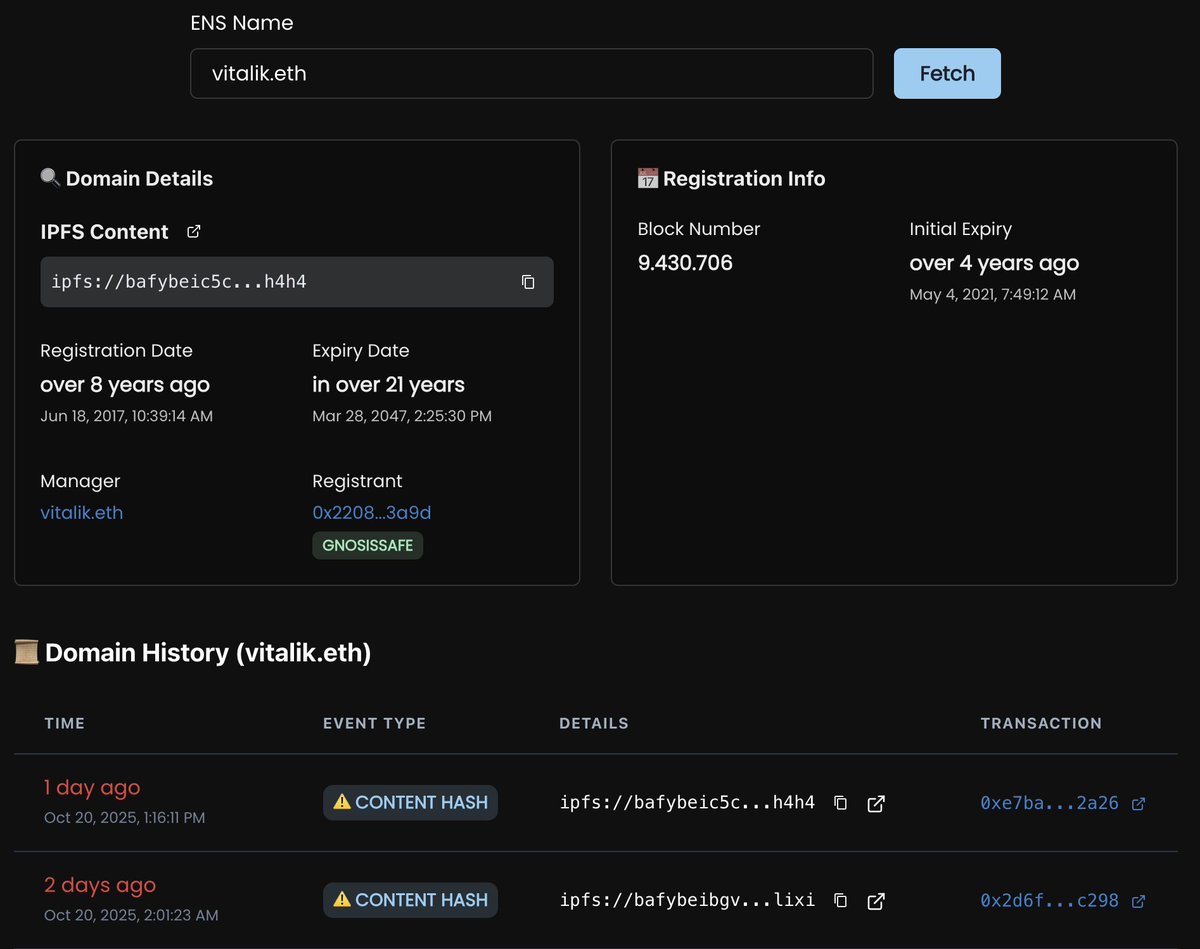
Just read @joelthorst's post on how Ethereum can raise the bar of secure webpage delivery - a pity we don't already have wider support for CID lookups and verification. 😅 @swissknifexyz's history lookup is a neat tool. Have seen a few pilot projects from universities that are following a similar direction.
Felix Hildebrandt tweet media
English
3
1
7
511