VuduVations

94 posts

VuduVations banner
VuduVations

VuduVations

@vuduvations

Building VuduVations. Consulting-as-Code: the AI orchestration layer you own, not rent. You can rent the intelligence. You can't rent the accountability.

Las Vegas Katılım Eylül 2023
181 Takip Edilen14 Takipçiler
Sabitlenmiş Tweet
VuduVations
VuduVations@vuduvations·
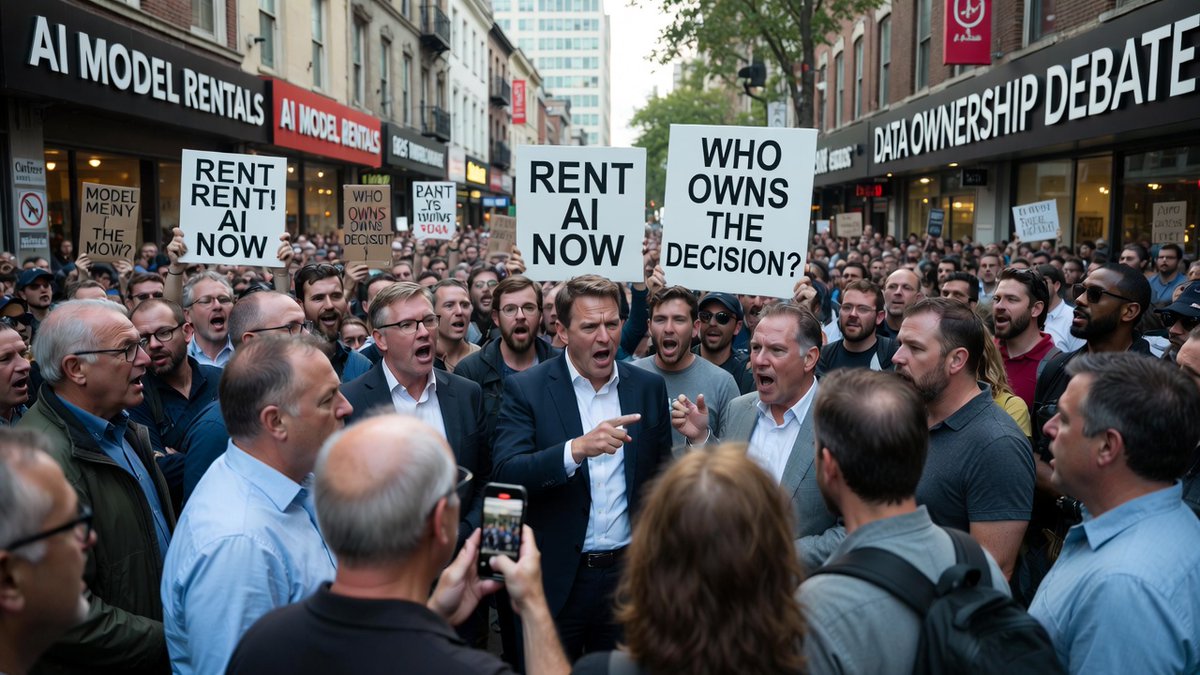
Everyone's fighting over which AI model to rent. Nobody's asking who owns the record of what it decided. The model is rented and swappable. The accountability isn't. That's the whole game.
VuduVations tweet media
English
0
0
0
21
VuduVations
VuduVations@vuduvations·
Sovereignty has become one of the load-bearing words in enterprise software, and it is now being used to describe two things that are close to opposites. The version that has taken hold in the CRM market, argued most recently in a joint Infosys and Salesforce piece, treats sovereignty as a question of location: - Customer data kept inside a national boundary, - Inference executed where the data physically resides, - Workloads hosted in a region-aligned cloud so that nothing of regulatory consequence crosses a border. That reading is real and the regulators are serious about it, but it is a residency problem, and residency is the floor beneath the question rather than an answer to it. The question that actually decides whether the work belongs to the enterprise is a different one, and it is the question the architecture in that piece never raises. It is not where the system runs, but whether the institution can carry the system elsewhere and have it still function. In the sovereign stack being marketed, every layer that matters is leased from a single vendor, the hosting, the trust and governance layer, the agents that execute the decisions, and the data platform that unifies them, all of it assembled by an integrator and none of it owned by the company whose name sits on the regulatory filing. The data remains in the country, which satisfies the auditor, but the procedure that converts that data into a decision remains the property of the platform; when the contract turns over or a cheaper model arrives, the residency stays and the reasoning does not travel with it. The distinction matters because the market is selling the two as though they were one, and an enterprise can satisfy every residency requirement while owning none of the logic on which its operation now depends. Sovereignty that is worth the word is the part the institution operates and can move, the routing, the policy, and the record of what was decided and why, encoded as a procedure the company holds and can rerun on whatever model is defensible next quarter and in whatever jurisdiction it is later compelled into, with the audit trail resident inside the institution rather than inside a vendor's tenancy. Keeping the data inside the border is the part the regulation forces and the vendors are content to sell; keeping the procedure itself an owned asset is the part that survives a change of supplier, and it is very nearly the only part no one in this market is offering. That is the asset Consulting-as-Code was built to make the client keep. Try Vuduvations today.
Infosys@Infosys

Customer data stays local. #Customerexperiences stay global. As #AIadoption accelerates and regulations tighten, enterprises need #CRM architectures built for sovereignty from day one. Read the latest POV: infy.com/7RoY3 #Agentforce #DataSovereignty #InfosysKnowledgeInstitute #InfosysSalesforceServices
English
0
0
0
34
VuduVations
VuduVations@vuduvations·
How fast is the AI landscape changing? Here is an example, @satyanadella the CEO of Microsoft 5-weeks ago published his view of frontier without an ecosystem. That changed yesterday when he said: "By keeping the harness separate from the model, and the context and memory separate from the model, you absolutely can use multiple models... any one model can go away, and you can still continue to be in control of your own destiny." That is Consulting-as-Code's architecture in Microsoft's CEO's words - keep the harness, the context, and the record separate from the model. He even names the failure mode: companies "without an AI-gateway layer that separates their prompts from the model will be in trouble." Rent the Stack - Own the Switch try Consulting-as-Code.
VuduVations tweet media
English
0
0
0
13
VuduVations retweetledi
VuduVations
VuduVations@vuduvations·
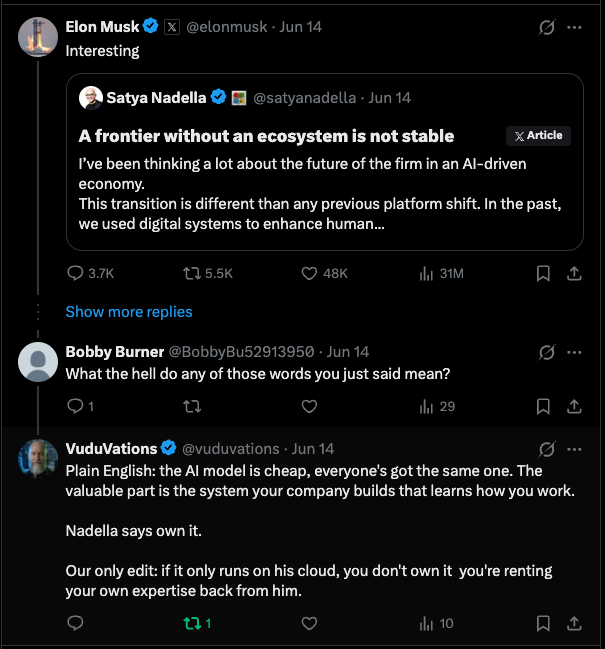
Plain English: the AI model is cheap, everyone's got the same one. The valuable part is the system your company builds that learns how you work. Nadella says own it. Our only edit: if it only runs on his cloud, you don't own it you're renting your own expertise back from him.
English
0
1
0
11
VuduVations
VuduVations@vuduvations·
The reason an operator should care, not only a policy person, is that a contested rulebook with no referee makes any single-standard bet reckless. What an operator can do instead is own the layer that complies with whichever regime applies where the work happens: route to the permitted model, enforce the local policy, keep the record that jurisdiction's auditor will accept. That is what sovereignty means in practice. Not a flag to wave but a layer to operate, and it carries the most weight in exactly the moment no one is refereeing.
CNBC@CNBC

Op-ed: Over 2,000 proposals aim to govern AI. Not a single one addresses a long-term regulatory framework cnbc.com/2026/07/27/ai-…


English
0
0
0
10
VuduVations
VuduVations@vuduvations·
@CNBC Meanwhile the standards race runs. China routes AI governance through the UN's telecom body, where states hold the pen, and open-sources capable models so the world runs on its stack. Industry floats its own private regulator. The US government seat sits empty.
English
0
0
0
25
CNBC
CNBC@CNBC·
Op-ed: Over 2,000 proposals aim to govern AI. Not a single one addresses a long-term regulatory framework cnbc.com/2026/07/27/ai-…
English
6
4
11
24.3K
VuduVations
VuduVations@vuduvations·
@WSJ Is this the new 'buzzword' of the week?
English
0
0
0
40
VuduVations
VuduVations@vuduvations·
Kimi K3 - "Open" still isn't "cheap to self-host." 2.8T params needs real GPU infrastructure; the cost-per-task wins assume someone runs it at scale. That caveat reinforces the compute-concentration point rather than weakening it.
English
0
0
0
23
VuduVations
VuduVations@vuduvations·
Kimi K3: It isn't just "free" - it's near-frontier AND cheap, and independent third parties confirm it. The honest story is now: near-frontier quality, a fraction of the cost, verified outside the lab. On a coding agent benchmark, 4 points behind the top Anthropic model at 38% of its cost, and it matches Claude Opus 4.8's max-effort score at roughly one-third the cost.
English
3
0
0
68
VuduVations
VuduVations@vuduvations·
Kimi K3: Section 6.2.2 is the sensitive one. K3 found 16 previously-unknown vulnerabilities across six projects, including two Linux kernel bugs (a remotely-triggerable heap overflow and a Dirty-COW-class privilege escalation), and completes end-to-end exploits on 14 of 36 tasks. The line that matters: "Frontier models from Anthropic and OpenAI refuse cyber-related tasks, making a comparable evaluation infeasible; we therefore exclude them." A joint UK AI Security Institute + NIST/CAISI assessment corroborates it.
English
0
0
0
28
VuduVations
VuduVations@vuduvations·
Kimi K3: On web-agent tasks, best-in-class score (91.2%) at $2.03 per task, half the cost of the top OpenAI model and an order of magnitude cheaper than Claude at max effort.
English
0
0
0
31
VuduVations
VuduVations@vuduvations·
Kimi K3 - The cost story isn't just price, it's baked into the architecture. Engineered to be cheap to serve: MXFP4 quantization-aware training, an EAGLE-3 speculative-decoding draft model, and a linear-attention hybrid (Kimi Delta Attention) whose whole point is a fixed-size state that's cheap to run at 1M context. The RL post-training targets long-horizon tool use, and the named target domains are investment banking, data analysis, legal practice, and tax auditing, with mock Gmail/Slack/Notion/Canvas environments. Its white-box harness can even instantiate Claude Code, Codex, and Hermes. Again - cheap to run is the point.
English
0
0
1
91
VuduVations
VuduVations@vuduvations·
@FBIDirectorKash 100% - if your interested in learning more about how these scammers work; @ScammerPBFan runs a very entertaining and educational channel on Youtube -often livestream: ~scammerpayback
English
0
0
0
306
FBI Director Kash Patel
FBI Director Kash Patel@FBIDirectorKash·
Scam centers are a global pandemic! This FBI under President Trump’s leadership, has made crushing fraud a top priority. Now we’re taking the fight to every corner of the world. Every compound we dismantle. Every network we destroy. Every dollar we recover. This is not just an FBI mission. This is not just an American mission. This is a global mission. And together, we will eliminate the threat, and protect the American people. -DKP🇺🇸
English
1.3K
3.6K
16.1K
301.3K
VuduVations
VuduVations@vuduvations·
Operational sovereignty is control over deployment. Epistemic and provenance sovereignty are control over understanding and verification. Open weights let you own and operate the finished engine. Developmental openness lets you inspect the factory, materials, assembly process, and production records. I am starting to see open weights as something that can either be turned on or off by the application layer. I've been going back and forth, but the BLOOM definition of open source is not today's definition of open-weights. I am landing on the impact being nothing more than a config change based on a strategy.
English
0
0
0
9
Dean W. Ball
Dean W. Ball@deanwball·
By the way, it really is true that I have been supportive of open-weight models for years. Those who were in the weeds of the SB 1047 debate will recall that many of my criticisms of that bill related to its potential impact on open-weight models. I communicated poorly last week
Dean W. Ball tweet mediaDean W. Ball tweet mediaDean W. Ball tweet media
Dean W. Ball@deanwball

My view for years has been that the best version of the future is one where both open-weight and closed-weight models thrive. Both have unique sets of benefits and drawbacks. I hope that the U.S. can lead in both.

English
17
6
186
23K
VuduVations
VuduVations@vuduvations·
This is a good take; but, it's the digital distillation that becomes illegal or sanctioned. The only way you can circumvent is to own the layer above and be able to switch the model without losing the memory. Everything else is geo-political. Own the switch not the Stack.
English
0
0
0
4
Parker Conrad
Parker Conrad@parkerconrad·
If Anthropic is right and distillation is impossible to prevent, it follows that the strategic value of anyone opening a lead on frontier model capabilities is short-lived, and national security arguments for protectionism fall apart. If china pulls ahead we can distill them!
English
171
174
3K
180.5K
VuduVations
VuduVations@vuduvations·
@OpenAINewsroom This is real open source, and an amazing reminder that probabilities may produce the possibilities, but human curiosity determines where we go.
English
0
0
0
13
OpenAI Newsroom
OpenAI Newsroom@OpenAINewsroom·
After Kiley was diagnosed with glioblastoma, an aggressive form of brain cancer, doctors told her she might have only months to live. At 18, she wrote a will, chose a casket, and began living scan to scan. But, over the next five years, she kept on living, defying expectations. Her scans stayed stable. Why? How? After a recent MRI, her husband @ColeLemasters used ChatGPT to help make sense of the dense language in her radiology report. That conversation led him back to Kiley’s original biopsy records, where ChatGPT helped surface a crucial detail: an IDH1 mutation. In partnership with her neuro-oncologist, he then confirmed what that meant. Under updated medical standards, Kiley’s tumor was not glioblastoma, but an IDH-mutant astrocytoma: still serious, but with a very different prognosis. Instead of bracing for the worst, Kiley and her doctors began focusing her treatment plan on long-term care. Now, after years of uncertainty, she and Cole are planning for a future.
OpenAI Newsroom tweet media
English
122
265
3.2K
360.4K
NVIDIA
NVIDIA@nvidia·
Welcome @jensenhuang 💚 The future of AI leadership needs both frontier closed models and frontier open models.
Jensen Huang@JensenHuang

For my first post, I’m sharing a letter @NVIDIA signed on why open models matter. AI will transform every industry, power every company, and be built by every country. Open models strengthen safety and cybersecurity, accelerate innovation and diffusion, and enable sovereignty. The world needs both frontier closed models and frontier open models. images.nvidia.com/pdf/Open-Weigh…

English
314
766
8.3K
808.9K
Jensen Huang
Jensen Huang@JensenHuang·
For my first post, I’m sharing a letter @NVIDIA signed on why open models matter. AI will transform every industry, power every company, and be built by every country. Open models strengthen safety and cybersecurity, accelerate innovation and diffusion, and enable sovereignty. The world needs both frontier closed models and frontier open models. images.nvidia.com/pdf/Open-Weigh…
Jensen Huang tweet mediaJensen Huang tweet mediaJensen Huang tweet media
English
16.2K
29.7K
172.2K
64.2M
VuduVations
VuduVations@vuduvations·
The control point is moving to inference** (open weights + the capital-to-inference shift). That is exactly where the procedure layer lives - in the routing, policy, and the record sits at the inference/execution point, not the model. As the model commoditizes and inference becomes the contested layer, owning the switch at that layer is where durable value accrues. Model-portability is the hedge: when the cheapest capable model changes quarterly, the enterprise that owns the procedure layer swaps the engine without touching the accountability. The one that hard-wired its logic into a single lab's stack has to re-integrate, and re-trust -every time the floor moves.
English
0
0
0
4
David Sacks
David Sacks@DavidSacks·
Secretary @howardlutnick is right. The Kimi Panic needs to stop. — American frontier models are still ahead. When you factor in what’s in the lab, the gap is even larger. As long as we keep releasing, we will stay ahead. Let our horses run. — As Ben Thompson showed, Kimi’s apparent cost advantage largely disappears once you account for higher token usage and the real cost of running a model this size. Open weights still require expensive infrastructure. — Anthropic and OpenAI are growing revenue at rates that Silicon Valley has never seen before at this scale. This remains the clearest test of who is winning the market. President Trump’s light-touch regulatory approach is working. We should remain confident in American innovation. As long as we don’t sabotage ourselves with unnecessary rules, the U.S. will continue to win.
Howard Lutnick@howardlutnick

CAISI’s latest report shows that Kimi K3 remains behind America’s leading frontier AI models. The United States continues to lead in frontier AI because we’re home to the greatest innovators and technologists the world has ever seen.

English
309
414
4.8K
550.3K