Wolfgang Vitale

469 posts

Wolfgang Vitale

Wolfgang Vitale

@w4vitale

Protocol specialist @BitcoinSuisseAG | prev. R&D nanoelectronics @EPFL, power semiconductors @Hitachi

Katılım Aralık 2009
473 Takip Edilen966 Takipçiler
Wolfgang Vitale retweetledi
EthereumZuri.ch
EthereumZuri.ch@EthereumZurich·
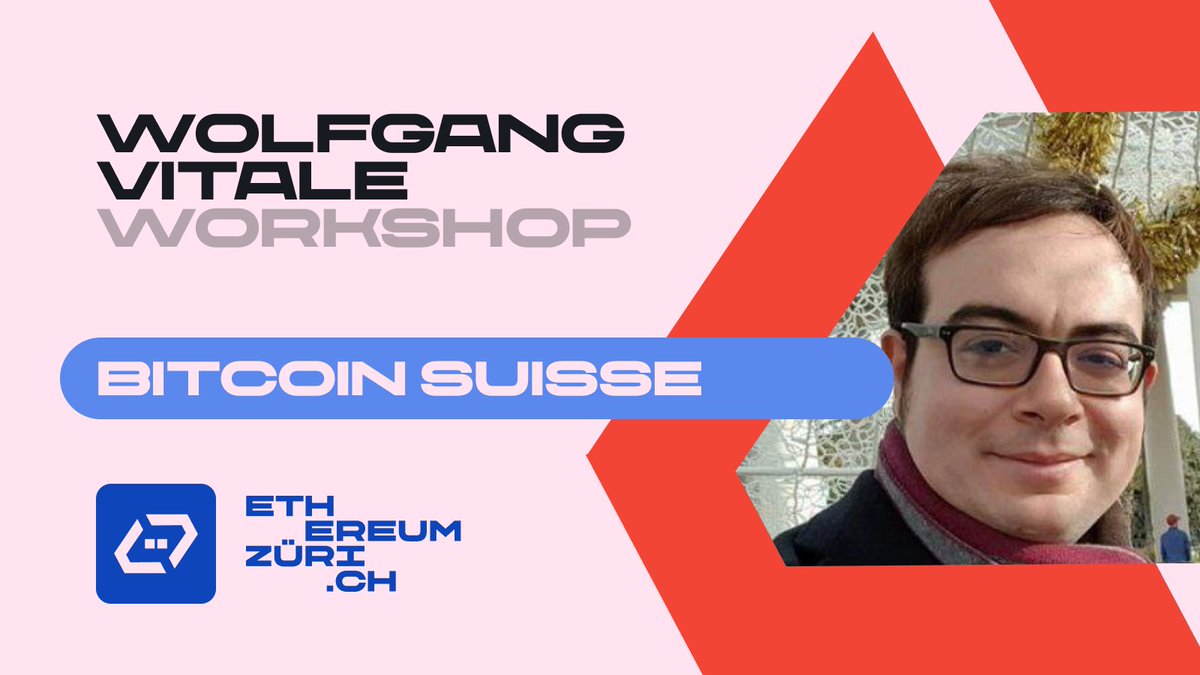
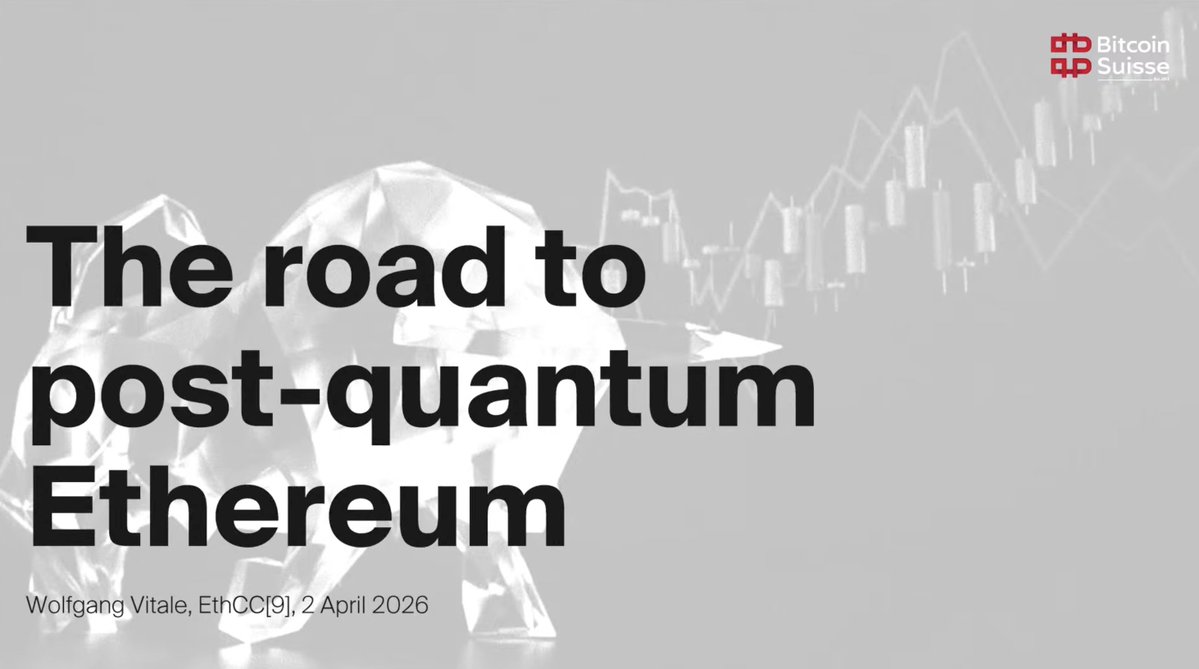
“The road to post-quantum Ethereum” by Wolfgang Vitale (@w4vitale ) Wolfgang gives a clear status update on post-quantum readiness for Ethereum, covering quantum timelines, impact on signatures, account model, BLS aggregation, KZG commitments, and what to watch in 2026.
EthereumZuri.ch tweet media
English
1
1
9
502
Wolfgang Vitale retweetledi
Thomas Coratger
Thomas Coratger@tcoratger·
Quantum computing isn't a faster PC; it's a fundamentally different paradigm running on qubits as said by @w4vitale during @EthCC. It poses a massive threat to blockchain cryptography, but Ethereum is preparing. Here is a breakdown of the quantum threat and ETH's roadmap. 🧵👇
English
20
23
117
14.9K
Wolfgang Vitale
Wolfgang Vitale@w4vitale·
Good reminder of how far social engineering can go. One can read it as "don't trust anyone ever, always adversarial mindset" but that's not always ideal. The way to go is: 1) critical systems deserve the highest security. Critical signing devices should never touch anything else 2) NEVER take shortcuts on your security protocols. Trust the process. It's there to protect you from the most insidious threats, not the obvious ones.
Drift@DriftProtocol

x.com/i/article/2040…

English
0
1
4
125
Hunter Beast 🕯️
Hunter Beast 🕯️@cryptoquick·
> logical qubits > minutes to execute no indication of quality, fidelity, etc could still take months to find even one key, Shor's is always probablistic even in the best case we should be prudent and careful but never give into fear
QSHA256@Qsha_256

New Google paper: Shor’s algorithm compiled to 1,200 logical qubits + 70M Toffoli gates breaks ECDLP-256. <500K physical qubits. Minutes to execute. Every ECC-based chain is now on a hard deadline. research.google/blog/safeguard…

English
22
36
230
23.9K
Wolfgang Vitale
Wolfgang Vitale@w4vitale·
If you're interested in these topics let's meet at EthCC or pass by my talk this Thursday on the current status of quantum computing and what it means for Ethereum, I'd like to chat about it ethcc.io/ethcc-9/agenda…
English
0
0
2
101
Wolfgang Vitale
Wolfgang Vitale@w4vitale·
Very impressive result 1) we can expect further optimizations with renewed focus on ECDLP 2) it might become "normal" now not to disclose algorithmic optimizations (a key enabler was zk-proven but still) 3) the gap to CRQC capability is narrower but ofc there are still huge, huge fundamental scalability milestones to be proven. 4) it's good to see proper analysis of impact on blockchain based systems and more nuanced topics related to migration strategies, also from players like Google who are not specifically focused on our industry. The thing is, it's not time to panic, but there is no time to relax. It was already true before this paper, but it might be more obvious now.
Justin Drake@drakefjustin

Today is a monumentous day for quantum computing and cryptography. Two breakthrough papers just landed (links in next tweet). Both papers improve Shor's algorithm, infamous for cracking RSA and elliptic curve cryptography. The two results compound, optimising separate layers of the quantum stack. The results are shocking. I expect a narrative shift and a further R&D boost toward post-quantum cryptography. The first paper is by Google Quantum AI. They tackle the (logical) Shor algorithm, tailoring it to crack Bitcoin and Ethereum signatures. The algorithm runs on ~1K logical qubits for the 256-bit elliptic curve secp256k1. Due to the low circuit depth, a fast superconducting computer would recover private keys in minutes. I'm grateful to have joined as a late paper co-author, in large part for the chance to interact with experts and the alpha gleaned from internal discussions. The second paper is by a stealthy startup called Oratomic, with ex-Google and prominent Caltech faculty. Their starting point is Google's improvements to the logical quantum circuit. They then apply improvements at the physical layer, with tricks specific to neutral atom quantum computers. The result estimates that 26,000 atomic qubits are sufficient to break 256-bit elliptic curve signatures. This would be roughly a 40x improvement in physical qubit count over previous state-of-the-art. On the flip side, a single Shor run would take ~10 days due to the relatively slow speed of neutral atoms. Below are my key takeaways. As a disclaimer, I am not a quantum expert. Time is needed for the results to be properly vetted. Based on my interactions with the team, I have faith the Google Quantum AI results are conservative. The Oratomic paper is much harder for me to assess, especially because of the use of more exotic qLDPC codes. I will take it with a grain of salt until the dust settles. → q-day: My confidence in q-day by 2032 has shot up significantly. IMO there's at least a 10% chance that by 2032 a quantum computer recovers a secp256k1 ECDSA private key from an exposed public key. While a cryptographically-relevant quantum computer (CRQC) before 2030 still feels unlikely, now is undoubtedly the time to start preparing. → censorship: The Google paper uses a zero-knowledge (ZK) proof to demonstrate the algorithm's existence without leaking actual optimisations. From now on, assume state-of-the-art algorithms will be censored. There may be self-censorship for moral or commercial reasons, or because of government pressure. A blackout in academic publications would be a tell-tale sign. → cracking time: A superconducting quantum computer, the type Google is building, could crack keys in minutes. This is because the optimised quantum circuit is just 100M Toffoli gates, which is surprisingly shallow. (Toffoli gates are hard because they require production of so-called "magic states".) Toffoli gates would consume ~10 microseconds on a superconducting platform, totalling ~1,000 sec of Shor runtime. → latency optimisations: Two latency optimisations bring key cracking time to single-digit minutes. The first parallelises computation across quantum devices. The second involves feeding the pubkey to the quantum computer mid-flight, after a generic setup phase. → fast- and slow-clock: At first approximation there are two families of quantum computers. The fast-clock flavour, which includes superconducting and photonic architectures, runs at roughly 100 kHz. The slow-clock flavour, which includes trapped ion and neutral atom architectures, runs roughly 1,000x slower (~100 Hz, or ~1 week to crack a single key). → qubit count: The size-optimised variant of the algorithm runs on 1,200 logical qubits. On a superconducting computer with surface code error correction that's roughly 500K physical qubits, a 400:1 physical-to-logical ratio. The surface code is conservative, assuming only four-way nearest-neighbour grid connectivity. It was demonstrated last year by Google on a real quantum computer. → future gains: Low-hanging fruit is still being picked, with at least one of the Google optimisations resulting from a surprisingly simple observation. Interestingly, AI was not (yet!) tasked to find optimisations. This was also the first time authors such as Craig Gidney attacked elliptic curves (as opposed to RSA). Shor logical qubit count could plausibly go under 1K soonish. → error correction: The physical-to-logical ratio for superconducting computers could go under 100:1. For superconducting computers that would be mean ~100K physical qubits for a CRQC, two orders of magnitude away from state of the art. Neutral atoms quantum computers are amenable to error correcting codes other than the surface code. While much slower to run, they can bring down the physical to logical qubit ratio closer to 10:1. → Bitcoin PoW: Commercially-viable Bitcoin PoW via Grover's algorithm is not happening any time soon. We're talking decades, possibly centuries away. This observation should help focus the discussion on ECDSA and Schnorr. (Side note: as unofficial Bitcoin security researcher, I still believe Bitcoin PoW is cooked due to the dwindling security budget.) → team quality: The folks at Google Quantum AI are the real deal. Craig Gidney (@CraigGidney) is arguably the world's top quantum circuit optimisooor. Just last year he squeezed 10x out of Shor for RSA, bringing the physical qubit count down from 10M to 1M. Special thanks to the Google team for patiently answering all my newb questions with detailed, fact-based answers. I was expecting some hype, but found none.

English
1
0
3
219
Wolfgang Vitale
Wolfgang Vitale@w4vitale·
Midnight is betting on lattice-based cryptography for post-quantum. This and more on the state of crypto, token economics, AI and more in the new Verified podcast with @IOHK_Charles youtu.be/xUD2j0XUE8g
YouTube video
YouTube
English
0
0
4
151
Wolfgang Vitale
Wolfgang Vitale@w4vitale·
The main research time/money was not on "crypto" but on optimizing shor's algorithm for solving ECDLP with reduced requirements. The findings have impact on other systems who rely on elliptic curves. How blockchains are dealing or will deal with the upgrade is an interesting technical and social question, honestly I like seeing this treated with the rigor and attention it deserves.
English
0
0
0
247
Wolfgang Vitale retweetledi
vitalik.eth
vitalik.eth@VitalikButerin·
I was recently at Real World Crypto (that's crypto as in cryptography) and the associated side events, and one thing that struck me was that it was a clarifying experience in terms of understanding *what blockchains are for*. We blockchain people (myself included) often have a tendency to start off from the perspective that we are Ethereum, and therefore we need to go around and find use cases for Ethereum - and generate arguments for why sticking Ethereum into all kinds of places is beneficial. But recently I have been thinking from a different perspective. For a moment, let us forget that we are "the Ethereum community". Rather, we are maintainers of the Ethereum tool, and members of the {CROPS (censorship-resistant, open-source, private, secure) tech | sanctuary tech | non-corposlop tech | d/acc | ...} community. Going in with zero attachment to Ethereum specifically, and entering a context (like RWC) where there are people with in-principle aligned values but no blockchain baggage, can we re-derive from zero in what places Ethereum adds the most value? From attending the events, the first answer that comes up is actually not what you think. It's not smart contracts, it's not even payments. It's what cryptographers call a "public bulletin board". See, lots of cryptographic protocols - including secure online voting, secure software and website version control, certificate revocation... - all require some publicly writable and readable place where people can post blobs of data. This does not require any computation functionality. In fact, it does not directly require money - though it does _indirectly_ require money, because if you want permissionless anti-spam it has to be economic. The only thing it _fundamentally_ requires is data availability. And it just so happened that Ethereum recently did an upgrade (PeerDAS) to increase the amount of data availability it provides by 2.3x, with a path to going another 10-100x higher! Next, payments. Many protocols require payments for many reasons. Some things need to be charged for to reduce spam. Other things because they are services provided by someone who expends resources and needs to be compensated. If you want a permissionless API that does not get spammed to death, you need payments. And Ethereum + ZK payment channels (eg. ethresear.ch/t/zk-api-usage… ) is one of the best payment systems for APIs you can come up with. If you are making a private and secure application (eg. a messenger, or many other things), and you do not want to let people to spam the system by creating a million accounts and then uploading a gigabyte-sized video on each one, you need sybil resistance, and if you care about security and privacy, you really should care about permissionless participation (ie. don't have mandatory phone number dependency). ETH payment as anti-sybil tool is a natural backstop in such use cases. Finally, smart contracts. One major use case is _security deposits_: ETH put into lockboxes that provably get destroyed if a proof is submitted that the owner violated some protocol rule. Another is actually implementing things like ZK payment channels. A third is making it easy to have pointers to "digital objects" that represent some socially defined external entity (not necessarily an RWA!), and for those pointers to interact with each other. *Technically*, for every use case other than use cases handling ETH itself, the smart contracts are "just a convenience": you could just use the chain as a bulletin board, and use ZK-SNARKs to provide the results of any computations over it. But in practice, standardizing such things is hard, and you get the most interoperability if you just take the same mechanism that enables programs to control ETH, and let other digital objects use it too. And from here, we start getting into a huge number of potential applications, including all of the things happening in defi. --- So yes, Ethereum has a lot of value, that you can see from first principles if you take a step back and see it purely as a technical tool: global shared memory. I suspect that a big bottleneck to seeing more of this kind of usage is that the world has not yet updated to the fact that we are no longer in 2020-22, fees are now extremely low, and we have a much stronger scaling roadmap to make sure that they will continue to stay low, even if much higher levels of usage return. Infrastructure for not exposing fee volatility to users is much more mature (eg. one way to do this for many use cases is to just operate a blob publisher). Ethereum blobs as a bulletin board, ETH as an asset and universal-backup means of payment, and Ethereum smart contracts as a shared programming layer, all make total sense as part of a decentralized, private and secure open source software stack. But we should continue to improve the Ethereum protocol and infrastructure so that it's actually effective in all of these situations.
English
414
339
2K
294.5K
Wolfgang Vitale retweetledi
mariani.hl
mariani.hl@MarcoMarianii·
Had the opportunity to interview the great @arnaudschenk with the goat @w4vitale. We talked about @aztecnetwork. It‘s history, the CCA, the TGE and why its a crypto native play with an institutional focus. Institutions (and everyone else) need Privacy! They knew this from the beginning. Btw: When was the last time you did something for the first time?? Officially a Podcast bro now
Bitcoin Suisse AG@BitcoinSuisseAG

📣 "Privacy Unlocks Ethereum's Product-Market Fit" — Arnaud Schenk (@arnaudschenk), Co-Founder of @aztecnetwork In this latest episode, Arnaud joins Wolfgang Vitale (@w4vitale) and Marco Mariani to make the case for why privacy — not scalability — is the real reason blockchains haven't crossed the line with mainstream adoption. Arnaud breaks down: - Why a syndicated loans deal in 2017 accidentally turned into an 8-year privacy protocol - How client-side proving works — and why your data never leaves your device, not even to the network - The ZK + MPC combination that makes multi-party finance possible without anyone seeing anyone else's numbers - Why Aztec launched fully decentralized from day one — and why "we'll decentralize later" is a promise that never gets kept From reluctant cryptographers to a private world computer — this is what eight years of building from first principles actually looks like. 🔐 📺 Watch the full conversation: btcs.ag/y6g

English
1
1
3
258
Wolfgang Vitale
Wolfgang Vitale@w4vitale·
For too long crypto apps had to cope with complete lack of privacy. Option 1: find some use case that can live with it. Option 2: trust someone or something with some secret. Option 3: stop coping. @aztecnetwork chose the hard way. Because it was the only way. I enjoyed talking to @arnaudschenk and learning about the story of the project. Aztec wasn't born as a "privacy project". Privacy was needed to provide actual value. Aztec didn't strive for a decentralized sequencer set at launch to score alignment points. It was actually needed for sustainable privacy. It's refreshing. I hope you also find the conversation interesting.
Bitcoin Suisse AG@BitcoinSuisseAG

📣 "Privacy Unlocks Ethereum's Product-Market Fit" — Arnaud Schenk (@arnaudschenk), Co-Founder of @aztecnetwork In this latest episode, Arnaud joins Wolfgang Vitale (@w4vitale) and Marco Mariani to make the case for why privacy — not scalability — is the real reason blockchains haven't crossed the line with mainstream adoption. Arnaud breaks down: - Why a syndicated loans deal in 2017 accidentally turned into an 8-year privacy protocol - How client-side proving works — and why your data never leaves your device, not even to the network - The ZK + MPC combination that makes multi-party finance possible without anyone seeing anyone else's numbers - Why Aztec launched fully decentralized from day one — and why "we'll decentralize later" is a promise that never gets kept From reluctant cryptographers to a private world computer — this is what eight years of building from first principles actually looks like. 🔐 📺 Watch the full conversation: btcs.ag/y6g

English
0
1
5
322
Wolfgang Vitale
Wolfgang Vitale@w4vitale·
@gdonnoheth Nice summary, I would just clarify how EIP-7917 is for protocols relying on based preconfirmations, while based just on your text one would assume it applies on standard L1 block production.
English
1
0
1
35
gdonnoh.eth
gdonnoh.eth@gdonnoheth·
it’s been 2 months since the Fusaka upgrade. several EIPs increased Ethereum’s overall power: – cheaper & more scalable data availability – faster confirmations – better pricing signals for blobs – lighter nodes here’s a short dive into what changed and how the network is doing
English
6
2
18
619
Wolfgang Vitale
Wolfgang Vitale@w4vitale·
Thanks for writing all this, it helps. It's easy to just put all multisigs in the same bucket. To summarize - asset bridged to an independent chain rely on a honest majority for security (either safety or liveness, depending on threshold) - assets bridged to a stage 1 rollup do NOT. It's a honest minority assumption by design, both for safety and liveness at teh same time. Honest minority assumption is strictly better, validating bridge with stage 1 security council is a more secure construction, that's clear. It's good to know which rollups are stage 1, it's an objective, measurable advantage that might be underestimated. Of course it depends on how you define security (I like you clarified everything in this article), I see Toly focused on worst case impact -- same worst case impact = same security. "what's the worst possible thing that can happen" is often a useful question, not the whole thing, but something good to reason about. And yeah I mean at the end of course also the actual, practical implementation matters. Constructions that are less secure by design can be "more secure" (as less likely to end up in realizing the worst case) "in practice". You may rely on a honest minority by design, but what if many members of the multisig are not really independent? What if, well, they are just more likely to be dishonest? :D These are all subjective evaluations, and I like that L2beat helps so much on objective evaluations. Knowing which rollups are stage 1 is useful. But yeah, subjective evaluations are aslo important. It's good to know as much as possible about the bridge - as you said about using intent protocols. The bridge can be abstracted away, but it's there. DVNs can be not obvious to assess. I want to know the bridge structure.
English
1
0
1
108
PhiMarHal
PhiMarHal@PhiMarHal·
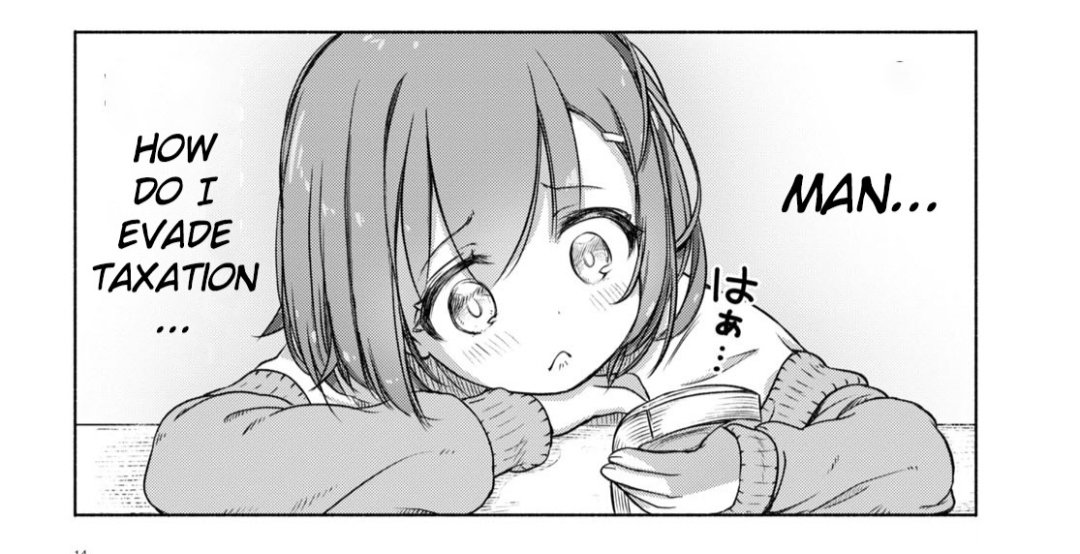
@animetv_jp Time for anime normies to learn about real struggle.
PhiMarHal tweet media
English
1
0
18
850
PhiMarHal
PhiMarHal@PhiMarHal·
New algo seems to reward likes much more heavily in reply visibility. The moment you get 1 like, it snowballs. I cultivated my legion of beautiful sexy Smart Followers for this day. Kaito walked so PhiMarHal could run.
English
2
0
5
288