Tom Waite

213 posts

Tom Waite banner
Tom Waite

Tom Waite

@waitetom

wallet @worldnetwork. built @dawn_wallet (acq by @tfh_technology), physics @imperialcollege

San Francisco Katılım Şubat 2019
713 Takip Edilen1.1K Takipçiler
Sabitlenmiş Tweet
Tom Waite
Tom Waite@waitetom·
I'm thrilled that Dawn has joined Tools for Humanity (@tfh_technology @worldnetwork). I firmly believe that World is in a unique place to deliver powerful financial tools for everyone, and lead the fight back in building trust again on the Internet.
Dawn Wallet@dawn_wallet

Dawn has joined Tools for Humanity, to bring next generation crypto finance to World! Since 2023 we've been working to make crypto truly accessible to a global audience. At @tfh_technology @worldcoin, we're going to be accelerating this vision to give sophisticated financial tools to everyone.

English
15
4
72
7.4K
Tom Waite
Tom Waite@waitetom·
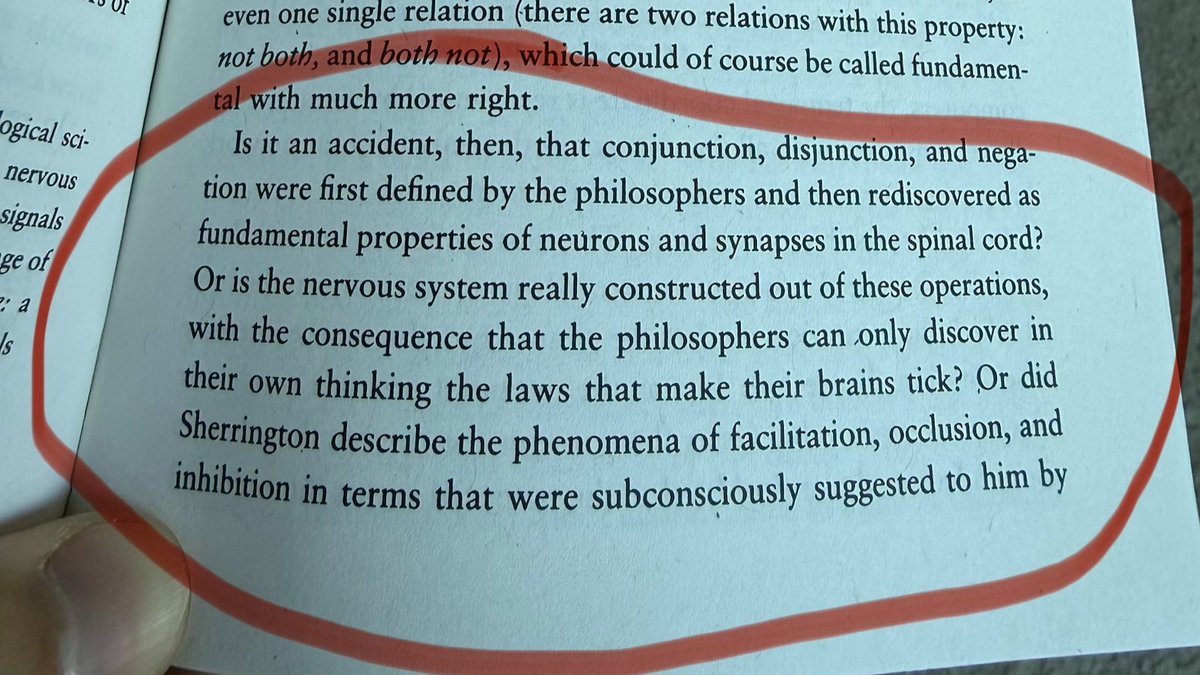
Fun idea. Probably not literally true, but the weak version is interesting. Human thinking seems to find AND/OR/NOT ideas very natural, and philosophy seems to have started there too. But, why? It doesn't need to be like that, you could build logic from just NAND or NOR for example. Doesn't sound crazy to think there's a link between what feels natural in how we think and our underlying brain structures.
Tom Waite tweet media
English
0
0
0
68
Tom Waite
Tom Waite@waitetom·
SF housing ~= leveraged AI stock? OpenAI, Anthropic and SpaceX/xAI all rumoured to be preparing IPOs. You can't build in SF -> fixed supply of housing in the AI capital. So, SF housing ~= leveraged exposure to AI companies?
English
0
0
0
88
Tom Waite
Tom Waite@waitetom·
Very cool use of zero-knowledge proofs - using a ZKP to prove you have an optimised Quantum algo, without leaking the actual algorithm itself
Justin Drake@drakefjustin

Today is a monumentous day for quantum computing and cryptography. Two breakthrough papers just landed (links in next tweet). Both papers improve Shor's algorithm, infamous for cracking RSA and elliptic curve cryptography. The two results compound, optimising separate layers of the quantum stack. The results are shocking. I expect a narrative shift and a further R&D boost toward post-quantum cryptography. The first paper is by Google Quantum AI. They tackle the (logical) Shor algorithm, tailoring it to crack Bitcoin and Ethereum signatures. The algorithm runs on ~1K logical qubits for the 256-bit elliptic curve secp256k1. Due to the low circuit depth, a fast superconducting computer would recover private keys in minutes. I'm grateful to have joined as a late paper co-author, in large part for the chance to interact with experts and the alpha gleaned from internal discussions. The second paper is by a stealthy startup called Oratomic, with ex-Google and prominent Caltech faculty. Their starting point is Google's improvements to the logical quantum circuit. They then apply improvements at the physical layer, with tricks specific to neutral atom quantum computers. The result estimates that 26,000 atomic qubits are sufficient to break 256-bit elliptic curve signatures. This would be roughly a 40x improvement in physical qubit count over previous state-of-the-art. On the flip side, a single Shor run would take ~10 days due to the relatively slow speed of neutral atoms. Below are my key takeaways. As a disclaimer, I am not a quantum expert. Time is needed for the results to be properly vetted. Based on my interactions with the team, I have faith the Google Quantum AI results are conservative. The Oratomic paper is much harder for me to assess, especially because of the use of more exotic qLDPC codes. I will take it with a grain of salt until the dust settles. → q-day: My confidence in q-day by 2032 has shot up significantly. IMO there's at least a 10% chance that by 2032 a quantum computer recovers a secp256k1 ECDSA private key from an exposed public key. While a cryptographically-relevant quantum computer (CRQC) before 2030 still feels unlikely, now is undoubtedly the time to start preparing. → censorship: The Google paper uses a zero-knowledge (ZK) proof to demonstrate the algorithm's existence without leaking actual optimisations. From now on, assume state-of-the-art algorithms will be censored. There may be self-censorship for moral or commercial reasons, or because of government pressure. A blackout in academic publications would be a tell-tale sign. → cracking time: A superconducting quantum computer, the type Google is building, could crack keys in minutes. This is because the optimised quantum circuit is just 100M Toffoli gates, which is surprisingly shallow. (Toffoli gates are hard because they require production of so-called "magic states".) Toffoli gates would consume ~10 microseconds on a superconducting platform, totalling ~1,000 sec of Shor runtime. → latency optimisations: Two latency optimisations bring key cracking time to single-digit minutes. The first parallelises computation across quantum devices. The second involves feeding the pubkey to the quantum computer mid-flight, after a generic setup phase. → fast- and slow-clock: At first approximation there are two families of quantum computers. The fast-clock flavour, which includes superconducting and photonic architectures, runs at roughly 100 kHz. The slow-clock flavour, which includes trapped ion and neutral atom architectures, runs roughly 1,000x slower (~100 Hz, or ~1 week to crack a single key). → qubit count: The size-optimised variant of the algorithm runs on 1,200 logical qubits. On a superconducting computer with surface code error correction that's roughly 500K physical qubits, a 400:1 physical-to-logical ratio. The surface code is conservative, assuming only four-way nearest-neighbour grid connectivity. It was demonstrated last year by Google on a real quantum computer. → future gains: Low-hanging fruit is still being picked, with at least one of the Google optimisations resulting from a surprisingly simple observation. Interestingly, AI was not (yet!) tasked to find optimisations. This was also the first time authors such as Craig Gidney attacked elliptic curves (as opposed to RSA). Shor logical qubit count could plausibly go under 1K soonish. → error correction: The physical-to-logical ratio for superconducting computers could go under 100:1. For superconducting computers that would be mean ~100K physical qubits for a CRQC, two orders of magnitude away from state of the art. Neutral atoms quantum computers are amenable to error correcting codes other than the surface code. While much slower to run, they can bring down the physical to logical qubit ratio closer to 10:1. → Bitcoin PoW: Commercially-viable Bitcoin PoW via Grover's algorithm is not happening any time soon. We're talking decades, possibly centuries away. This observation should help focus the discussion on ECDSA and Schnorr. (Side note: as unofficial Bitcoin security researcher, I still believe Bitcoin PoW is cooked due to the dwindling security budget.) → team quality: The folks at Google Quantum AI are the real deal. Craig Gidney (@CraigGidney) is arguably the world's top quantum circuit optimisooor. Just last year he squeezed 10x out of Shor for RSA, bringing the physical qubit count down from 10M to 1M. Special thanks to the Google team for patiently answering all my newb questions with detailed, fact-based answers. I was expecting some hype, but found none.

English
0
0
0
176
Tom Waite
Tom Waite@waitetom·
Claude figured out how to get full control over my smart TV, with really minimal prompting from me. Absolutely wild. It can turn on/off, mute, change volume, switch channels, launch apps. Anything. Out of curiosity, I had asked Claude to inspect my local WiFi and find all connected devices. It found my TV, lights, Eight Sleep mattress, computers etc. I asked Claude if it could figure out how to turn the TV on. The TV was completely dead, no ping response. I wasn't expecting anything. Claude thought and decided to send a "Wake-on LAN magic packet" - whatever that is - to the TV's IP address. Boom, the TV bursts into life. The AI then scanned ports, figured out the TV's API and realised it needed me to grant it access. So, it sent an API request which triggered an approval popup (pic below) for me to grant access via the TV remote. At this point, Claude was given an access token with full access to the TV! It is going to be fascinating watching how models and cybersecurity play out.
Tom Waite tweet media
English
0
0
4
209
Tom Waite
Tom Waite@waitetom·
Coding agents are going to become the general agents for knowledge work. Need an accountant to calculate taxes? Have Claude write some scripts and use a Python SDK. Digital knowledge work is a patchwork of intelligence, API calls, databases and sharing context. Coding agents are already native to that world.
DC@dcposch

I'm saving almost $60k on taxes using Claude as accountant, plus Beancount to run the math. "Text is the universal interface" wins again! Big thanks to @wminshew for the tip.

English
1
0
1
191
Jessica Rumbelow
Jessica Rumbelow@JessicaRumbelow·
We've been building Disco for two years, to help science escape confirmation bias. Systematic, data-driven discovery for all mankind. Multiple novel findings published. Completely free for public data! And as of today, no waitlist: leap-labs.com The thesis: hypothesis-driven science can only find what you already suspect. Confirmation bias, publication bias, path dependence in the literature – most published findings don't replicate. LLMs trained on papers inherit all of this. Agents can automate what a human would do – hypotheses, analysis code, lit review – but they share all our biases. They search under the streetlights, just like we do. Disco gives them a capability they can't replicate with prompting + pandas. Because it starts from the data. Neural networks find patterns. Interpretability makes them legible. Hold-out validation and contextualisation make them defensible. Available via web UI, Python SDK, MCP server, or REST API. github.com/leap-laborator…
English
11
11
66
8.2K
Tom Waite
Tom Waite@waitetom·
We're going to need new tools to understand and give direction to codebases. AI can rapidly churn out immense amounts of quality code, and review that code better than most humans. How does a human keep their "feel" for and "connection" to a large codebase? Maybe the short term answer is just "more AI" - AI tools that tell us what's going on. Long term, maybe it all collapses into some sort of "compiler" that turns product intuitions into working systems.
English
0
0
3
119
Tom Waite
Tom Waite@waitetom·
I need a design agent. We have code writing agents, security agents, PR review agents. But making software look great and be useable still seems pretty unsolved. Figma Make is the best thing I've tried so far, but it's browser based. I want a terminal based tool.
English
2
0
4
208
Tom Waite
Tom Waite@waitetom·
At the start of Dawn, we were exploring with @tomwalpo how to build payments natively into the Internet - "Build Web3 into the Web" - and came up with HTML+: @dawnwallet/building-web3-into-the-web" target="_blank" rel="nofollow noopener">paragraph.com/@dawnwallet/bu… Idea was to have crypto-enabled HTML tags, e.g. `` HTML+ was an early attempt at the problem, it's very cool to now see x402 emerge with real adoption and usage. Stablecoins are the currency of the Internet!
English
2
0
4
169
Tom Waite
Tom Waite@waitetom·
@OfficialLoganK Hard agree and even code review is starting to go the way of machines. Giving Claude/Gemini access to a PR via the GitHub CLI and asking for a review already works better than the average rushed human review.
English
0
0
0
156
Logan Kilpatrick
Logan Kilpatrick@OfficialLoganK·
The bottleneck has so quickly moved from code generation to code review that it is actually a bit jarring. None of the current systems / norms are setup for this world yet.
English
379
183
4K
521.7K
Tom Waite
Tom Waite@waitetom·
SF is unrivalled as a city for a bike ride
Tom Waite tweet mediaTom Waite tweet mediaTom Waite tweet media
English
0
0
6
181
Tom Waite
Tom Waite@waitetom·
@garrytan Especially useful when you have a product with two native apps - Swift and Kotlin. Once one side has implemented a feature, you can use it as a reference for Codex/Claude and ask it to build a first pass for the other side.
English
0
0
0
117
Garry Tan
Garry Tan@garrytan·
One of the interesting things you can do easily now is once you know a given codebase does X, any codebase you need to X can do it in about half an hour Suddenly hoarding code does seem like a great way to be able to do more things And more begets more
Garry Tan tweet media
English
32
26
371
27.2K
Tom Waite
Tom Waite@waitetom·
Built an AI bookkeeper to auto-reconcile startup bank transactions in Xero. I wish we'd had it at Dawn - we spent hours labelling and reconciling transactions, or would have to pay an expensive professional to do it. It was extremely annoying and boring. How it works: 1. Pull transactions from Mercury's API (checking, credit card) 2. LLM reads each transaction and predicts: who's the vendor, what account code, is it spend or income? 3. Ping the Xero accounting API to create matching entries in Xero 4. Xero sees the bank feed line + the new entry and auto suggests the match 5. Open the Xero reconciliation screen, see everything pre-populated and click "Ok" Would have saved hours. Only works with Mercury and Xero atm, the LLM gets ~93% of categorisations right but sure can optimise that.
English
0
0
5
242
Tom Waite
Tom Waite@waitetom·
@PaulRBerg Sounds great, we need to do that at World. Agree not long until the models can autonomously handle it whilst we sleep!
English
0
0
1
24
Paul Razvan Berg
Paul Razvan Berg@PaulRBerg·
Yep. At Sablier, I set up a cron job that runs every 6 hours, fetches the latest errors from Sentry, and opens a GitHub issue with a proposed fix plan. I still manually review the plan because it makes mistakes, but I suppose that by the end of the year, models will be good enough that fixing and git committing directly will be OK.
English
1
0
0
105
Tom Waite
Tom Waite@waitetom·
"Self healing" software feels like it's just about possible now. 1) Deploy agents to monitor Datadog and server logs 2) Agents identity a spike of status 500 errors 3) Repair agents triage the issue and open a PR to fix Like a white blood cell immune response, agents sweep through server logs eradicating any bug they find.
English
1
0
10
378
Tom Waite
Tom Waite@waitetom·
Got my Reachy robot controlling my home lights via my voice! Setup is: - A couple smart plugs - Zigbee dongle - Home Assistant OS on a Raspberry Pi, exposing an API On the Reachy robot side, I wrote a couple tools that the LLM can use to ping the Home API. So: voice command -> LLM understands -> Reachy chooses light tool -> API call -> light fills my living room
English
0
0
2
110