Lei Wang

253 posts

Lei Wang

Lei Wang

@wangleiphy

Computational quantum physics ∩ Machine learning. Researcher at Chinese Academy of Sciences

Beijing Katılım Mart 2014
1.5K Takip Edilen1K Takipçiler
Lei Wang retweetledi
Victor V. Albert
Victor V. Albert@victorvalbert·
Exciting, scary, and thoughtful session on the future of AI at #apsmarch and possible breakdown of peer review. Matthew D. Schwartz: "AI will keep getting better and better at physics. We will not."
Victor V. Albert tweet media
English
7
12
71
16.3K
Orbital
Orbital@OrbitalHardware·
Reply to this tweet and show how us how you’re using Orb! And if you haven’t used it yourself, it’s available on GitHub → github.com/orbital-materi…
English
3
0
2
167
Orbital
Orbital@OrbitalHardware·
AI for scientific research continues to rapidly improve 🤖 Watch @TimothyDuignan demo how our chemistry agent used our simulation model, Orb-v3, to compute a crystal's phonon band structure, the microscopic blueprint that controls a material’s thermal properties. This is the kind of task an experimentalist would normally take to a computational chemist and wait days or weeks for the result. With our agent, it only took minutes; 272 messages and 137 tool calls later, it produced results matching the scientific literature. That's only possible because the agent can now check its own work, catch its mistakes, and verify its outputs at a level that produces trustworthy science. Watch the video below for more 👇
English
2
3
22
1.5K
Lei Wang retweetledi
Jorge Bravo Abad
Jorge Bravo Abad@bravo_abad·
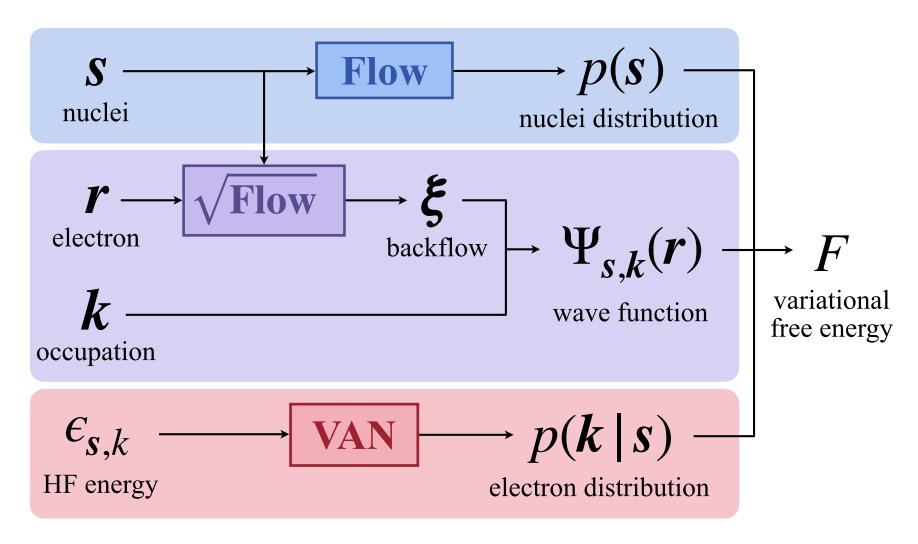
Deep generative models solve the hydrogen Hugoniot puzzle in warm dense matter Predicting how hydrogen behaves under extreme compression—conditions inside giant planets or during fusion implosions—remains one of the hardest problems in condensed matter physics. The key benchmark is the Hugoniot curve: the thermodynamic states reached when a shock wave compresses deuterium to megabar pressures. Experiments using lasers, gas guns, and pulsed power facilities have mapped parts of this curve, but results don't always agree, and there's a stubborn theoretical gap. Path-integral Monte Carlo works at high temperatures but hits the fermion sign problem as temperature drops. Ground-state methods break down when thermal electron excitations matter. In between—roughly 10,000–60,000 K—no method has provided reliable predictions. Zihang Li and coauthors tackle this with a deep variational free energy framework using three jointly trained generative neural networks. A normalizing flow captures the Boltzmann distribution of classical nuclei. An autoregressive transformer learns electron occupation across excited Hartree-Fock orbitals, respecting Pauli exclusion and encoding the Fermi-Dirac distribution as a learned prior. A permutation-equivariant flow applies a unitary backflow transformation to electron coordinates, producing orthonormal many-body wave functions for ground and excited states. All three networks have tractable normalization constants—critical because the free energy includes entropy terms requiring exact probability densities. By jointly minimizing the variational free energy, the authors compute deuterium's equation of state across the problematic intermediate regime. Their Hugoniot curve agrees with Z-machine and laser experiments, connects smoothly with PIMC at high temperatures, and extends into low-temperature territory where PIMC fails—achieving the "handshake" between ground-state and finite-temperature calculations. From the ML perspective, the architecture is remarkable: three different generative models—a continuous flow, a discrete autoregressive sampler, and an equivariant coordinate transformation—each targeting a distinct physical degree of freedom, trained end-to-end against a single variational objective. The method avoids the fermion sign problem entirely and computes entropy and free energy directly. Deep generative models are enabling first-principles calculations where traditional quantum many-body methods hit fundamental walls—delivering more reliable inputs for planetary modeling and fusion design. Paper: journals.aps.org/prl/abstract/1…
Jorge Bravo Abad tweet media
English
3
17
72
3.6K
Jason Wei
Jason Wei@_jasonwei·
AlphaEvolve is deeply disturbing for RL diehards like yours truly Maybe midtrain + good search is all you need for AI for scientific innovation And what an alpha move to keep it secret for a year Congrats big G
English
51
95
1.8K
267.1K
Greg Yang
Greg Yang@TheGregYang·
I've been suffering from Lyme disease. I'm stepping back from xAI into an informal advisory role so I can go founder mode on my health, starting today. --- The symptoms started when I got sick (cold, flu, or COVID -- I'm not sure which) in early 2025. I distinctly felt less energetic, less creative, and less agentic even weeks after "recovery." After that, my condition ebbed and flowed, but the lows kept getting lower. Accidentally eating the wrong thing would make me extremely tired, taking days to recover. Working out would leave my whole body feeble for days. There was a week where I slept 12 hours a day and still couldn't recover. Lyme is famously hard to diagnose, but luckily I have an incredible doctor. He suspected these symptoms, far from being just in my head, indicated immune issues. Detective work over a few rounds of testing revealed I have Lyme disease. I was very surprised because Lyme is said to come from tick bites (where the bump looks like a target), but I don't ever remember having one. Likely I contracted Lyme a long time ago, but until I pushed myself hard building xAI and weakened my immune system, the symptoms weren't noticeable. --- Overall, I actually feel lucky to have discovered this early. Lyme is a serious disease that only gets harder to treat with age -- patients discovering it in their 50s or 60s have a much tougher time. Lyme can also be debilitating, leaving its victims bedridden, but luckily I'm still functional and can take care of myself day to day. So while some folks have said "you shouldn't have pushed yourself so hard," I'm glad I did. I found this issue early, and now I can fix it so I can push myself even harder when I rebound. --- Chronic Lyme is not well understood in the literature or by the public. For folks suffering from it, it can be a lonely fight. But I hope my story can make it just a little less lonely.
English
1.3K
239
9.9K
1.1M
Lei Wang retweetledi
Hiroshi Shinaoka
Hiroshi Shinaoka@HShinaoka·
Next AP-CMP seminar! December 23, 2025 (Tuesday) 11:00 JST-12:00 JST Gil Young Cho (Korean Advanced Institute of Science and Technology) Most Two-Dimensional Bosonic Topological Orders Forbid Sign-Problem-Free Quantum Monte Carlo Simulation: Nonpositive Gauss Sum as an Indicator
English
1
2
1
733
Lei Wang retweetledi
Hiroshi Shinaoka
Hiroshi Shinaoka@HShinaoka·
来週のセミナーは、新しい量子埋め込み理論のお話 (DMETの一般化に対応) Date: September 2, 2025 (Tuesday) 11:00 JST-12:00 JST Speaker: Tsung-Han Lee Title: Ghost Rotationally-Invariant Slave-Boson Approach to Strongly Correlated Materials #seminar-4" target="_blank" rel="nofollow noopener">asian-pacific-cmp-seminars.github.io/#seminar-4
日本語
1
5
10
1.8K
Lei Wang retweetledi
Hiroshi Shinaoka
Hiroshi Shinaoka@HShinaoka·
Next talk in one week! asian-pacific-cmp-seminars.github.io Date: August 12, 2025 (Tuesday), 11:00–12:00 JST Speaker: Po-Yao Chang (National Tsing Hua University) Title: Diagnosing Many-Body Systems with Entanglement: Insights from Non-Unitary CFTs and TQFTs
English
0
4
7
1.6K
Lei Wang retweetledi
Hiroshi Shinaoka
Hiroshi Shinaoka@HShinaoka·
We are launching a new online seminar series: the Asian-Pacific Condensed Matter Physics (AP-CMP) Seminars. asian-pacific-cmp-seminars.github.io The goal is to connect researchers in condensed matter physics across the Asia-Pacific region and beyond. Talks will be in English and open to all.
English
1
7
13
2.7K
Lei Wang retweetledi
Kim Andrea Nicoli
Kim Andrea Nicoli@nicoli_kim·
🚨 Special Issue Alert! Thrilled to co-edit, together with @wangleiphy & @AninditaMaiti7, a new issue on Deep Generative Models for Simulating Physical Systems 🎯 If you’re working at the intersection of generative models & physics, this could be for you! 🔗 Link in thread 👇🏻
English
1
3
7
585
Raj Ghugare
Raj Ghugare@GhugareRaj·
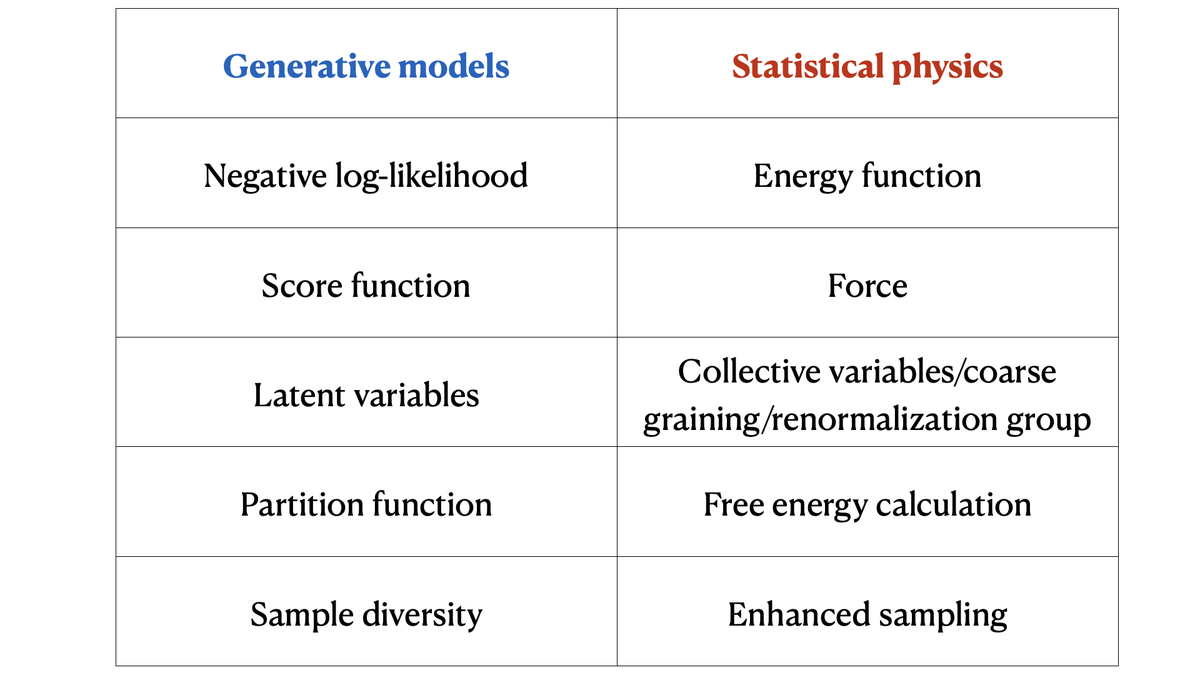
Normalizing Flows (NFs) check all the boxes for RL: exact likelihoods (imitation learning), efficient sampling (real-time control), and variational inference (Q-learning)! Yet they are overlooked over more expensive and less flexible contemporaries like diffusion models. Are NFs fundamentally limited?
Raj Ghugare tweet media
English
6
21
223
29.7K
Lei Wang retweetledi
Jun-Yan Zhu
Jun-Yan Zhu@junyanz89·
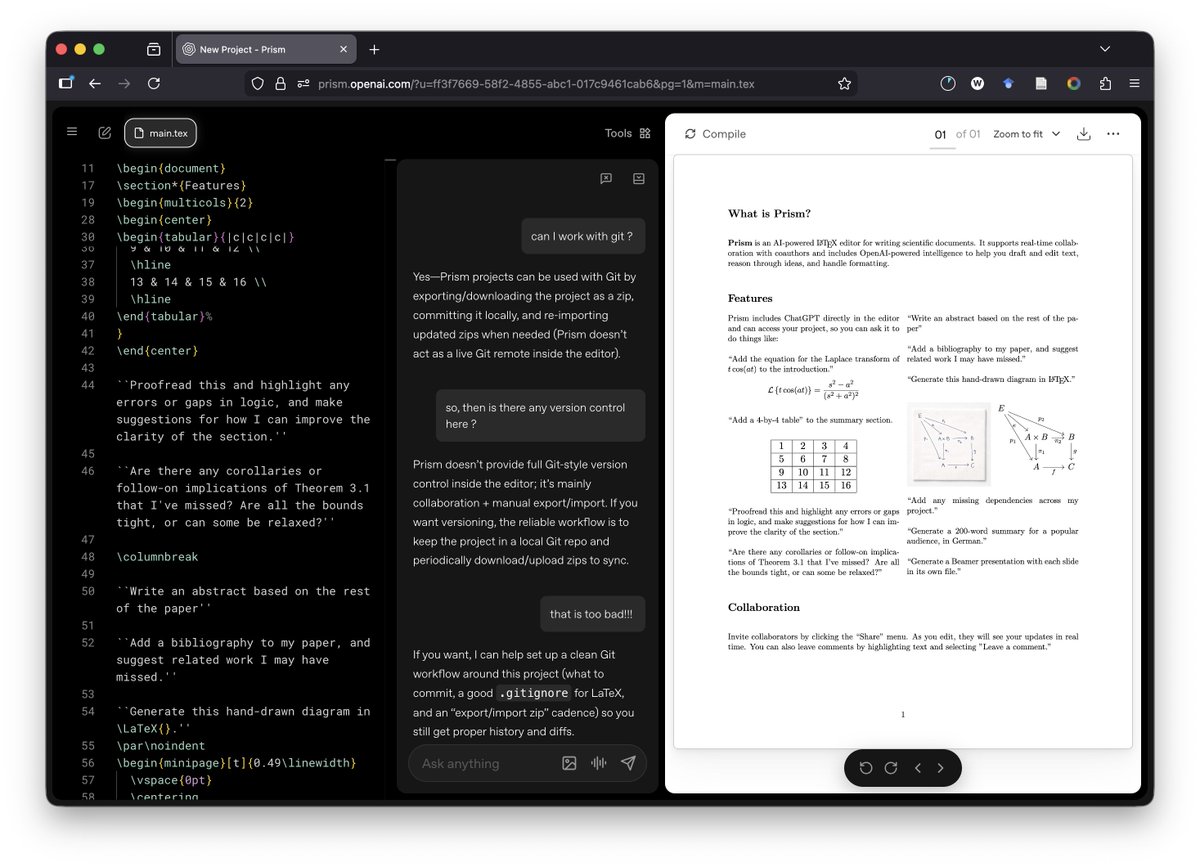
We've released the code for LegoGPT. This autoregressive model generates physically stable and buildable designs from text prompts, by integrating physics laws and assembly constraints into LLM training and inference. This work is led by PhD students @AvaLovelace0, @kangle_deng, @RuixuanLiu_, and in collaboration with CMU faculty Changliu Liu and Deva Ramanan. LegoGPT is a small first step towards the ultimate goal of generative manufacturing of physical objects. Our implementation is limited to 20x20x20 dimensions, 21 object categories, and simple brick types, but we are working on scaling it up! Code: github.com/AvaLovelace1/L… Website: avalovelace1.github.io/LegoGPT/ Demo: huggingface.co/spaces/cmu-gil…
English
9
72
508
38.5K
Victor Galitski
Victor Galitski@VictorGalitski·
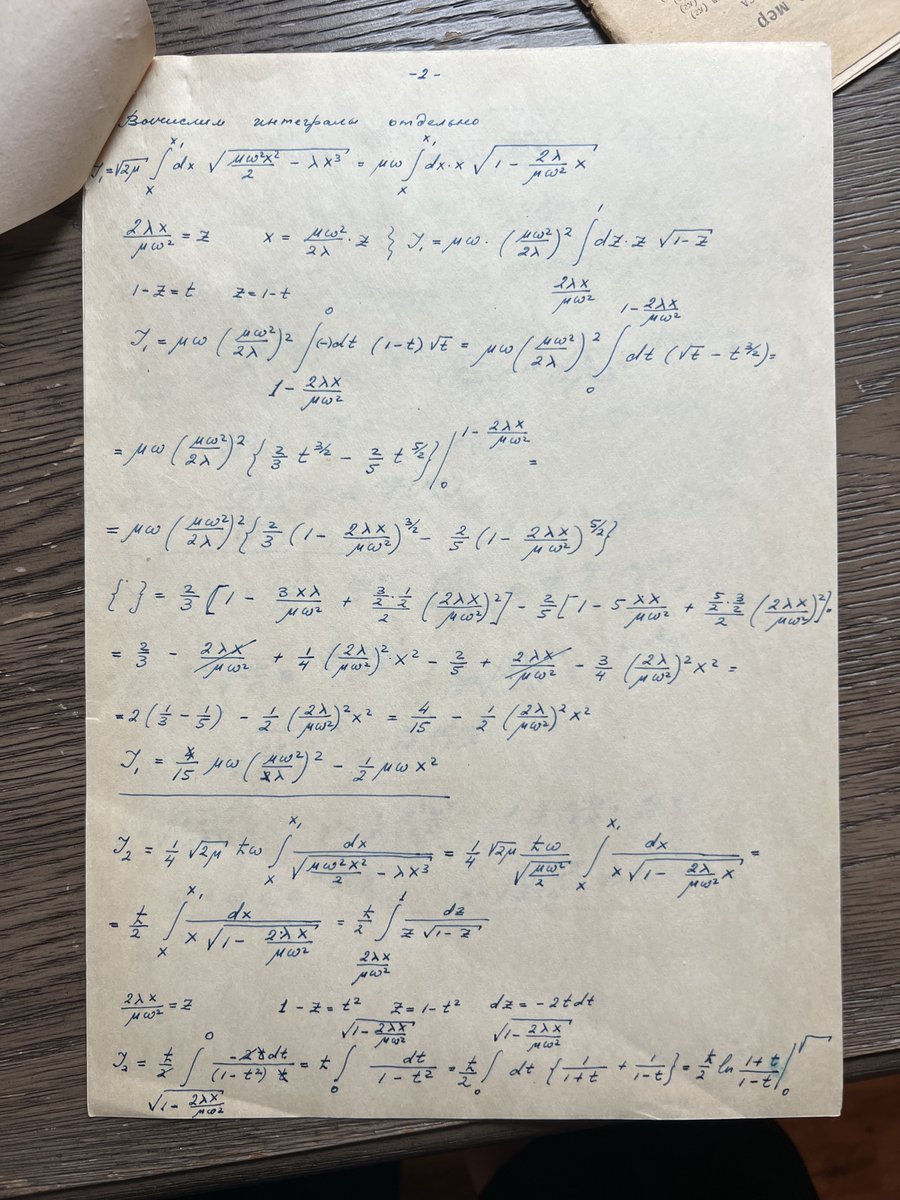
Lev Landau's "Theoretical Minimum"—a legendary physics & math exam series from the 1930s—was never fully published or digitized. I inherited original materials from my grandfather, who worked with Landau. Our team is digitizing them for public access. DM if interested!
Victor Galitski tweet mediaVictor Galitski tweet mediaVictor Galitski tweet mediaVictor Galitski tweet media
English
51
250
2.2K
123.7K