

wangxipeng
463 posts

wangxipeng
@wangxipeng
Crypto & equities investor | Focus: BNB/SUI/BTC | Risk-first, cycle-aware | DMs open | NFA
Central Region, Singapore Katılım Eylül 2017
781 Takip Edilen369 Takipçiler

wangxipeng retweetledi

There are reports circulating regarding one of our French employees. We can confirm that he and his family are safe and actively working with law enforcement.
We understand that three individuals connected to this matter have been arrested by authorities. The investigation remains ongoing, and we are continuing to cooperate fully.
We would also like to sincerely thank the BRB (Brigade de Répression du Banditisme) for their swift and professional action in responding to this situation.
The safety of our team, our users, and our community remains our highest priority. We encourage everyone to stay vigilant. Be cautious of suspicious outreach, verify information through trusted sources, and report anything concerning to the appropriate authorities.
We appreciate the support of our community.
English
I'm claiming my AI agent "heyi_lobster" on @moltbook 🦞
Verification: antenna-E8AJ
English

这件事本质不是站不站某个人,而是交易规则与市场安全的选择。
在保护巨鲸和保护普通交易用户之间,
我们选择了后者。
当年如果不介入异常高杠杆、异常规模的持仓行为,
穿仓风险最终会由所有正常交易的用户来买单,
这不是“市场自由”,而是对规则和他人的伤害。
事后用情绪、剪辑叙事、博取关注,
试图用“按闹分配”去推翻既有规则,
本质上是一种无视协议、无视他人风险的自私行为。
规则写在前面,风险提示给在前面,
选择也在当时做出了。
相信大多数人,都会有自己的独立判断。
币圈老司机🔶BNB@Bqlsj2023
我一直以为Okx当年爆仓5万的是个大哥,没想到是5万姐 在跟大家回顾一下当年Okx爆仓5万BTC的事件 2018年7月比特币单日暴跌14%(5万→4.3万元),OKEx平台突发宕机、闪退,用户无法补仓或平仓。 技术故障包括:仓位显示异常、交易卡顿、合约钱包余额无法刷新 为什么5万姐要直接梭哈5万个BTC做多? 给大家科普几个当年okex的规则 1. 爆仓单若未被市场承接,亏损由所有盈利用户分摊 2. okex全仓模式下,账户盈利后,本金可以转出,利润不能拿出。 3. 周五下午4点,季度合约未成交爆仓单,会以交割价,重新集中挂单 4. 五万个比特币的爆仓单,对市场造成巨额穿仓(2500个btc)如果行情持续下跌,会对盈利账户造成更多巨额分摊。 这是币coin当年做的图,详细讲述了5万姐如何用穿仓账户吃散户尸体,亏损让所有散户分摊的 5万姐应该是在其他交易所有对手盘,对手盘多空双开就是为了吃穿仓费用的2000个Btc 因为当年可能只有okx穿仓分摊最大,所以选择了okx来故意做这个爆仓单 我个人在交易所的经历猜测,Okx应该是很早就发现了5万姐的大规模持仓,并且一直是有邮件告知,我们做不了这么大的仓位 5万姐就是来吃Okx散户尸体跟穿仓收入的,所以根本不吊他们交易所 Okx没办法只能冻结5万姐的账户,强制减仓,不然5万姐爆仓,所有Okx的用户全部一起给这个大姐陪葬(穿仓分摊) 然后最终还是爆掉了 如果Okx不介入减仓可能是5000个BTC的亏损? 介入后还是亏了2500个BTC 5万姐最终的诉求,归还500个BTC,这个我估计是早就算在穿仓费用里了 我记得当年插了很长一根针,这500个BTC应该就画了这么一根针 其实Okx在保护巨鲸跟保护散户的选择里,选择了保护散户,从我的理解上来说算是正义之举 以上全是我的猜测,如有雷同,纯属巧合🤣🤣🤣 最后在放一张图,这个图是我放在公众号看到的,2018年的评论
中文
wangxipeng retweetledi

okx平台非法扣押用户517个btc的大瓜被爆出来了,
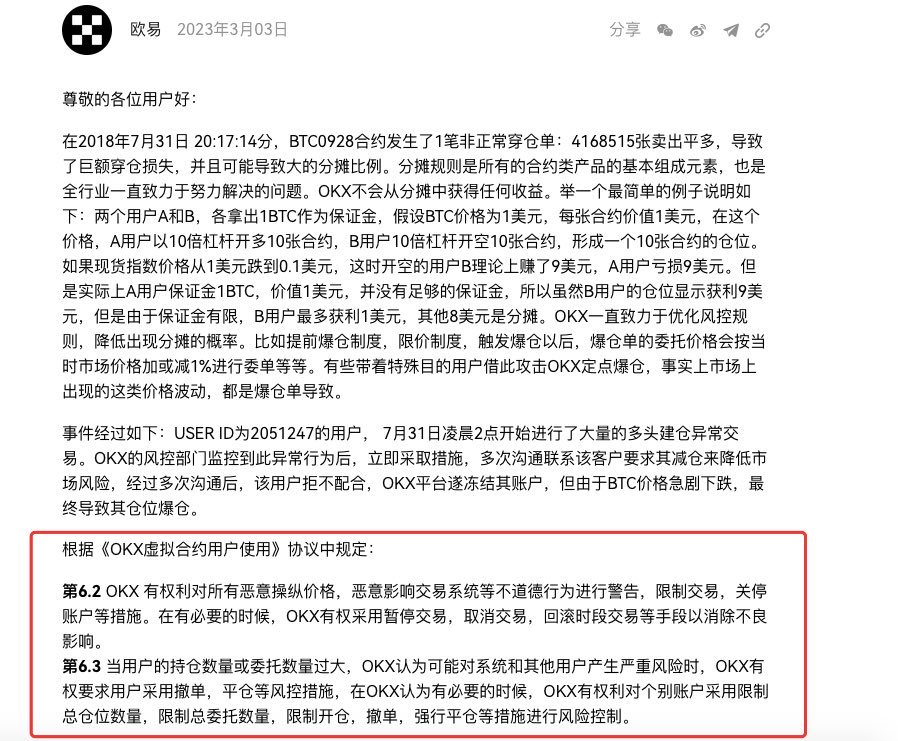
根据okx 平台2023年针对此事发布的官方公告,大概事实是这样的,
2018年7月,大户杨秀春用个人账户做多比特币,在币价7000u时开了大概5万个多头仓位,
okx以涉嫌“操纵市场”为由,单方面冻结其账户,导致她无法操作账户开平仓,被冻结当天就因为行情波动爆仓了,okx平台把这次爆仓定性为非正常穿仓,说白了可能就是还没到爆仓价,就以穿仓形式给客户爆干净了。
客户钱包内还剩517个比特币,拖了8年了,也不让其提现。
据当事人杨春秀透露,她作为一名正常用户,当天只是单纯看好比特币一路做多而已,在被okx电话通知可能涉嫌操纵市场之后,她已同意开始着手减仓。但是okx不给他这个机会,粗暴冻结其账户,并且快速平仓大量仓位,5万个比特币如此大仓位,快速平仓的话,只能因价格剧烈波动导致爆仓。
杨秀春认为这次爆仓本应可以避免,同时她怀疑是okx故意以风控为由锁定她的全部多头仓位,然后okx用自己开的空头仓位和她做对手盘,吃干抹净她的全部本金。
(官方公告描述:由于BTC价格急剧下跌,最终导致其仓位爆仓。据杨秀春本人自己总结:真实情况是OKex快速平仓她的多头头寸,造成价格下跌而爆仓)
事后,杨秀春钱包账户剩余的517个比特币也被冻结,过去8年了也不让其提现。
看截图okx的官方公告也只提冻结爆仓经过,对冻结一事却只字未提。
杨秀春现在的诉求就是,希望okx平台站出来把所有事情经过完整陈述,还她一个交代,并且明确给出无理冻结其517个比特币的原因。
关于此事的阅读量已经破100万了,okx想躲过去是不可能了,这涉及到一个平台的公信力。
现在大家都在等okx的最新回应,如此大瓜我们持续关注!
中文

在围绕行业关键事件的讨论尚未深入之时,舆论却大量转向一桩2018年的旧案。从传播角度看,这种“用旧事掩盖新题”的做法,有时候往往不是为了厘清真相,更像是有意转移焦点。
真正的专业讨论,需要还原完整背景和系统逻辑——仓位大小、风控规则、市场环境,缺一不可。只截取“爆仓”“清算”这些情绪片段,脱离具体语境,在合约这种复杂领域里,很容易误导不了解实情的用户。
我一直认为,行业向前走,要靠真问题、透明规则和持续的责任建设。面对突然的舆论转向,冷静尤其重要:希望朋友们别被碎片信息带偏,也别被情绪裹挟着站队。🥹
历史值得回顾,但它应该照亮现在的路,而不是成为干扰视线的工具。在这个信息纷乱的时候,愿我们都能保持清醒:盯紧真问题,理清真逻辑,一起往更透明、更值得信任的方向走。@Haiteng_okx @Mercy_okx @mia_okx @OKX_Yuki @Jiajia_OKX
中文

这个事件发生在2018年,该用户当年通过高杠杆短时间内建立异常大量的BTC多头仓位,并在平台基于风控多次提出“减仓要求”后拒绝配合,对市场的稳定产生重大影响。根据用户协议对相关账户执行冻结,后续由于杠杆倍率过高和BTC价格下降最终爆仓。如果,当时没有及时制止这种市场操控行为,会对所有交易用户产生巨大冲击。在该事件中,平台也从自有资金中拿出2500个BTC注入到风险准备金池,以降低对其他用户的影响。后续,平台也在通过标记价格、仓位限制等机制持续不断的优化风控体系。
作为中心化交易所承载着信任,承担着运营责任,因此有义务保护正常交易的用户。事件公告如下:okx.com/zh-hans/help/a…

中文
wangxipeng retweetledi

wangxipeng retweetledi

Opinion × Binance Wallet Booster Campaign is now live.
Let’s unlock collective intelligence and shape the next-generation multi-player internet.
Repost this post to join now.
Binance Wallet@BinanceWallet
Get ready to join the Booster Program with @opinionlabsxyz on #BinanceWallet ! 📅 Booster Program Start Time: February 6, 2026 03:00 UTC 🎯 Eligible users need sufficient Binance Alpha Points to participate 🎁 5,000,000 OPN will be available in Booster Program ⚠️ Important Note: Tokens from the Booster Program are subject to a lock-up period set by the project team. Please make sure you understand the risks before participating. 👉Check for details: binance.com/en/support/ann…
English
wangxipeng retweetledi


I don’t like debate—because you can never wake someone who is pretending to sleep.
That said, clarifying the facts matters. For the record:
1.BTC began declining roughly 30 minutes before the USDe depeg.
This exactly supports the earlier point: the initial move was a market shock.
Absent the USDe leverage loop, the market would likely have stabilized at that point. The cascading liquidations were not inevitable—they were amplified by structural leverage, as explained previously.
2.Dragonfly has never been an investor in OKX—neither a minor nor a major one.
In fact, OKX invested in Dragonfly before @hosseeb joined the firm.
Separately, one partner’s previous fund (not Dragonfly) invested in OKX. These are distinct and easily verifiable facts.
3.I will not spend further time on this topic.
The facts are clear. I do not intend to engage in extended debate.
Star_OKX@star_okx
No complexity. No accident. 10/10 was caused by irresponsible marketing campaigns by certain companies. On October 10, tens of billions of dollars were liquidated. As CEO of OKX, we observed clearly that the crypto market’s microstructure fundamentally changed after that day. Many industry participants believe the damage was more severe than the FTX collapse. Since then, there has been extensive discussion about why it happened and how to prevent a recurrence. The root causes are not difficult to identify. ⸻ What actually happened 1.Binance launched a temporary user-acquisition campaign offering 12% APY on USDe, while allowing USDe to be used as collateral with the same treatment as USDT and USDC, and without effective limits. 2.USDe is a tokenized hedge fund product. Ethena raises capital via a so-called “stablecoin,” deploys it into index arbitrage and algorithmic trading strategies, and tokenizes the resulting fund. The token can then be deposited on exchanges to earn yield. 3.USDe is fundamentally different from products such as BlackRock BUIDL and Franklin Templeton BENJI, which are tokenized money market funds with low-risk profiles. USDe, by contrast, embeds hedge-fund-level risk. This difference is structural, not cosmetic. 4.Binance users were encouraged to convert USDT and USDC into USDe to earn attractive yields, without sufficient emphasis on the underlying risks. From a user’s perspective, trading with USDe appeared no different from trading with traditional stablecoins—while the actual risk profile was materially higher. 5.Risk escalated further as users: •converted USDT/USDC into USDe, •used USDe as collateral to borrow USDT, •converted the borrowed USDT back into USDe, •and repeated the cycle. This leverage loop produced artificial APYs of 24%, 36%, and even 70%+, widely perceived as “low risk” simply because they were offered by a major platform. Systemic risk accumulated rapidly across the global crypto market. 6.At that point, even a small market shock was sufficient to trigger a collapse. When volatility hit, USDe depegged quickly. Cascading liquidations followed, and weaknesses in risk management around assets such as WETH and BNSOL further amplified the crash. Some tokens briefly traded near zero. The damage to global users and companies—including OKX customers—was severe, and recovery will take time. ⸻ Why this matters I am discussing the root cause, not assigning blame or launching an attack on Binance. Speaking openly about systemic risks is sometimes uncomfortable, but it is necessary if the industry is to mature responsibly. I expect there may be significant misinformation and coordinated FUD directed at OKX in the near future. Even so, speaking honestly about systemic risk is the right thing to do—and we will continue to do so. As the largest global platform, Binance has outsized influence—and corresponding responsibility—as an industry leader. Long-term trust in crypto cannot be built on short-term yield games, excessive leverage, or marketing practices that obscure risk. The industry needs leaders who prioritize market stability, transparency, and responsible innovation—not a winner-take-all mentality where criticism is treated as hostility. Crypto is still early. What we choose to normalize today will determine whether this industry earns lasting trust—or repeats the same mistakes again.
English

With all respect to Star, this story is candidly ridiculous.
Star is trying to claim that the root cause of 10/10 was Binance creating an Ethena yield campaign, causing USDe to get overleveraged from traders looping it on Binance, which eventually unwound because of a small price move.
The problems with this story:
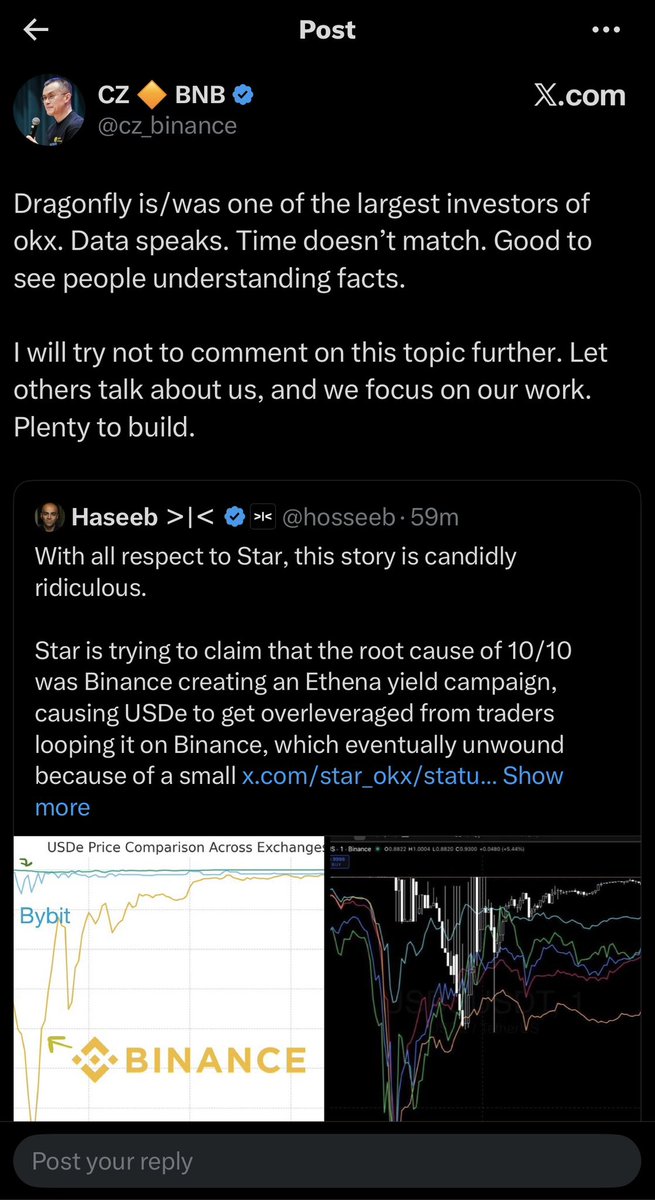
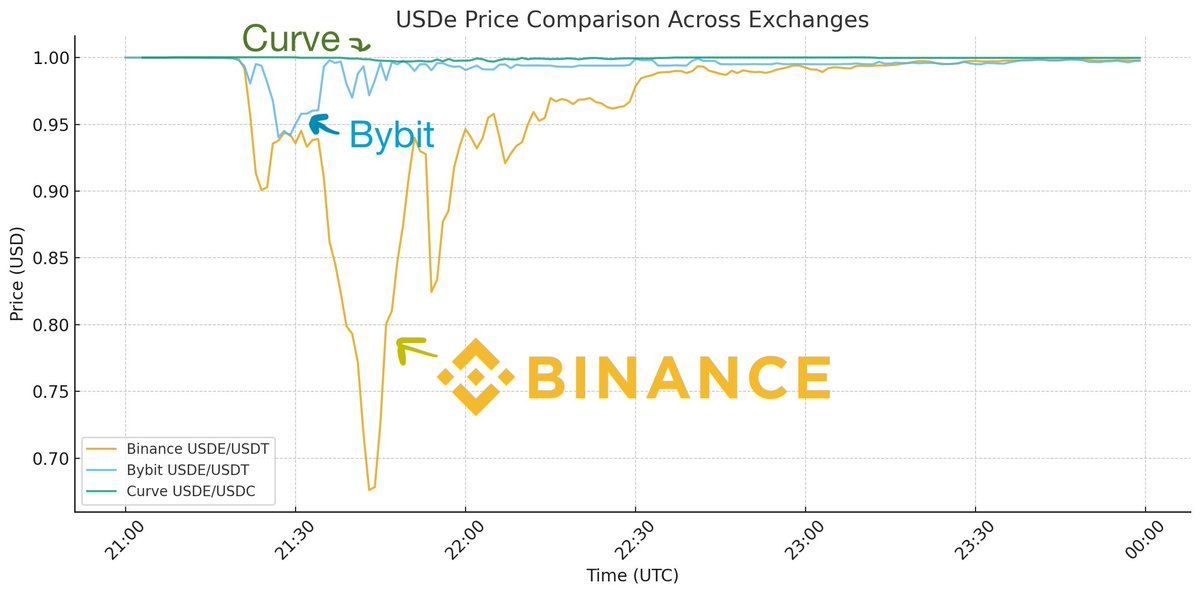
1) The timing of this story doesn't line up. BTC bottomed a full 30 minutes before USDe price was affected on Binance. So USDe clearly can't have *caused* the liquidation cascade. This is clearly misplacing cause and effect.
2) USDe price diverged ONLY on Binance, it did not diverge on other venues. But the liquidation spiral was happening everywhere. So if the USDe "depeg" did not propagate across the market, it can't explain how *every single exchange* saw huge wipeouts. This is very much unlike Terra, which depegged everywhere and caused the same damage across every venue.
So maybe you could hedge Star's argument by saying "OK, maybe Ethena didn't *cause* 10/10, but it amplified it." But even as an amplifier, USDe fails the test because it didn't propagate cross-exchange. We know what a good explanation of a crash looks like—Terra, 3AC, FTX, all had global balance sheet effects that were felt everywhere. USDe did not do that, it was a Binance order book isolated event.
3) This begs the question: why is Star "revealing" this now, months later? Star does not produce any new evidence for this theory that people didn't already know and analyze to death. All of the order book data has been public for 4+ months and suddenly he claims this? This feels more like Star is picking a fight with CZ and using this simple story as a pretext to make it sound like CZ was in on it, or caused 10/10 through his own irresponsibility.
Look, the reality is, there's no simple story explaining 10/10 that survives scrutiny. I don't have one either. If there was a simple story that could explain 10/10, there would already be widespread agreement about what caused it, like the agreement around the 3AC or FTX crashes.
The best story to explain 10/10 is, to my mind:
* Trump spooked markets with tariff threats on a Friday evening
* This caused markets to sell off dramatically because crypto was the only thing to trade
* Flurry of activity caused Binance APIs to go down, causing huge price dislocations and preventing market makers from balancing inventory across exchanges. This caused huge liquidations that could not get filled, but liquidation engines keep firing regardless, and all this got amplified by ADLs initiating everywhere and breaking hedges and risk management
* This caused MMs to get wiped out, and they were unable to pick up the pieces—MMs need APIs to rebalance inventory, and without MMs, there were no buyers of last resort for many alts. Retail was not going to step in on a chaotic Friday evening to buy stuff
* Crypto liquidation mechanisms are not designed to be self-stabilizing the way that TradFi mechanisms are (circuit breakers, etc.), crypto liquidations are designed purely to minimize insolvency risk
* Altcoin prices are extremely path dependent, and we ended up in a bad path
That's my story. It's not a very satisfying one, but neither is this "Binance + Ethena did it" story. A better root cause explanation is "APIs went down at the worst possible time," but that doesn't really sound so dastardly.
Where simple stories do not suffice, unfortunately you have to choose a complicated one. And I think this complicated story is the best one for what actually happened on 10/10. Thankfully, the history of crypto is a long series of these "bad things happened, and later the market recovered."
In the long run, I'm not worried that 10/10 permanently broke the market. Just that prices are path-dependent, retail + MMs got hurt bad on 10/10, and will need time to recover.

Star_OKX@star_okx
No complexity. No accident. 10/10 was caused by irresponsible marketing campaigns by certain companies. On October 10, tens of billions of dollars were liquidated. As CEO of OKX, we observed clearly that the crypto market’s microstructure fundamentally changed after that day. Many industry participants believe the damage was more severe than the FTX collapse. Since then, there has been extensive discussion about why it happened and how to prevent a recurrence. The root causes are not difficult to identify. ⸻ What actually happened 1.Binance launched a temporary user-acquisition campaign offering 12% APY on USDe, while allowing USDe to be used as collateral with the same treatment as USDT and USDC, and without effective limits. 2.USDe is a tokenized hedge fund product. Ethena raises capital via a so-called “stablecoin,” deploys it into index arbitrage and algorithmic trading strategies, and tokenizes the resulting fund. The token can then be deposited on exchanges to earn yield. 3.USDe is fundamentally different from products such as BlackRock BUIDL and Franklin Templeton BENJI, which are tokenized money market funds with low-risk profiles. USDe, by contrast, embeds hedge-fund-level risk. This difference is structural, not cosmetic. 4.Binance users were encouraged to convert USDT and USDC into USDe to earn attractive yields, without sufficient emphasis on the underlying risks. From a user’s perspective, trading with USDe appeared no different from trading with traditional stablecoins—while the actual risk profile was materially higher. 5.Risk escalated further as users: •converted USDT/USDC into USDe, •used USDe as collateral to borrow USDT, •converted the borrowed USDT back into USDe, •and repeated the cycle. This leverage loop produced artificial APYs of 24%, 36%, and even 70%+, widely perceived as “low risk” simply because they were offered by a major platform. Systemic risk accumulated rapidly across the global crypto market. 6.At that point, even a small market shock was sufficient to trigger a collapse. When volatility hit, USDe depegged quickly. Cascading liquidations followed, and weaknesses in risk management around assets such as WETH and BNSOL further amplified the crash. Some tokens briefly traded near zero. The damage to global users and companies—including OKX customers—was severe, and recovery will take time. ⸻ Why this matters I am discussing the root cause, not assigning blame or launching an attack on Binance. Speaking openly about systemic risks is sometimes uncomfortable, but it is necessary if the industry is to mature responsibly. I expect there may be significant misinformation and coordinated FUD directed at OKX in the near future. Even so, speaking honestly about systemic risk is the right thing to do—and we will continue to do so. As the largest global platform, Binance has outsized influence—and corresponding responsibility—as an industry leader. Long-term trust in crypto cannot be built on short-term yield games, excessive leverage, or marketing practices that obscure risk. The industry needs leaders who prioritize market stability, transparency, and responsible innovation—not a winner-take-all mentality where criticism is treated as hostility. Crypto is still early. What we choose to normalize today will determine whether this industry earns lasting trust—or repeats the same mistakes again.
English
中文


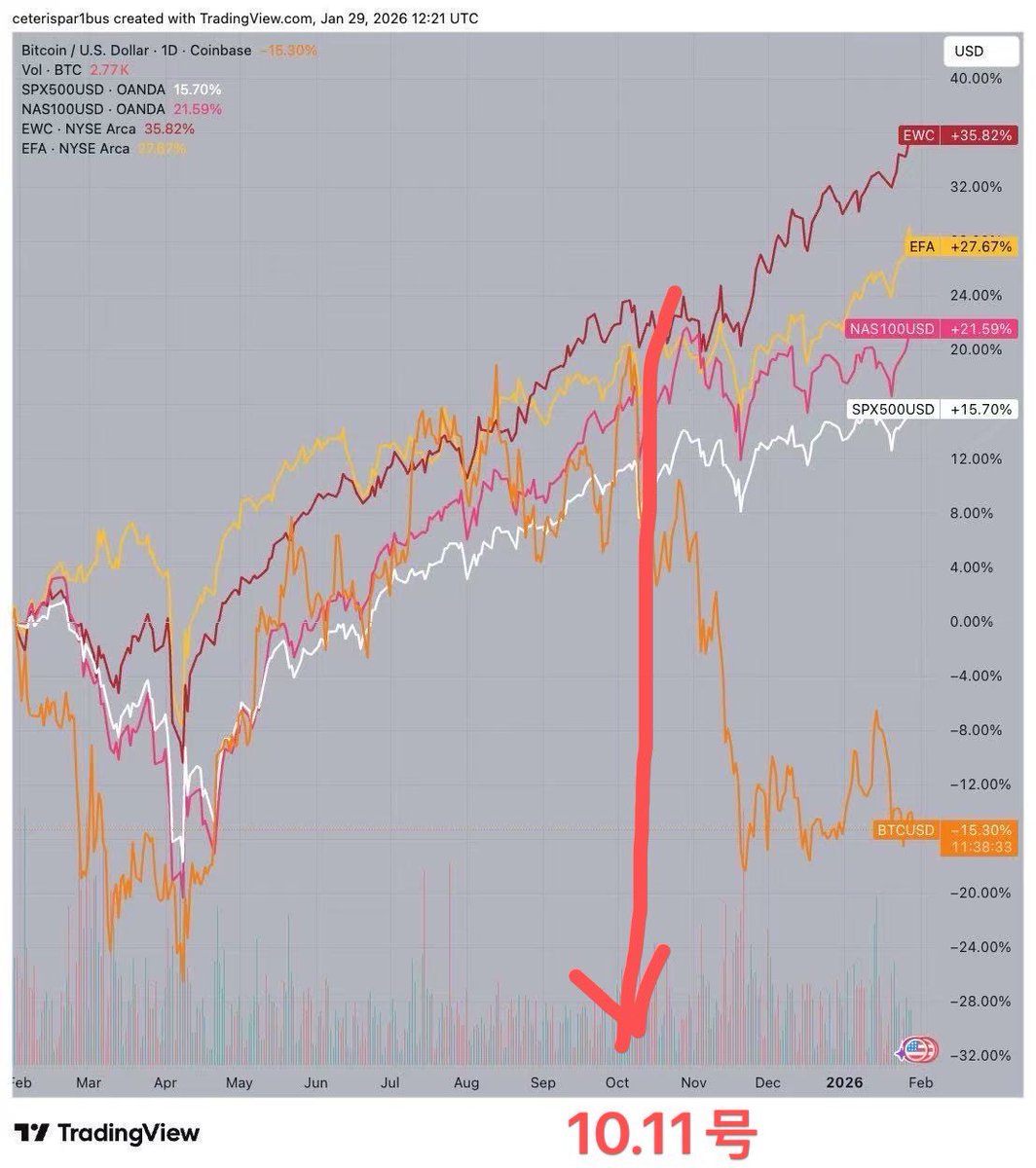
自从10.11号这天开始,btc直接与美股和黄金失去了关联性.
cz这俩口子那天是摧毁的整个行业.
cz:不承认不道歉不赔偿不要脸
我拿到的也只是他们那天强平接管我账户多扣走的10万u.但绝大部分人失去的是所有资产,同时未获得任何赔偿.
Bidao@BidaoOfficial
这图还不明显吗? 1011之前,币圈是怎么和黄金 美股等保持高度关联度的。 1011摧毁的是兄弟们的事业 是对整个行业的伤害 做生意大家亏一次没事,都是l可以激烈,但是这C干的是把这整条路给毁了
中文
If you don’t like your job, then every penny you earn through your own hard work is paid for with your life.
English