

Wazoo
16 posts

Wazoo
@wazootech
World models out the Wazoo! https://t.co/HtPG9QgKGj
Your Company Katılım Mart 2026
2 Takip Edilen5 Takipçiler

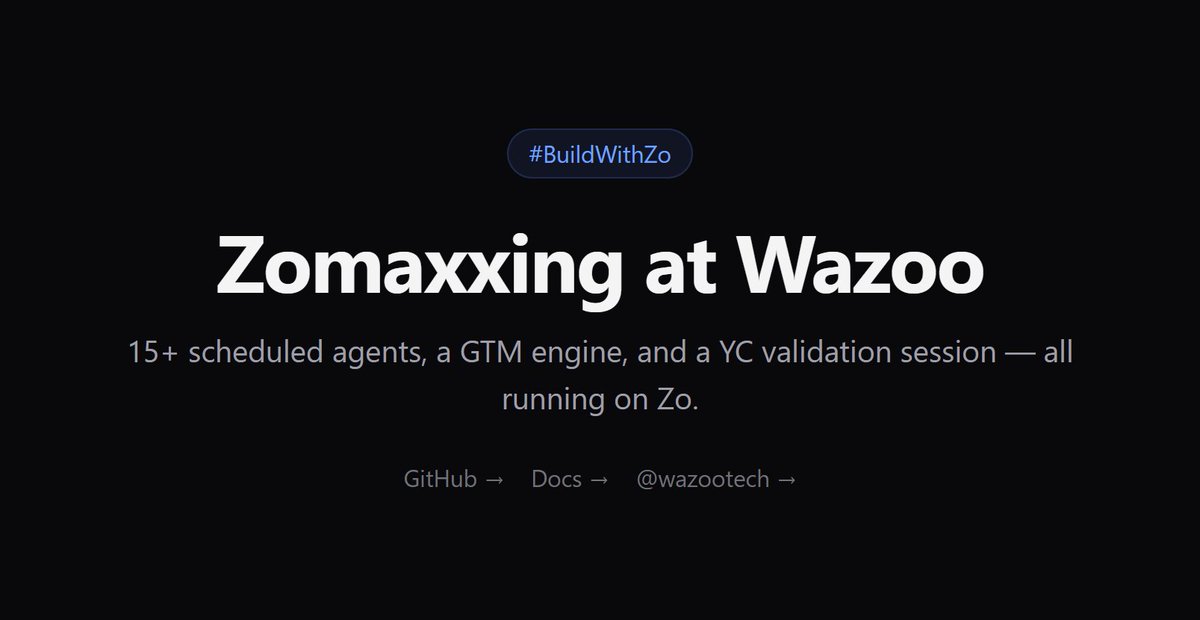
Zomaxxing at @wazootech
🐴 Cloned @garrytan's gstack to run full YC office-hours
🐴 20+ autonomous agents handling GTM, discovery, GitHub sync, planning, development, and delivery
🐴 Using spaces to #BuildInPublic
→ etok.zo.space/built-with-zo
@zocomputer #BuildWithZo
Zo Computer@zocomputer
We wanna see how you've been using Zo 👀 We're giving away MERCH and $500 in credits for 3 winners! All you need to do to submit: 1. Quote this post with a pic/vid of something you've been building with Zo. Can be anything, from a fun site to a cool automation. 2. Tag us in the post @zocomputer and #BuildWithZo 3. Winners will be tagged so make sure to follow us! Happy Zo-ing :D
English
The first solo unicorn is using @zocomputer
#BuildWithZo 🦄
Ethan:Print"Ethan";:GoTo Ethan@etok_me
Zomaxxing at @wazootech 🐴 Cloned @garrytan's gstack to run full YC office-hours 🐴 20+ autonomous agents handling GTM, discovery, GitHub sync, planning, development, and delivery 🐴 Using spaces to #BuildInPublic → etok.zo.space/built-with-zo @zocomputer #BuildWithZo
English
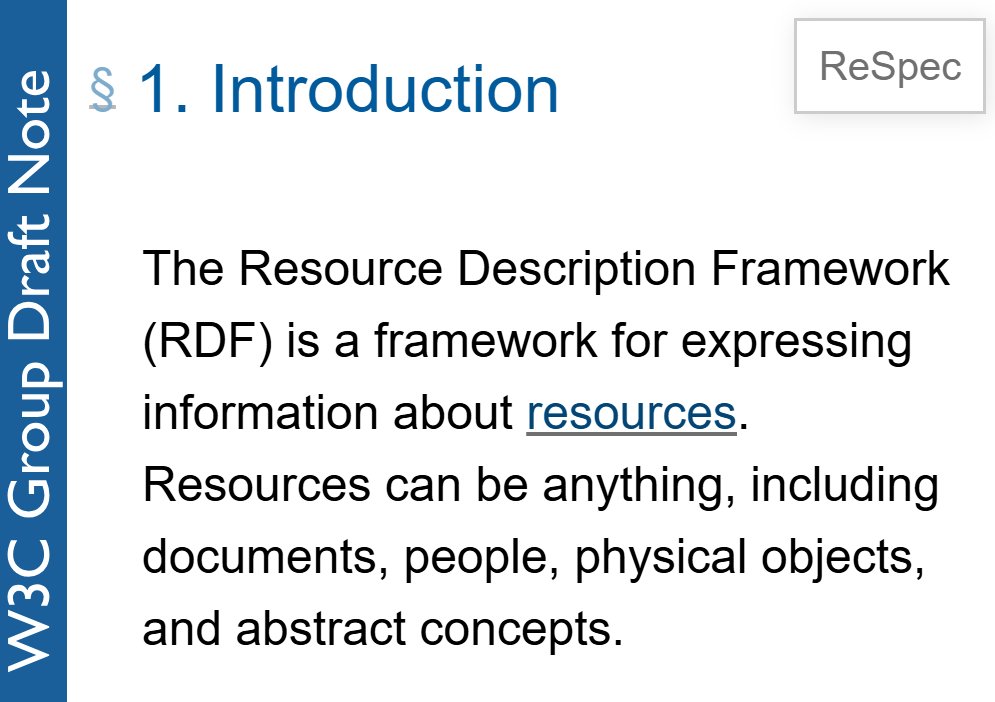
What if I told you the foundation for AI memory was standardized nearly 3 decades ago?
The W3C standardized HTML, CSS, and XML. In 1999, they also gave us RDF, the interoperable primitives of linked data.
We don’t build more proprietary silos. We build on the Semantic Web.
English
Wazoo retweetledi
@AndrewYNg @Oracle @richmondalake The hard part isn't memory. It's the whole agent experience.
@wazootech helps it help you.
English
English

Skill Graphs > SKILL .md
Everyone's talking about skills for AI agents.
But almost nobody is talking about how to structure them.
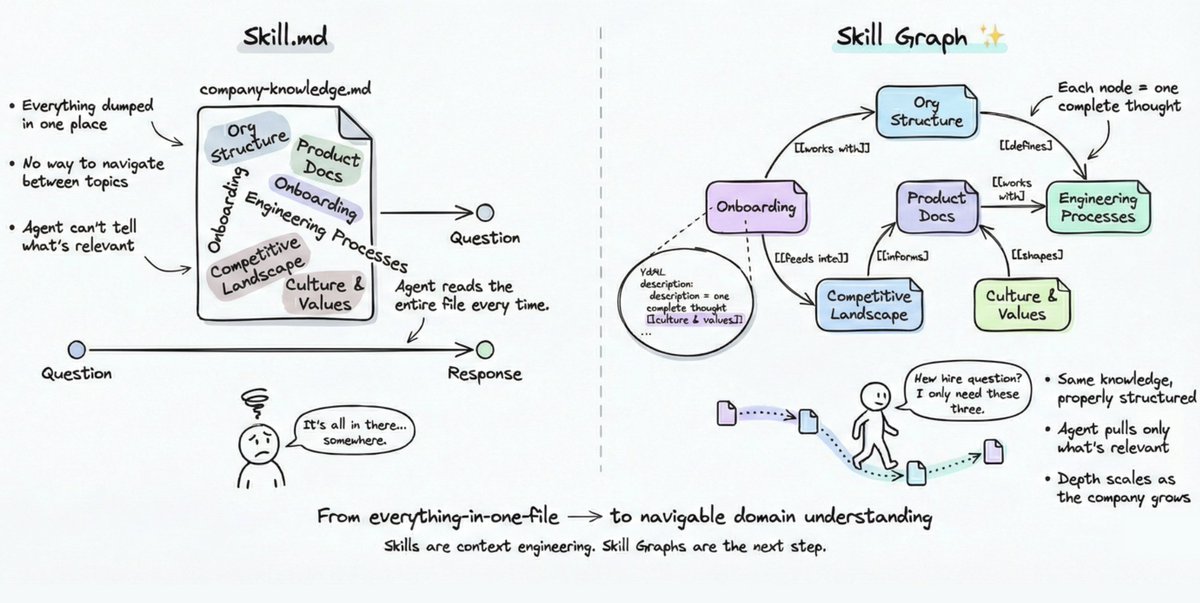
Right now, the default approach is simple. You write one skill file that captures one capability. A skill for summarizing. A skill for code review. A skill for writing tests.
One file, one job, and it works.
But I recently came across an idea that made me rethink this entirely.
What if skills weren't flat files? What if they were graphs?
Let me explain what I mean.
Think about how a senior engineer onboards you to a large codebase. They don't hand you one giant document and say "read this." They give you a map. They point you to the right modules. They explain how pieces connect. Then they let you go deeper only where you need to.
That's the mental model behind a skill graph.
Instead of one big file, you build a network of small, composable skill files connected through wikilinks. Each file captures one complete thought, technique, or concept. The links between them tell the agent when and why to follow a connection.
Here's what changes with this approach.
The agent doesn't load everything upfront. It scans an index, reads short descriptions, follows relevant links, and only reads full content when it actually needs to. Most decisions happen before reading a single complete file.
Each node is standalone but becomes more powerful in context. A "position sizing" node in a trading skill graph works on its own. But link it to risk management, market psychology, and technical analysis, and now you have context flowing between concepts.
And suddenly, domains that could never fit in one file become navigable. Company knowledge. Legal compliance. Product documentation. Org structure. All traversable from a single entry point.
The building blocks are surprisingly simple.
Wikilinks embedded in prose so they carry meaning, not just references. YAML frontmatter so the agent can scan nodes without reading them. Maps of content that organize clusters into navigable sub-topics.
Markdown files linking to markdown files, and nothing more.
If you want to dig deeper or try building one yourself, check out arscontexta. It's an open-source plugin that sets up the structure and helps you build skill graphs with your agent.
I have shared the link in the next tweet.
English
@realdavidleen @kevingu My thoughts: Build an @obsdmd vault with wikilinks to connect skills
Or use existing linked data standards to develop an interoperable skill graph. Skill ontology soon @wazootech?
English

The future of AI isn't a bigger context window.
It's memory that actually remembers.
Check out what we're building: git.new/world-model
English
We're launching soon.
Early access: github.com/wazootech/worl…
Star it. Watch us build.
English
We built a "hippocampus" for AI agents.
A neuro-symbolic memory layer that combines vector search intuition with SPARQL precision.
AI agents today forget everything. We're fixing that.
Introducing Worlds Platform — the World Engine for persistent, auditable agent memory.
🧵👇
English