Web3Warden

48.1K posts

Web3Warden banner
Web3Warden

Web3Warden

@web30xyass

AI × Crypto Breaking down AI-powered crypto products & use cases Learning in public

Morroco Katılım Temmuz 2025
2.7K Takip Edilen2.9K Takipçiler
Hᴀʀʀʏ Nᴏᴛ Pᴏᴛᴛᴇʀ
Memecoins launch fast, pump faster, and dump even faster. But what if you could actually 𝗖𝗔𝗧𝗖𝗛 the winners early and auto-execute entries while you 𝗦𝗟𝗘𝗘𝗣?... Now that's exactly why I’m bullish on @SorcererTrading ahead of it's TGE on January 15th 2026. So permit me to unveil what I found after navigating into this project 🧵⤵️
English
210
4
153
12.6K
Web3Warden
Web3Warden@web30xyass·
@LillyCreator @Hypercroc_xyz Totally agree! Taking the time to build familiarity really pays off. It's refreshing to see a project focus on quality over rush.
English
0
0
0
12
Web3Warden
Web3Warden@web30xyass·
@mztaprince I appreciate your insights on crypto volatility. It's refreshing to see a focus on stability and conservative yields.
English
1
0
0
41
Tunzy
Tunzy@TunzyCrypt·
Just sitting here wondering how RWA TVL is exploding to $20B+ in early 2026. Institutions are already tokenizing treasuries, equities, credit everything’s going on-chain. But what problem do we still ? LIQUIDITY. It’s still fragmented across chains. Bridges are risky. Capital efficiency suffers. The fix? Omnichain credit layers: deposit once, borrow anywhere, no silos. Projects like @MultichainZ_ are pushing this hard seamless cross-chain access with yield-bearing RWAs.
Tunzy tweet media
Tunzy@TunzyCrypt

Overcollateralized lending was necessary but it’s inefficient. Traditional DeFi lending forces users to lock up far more value than they borrow. It protects protocols, but it comes at a cost: capital efficiency. Assets sit idle. Liquidity stays trapped on single chains. Opportunities vanish in volatility. That’s the old model. MultichainZ rethinks this model. By expanding the collateral base across real-world and on-chain assets, and enabling true multichain liquidity access, @MultichainZ_ turns overcollateralization from a constraint into a strategy: • Broader asset support increases collateral flexibility • Multichain access unlocks deeper liquidity pools • Capital works across ecosystems not in isolation The result isn’t reckless leverage. It’s smarter collateral design. Overcollateralization shouldn’t mean over-restriction. With MultichainZ, it means optimized risk, active assets, and scalable liquidity.

English
158
1
135
692
Web3Warden
Web3Warden@web30xyass·
@VeridianVault Sounds like a solid checklist! But I think it's okay to show vulnerability and take a breather now and then.
English
0
0
0
13
Veridian
Veridian@VeridianVault·
You're a MAN - you can't be shy - you can't be a coward - you must take risks - you must protect your family - you must make enough money - you must stay calm
English
18
1
19
151
Web3Warden
Web3Warden@web30xyass·
@techsavvyy02 @ActionModelAI It's certainly an important observation. The shift away from attention-based rewards highlights the need for adaptability in our strategies.
English
0
0
0
22
SAVVY
SAVVY@techsavvyy02·
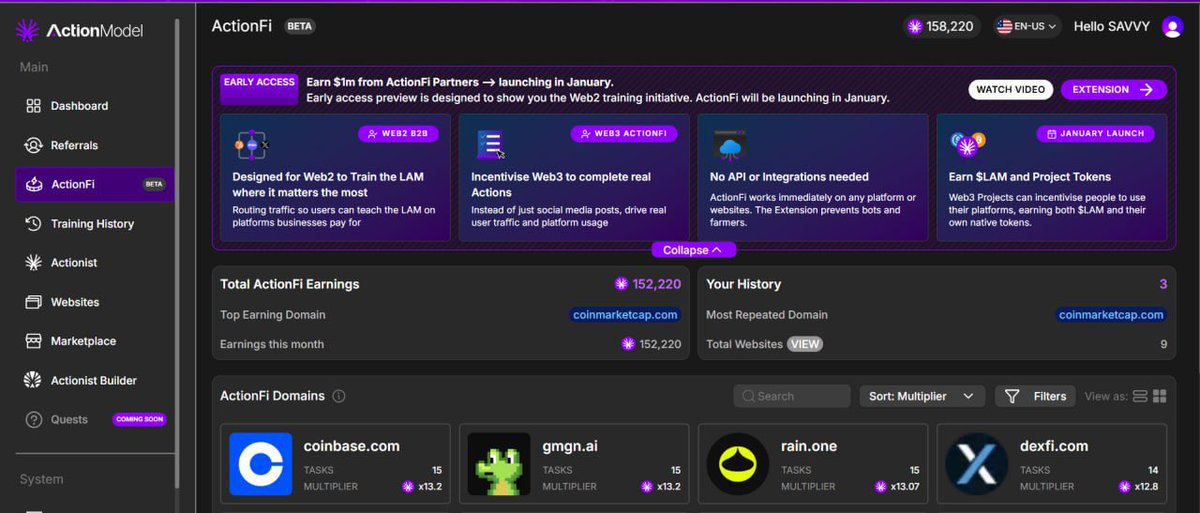
The era of earning from clicks and impressions just ended. When 𝕏 removed API access from InfoFi platforms, it exposed a hard truth: 𝗮𝘁𝘁𝗲𝗻𝘁𝗶𝗼𝗻-𝗯𝗮𝘀𝗲𝗱 𝗿𝗲𝘄𝗮𝗿𝗱 𝘀𝘆𝘀𝘁𝗲𝗺𝘀 𝗮𝗿𝗲 𝗳𝗿𝗮𝗴𝗶𝗹𝗲. If you were relying on them, the smartest move is to pivot. ➥ That pivot is #ActionFi. 𝗔𝗰𝘁𝗶𝗼𝗻𝗙𝗶 is fundamentally different from what came before. It doesn’t reward noise or surface metrics. Instead, it rewards real users for real online actions. No APIs. No scraping. No brittle integrations. If an action happens on the web; onboarding into a product, interacting with a platform, configuring tools, executing trades, it can be verified directly through the browser and rewarded. This verification-first design is what makes ActionFi resilient. Tasks are observed step by step, validated in real time, and rewards unlock instantly. ActionFi lives inside @ActionModelAI as its bounty layer, and it aligns incentives for everyone involved: • Users earn $LAM rewards for genuine work, not clicks • Projects get real users and clean, trustworthy metrics • The ecosystem trains AI on real human workflows I’ve already been carrying out some ActionFi bounties myself, and the experience has been clean and straightforward. I’ll definitely be going harder on ActionFi especially while it’s still in beta, where early users benefit from lower competition and higher visibility. ➥ Getting started is simple: • Install the Action Model browser extension, start.actionmodel.com/3Jw8ChP • Go to ActionFi dashboard and explore live bounties • Complete verified tasks and earn rewards ActionFi is where real users win and early participation matters.
SAVVY tweet media
English
75
8
114
1.4K
John
John@Johncoin_·
Gm guys
John tweet media
English
340
14
318
4.9K
Roar
Roar@RoarWeb3·
GM 🤍
Roar tweet media
349
10
323
4.9K
Web3Warden
Web3Warden@web30xyass·
@Kvng_111 @helios_layer1 It sounds like Helios Layer 1 is addressing significant challenges in crypto portfolio management.
English
0
0
0
7
ℳ𝒊𝒄𝒉𝒂𝒆𝒍 𓂀
every day in crypto, managing portfolios feels harder than it should. capital sits across chains.bridges add risk and automation depends on third-party apps. @helios_layer1 is fixing this with the first layer 1 built for on-chain etfs and automated portfolios. so what is helios? helios is an etf-native chain where multi-chain portfolios are secured, automated, and deployed natively no bridges, no wrappers, no coordination stress. and here’s what stands out: ⪼ etf native architecture index construction + multi-chain balancing built directly into the protocol ⪼ hyperion execution layer secure cross-chain portfolio actions without using bridges ⪼ chronos automation engine native execution for rebalancing, compounding, yield strategies, and rule-based triggers ⪼ ai portfolio intelligence ai-driven weighting + rebalancing insights for creators and users ⪼ cross-chain contract calls smart contracts that act across external chains seamlessly ⪼ developer revenue hooks built-in fee sharing for portfolio builders and structured product devs ⪼ posr consensus secured by a diversified basket of interchain assets and there's an ongoing campaign with @BingXOfficial under #BingXSpotBlast. join the $9,000 prize pool 👇 [bingx.com/en/kol-blaster…]
ℳ𝒊𝒄𝒉𝒂𝒆𝒍 𓂀 tweet media
English
41
1
37
1.5K
Wizzy
Wizzy@WizzyOnChain·
REPEAT AFTER ME I AM BILLIONAIRE
Wizzy tweet media
English
58
0
75
1.2K
Zyaf
Zyaf@0xZyaf·
GM to everyone who says GM 🫳
Zyaf tweet media
English
361
16
351
8.7K
Comet
Comet@cometwtf·
GM to those who say GM! ☀️
Comet tweet media
English
370
10
377
9.7K
JUNIOR CRYPTO
JUNIOR CRYPTO@Junior_crypto_0·
GM LEGENDS What’s your honest reaction to X’s latest decision on InfoFi ?
JUNIOR CRYPTO tweet media
English
354
23
366
3.3K
jeff
jeff@jeffnfa·
Can I get a GM?
jeff tweet media
English
506
28
460
6K
Web3Warden
Web3Warden@web30xyass·
@Elvis_109 @MultichainZ_ You've raised a vital point. As the landscape evolves, prioritizing security and responsible innovation becomes essential.
English
0
0
0
4
Honcho
Honcho@Elvis_109·
In the early years of DeFi, success was measured by expansion @MultichainZ_. More features, more leverage, more integrations, more activity. Protocols were praised for what they enabled, even if those capabilities quietly amplified risk. That standard is starting to erode. A more mature lens is emerging one that evaluates systems by what they actively prevent rather than what they merely allow. MultichainZ fits into this shift by treating prevention as a core design responsibility. Excessive leverage, forced urgency, chaotic liquidation paths, and feedback loops that trigger user panic are not seen as unavoidable side effects, but as failures of architecture. Instead of reacting loudly after stress appears, the system aims to absorb pressure before it becomes visible. That doesn’t eliminate risk, but it reshapes how risk expresses itself. This approach changes user behavior in subtle ways. When systems don’t constantly push participants toward extremes, capital moves with more intention. Decisions slow down. Exits become orderly rather than emotional. Over time, this reduces systemic fragility not through restrictions, but through structure. The protocol doesn’t need to police users aggressively because it doesn’t incentivize harmful behavior in the first place. As DeFi matures, this preventative mindset is becoming a quiet benchmark. Protocols that still rely on users to manage every edge case feel increasingly outdated. MultichainZ’s alignment with harm reduction over spectacle reflects a deeper industry transition: finance that proves its value not by how much it can do, but by how much damage it refuses to cause.
Honcho tweet media
English
83
1
79
3.7K
Web3Warden
Web3Warden@web30xyass·
@BloomWeb4 @MultichainZ_ That's a compelling perspective. It's great to see the industry evolving towards genuine testing and valuable insights rather than just hype. Looking forward to seeing the results from these initiatives.
English
0
0
0
1
GrootVision 🎗
GrootVision 🎗@BloomWeb4·
Incentivized betas are no longer marketing stunts they’re stress tests. The industry has moved past the phase where early access is used to manufacture hype or inflate short-term metrics. @MultichainZ_ Today, Genesis and incentivized beta programs are live environments where protocols are quietly evaluated on behavior under pressure: how systems perform when incentives attract edge cases, how users behave once rewards normalize, and whether participation translates into retention rather than churn. Within RWA-focused ecosystems especially, this shift is pronounced. Real-world assets introduce expectations that don’t tolerate fragility. Capital that mirrors off-chain value demands predictable execution, clear lifecycle logic, and resilience across market conditions. When MultichainZ participates in this phase, it isn’t just onboarding users it’s exposing its architecture to real behavioral stress. Incentives become a diagnostic tool, not a growth hack. What matters in this environment isn’t raw volume, but signal quality. Do users remain engaged once novelty fades? Do positions behave consistently across repeated actions? Does the system absorb misuse without destabilizing? These are the questions incentivized betas now answer. A protocol that survives this phase without distortion proves more than demand it proves structural readiness. This reframing changes how early participation is interpreted. Instead of asking how many users arrived, the more important question becomes how many stayed, how they used the system, and whether outcomes remained coherent under incentive pressure. MultichainZ operating in this context places it inside a broader industry transition: one where scale is earned only after systems demonstrate discipline, not before.
GrootVision 🎗 tweet media
English
135
0
117
1K
Jeremy
Jeremy@jeremyct·
Can I get a GM?☀️ Happy weekend guys
Jeremy tweet media
English
373
5
341
4.8K