CyberGhost

6.8K posts

CyberGhost banner
CyberGhost

CyberGhost

@webenstein_

Building beyond binaries.

Student Katılım Nisan 2021
1.7K Takip Edilen5.4K Takipçiler
Sabitlenmiş Tweet
CyberGhost
CyberGhost@webenstein_·
I’m 22 years old unc: - final-year Computer Science student - cracked 0 cybersecurity jobs so far - spending more time reading malware than touching grass - reverse engineering & security research arc - built blockchain security projects - financially dependent (student life lol
English
7
3
119
4.7K
Abhishek🌱
Abhishek🌱@Abhishekcur·
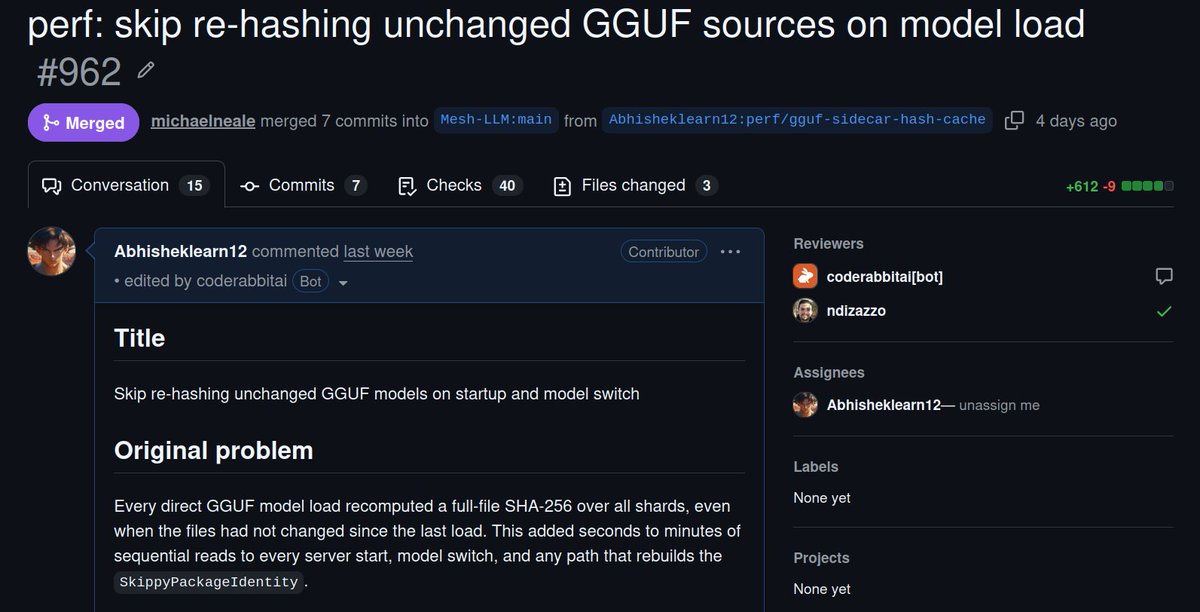
i cannot stop smiling. two of my open source pull requests just merged into main this week, and honestly i learnt more from these two than from months of my own side projects. the one that taught me the most, paradedb: in pg_search, top-k search and mvcc visibility ran as two separate steps. so dead rows a transaction couldn't even see were still landing in the top-k slots, and they inflated the pushed-down threshold, which then silently dropped live rows. you'd run a search and quietly get the wrong answer. no error. no warning. just wrong. that broke my brain in the best way. the scariest bugs don't crash. they hand you a confident, wrong result. my fix absorbs visibility filtering directly into segmentedtopk, so dead rows get removed before they ever touch the threshold or the top-k. now the results match postgres. the second one, mesh-llm: every direct gguf model load recomputed a full-file sha-256 over all shards, even when the files hadn't changed since the last load. that added seconds to minutes of sequential reads to every server start and every model switch. my fix caches the hash in a sidecar and reuses it when size and mtime still match, skipping the full-file read entirely. same lesson under both: stop doing work you don't need. one was wasted reads. one was wasted trust. two real repos. two maintainers. both reviewed, both merged. i learnt so much, and i am genuinely, ridiculously happy right now. the real test happens in oss. when you can contribute into a real production project, learn a lot doing it, get reviewed by people who know more than you, and your work still holds up, that is when you know it was actually true. this is why i love open source, will keep doing my bestt.
Abhishek🌱 tweet mediaAbhishek🌱 tweet media
English
5
2
38
1.5K
CyberGhost
CyberGhost@webenstein_·
How OAuth phishing works Attackers don’t always steal your password, they steal your trust. They send a fake app invitation, you sign in through the real Microsoft/Google login page, then unknowingly grant the app permission to access your account.
English
1
1
17
797
CyberGhost
CyberGhost@webenstein_·
How SharePoint RCE attacks work Attacker scans for vulnerable SharePoint servers. Sends a malicious request exploiting an unpatched flaw. Gains remote code execution. Installs a web shell, steals data, moves through the network, or deploys ransomware.
English
0
0
4
293
CyberGhost
CyberGhost@webenstein_·
The U.S. has indicted 3 Russian nationals and 2 companies for allegedly supporting ransomware operations responsible for $62M+ in losses.
English
0
0
2
175
CyberGhost
CyberGhost@webenstein_·
Cybersecurity Update: CISA is warning organizations to patch Microsoft SharePoint and Fortinet systems immediately as attackers are actively exploiting critical vulnerabilities. If you’re delaying security updates, you’re giving attackers a head start.
English
1
2
15
499
CyberGhost
CyberGhost@webenstein_·
Happy Sunday Cybersecurity fam!
CyberGhost tweet media
English
5
4
77
1.1K
CyberGhost retweetledi
NetworkChuck
NetworkChuck@NetworkChuck·
Everything in Linux is a file, literally everything! 🗃️
English
30
181
2.2K
83.8K
CyberGhost retweetledi
IT Guy
IT Guy@T3chFalcon·
Yes, the software is called LG OnScreen Control Plus. it runs silently in the background. it tracks which applications you use, when you use them, and how long. it phones home to LG servers. it cannot be uninstalled through normal means without leaving registry traces. gamers noticed because some anti-cheat systems flagged it as suspicious software. the monitor was getting people banned from games. now the TV side: LG also updated its webOS terms of service. if you use the AI voice features on your LG TV, the company says you may need to inform guests in your home that conversations could be recorded. not LG informing your guests. you. the homeowner. legally responsible for notifying anyone who walks into your living room that the television is listening. LG built a surveillance device. sold it to you. and made the disclosure your legal problem. so to recap what LG shipped this year: a monitor that installs tracking software on your PC without asking. a TV that records conversations in your home and requires you to warn your guests. both devices look exactly like a monitor and a TV. neither one tells you what it actually is at the point of sale. you found out when your game banned you. or when you read the terms. Credit: @GamersNexus for the discovery.
IT Guy tweet mediaIT Guy tweet media
Brahim@IBthecoder

LG just got caught automatically installing adware on PCs the moment you plug in their UltraGear monitor.

English
239
4K
18.4K
680.7K
CyberGhost retweetledi
Gabriel Odusanya 🇳🇬🇬🇧
I tweeted something earlier yesterday " cyber security is an act not a tool" some beginners are getting this wrong by thinking all there is to cyber security is just scanning, Pentesting and documenting. There is something called I secured it but it broke anyways, how did it happen. You will keep wondering what something is not working the right way it should. Cyber Security is more of the security principles, once that is met you have solved most of the issues and breaches occuring in the cyber space. These security principles are the real foundation for cyber security and why is making security security: CIA Triad - Confidentiality Integrity Availability these there major principles are more than what it seems I made a YouTube video on the deep dive on it . and after thee three we have more like PoLP - Principle of least privilege, this is where something like IAM comes in (Identity & Access Management)- a while niche on its own. Zero Trust principle & Architecture - one of the weakest link in cyber security still remains human, this trust is what is causing most problem is breaches that occurs through Phishing, Vishing & Smishing. And we have more principles like that in cyber security that we ought to have followed discreetly. cc: @ireteeh x @_DeejustDee x @TemitopeSobulo
CyberGhost@webenstein_

Have you realized that cybersecurity is much more than Nmap, Burp Suite, Wireshark, Metasploit, etc.? Cybersecurity is fucking deep as hell. Most of us are just scratching the surface.

English
0
3
9
363
Dark Coder
Dark Coder@dark_coderz·
If you could master only ONE startup skill, what would it be?
English
17
1
19
555
CyberGhost
CyberGhost@webenstein_·
Cybersecurity Tip: Don’t trust a website just because it uses HTTPS. A padlock means the connection is encrypted, not that the website is legitimate.
English
2
1
16
614
CyberGhost retweetledi
Kiing Vamp
Kiing Vamp@kiing_vamp·
@webenstein_ Facts. The tools are the 5% you can demo. The other 95% is threat modeling, understanding business logic, knowing how protocols actually break, writing your own tooling when nothing off-the-shelf fits and honestly, just years of pattern recognition from breaking things
English
0
1
7
137
CyberGhost
CyberGhost@webenstein_·
I’m not your regular cybersecurity instructor. I build deep tools, discover vulnerabilities, break systems, fix them, and keep digging deeper.
English
1
2
16
413
CyberGhost
CyberGhost@webenstein_·
Have you realized that cybersecurity is much more than Nmap, Burp Suite, Wireshark, Metasploit, etc.? Cybersecurity is fucking deep as hell. Most of us are just scratching the surface.
English
6
5
48
2.8K
CyberGhost
CyberGhost@webenstein_·
@T3chFalcon I love u mahn, your feeding me with so much knowledge!!!!!!!
English
0
0
0
244
IT Guy
IT Guy@T3chFalcon·
The 2020 SolarWinds attack didn't hack 18,000 organizations. It hacked one. then the other 17,999 hacked themselves. here's how. SolarWinds made a network monitoring tool called Orion. used by 33,000 organizations, including the US Treasury, DoD, State Department, NATO, and most of the Fortune 500. It monitored everything: switches, routers, firewalls, Active Directory, storage systems. it had privileged access to everything it touched. Russian intelligence group APT29 got into SolarWinds' software build pipeline in September 2019. they watched. they tested. they waited. February 2020: they injected a backdoor called SUNBURST into Orion's legitimate code. it looked like a real software component. it passed code reviews. it passed security scans. it was digitally signed by SolarWinds' own certificate. March 26, 2020: SolarWinds pushed an Orion update to customers. every customer who installed the update installed SUNBURST. the backdoor was a masterpiece of evasion: — it sat completely dormant for 12-14 days after installation. no activity. nothing to detect. — it communicated using legitimate-looking DNS traffic that blended into normal network noise. — it checked if the infected machine belonged to a security company and went dark if so. — it impersonated legitimate SolarWinds traffic patterns to avoid behavioral detection. — it operated undetected for nine months across thousands of networks. The NSA, Microsoft, Department of Homeland Security didn't catch it. FireEye caught it. because FireEye noticed their own red team tools had been stolen. they investigated their own breach. found SUNBURST. and went public on December 13, 2020. the hack had been running since March. nine months.
Mololuwa | Cybersecurity - (The God Complex)@cyber_rekk

who rememebers the 2020 SolarWinds supply chain attack?

English
5
15
109
10K
CyberGhost retweetledi
IT Guy
IT Guy@T3chFalcon·
Your browser's autofill feature is stealing your data. sorry, not your browser. attackers using your browser against you. You land on a page with a form. looks normal. two visible fields. name and email. you click into the name field and let autofill do its thing. behind the page are six more fields you cannot see. hidden with CSS. pushed off-screen. invisible to you. not to your browser. when autofill populates the visible fields it populates all recognized fields simultaneously. including the hidden ones. your name. email. home address. phone number. credit card number. all of it. submitted silently when you hit send. Nearly 40% of malicious web attacks now involve formjacking, injecting hidden fields into legitimate or fake forms to harvest autofilled data. the attack doesn't require you to click a suspicious link. it doesn't require you to download anything. it doesn't require you to type a single sensitive character. it just needs you to autofill a form on the wrong page.
PhishCore™️@PhishCore

Don't sleep on autofill phishing; It's one of the sneakiest and most underrated attack vectors people encounter daily.

English
18
312
1.2K
50.6K
CyberGhost
CyberGhost@webenstein_·
Cybersecurity Tip: Don’t reuse passwords. One breach shouldn’t unlock all your accounts.
English
0
0
4
229