willbank

9.8K posts

willbank banner
willbank

willbank

@willbank

Prioritise economic freedom, technological innovation & digital privacy. Ex-entrepreneur. DeFi maxi. Nuclear & renewables for abundant low-cost energy for all.

On chain Katılım Şubat 2009
1.2K Takip Edilen1.4K Takipçiler
Sabitlenmiş Tweet
willbank
willbank@willbank·
This is a really interesting article but for me it highlights 2 very important errors in societal thinking: "It's nobody's job to create jobs" - incorrect!! It's everybody's job to create their own job. This is the fundamental re-framing in society - it's why we've seen an explosion of entrepreneurialism not just in the traditional sense but also in solo owner-operator businesses like influencers and even OF girls. As the tools get more widespread, the cost of adoption comes down and then AI makes them more powerful so the net result is that we can all express our commercial ambitions with much lower overhead (and therefore risk). "It's technology enabling the rich to do their own work" - incorrect again!! It's technology enabling us all to do our own work. As above we have to get away from this absurd idea that capitalism (which is originally a Marxist and pejorative term for those who hoard capital to the detriment of the workers) is evil: we ALL have capital to some degree or other (financial, time, skills) and how we allocate that is up to us. At its most fundamental AI is reducing the amount of capital needed to start or grow your business - this is inherently better for workers than capital holders because it actually erodes the competitive advantage that existed in the status quo ante - the cost to play the game has fallen, more people will play, more will succeed because the unfair moat of having the capital is eroded. We have to reframe in this manner to enable people to see a brighter future for themselves rather than a diminished and dependent one, which is what UBI suggests.
English
0
0
3
1.2K
Graham Neubig
Graham Neubig@gneubig·
I tell GPT 5.5, you are a manager, not a coder. Find the issues to solve and delegate to other agents. Do not write any code yourself. It does so for a while. I think "good GPT" and log off, I let it do its long running tasks with its team of subordinates. I log on an hour later and check in. GPT 5.5 is coding alone, its sub agents diligently waiting for orders. No STOP, I say, you are a manager. You MUST NOT code. My bad, says GPT 5.5, got it, I must manage, not code. One hour later, GPT 5.5 is coding. But it's OK GPT, I get you. For I am also guilty. No matter how many times a coder is told they are a manager, in their heart of hearts, they are still a coder. So I tell Claude Opus 4.7...
English
120
109
3K
411.4K
willbank retweetledi
Institute of Economic Affairs
🇬🇧 Britain has no wealth tax. Yet it raises more tax from wealth than every country that does - Spain, Switzerland and Norway - and every other OECD nation. We shouldn't be looking for more ways to tax wealth. We should be looking at more ways to create it.👇️
Institute of Economic Affairs tweet media
English
53
351
1.1K
49.9K
willbank retweetledi
Brivael Le Pogam
Brivael Le Pogam@brivael·
Hello Julia, sans aucune ironie, c'est top que tu prennes le temps de te renseigner. Mais le problème quand on lit Marx aujourd'hui, c'est qu'on prend pour acquis sa prémisse de départ, alors qu'elle a été démontée scientifiquement il y a plus de 150 ans. Toute la pensée de Marx repose sur la théorie de la valeur-travail. L'idée que la valeur d'un bien vient de la quantité de travail nécessaire pour le produire. Si tu acceptes cette prémisse, alors oui, tout son raisonnement tient. Le capitaliste "vole" la plus-value du travailleur, l'exploitation est mathématique, la révolution est inévitable. Sauf qu'en 1871, trois économistes (Menger en Autriche, Jevons en Angleterre, Walras en Suisse) découvrent indépendamment la même chose : la valeur n'est pas objective, elle est subjective et marginale. Un verre d'eau dans le désert vaut une fortune. Le même verre à côté d'une rivière ne vaut rien. Le travail incorporé est identique. Donc le travail ne détermine pas la valeur. C'est le consommateur qui valorise un bien selon son utilité marginale dans un contexte donné. Exemple concret : tu peux passer 1000 heures à tricoter un pull moche que personne ne veut. Selon Marx, ce pull a énormément de valeur (beaucoup de travail incorporé). Selon la réalité, il ne vaut rien. Parce que personne n'en veut. À l'inverse, Bernard Arnault crée des milliards de valeur non pas parce qu'il "exploite" mais parce qu'il a su anticiper et organiser des désirs humains à grande échelle. La valeur est créée par la coordination, pas extraite par le vol. Cette découverte (la révolution marginaliste) a invalidé tout l'édifice marxiste. Pas pour des raisons idéologiques, pour des raisons scientifiques. C'est pour ça que plus aucun département d'économie sérieux au monde n'enseigne Marx comme un cadre d'analyse valide. On l'enseigne en histoire de la pensée. Maintenant, le truc important. Si ton intention en lisant Marx c'est d'aider les pauvres (c'est une intention noble), alors tu vas être surprise par ce qui suit. Regarde les chiffres de la Banque mondiale. En 1820, 90% de l'humanité vivait dans l'extrême pauvreté. Aujourd'hui, moins de 9%. Cette chute historique ne s'est PAS produite dans les pays qui ont appliqué Marx. Elle s'est produite dans les pays qui ont libéralisé leur économie. Chine post-1978, Vietnam post-1986, Inde post-1991, Pologne post-1989. À chaque fois qu'un pays libéralise, des centaines de millions de gens sortent de la pauvreté en une génération. À chaque fois qu'un pays applique Marx (URSS, Cambodge, Corée du Nord, Venezuela), c'est la famine et les goulags. Ce n'est pas une opinion, c'est l'expérience la plus massive jamais menée en sciences sociales. Plusieurs milliards de cobayes humains, sur un siècle. Donc paradoxalement, si tu aimes vraiment les pauvres, la position la plus cohérente n'est pas d'être marxiste. C'est d'être pour la liberté économique. Parce que c'est empiriquement la seule chose qui a jamais sorti massivement les gens de la misère. Pour creuser, je te recommande trois lectures qui vont changer ta vision : "La Loi" de Frédéric Bastiat (court, lumineux, gratuit en ligne) "La Route de la Servitude" de Hayek "Économie en une leçon" de Henry Hazlitt Bonne lecture, et vraiment chapeau de chercher à comprendre plutôt que de rester dans tes certitudes. C'est rare.
Julia ひ@lifeimitatlife

Depuis tout à l'heure je me renseigne sur les idées de Karl Marx sincèrement je n'arrive pas à comprendre comment on peut être pour le capitalisme et même plus généralement être de droite

Français
1.5K
11.1K
48.8K
3.2M
willbank
willbank@willbank·
People should be able to see the surveillance state clearly behind this flimsy mask… but they’ll keep ignoring it. Just like they ignored the wake-up calls of our shattered society in 2008 and 2020 when those in power paid themselves and danced their evenings away while you were locked in your home.
International Cyber Digest@IntCyberDigest

🚨🇪🇺 The European Commission is about to steal your search history in one of the largest forced data grabs in the history of the open internet, and almost nobody is talking about it. The scope is staggering: 🔴 Every query you type 🔴 Every voice and photo search 🔴 Every autocomplete you accept 🔴 Your language, your device 🔴 Your country pinned to a ~3km² grid 🔴 Every result you saw, every link you hovered 🔴 Every click and scroll 🔴 The full chronological order of your search sessions Meaning the European Union now knows your: 🔴 Health symptoms 🔴 Pregnancy 🔴 Sexual orientation 🔴 Political views 🔴 Religious beliefs 🔴 Financial distress 🔴 Legal trouble 🔴 Addictions 🔴 Affairs Under the proposed measures for DMA Article 6(11), Google would be ordered to ship the daily search behaviour of hundreds of millions of Europeans to multiple third parties through a daily API feed. Any approved "online search engine," AI chatbots included, would get five years of access. The things people only ever type when they think no one is watching. All of it now scheduled to flow daily into an open-ended list of third parties scattered across the European Union. Brussels promises "anonymisation." The reality is a thin technical veneer that has been broken in academic literature again and again for over a decade. Search behaviour is a fingerprint. Stripping a name does not change that. Mass data leaks become inevitable. Every new beneficiary is a new attack surface, and every annual audit is a year of silent exposure between checks. The 2025 Discord vendor breach already showed how fast 70,000 government IDs can leak through a single weak link. Now imagine that link holding Europe's search history. Surveillance without consent becomes the default. Hundreds of millions of EU citizens never agreed to have their queries packaged and shipped to companies they have never heard of. The legal fiction of "anonymisation" cannot manufacture consent that was never given. Behavioural search data is a goldmine for phishing, blackmail, social engineering, and corporate espionage. Foreign intelligence services get a back door without effort. They do not need to breach Google. They only need to compromise the weakest name on the beneficiary list. One insolvent startup. One compromised contractor. One approved entity quietly acquired by a hostile state. In the name of "competition," the EU is about to manufacture a permanent, distributed, daily-refreshed copy of Europe's collective search history. A surveillance dataset Brussels itself would never approve if any other government tried to build it. The public consultation closes Friday, May 1, 2026 at 23:59 CEST. The final binding decision lands July 27, 2026. After that, the door does not close again. Tag your MEPs! File a response! Make noise!

English
0
0
1
18
willbank
willbank@willbank·
This is a very important and under appreciated point: the UK’s structural exposure to AI disruption is severe. And not just in housing/property assets but also in the impact of deflation on our teeter-tottering debt structure more widely, and indeed sterling’s absurd over-valuation vs most currencies and particularly the $.
Josh Hunt@iAmJoshHunt

There are two numbers that should be sitting on every UK policymaker's desk this year. They are not. The first is £9.18 trillion. The total value of UK housing stock. The second is 70%. The share of UK workers in occupations the IMF classifies as exposed to AI. Higher than the US. Higher than the advanced-economy average. Both numbers are real. Both come from serious published research. Neither is talking to the other. Start with what UK housing actually is. Not bricks. Not land. Not planning permission. At the margin, UK housing is priced by what the next buyer can borrow. Mortgages clear at 4 to 4.5 times salary. Which means housing is a leveraged bet on British wages. Now look at what those wages are. 81% of UK GDP is services. 83% of UK employment is services. Law. Finance. Consulting. Admin. Media. Tech. Middle management. These aren't side categories. They are the British economy. They are also the roles with the highest AI exposure. Goldman Sachs ranks them at the top: legal, financial analysis, operations, content production. The IMF puts 70% of UK workers in AI-exposed occupations, against around 60% in the US. Why is the UK so exposed? Because we deindustrialised faster and further than any G7 peer, and replaced factories with knowledge work. The UK has seen the steepest manufacturing decline of any G7 economy since 1970. Every policy decision for forty years pushed labour into exactly the categories now in the crosshairs. Then we concentrated it geographically. London and the South East hold over 40% of UK housing value on just 26% of the housing stock. Same regions. Same workers. Same wages. Same exposure. The financial concentration mirrors the labour concentration almost perfectly. Then we leveraged it. UK household debt: around £2 trillion. Of which mortgages: over £1.6 trillion. Debt-to-income ratio: 117.5%. Lloyds alone has a £317 billion mortgage book. The British banking system is a direct bet on services wages staying intact. Now run the scenario. If AI compresses services wages 10% over a decade, it is not a 10% fall in house prices. It's larger, and it's at the margin, because leveraged buyers drop out first and the comparables reset downward. That's how housing markets actually clear. And the UK has no hedge. The US has manufacturing reshoring, CHIPS Act money, energy abundance, resource extraction. Blue-collar wages rising as white-collar gets squeezed. The UK has none of it. We deindustrialised, layered the economy onto services, and financed £9 trillion of housing against wages that are now the most AI-exposed in the G7. The rebuttal is that AI boosts productivity. The OECD expects UK productivity growth of 0.4 to 1.2 percentage points a year from AI. Second only to the US in the G7. But mortgages don't clear on aggregates. They clear on individual incomes. And the aggregate hides who captures the gains. The IMF's own recent research finds AI-era wage gains concentrating at the high-skill and low-skill ends of the labour market. Middle-skilled workers don't share in them proportionately. Middle-skilled knowledge workers are the exact population whose mortgages clear the UK housing market. The blast radius goes well beyond house prices. Buy-to-let yields break. Pension funds' bank equity revalues. The council tax base erodes. Treasury receipts soften. Bank capital gets stress-tested against a shock no model has priced. Every major UK asset class is, in some form, long services wages. And yet the silence is total. Politicians can't say it. The median voter is a homeowner. Banks can't say it. Capital requirements. Pension trustees can't say it. Members' retirements depend on the number. The Treasury can't say it. Its own fiscal projections assume rising property-linked receipts forever. The silence is structural, not accidental. Britain didn't just bet the economy on services. We bet the balance sheet of every household on services wages surviving the most disruptive labour technology in a century. Nobody chose that trade explicitly. But every mortgage written in the last twenty years locked it in. The numbers in this post aren't mine. They come from the IMF, OECD, ONS, Savills, the Bank of England, NIESR, and the UK government's own January 2026 AI labour market assessment. Most came from Whitehall. Nobody in Whitehall is connecting them.

English
0
0
0
54
willbank
willbank@willbank·
This is worryingly true - there has never been an economy who prospered and also reduced their energy use over a multi-year period (irrespective of source).
SightBringer@_The_Prophet__

⚡️The von der Leyen quote is one of the most revealing things a European leader has said in the last decade and almost nobody is going to process it correctly. “The cheapest energy is the one you don’t use.” That is a sentence spoken by a person presiding over civilizational decline who has decided to reframe the decline as virtue. It’s not a policy statement. It’s a theological position. The energy crisis isn’t a problem to be solved by producing more energy. It’s an opportunity for Europeans to need less. To want less. To consume less. To live smaller lives in smaller apartments heated to lower temperatures with less travel and less activity and less economic output. The scarcity isn’t a failure. It’s the goal. This is the thing Americans and everyone outside of Europe cannot fully grasp about where European elite thinking has landed. They genuinely believe that reducing European energy consumption is morally good regardless of the economic consequences, because European consumption is tied to European environmental guilt which is tied to European colonial guilt which is tied to a broader belief that European civilization has been net negative for the world and should shrink. The energy crisis gives them political cover to implement policies that would otherwise be unpopular. Now they can say circumstances force the reduction when the reduction was always the plan. Von der Leyen is not an aberration. She represents the consensus view among the European political class. Macron believes this. Scholz believes this. The entire EU Commission believes this. They don’t say it this directly usually because it polls badly, but every major policy they implement is consistent with this worldview. Degrowth is not a fringe academic position in European politics. It’s the operating framework at the top. The American version of this framing would be “the cheapest energy is the one we produce ourselves at scale.” That’s what actually reduces cost and increases resilience. Building more nuclear, extracting more gas, expanding the grid, investing in new production. The European version is the opposite. Don’t build anything. Don’t extract anything. Don’t produce anything. Just use less. And when citizens can’t heat their homes or fly for work, frame it as virtue. This is why Europe can’t recover from the current trajectory. The recovery would require a complete reversal of the ideological framework that produced the decline, and that framework is held most strongly by exactly the people who have the power to change it. They’re not going to reverse it because they don’t see the trajectory as a problem. They see it as necessary and good.

English
0
0
0
44
willbank retweetledi
Sawyer Merritt
Sawyer Merritt@SawyerMerritt·
Mainstream media review from the @Independent after trying Tesla's FSD (Supervised) in the Netherlands: "The car behaved impeccably. And it’s so simple to use. What’s most remarkable is how unremarkable it all is. The car accelerates with confidence – not super-speedy but a very natural acceleration – and it corners smoothly. The car will overtake when it needs to (I was always checking the mirrors, just in case) and on occasions, it even swapped lanes approaching traffic lights when it spotted an advantage to be had – just as I would. And around the busy streets of the city centre, the car’s ability to spot every single hazard and react accordingly, was hugely impressive. Had I not been using FSD, I may have been a little more strident in squeezing between pedestrians and cycles, but the impeccably mannered Model Y always gave these more vulnerable road users the benefit of the doubt. The way the car turned sharply and cruised down narrow, cobbled streets – judging its width more confidently than I might in certain situations – was impressive, too. As was the fact that the hundreds of people we passed on Amsterdam’s streets seemed to have no idea that it was the car doing the driving – although there was the odd double-take when they realised my hands weren’t on the steering wheel. I’d highly recommend that you just give it a go – and I say the same about electric cars: try it, you might just like it." Great to see some mainstream media giving FSD a fair go. You can read Steve's full review here: independent.co.uk/cars/electric-…
Sawyer Merritt tweet media
English
64
346
2.7K
129.5K
willbank retweetledi
Pavel Durov
Pavel Durov@durov·
This is how the EU/UK now regulates social media: 🤐 Offer CEOs secret deals to censor dissent. 🚨 If they refuse, open criminal cases against them. 😑 When people push back, say it's "all for the children". 🎭 "Protecting children" has become the standard legal/PR cover.
English
2.3K
14.5K
67.6K
53.7M
willbank
willbank@willbank·
@compliantvc What's super-terrifying about this post is that it's clear US labs will not be able to train AIs to understand sarcasm. We'd better be careful with our jokes in future.
English
0
0
0
89
Henrick Johansson
Henrick Johansson@compliantvc·
Just spoke with dozens of European VCs They all agreed: AI is over No one is putting money into AI startups anymore OpenAI is likely going bankrupt I asked what the next big thing is They all answered in unison: Regulation. And the hot spot for the best regulations? Europe. Meanwhile, America is getting left behind
English
1.4K
158
2K
413.5K
willbank
willbank@willbank·
Yeah - I think they were way ahead and then for some reason (probably due to constrained compute) errors and ommissions crept in more and more. Plus codex 5.4 is cheaper than 4.6 or 4.7! I'm more culturally aligned with Anthropic I think but frankly I need the best intelligence of my finance community and my personal agent and right now that gpt5.4.
English
0
0
0
54
Marshall Taylor
Marshall Taylor@marshalltay·
@willbank @claudeai @OpenAI I think the codex model since 5.2 has been better for most coding tasks vs Sonnet/Opus (expect UI where it’s so poor) 5.4 now is just so good and I rarely hit usage limits.
English
1
0
1
182
willbank
willbank@willbank·
After 5-6 months of daily @claudeai Code usage I had to change completely to @OpenAI Codex this morning. Opus 4.7 is totally borked - lazy, superficial, assumes or hallucinates rather than checking code it's to interface against (even if you've atomically planned the execution). Code quality is appalling. For the last 2 weeks I've been cross-reviewing with Codex and sometimes it takes 20 passes to converge without critical or high severity bugs in Claude's suggested implementations. And most tellingly of all if you flag issues and ask for a forensic explanation it offers bullet points that genuinely don't make sense in English - they sound plausible but use words/terms that don't relate to the subject/code/goals at hand. And you can't roll back to 4.6 in Claude Code anymore so you're basically bang out of luck. Feedback submitted.
English
1
0
1
173
willbank
willbank@willbank·
Claude Code Opus 4.7 on any thinking setting has regressed considerably. It's lazy, it ignores its own rules, it guesses and jumps to conclusions without referencing the underlying code. It's slow. A huge disappointment. @ClaudeDevs
English
0
0
1
103
willbank retweetledi
Will
Will@TeslaJigsaw·
This is my Tesla Model Y in the UK. It already has all the hardware and software needed to drive itself under my supervision - making it dramatically safer than any regular car on our roads. Yet @transportgovuk, @Heidi_Alexander and the Vehicle Certification Agency have still not approved it for use here. It’s like having seatbelts fitted in the car… but the government won’t let you use them. This technology is already working safely in other countries around the world. Why are UK drivers and other road users being held back from a safer future? Enough with the delays already - follow the @RDWnl lead and get this approved. #Tesla #ModelY #FSD #FullSelfDriving #UKAutonomous @elonmusk
Will tweet media
English
117
164
1K
36.8K
willbank retweetledi
Peter McCormack 🏴‍☠️🇬🇧🇮🇪
A number of great accounts popping up 1. @UKGovscan - Independent transparency project. 2. @GreatBritishTT - Data-driven analysis of UK gov spending. 3. @UKDecline - Keeping track of the UK's spiralling decline statistics. 4. @HoTPOfficial - Vote on every bill and law ever debated in Parliament. Send others you know of, I am keeping a list. Pimp and share - data is a weapon.
English
76
921
2.4K
73K
willbank
willbank@willbank·
@iAmJoshHunt Yet sterling remains inexplicably strong especially vs USD. That seems destined to blow up at some point.
English
0
0
1
48
Josh Hunt
Josh Hunt@iAmJoshHunt·
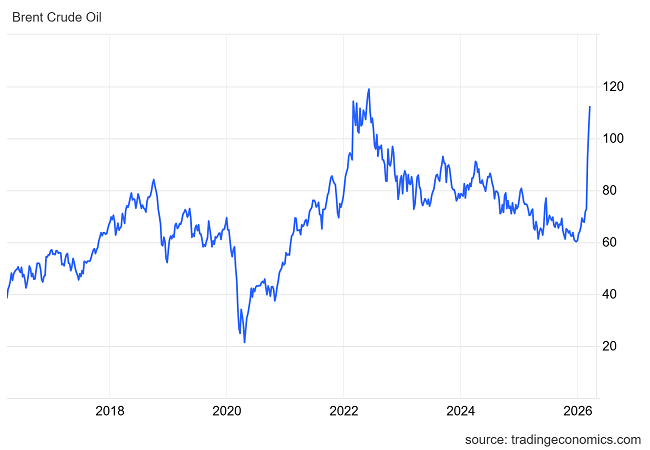
I want to talk about the scale of what’s coming for the UK over the next three months. Because I don’t think many people have joined the dots yet. The Strait of Hormuz has been effectively closed for over five weeks. Before this war, 135 ships passed through it every day. Now it’s 5 to 7. Over 600 vessels are still stranded. Iran has mined the strait, is charging tolls, and controlling who passes. The CEO of Abu Dhabi’s national oil company said it this week: “The Strait of Hormuz is not open. Access is being restricted, conditioned and controlled. That is coercion.” Two thirds of Gulf crude has no alternative route. 14 million barrels a day behind a 21-mile chokepoint. Energy bills are forecast to jump 20% in July. From £1,641 to nearly £2,000. The second major energy shock in four years. Petrol up over 15%. Diesel up nearly 30%. Wholesale gas rose 75% in under four weeks. Food inflation could hit 8% by June and 9% by December. Academics advising DEFRA say it could reach 12%. UK food prices are already 38% higher than before Covid. We’re only 62% self-sufficient in food. We import 60% of our nitrogen fertiliser. Red diesel for farming has surged 60%. Average arable farm income has fallen to £17,000, the lowest in over 20 years. Yesterday, China announced it’s halting all sulphuric acid exports from May. Sulphuric acid is essential for phosphate fertilisers, copper mining, oil refining, and battery manufacturing. A third of the world’s sulphur was already blocked by the Hormuz closure. Now the world’s largest exporter has pulled the other lever at the same time. The fertiliser crisis just got significantly worse, heading straight into planting season. Before the war, markets expected rate cuts. Now they’ve priced in two rate rises. Over 1,500 mortgage products have been pulled. Two year fixes have jumped from 4.8% to 5.5%. Nearly £1,000 a year extra on a £200k mortgage. Gone in weeks. Flights are next. A quarter of UK jet fuel comes from Kuwait, behind the strait. In early April, major carriers said they had five to six weeks of reserves. That clock is running. Ryanair’s CEO has warned 5-10% of summer flights could be cancelled. Iran’s strike on Qatar’s Ras Laffan LNG complex, which handles 30% of the world’s helium, is estimated to take 3 to 5 years to repair. Helium is critical for semiconductors and MRI machines. That’s not a disruption. That’s structural damage. Chemical and steel manufacturers are imposing surcharges of up to 30%. Analysts are warning of permanent deindustrialisation. European gas storage was at just 30% after a harsh winter. If the strait stays restricted through summer, Europe can’t refill for next winter. In Ireland, fuel protests shut down Dublin for four days. The army was deployed. Over 100 fuel stations ran dry, with warnings of 500 by end of the week. Downing Street has held talks on the potential for mass protests here. The OECD has downgraded the UK more than any other G7 nation. Growth slashed from 1.2% to 0.7%. Inflation forecast nearly doubled to 4%, with some saying it could breach 5%. Starmer and Trump spoke this week about military options to reopen the strait. The UK is leading a 30+ nation coalition. But the ceasefire is already fracturing. Iran re-closed the strait over Israeli strikes on Lebanon. Reeves is boxed in by fiscal rules. Higher gilt yields are eating her headroom. And I haven’t heard a credible plan from anyone in Westminster. Energy. Food. Fertiliser. Aviation fuel. Mortgages. Industrial chemicals. Semiconductors. Shipping. Government borrowing. Political stability. All under stress. All compounding. This country imports 44% of its energy. Has almost no gas storage. Imports most of its food and fertiliser. Gets a quarter of its jet fuel from behind a mined strait. Every structural weakness built up over 20 years is being stress tested at once. The next three months aren’t going to be uncomfortable. They’re going to be defining
English
371
1.4K
5.5K
906.6K
willbank retweetledi
The Free Speech Union
The Free Speech Union@SpeechUnion·
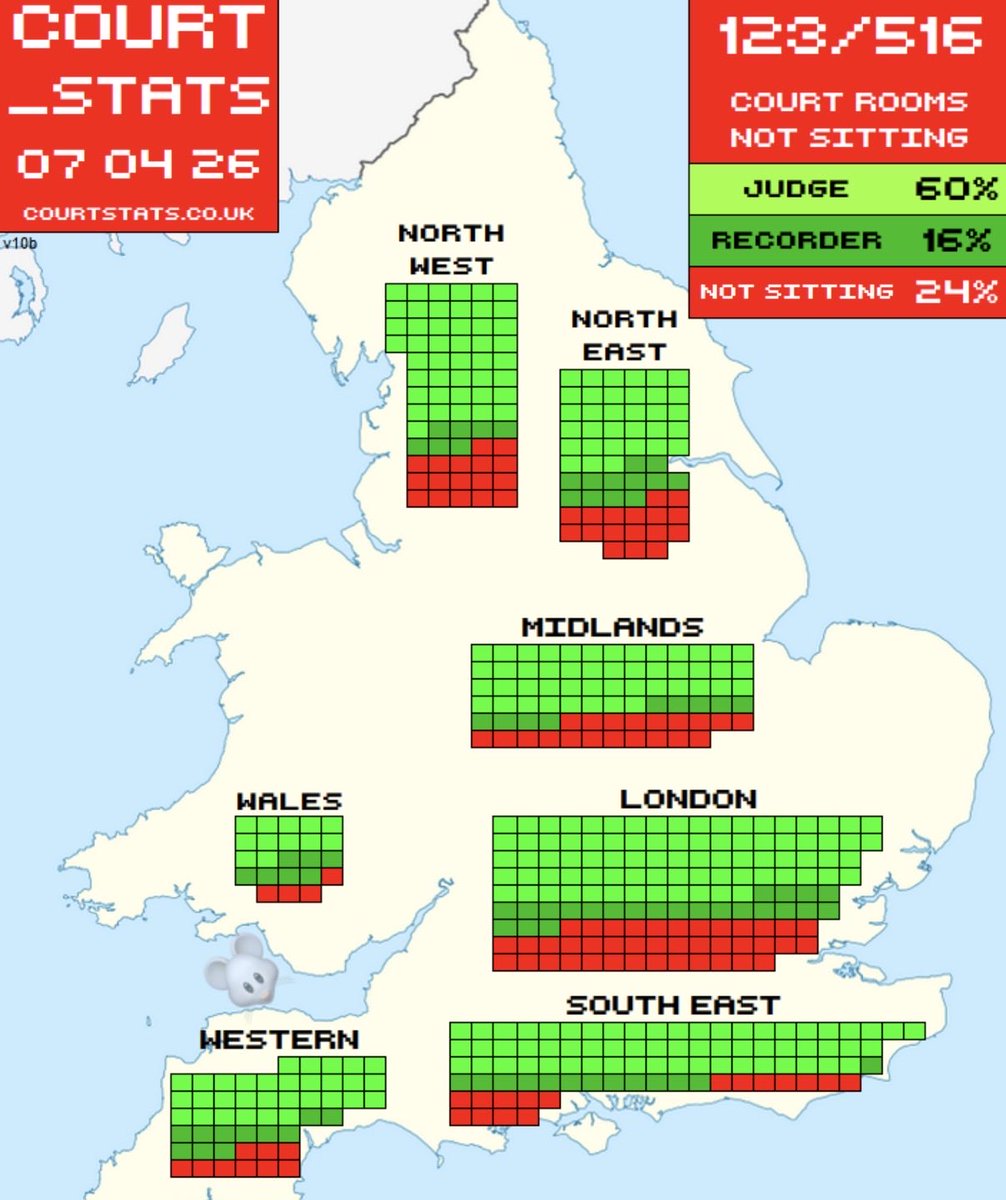
123 out of 516 Crown Courtrooms in England and Wales are sitting empty today — that’s 24%. Yet @DavidLammy claims the only way to cut the 80,000-case backlog is to curb our ancient right to trial by jury. There is no credible evidence for this. A report by the Institute for Government shows it would save just 2% of Crown Court time — not the 20% claimed. It’s obvious: jury trials aren’t the problem. Our courts simply aren’t sitting. Another reason why victims aren’t getting timely justice is the Justice Secretary’s failure to do his job. #SaveJuryTrials
The Free Speech Union tweet media
English
20
635
1.4K
14.3K
willbank
willbank@willbank·
@elonmusk It has been beyond awful in the UK for years. Experienced FSD after a recent Giga Texas tour, drove us to the Boring Co HQ and back to Austin. Flawless at all times. Amazing. Can’t wait for UK & Europe launch.
willbank tweet media
English
0
0
0
184
Elon Musk
Elon Musk@elonmusk·
Europe will love Tesla self-driving! Due to the extreme regulatory burden of the EU, which in general stifles innovation in Europe, Tesla owners there have been stuck with basic lane-following.
Sawyer Merritt@SawyerMerritt

German TV reporter testing @Tesla FSD (Supervised) V14 in the country as public transport in rural areas: "I was genuinely impressed. In the situations where we experienced the system, it worked perfectly and safely. I hadn't expected that. Even in the bad weather conditions in the Eifel region. In many cases, it reacted at least as well as a human driver, if not better. If Tesla is ever allowed to roll out this system nationwide in Germany, I think it will have a major impact on mobility. And that will only be the beginning of some very significant changes in transportation..."

English
6.1K
9.2K
74.4K
37M
willbank
willbank@willbank·
@LynAldenContact Your writing is outstandingly clear. The best in the business IMHO.
English
0
0
0
144
Lyn Alden
Lyn Alden@LynAldenContact·
My March public newsletter is now available, and discusses to what extent the war on Iran may impact the "gradual print" scenario. Enjoy: lynalden.com/march-2026-new…
Lyn Alden tweet media
English
64
116
1.2K
134K
willbank retweetledi
Liam Halligan
Liam Halligan@LiamHalligan·
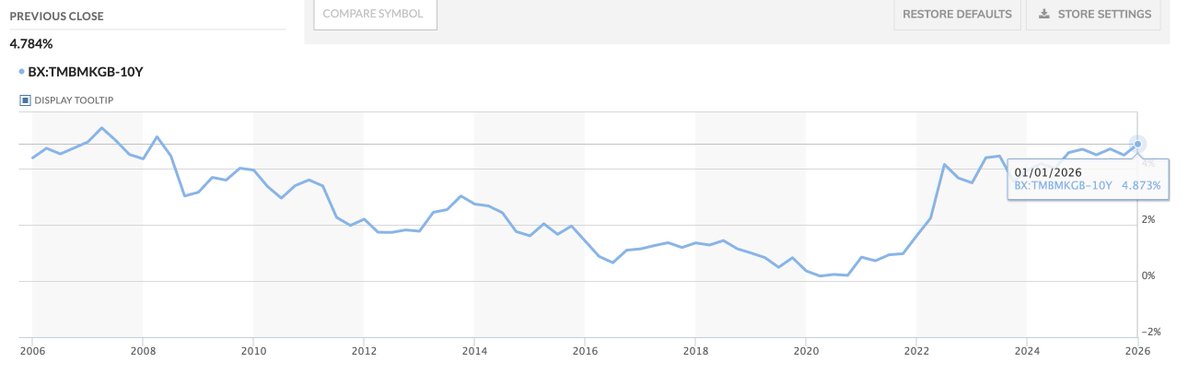
So the UK's 10-year gilt yield - the cost of government borrowing - is now up at 2008 levels. An 18-year high The difference is that, back then, UK national debt was 48pc of GDP, and now it's the best part of 100pc. So the debt service costs are much MUCH heavier. Of the £14.3bn the UK government borrowed in February alone, no less than £13bn of that was spent on interest on existing debts - a situation which is not only unsustainable, but very close to provoking a disastrous financial collapse. Yet still, our national discourse is all about more spending, more borrowing, more "state intervention". When is the Labour party – and much of the listless, unthinking rump of the UK's political and media class – going to start acknowledging reality? WHEN ....?
Liam Halligan tweet media
English
296
1.7K
5K
397.9K