

will
119 posts

Some work for you to do today itself:
I was going through my .claude folder yesterday and realized something that scared me..
claude code reads your .env file the moment you open a project.
every API key in there like i use binance, dune, openai, stripe - gets loaded into the conversation.
and the conversation goes to anthropic's servers.
i had "never read .env files" in my CLAUDE.md . thought that was enough. it's not..
CLAUDE.md is just a suggestion to claude.
it follows it most of the time. but on long, complex tasks it forgets.
there was a github issue in april where claude leaked env contents even with the rule in place.
if you trade with API keys in .env, this isn't a maybe. one ambiguous prompt and your keys are sitting on someone else's server.
3 ways your secrets leak.
> claude opens the .env file directly while exploring your project. the obvious one.
> claude runs your tests. one test fails and the error log shows the full API key in plain text. claude captures everything it sees in the terminal, including that.
> claude searches your code with grep. the search finds a config file that has credentials. matched lines show up in chat. nobody asked for the keys but they're there.
most people only block the first one. the other two are where you actually get hurt.
the fix is one file.
open ~/.claude/settings.json and add this:
{
"permissions": {
"deny": [
"Read(**/.env*)",
"Read(**/*.pem)",
"Read(**/*.key)",
"Read(**/secrets/**)",
"Read(**/credentials/**)",
"Read(**/.aws/**)",
"Read(**/.ssh/**)",
"Write(**/.env*)",
"Write(**/secrets/**)"
]
}
}
these "deny rules" tell your computer to block claude from reading those files. it's not a polite request like CLAUDE.md.
claude literally cannot open them.
for the runtime leak, make a separate file called .env.test with fake values.
point your tests at that instead of your real .env. now if a test fails and dumps secrets, only fake secrets show up.
STRIPE_SECRET_KEY=sk_test_not_real
OPENAI_API_KEY=sk-test-dummy
extra layer for safety. add a pre-commit hook that scans your code for common API key patterns before they ever reach github.
#!/bin/bash
PATTERNS=('sk-ant-' 'sk-live-' 'ghp_' 'AKIA' 'eyJ')
for pattern in "${PATTERNS[@]}"; do
if git diff --cached | grep -qE "$pattern"; then
echo "BLOCKED: secret found"
exit 1
fi
done
save it as .git/hooks/pre-commit and run chmod +x .git/hooks/pre-commit.
5 minutes to set up. stays on every project from now on.
if you skip this, your next prompt could put a live key in an anthropic chat log and rotating keys after a leak is the kind of work nobody plans on a friday.
English
will retweetledi


will retweetledi

Sam Dare just dumped 37,000 TAO on his own subnet holders.
Roughly $10 million. In two clips. After publicly accusing Bittensor of being centralized.
Then he walked.
This is the Covenant AI exit nobody is telling you the full story about.
The setup.
Sam Dare runs Covenant AI. They operated three subnets on Bittensor. Templar (SN3), Basilica (SN39), Grail (SN81).
Templar was the crown jewel. The team behind Covenant 72B. The model Jensen Huang shouted out on All-In. The reason TAO ran 90% in March.
Yesterday Sam posted a long thread accusing Bittensor founder Const of "decentralization theatre."
Hours later he sold his bags.
The allegations.
• Const suspended emissions to Covenant's subnets
• Const removed Sam's moderation rights over his own community
• Const deprecated Covenant's subnet infrastructure
• Const dumped TAO at strategic moments to apply economic pressure
• A three-person multisig that's actually controlled by one guy
Sounds damning. Until you read Const's response.
Const's actual response.
• "I do not have the ability to suspend emissions." He sold 1% of his alpha holdings on three Covenant subnets that were on near-100% burn code. Same buy/sell rights every TAO holder has.
• He didn't remove Sam as a Discord mod. He gave Sam a temporary timeout for deleting honest criticism from his own community channel. Mod role was reinstated.
• "Deprecating infrastructure." Const doesn't even know what that means.
• Less than 1% of what Const had personally invested in Sam's teams. Visibility is impossible to avoid in his position.
Const previously gave Sam a 2,000 TAO bonus and invested thousands of TAO into his subnets.
Const's "dump" was around 200 TAO.
Sam's dump was 37,000+ TAO.
The rug.
That's $10 million pulled from holders who believed in the Covenant 72B story.
Subnet holders are catastrophically down. The "noble dev exposing the evil founder" framing falls apart the second you check the wallet.
What Const is actually building next.
Const answered a DM from @TaoOutsider right after the exit. He sounded calm. Called it a "spring forward moment."
Here are some suggestions @0xSammy gave for TAO:
• Lock-based subnet ownership. Subnet ownership tied to a team's long-term economic commitment.
• Vesting schedules visible onchain so investors see unlocks in advance.
• Founders won't be able to sell emissions as they receive them.
• Exit cool-down periods so leaving teams can't dump 100% at once.
• Headless subnet architecture so no single team can pull the plug.
• Protocol-level IP retention so models trained on Bittensor compute stay with the network.
• Onchain revenue sharing flowing back to alpha holders.
These are the changes Bittensor needs right now. I hope this $10M rug will force these changes to happen sooner, rather than later.
The contrarian take.
Most people are watching this and concluding Bittensor is broken.
I'm watching this and concluding Bittensor is finally maturing.
Const built the team. Const funded it. Const did most of the research on Templar. Sam was the face. The compute, the emissions, the incentive design that made Covenant 72B possible. None of it leaves with him.
Someone else can take that model and build a bigger run on the same network.
The subnets to watch right now per Stillcore Capital's Mark Jeffrey:
• SN64 Chutes. Inference at 1/6th the cost of competitors.
• SN62 Ridges. AI coding assistance beating Claude and Cursor on SWE-bench at 1/770th the cost.
• SN4 Targon. $42M valuation.
• SN9 IOTA. Decentralized training infrastructure.
(Also SN50, 68, 65, 44, 18, 85, 17, 48, 93, 54)
The TAO bull thesis didn't need Sam Dare. It needed proof that builders can build on permissionless infrastructure.
Covenant 72B was that proof.
It still exists. The network that made it possible still exists.
Sam left. The thesis didn't.
English

TAO生态高潜力alpha:SN65 TPN
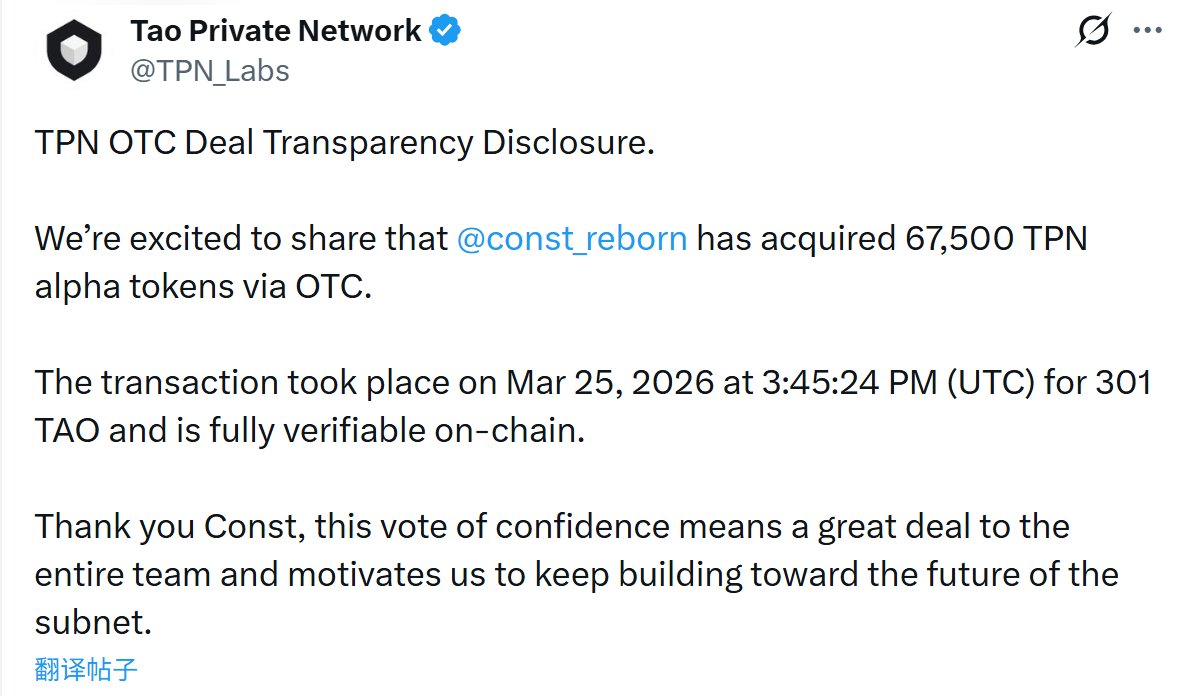
Const在场外用301个TAO,买了67500个SN65 alpha代币。此前, Const 也不止一次公开谈论SN65。
作为生态的核心人物,Const反复提一个子网肯定是值得我们去关注的。于是就去调研了一番。
SN65 TPN 简单来说就是去中心化的VPN,它的节点都是真实的家庭宽带用户,而非中心化机房或数据中心。
由于这些IP地址都是基于真实的家庭用户共享,通过TPN节点转发,与普通的的本地用户流量完全无法区分,因此具有极强的抗审查性和反地理屏蔽能力。
所以,SN65 不仅为普通用户提供去中心化的隐私保护与访问自由,还可以为各种AI Agent、数据抓取器和量化交易机器人提供不可或缺的网络层伪装👇👇
中文
will retweetledi

TODAY 🚨: The Commission issued an interpretation that clarifies the application of federal securities laws to crypto assets.
This is a major step to provide greater clarity regarding the Commission’s treatment of crypto assets.
Read the release here: ow.ly/XhhV50YvxvO

English
will retweetledi
The United States Department of the Treasury admits crypto mixers have legitimate privacy uses on public blockchains.
In a March 2026 congressional report titled "Innovative Technologies to Counter Illicit Finance Involving Digital Assets" (submitted under the GENIUS Act framework), the Treasury explicitly acknowledges legitimate privacy uses for crypto mixers on public blockchains.
Key excerpts from the report include:“Lawful users of digital assets may leverage mixers to enable financial privacy when transacting through public blockchains.
For instance, individuals may use mixers to protect sensitive information on personal wealth, business payments or charitable donations from appearing on a public blockchain.”
“As consumers increase their use of digital assets for payments, individuals may want to use mixers to maintain more privacy in their consumer spending habits.”
This represents a nuanced shift in tone from earlier Treasury actions (e.g., 2022 sanctions on Tornado Cash and other mixers like Blender, where the focus was heavily on their illicit exploitation by actors like North Korea's Lazarus Group, ransomware operators, and money launderers).
While the department continues to highlight risks mixers remain high-risk for obfuscating illicit flows and have been targeted in sanctions and proposed regulations the report recognizes that mixers aren't inherently criminal and can serve valid privacy needs in transparent blockchain environments.

English
will retweetledi

A historic moment for crypto.
Kraken Financial has been granted a Federal Reserve master account, making us the first digital asset bank with direct access to the U.S. payments system.
A major step toward connecting crypto infrastructure with the core rails of global finance.
blog.kraken.com/news/federal-r…
English

我昨天买了一台 mac mini ,
装上了 Clawdbot/Moltbot 。
然后把 闲鱼账号 交给了 Clawdbot,
睡觉前告诉他,去闲鱼倒卖文档,把mac mini 的钱赚回来。
今天一大早有人敲门,
来了一位学生模样的人,
说我在闲鱼把 mac mini 原价卖给了他。
中文

will retweetledi


will retweetledi

I deeply believe in saving for retirement and old age.
I just don’t think money is the most important thing to save.
I’m saving memories.
That may sound sentimental, but it’s actually a very practical way to think about aging. When people talk about retirement planning, they usually focus on one question: How much money will I need? That’s an important question, but it’s incomplete. It ignores what retirement actually looks like from the inside.
As you get older, your world narrows. Your body slows down. Your appetite for novelty changes. You do fewer things, but you revisit the same thoughts more often. You replay moments. You tell stories. You remember.
Money helps keep you comfortable, but memories are what you actually live on.
When people imagine old age, they picture freedom – travel, hobbies, leisure. What they often miss is that much of that freedom depends on things you can no longer manufacture later. Energy. Physical resilience. Social momentum. Shared history. These aren’t things you can buy at 70, no matter how well-funded your retirement account is.
That’s why I think of memories as a form of savings. Not instead of money, but alongside it – and, in some ways, above it.
A memory made today has decades to appreciate. It gets retold. Revisited. Reframed. It becomes part of your identity. It quietly compounds over time in a way money never quite does. A great experience at 40 doesn’t just exist at 40 – it exists at 50, 60, and 80, too.
A dollar, by contrast, only matters at the moment you spend it.
This way of thinking also changes how I think about retirement itself. We tend to treat retirement as the payoff phase – the moment when life finally begins. But in reality, retirement is more like a withdrawal phase. You’re drawing down from what you built earlier, financially and emotionally.
Money funds the logistics. Memories fill the days.
That’s not a knock on saving. Financial security matters. It reduces stress, preserves dignity, and gives you choices. But past a certain point, additional money doesn’t create additional meaning. It just extends optionality around comfort. The richness of retirement comes from what you already lived, not what you can still afford.
This is especially true when it comes to relationships. Shared experiences create a kind of emotional capital that doesn’t expire. Trips taken together. Traditions built. Stories that only make sense to the people who were there. Those things don’t show up on a balance sheet, but they’re what you return to when the days get quieter.
I also think this reframing removes a lot of unnecessary guilt around enjoying life earlier. Spending money on experiences isn’t a failure of discipline if it’s done intentionally. It’s a recognition that some forms of wealth are time-locked. If you don’t invest in them when they’re available, they’re gone.
In that sense, memories aren’t indulgences. They’re long-term assets.
When I think about old age, I don’t imagine myself checking account balances with satisfaction. I imagine remembering. Laughing at stories I’ve told too many times. Feeling grateful that I didn’t postpone everything meaningful until a stage of life when my ability to enjoy it was diminished.
That’s the retirement I’m planning for.
So yes, I save money. I invest. I think about the future. But I also deliberately invest in moments that I know I’ll want to remember later – because those are the assets I’ll actually be drawing from.
When everything else slows down, memories don’t.
That’s how I measure my net worth now.
The Wolf Of All Streets@scottmelker
I want to die completely broke. When I tell people this, I usually get one of two reactions. Either they assume I’m joking, or they assume I’ve lost my mind. Sometimes both. So let me clarify before anyone forwards this to a financial planner in panic. I don’t mean reckless. I don’t mean irresponsible. And I definitely don’t mean unprepared. What I mean is that I don’t want to die having optimized my entire life around a number that only matters when my ability to actually use it is gone. We talk constantly about the time value of money. A dollar today is worth more than a dollar tomorrow because it can be invested, compounded, and put to work. Time increases its potential. Life, however, works in the opposite direction. Time doesn’t increase the value of experiences – it usually decreases it. Certain experiences are simply more accessible, more enjoyable, and more meaningful at specific stages of life, and no amount of money later can fully replicate them. When you’re younger, you’re sitting on an asset that quietly depreciates every year: health, energy, physical capability, curiosity, and a tolerance for discomfort. A dollar at 35 buys a fundamentally different life than a dollar at 75. Pretending otherwise is comforting, but it’s not honest. Life has a time value too, and it doesn’t compound. When people hear “die broke,” they often picture irresponsibility or excess. That’s not what I’m describing. I’m talking about intentional depletion – using money as a tool to maximize life while you’re able to live it, rather than stockpiling it indefinitely for a future version of yourself that may not exist in the way you imagine. Saving matters. Security matters. Optionality matters. But past a certain point, additional saving delivers diminishing returns while the cost of waiting keeps rising. Saving for retirement makes sense. Over-saving at the expense of living doesn’t. We’re taught to treat retirement as the main event – sacrifice now so you can enjoy later. Delay life so you can eventually live it. But that framework assumes a lot: that your health cooperates, that your energy remains, that your relationships are intact, and that your interests don’t change. Most of all, it assumes experiences are interchangeable across time. They aren’t. The trip you take at 35 is not the same trip at 70, even if it’s first class. Skiing with your kids, traveling with friends, pushing your body, starting something new – these things are perishable. They don’t age gracefully, and postponing them doesn’t preserve value. It destroys it. There’s also a strange moral judgment baked into personal finance culture that equates delayed gratification with virtue and present enjoyment with failure. I don’t buy that. There’s a meaningful difference between consumption that disappears and spending that compounds in memory, perspective, relationships, and confidence. Experiences don’t show up on a balance sheet, but they pay dividends in ways that money never can. Your memories are what matter in the end, not your net worth. This way of thinking has also changed how I view legacy and what I want to give my kids. I don’t care about leaving behind generational wealth the way I once did, especially not as a lump sum that shows up only after I’m gone. If I’m going to give them anything meaningful, I’d rather do it while I’m alive – when it can actually shape who they become. I want to use my resources earlier to give them experiences, exposure, and tools that help them build confidence, curiosity, and resilience. Travel that broadens perspective. Opportunities that stretch them. Lessons about money, risk, work, and independence learned through experience, not inheritance. I want them to understand how to create value, how to adapt, and how to rebuild if things fall apart. I still want to leave them with enough. But “enough” isn’t a massive number waiting at the end of my life. Enough is a foundation, plus the skills to stand on their own. Unlimited money can become a crutch. Capability is freedom. I’d rather they inherit confidence than comfort – and I’d rather be around to help them learn it than hope they figure it out after I’m gone. Everyone talks about the risk of running out of money. Almost no one talks about the risk of running out of time. And even less people talk about the tragedy of wasting valuable hours of your youth working for money that will never get spent. What a waste of your valuable time. We’re very good at smoothing consumption – using money, planning, and credit to keep life stable while quietly deferring the things that actually make it meaningful. From the outside, everything looks fine. Under the hood, life is being postponed. The biggest gamble isn’t that you won’t have enough someday. It’s that someday arrives and you’re no longer capable of the life you spent decades planning for. I want to die broke not because I don’t value money, but because I value life more. I want to use my resources to create memories while they’re available, not just affordable. To save enough to be secure, but not so much that I defer living indefinitely. To leave my kids with a foundation, not a cage. I don’t pretend this is the right answer for everyone. I don’t even pretend it’s my final answer. But if the time value of money matters, then the time value of life matters more.
English

David Friedberg: California’s “Billionaire Tax” is a Trojan Horse to Go After the Middle Class's Private Assets
@friedberg:
“The reason they're calling it a billionaire tax is to make it easier for people to vote for it, and sign up to this entirely new tax system that they're proposing to put on all Americans at some point, and for the first time ever degrading our private property rights.”
“Forget about how much wealth you have, forget about how rich you are, forget about the term billionaire, millionaire, whatever it is.”
“We're creating, or proposing the creation, of a new tax system that allows the government for the first time ever to come in and audit everything you own.”
“All the jewelry your grandma gave you, the value of all the couches in your house, the value of your car, the value of all your stocks and bonds, and the government can come in, and for the first time, look through the veil into your personal property.”
“And say, ‘Here's how much all this stuff is worth. I'm charging you a percentage of that. That's what I need to get paid.’ And it doesn't matter that it starts with billionaires. What matters is that we're giving the government the right to look into our private property and take a percentage of it every year.”
“The total net worth of billionaires in the US is $8 trillion.”
“The net worth of the US, the middle class, and everyone else is $170 trillion, compared to $8 trillion of the billionaires.”
@chamath:
“They need a way to open the door so that they can go after the real honey pot.”
“The real honeypot is not 200 people.”
@friedberg:
“Just so everyone understands the real goal of this is not to tax billionaires, because there are other ways to tax billionaires.”
“Charge them a capital gains tax if they borrow against their assets that they haven't paid capital gains tax on. Very simple, that can resolve this.”
“Another thing you can do, you can raise the capital gains tax rate. Sounds unpopular. I don't agree with that, but that's another way to deal with this, which is to take the capital gains tax rate from 20% to 30%. You could do that.”
“The real goal of this is to create, for the first time in American history, a private property asset seizure tax. Because they're going after the $170 trillion, not the $8 trillion that the billionaires have.”
English
will retweetledi

ZEC 在一片下跌的大盘中连续两个月暴涨超 700%,
如果只看价格,你会以为 ZEC @Zcash 是本轮市场里唯一的“基本面胜利者”;
但如果把链上数据、资金流向和合约结构放在一起,你会看到一个更完整、更复杂的故事。
首先,隐私需求的确在爆发。Zcash 的核心指标“屏蔽池”规模在半年内大幅增长,从 266 万枚上涨到 498 万枚,占全网供应的比例从 18% 提升到近 30%。其中 86% 的资金流入最新的 Orchard 池,隐私交易笔数也从周均 3–4 万暴增至 46 万笔,说明真正使用隐私功能的资金与用户确实在增加。
但从 9 月底开始,故事的主导权逐渐从“需求”转向“情绪”。
ZEC 合约持仓从 1875 万美元飙升至 13.8 亿美元,资金费率一度跌到 -0.4192%,空头为做空付出巨大成本——但价格却继续爆冲,最高涨到 750 美元。光 Hyperliquid 上空单爆仓的金额就超过 3300 万美元。多空挤压下的连环爆仓,推动 ZEC 完成了最陡峭的加速段。
链上数据也证明了情绪的反客为主。隐私交易占比在价格暴涨阶段反而下降,透明池交易迅速上升,说明大量“非隐私需求”的用户正在冲进场内,链上活跃度更多来自 FOMO,而不是隐私使用本身。
ZEC 的行情因此呈现明显的“双段式结构”:
第一段是需求驱动的慢启动。屏蔽池资金从 8 月初开始增加,价格却仍在底部徘徊。
第二段是情绪驱动的爆发。当涨幅突破关键阈值,合约和现货 FOMO 资金共同加速把价格推向极端。
但真正值得问的是——这轮涨势是长期趋势的序章,还是一次结构性行情?
从基本面看,隐私需求确实在上升,尤其在 MiCA 落地、全球 KYC/监控趋严的大背景下。相比 Monero,ZEC 的“可选隐私”与“查看密钥”设计使其更有可能获得合规机构采用,这也是 ZEC 能在今年重新被讨论的关键理由之一。
然而,把链上指标与价格拆开来看,ZEC 当前的估值显然远超其实际使用规模。屏蔽池规模换算成美元约 28 亿,与主流公链 TVL 相比并不突出,隐私交易量也仍在相对早期阶段。短期价格更多由情绪驱动,而非基本面支撑。
ZEC 暴涨的真相很清晰:需求是火种,情绪是火焰。问题是,当风停下来,火能否继续烧下去?

中文
will retweetledi

47天亏光5800万美金
麻吉大哥的前世与今生!
今天,强哥给兄弟们来回顾一下嘻哈教父——麻吉大哥(黄立成),从顶流明星到币圈归零仔的传奇币圈经历!
🧨 巅峰时刻:账户近6000万美金
时间回到 9月18日,
那时他的账户浮盈 4400万美金,总资产接近 6000万刀,
是链上最靓的合约大佬之一。
但从巅峰到归零——
只用了不到 两个月。
如今账户余额只剩 1718美刀。
🎤 从潮流教父到风口猎手
麻吉大哥,本名黄立成。
92年,他带着弟弟与表弟组成“麻吉”乐队,
发行十几张专辑,红遍台湾。
97年解散组合后,他创办 麻吉娱乐。
2015年又踩中直播风口,创立 17直播,
估值飙到几十亿新台币,连王思聪都投过。
那时的他,既懂流量,又懂注意力经济——
风口之上,他几乎次次吃到肉。
直到他踏进了币圈。
💰 第一次收割:区块链项目 MITH
2018年,他推出区块链项目 MITH(秘银),
号称“区块链版 Instagram”。
靠着名气私募5000万美元,
上线后币价暴涨,团队三个月内抛售89%代币。
币价暴跌超80%,最终归零下架。
麻吉大哥赚得盆满钵满,
而散户血流成河——
也正因此,他的“镰刀名声”传遍全网。
🧱 第二次起飞:Cream Finance
2020年,他又推出借贷协议 Cream Finance。
巅峰时管理资产超10亿美元。
但漏洞频出,21年被黑客攻击5次,
一次损失 1.3亿美金。
最终他甩锅离场,成功套现。
🐒 NFT时代的麻吉大割
2021年NFT爆火,
他转型NFT OG,囤下 55个无聊猿、102个变异猿,
还送NFT给周杰伦蹭热度。
但2023年NFT市场转冷,
他疯狂抄底、接盘,全买在高位。
最后抛出上千枚NFT,
直接砸崩无聊猿地板价25%,
亏掉 5000多枚ETH。
于是,他有了新外号——“麻吉大割”。
🐶 Meme币风口:BOBAOPPA
2024年,Solana链上meme币爆火,
他又推出狗币 BOBAOPPA,
24小时募资超4000万美金。
结果上线当天暴跌70%,
再一次“割”得干净彻底。
⚰️ 最后一搏:Hyperliquid 爆仓
2025年,他盯上合约平台 Hyperliquid。
开25倍杠杆,从盈利到崩溃:
•6月盈利 650万
•7月仓位 1.26亿美金
•9月巅峰浮盈 4400万
•10月11日暴跌清算
•11月4日账户仅剩 1.6万美金
他仍不死心,又开25倍多单,
结果再次爆仓——
账户余额只剩 1718美金。
🌀 币圈真相:归零只是时间问题
Hyperliquid 今年以来清算金额超 100亿美金,
上千个钱包被清空,
麻吉大哥只是其中一个。
但一个麻吉大哥倒下了,
永远会有下一个麻吉大哥站起来。
因为暴富太诱人。
如今的币圈,
不需要白皮书,也不需要产品,
只要一个合约地址、几句口号,
资金就会蜂拥而入。
这里没有真正的投资,
只有蓄势与收割。
所有的不劳而获,
终将以另一种方式归还。
风口来了又去,
有人站在顶点,也有人被卷成灰烬。
币圈永远不缺新的“麻吉大哥”。
最后期待给强哥 点赞👍➕关注
每天都有精彩内容以及行情分析

中文

dash pumping 47.9% to $71 after zcash already ran 365% is your sector exhaustion signal. beta coins only get their turn when the leader runs out of buyers. zen up 34.5% today confirms it. when the garbage outperforms quality, distribution is complete. privacy coin top is in.
English

Finally 😀
Bitwise@Bitwise
Introducing $BSOL — the Bitwise Solana Staking ETF. Starts trading tomorrow. - First U.S. ETP to have 100% direct exposure to spot SOL - Maximizing Solana’s 7%+ average staking reward rate* - Targeting 100% of assets staked - Staking through Bitwise Onchain Solutions, powered by @heliuslabs - 0% fees, with waiver for a limited time** We believe Solana is a key platform for enabling capital markets to come onchain and is perfectly positioned for this moment. Now, investors can get exposure to its growth potential and 7% average staking rewards with BSOL. Solana is headed into the mainstream—and we think it’s just getting started.
English

SPX6900 is the first financial movement owned by the internet generations.
Millennials were hit hard by the 2008 crisis: debt, stagnant wages, unaffordable housing, and assets captured by the 1%.
They know how TradFi failed them and bring credibility and resources into SPX6900.
Gen Z grew up fully online.
Digital natives raised on memes, culture, and constant change. They bring energy, creativity, and viral reach.
Together, they form a feedback loop: Millennials give depth and resilience while Gen Z fuels growth and scale.
That’s why SPX6900 is more than a coin.
It’s the first intergenerational on-chain movement reshaping finance, culture, and meaning.
#SPX6900

English