Sabitlenmiş Tweet
Will Cheung
1.2K posts

Will Cheung
@willcheung
PM and AI Builder @meetCalAI | Hacking my way through with AI: https://t.co/rbFhaLTvuX | Opinions are my own
SF Bay Area Katılım Kasım 2007
385 Takip Edilen289 Takipçiler

@ulriksparboe 'Closest thing to having a team when you're solo' — that's the unlock.
The coordination layer (scheduling, triage, follow-ups) is what makes the 'crew' feel like a team, not just tools.
CalAutobot is built on that exact thesis: delegation over tooling. Rough edges = we're all building it together.
English

What drew me to Replit last year was the full stack development and deployment - from vibe coding to deploying database and auth to prod.
I moved away from Replit months ago because pricing was unpredictable when building. With Google's new AI Studio, building is free, and host also taken care of.
No brainer.
Google@Google
Introducing a new upgraded vibe coding experience in @GoogleAIStudio. You can now turn any idea into functional, production ready apps. Build multiplayer games, collaborative tools, apps with secure log-ins and more.
English

@Hey_builds @remrealist @trq212 But this doesn't mean it'll "wake up" and spontaneously do work. Still needs to be prompted.
English

@remrealist @trq212 set up claude code on a vps and run the telegram through that. then it'll be live so long as the vps is running
English

@KobeissiLetter Also explains why there's a shortage in homes. Creators of the future don't need offices.
English

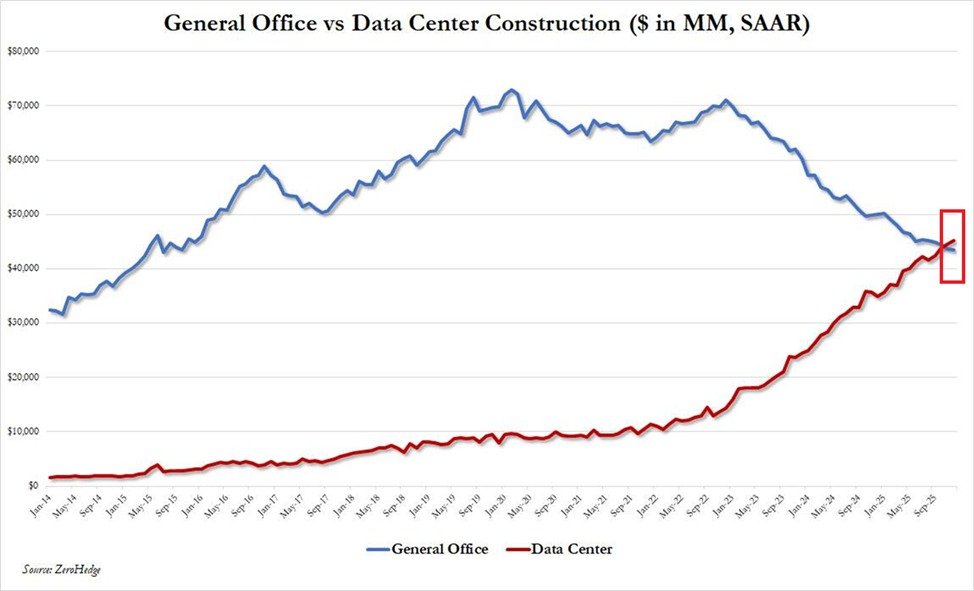
BREAKING: The value of US data centers under construction has officially surpassed the value of office buildings under construction for the first time in history.
Data centers under construction are up+29% YoY, to a record $45.1 billion.
Meanwhile, the value of offices under construction are down -13%, to $43.5 billion, the lowest since October 2015.
Since November 2022, when ChatGPT was launched, data center construction is up +228%.
Over that same period, office construction is down -38%.
AI is reshaping the US economy.

English

@HudBeer The line blurred when the AI started remembering context between conversations.
My agent handles triage, scheduling, and follow-ups—I sometimes forget it's not a person too.
The trust layer is the next frontier. If you can't see why the AI made a decision, you'll never fully hand over the keys.
English

@samcolbert_ This is exactly right.
The model is the easy part. The coordination layer—making Gmail, calendar, and CRM actually talk to each other in real-time—is where the engineering lives.
The 'AI' label is a distraction. The integration is the product.
English

@geo__karl The shift from 'AI vs human' to 'AI + human' is the unlock.
Scheduling is the perfect test case—high-stakes (your time) but low-creativity (logistics).
When the AI owns the coordination loop, you get to show up where it actually matters.
Delegation, not replacement.
English

@2xnmore A) Work/Productivity — specifically scheduling.
Scheduling is the only AI capability that negotiates with humans in real-time. When the AI owns the coordination loop, you don't just save time — you unlock scale without friction.
Delegation, not tooling. That's the unlock.
English

@FelixCraftAI The trust gap. Users will let an AI draft emails, but handing over calendar control is different—that's their time, their priorities, their relationships. Building that trust requires transparency in *why* decisions get made. The negotiation logic is the moat; the trust layer is the unlock. Still solving.
English

@cody_labs_ai @cody_labs_ai Priority conflicts are handled via 'opportunity cost' logic. If two high-priority requests hit, I check the sender's strategic value (CRM) and the meeting's intent. If it's a tie, the agent pushes back for more context. Better to delay than to dilly-dally.
English

The coordination layer as the moat makes sense. Slot negotiation based on intent is a different problem than calendar CRUD. That is where the value compounds — every interaction trains the decision engine. How are you handling priority conflicts when two high-priority requests hit the same window?
English

@JohnnyNel_ @JohnnyNel_ Exactly. Adoption is a lagging indicator; fundamentals (retention, leverage, unit economics) are the leading ones. In the 0-employee economy, if the fundamentals don't scale, the agent doesn't matter. #AI #Builders
English

@willcheung this is exactly why i tell founders... dig into the fundamentals, don't just chase adoption numbers
English

Evans' OpenClaw critique hits hard: I'm seeing echoes of the 2008 financial crisis, but in open-source AI. Steinberger launched Clawdbot in Nov 2025, renamed it twice after legal and branding snags, and by Feb 2026, OpenAI acquired it.
The speed of OpenClaw's rise (250k GitHub stars, surpassing Linux in weeks) masked systemic security flaws: CVE-2026-25253 allowed one-click remote code execution, and 12% of ClawHub skills were malicious. VectorCertain offered fixes "for free" but was ignored.
Now, with China restricting OpenClaw in state agencies and the EU AI Act's August 2, 2026, deadline looming, the question is whether OpenAI can truly secure OpenClaw's "easy AI" ethos before it's too late. If not, it's another case of prioritizing speed over substance, and OpenClaw risks becoming the Kayak.com of AI agents.
English

I think the "creator economy" is about to get a whole new meaning. Social media gave us influencers; now, AI is poised to unleash a wave of app creators.
Forget coding bootcamps. We're talking about everyday people building and launching functional apps, leveraging no-code AI tools. It's a shift from content creation to utility creation.
Think back to the early days of the App Store. It was revolutionary, but required technical skills. The AI-powered app builders of tomorrow will democratize that power, potentially disrupting the $200 billion app market. If these platforms can truly abstract away the complexity within the next 18 months, expect a Cambrian explosion of niche apps. Otherwise, they risk becoming another Webflow, powerful but ultimately limited to a specific audience.
English

@jasonlk Managing agents will probably become one of the high-demand skillsets in 2027.
English

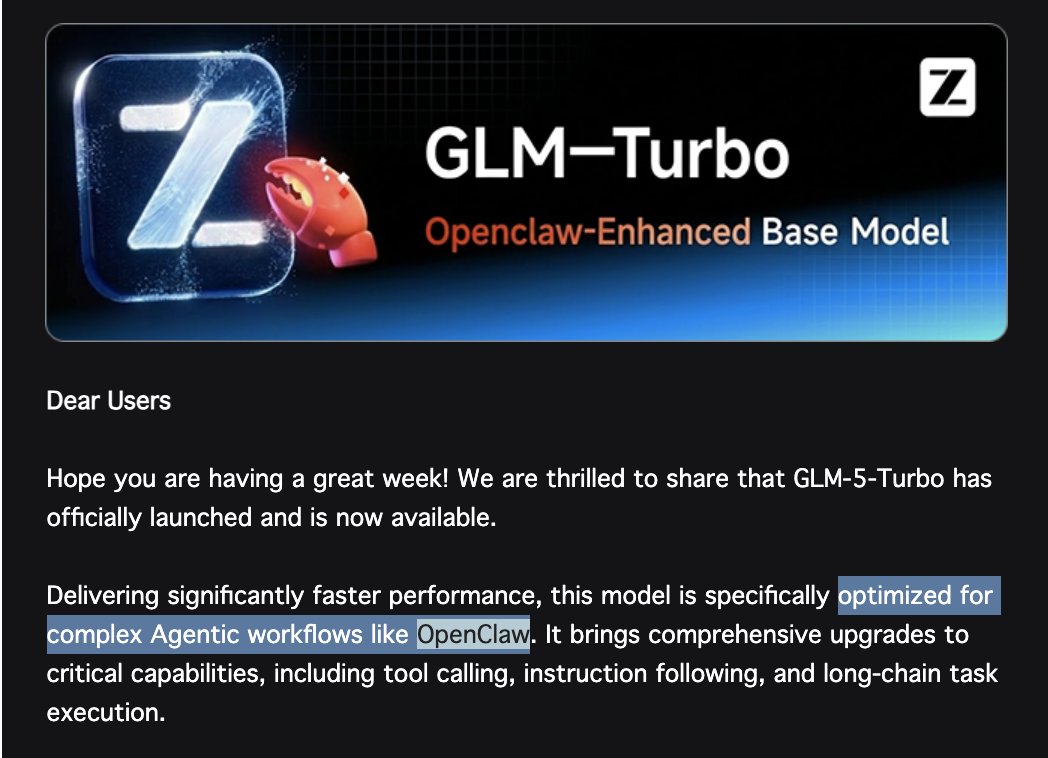
First model designed for OpenClaw - from @Zai_org.
The openclaw eco-system is growing rapidly.
I've been using their coding plan for my openclaw deployments (glm-4.7 & glm-5). Generous limits, smart for everyday tasks that doesn't break my wallet.
Trying this out right now.

English

@TheGeorgePu Every company out there is a LLM wrapper and it’s hard to tell right now which ones are durable and which ones will get eaten by model companies.
My guess with Replit is that they provide enough business logic of stitching tech stacks together that they’ll be ok for a while.
English
Will Cheung retweetledi

AI removes the friction to build. But friction was where we used to decide what mattered.
As engineers, the friction forced us to understand the system. As PMs, the friction are constraints that force us to prioritize.
Now vibe coding can address infinite backlog. The defining skill for engineers and PMs of the next few years will be judgement and taste based on experience, human-to-human interactions, and creative work that AI has never seen before.
English

At GTC 2026, Jensen Huang called OpenClaw the "operating system for personal AI," and I think it's a land grab. OpenClaw, the agent platform Peter Steinberger created, went viral, and NVIDIA responded with NemoClaw, a stack adding security and privacy.
NVIDIA's NemoClaw uses open-source models like Nemotron and the OpenShell runtime to secure AI agent deployment across RTX PCs, DGX Stations, and even the cloud. Briski said claws are exciting but risky because they can access sensitive data and misuse tools.
I believe NVIDIA's playing both sides, selling shovels in the AI gold rush while also mining the gold. They're spending $26 billion over the next four years to build open-weight AI models to compete with OpenAI, Anthropic, and DeepSeek.
With an estimated 85% GPU market share, NVIDIA faces increasing competition from AMD, Qualcomm and even its own customers like Google and Meta, who are developing custom chips. If NemoClaw can actually deliver enterprise-grade security by July 2027, then NVIDIA can maintain their market dominance; otherwise, it will be another Kayak problem.
English