Windsock 2000
177 posts

We've kicked long to Guelfi with 2 opponents on him 4 times
English


If you had to keep one, who you got?
Matt Guelfi
Jye Menzie
Jade Gresham
Alwyn Davey Jnr
#godons 🔴⚫️
English

I’ve either played, coached or watched footy for over 60 years and when a free kick is paid in a ruck contest I reckon 80% of the time I don’t know who’s free kick it is.
English
@RalphyHeraldSun @FOXFOOTY Train less fitness and more skills. Less injuries and more wins. Done fixed it.
English

Essendon is conducting an extensive injury review to ensure that there is nothing in its program contributing to the soft-tissue concerns. The ACLs are freak luck but there have been too many soft-tissue recurrences in recent years. Everything up for grabs @FOXFOOTY
English

“If a collision results in a concussion to a player, but that collision was not caused or contributed to by a failure by the reported player to take reasonable care, there is no reportable offence.”
Key line. Outcome only considered IF it’s a reportable offence. @FOXFOOTY
David Zita@DavidZita1
This charge of rough conduct arises in the context of a marking contest. Alex Pearce has been charged with rough conduct as a result of a collateral with Darcy Byrne-Jones at Port Adelaide. The circumstances were as follows. Byrne-Jones was loose on the forward flank and leading towards the boundary. It was raining at the time, and the kick was misdirected. Byrne-Jones had to change course and head back inwards and towards the goal with the flight of the ball. Pearce, whose evidence was given thoughtfully and with an obvious endeavour to answer truthfully, said that he was aware that Byrne-Jones was loose, and that when he saw the kick, he thought he was a reasonable chance to mark the ball. He headed off at full pace. Byrne-Jones ran back with the flight of the ball. The kick was fairly high, and the players arrived at the ball in roughly opposite directions at almost precisely the same time. That last point is critical. Pearce’s attempt to mark was entirely realistic. He had his arms out to attempt to take a chest mark, and if not for Byrne-Jones entering the contest from the opposite direction, would likely have taken the mark. Pearce said that he didn't deviate from his line to the ball and the vision supports that evidence. Pearce said that his eyes never left the ball until the last split second when he glanced down to Byrne-Jones and it was too late to pull out of the contest. The vision supports that evidence. Pearce said that he dropped his arms further at the last moment so as to attempt to minimise the harm to Byrne-Jones. The vision supports that evidence. It follows that we do not find that this was rough conduct. It’s important to highlight two matters. First, the AFL quite properly conceded that if, contrary to their submissions, Pearce had a realistic chance of marking the ball until the last moment, this was not rough conduct. This concession was made in circumstances where it was not suggested that Pearce’s method of attempting the mark was itself inherently dangerous, and where it was not suggested that Pearce’s eyes had left the ball until the last split second. Secondly, it it is not and never has been the position of the tribunal, or as far as we can ascertain, the MRO that an outcome of concussion inevitably results in a finding of at least careless conduct. Every incident must be and is examined and determined on its own facts. If a collision results in a concussion to a player, but that collision was not caused or contributed to by a failure by the reported player to take reasonable care, there is no reportable offense Here, from numerous angles, it appeared that this incident might have involved a bump that constituted rough conduct. However, when all of the vision was closely examined and the evidence of Pearce was taken into account, it was clear that: A) he intended to mark the ball. B) He was a realistic chance to mark the ball C) His eyes never left the ball until it was too late D) He did what he could at the last minute to minimise impact to the oncoming player E) This was not in fact a bump The AFL properly and expressly stated that it did not rely on the rough conduct high bump provision, but only the rough conduct general provision. Evidence showed that what Pearce did was not to bump Byrne-Jones, rather, to move in a way to attempt not to bump him. The charge is dismissed.
English
@BomberBanter_au @essendonfc Graphics 🔥. Looking forward to your debut!
English

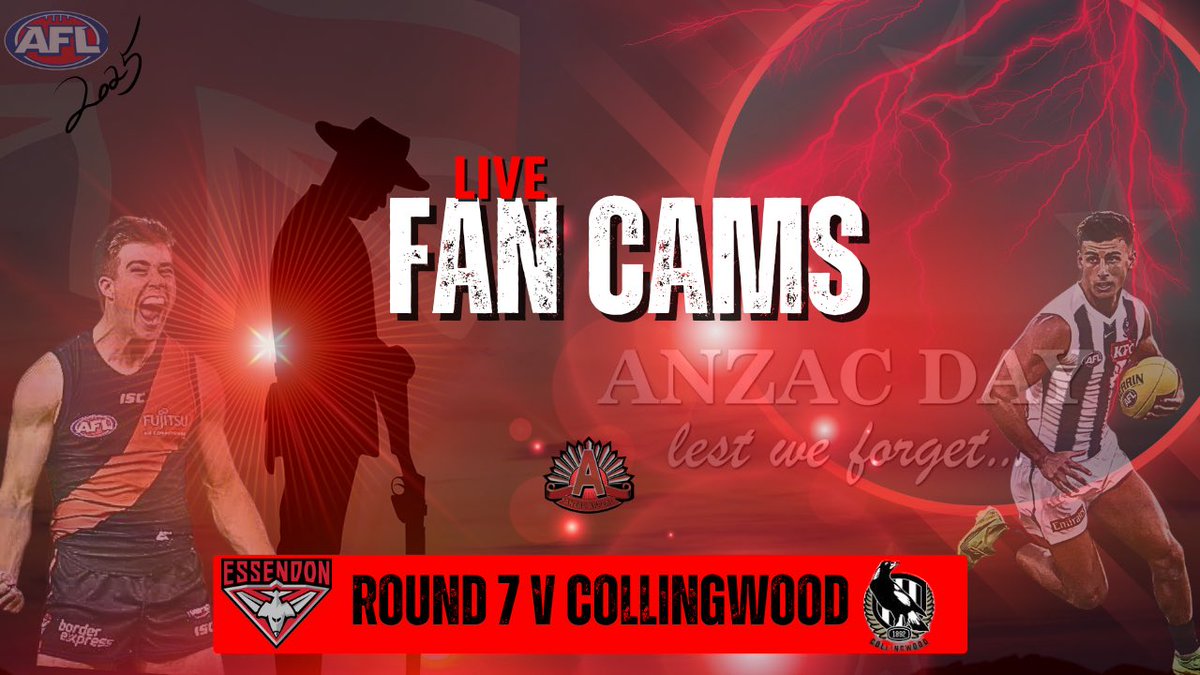
We go LIVE post game TONIGHT with the first @essendonfc Fam Cams - no doubt we’ll have a lot to dissect from the game & there may even be some appearances from some of your favourite podcasters & Papa’s 😉
See you at 7.30pm 🙌🏻 can’t wait!
#godons
youtube.com/live/5JjZJy1aC…

YouTube
English
@FionaRoseT @AFL Between that and 50m penalties it’s clear that judging distance is not possible by on field umpires. A problem easily solved with technology.
English
@FionaRoseT Great call has been strong all game. One of the few.
English
It's pretty simple, Noah Balta (who pleaded guilty) should not play until sentenced. The end
English

A powerful design honouring those who have made the ultimate sacrifice. ❤
Read more 📝 | mfcde.es/4lNYhw3

English
@EFCcorrespond It’s a bizarre stance. Should have been suspended pending outcome. Based on the guilty plea I would now expect at least a ban of several years from AFL or lifetime. Clearly brought the game into disrepute. No excuse.
English
So Noah Bolta has pleaded guilty to assault and will be sentenced in 3 weeks. He may or may not do time... The AFL are happy for him to play pending his sentence.
Are we happy with this stance?
English
@Celebchaser @EFCcorrespond @WHWindsock @BLEC1 @FionaRoseT @crazythainame Project Top 4 (draft pick) on track
English

Looks like @windsock2k and @EFCcorrespond were right on the Pod….11 on the ladder looks ambitious! #projecttop4intatters @WHWindsock @BLEC1 @FionaRoseT @crazythainame
English
@DavidZita1 @FOXFOOTY Ridiculous. Cleary goes to ground endangering himself and others. Free kick Archer. Case closed. Cleary should have kept his feet and approached the ball side on expecting and absorbing the tackle.
English
Reasons:
We find that this was rough conduct against Cleary, which, in the circumstances, was unreasonable.
We carefully considered the evidence.
We consider that the relevant circumstances are:
A) This was not a contested ball situation… Cleary was always closer to the loose ball and was always going to reach the loose ball before Archer. Archer gave evidence that he intended to tackle Cleary if Cleary took possession of the ball.
B) It was reasonably foreseeable that Cleary may, at least to some extent, go to ground and not cleanly gather the ball and then straighten up in a manner that would have permitted Archer to tackle him without the unreasonable risk of injury.
We acknowledge that the rules encourage players to keep their feet to the extent possible in contest situations, and we acknowledge that players are coached to try to keep their feet, but this does not always happen.
Players should be taken to be aware that it does not always happen.
Players frequently go to ground, either because they intend to, because they stumble, or because they're pushed.
We’re unable to determine here whether Cleary made an entirely voluntary election to put his knee on the ground, or whether he did so at least in part because of his momentum, movement of the ball and the pressure of the moment.
In our view the important matter is that it was reasonably foreseeable that he would do so. Cleary did not dive and did not collapse to the ground. He went to one knee and then both knees when bending over at speed in a contest situation.
Ultimately, his body moved in a way that went beyond or lower than him being on both knees, but this was a product of his speed, his momentum, the way he approached the ball.
Again, we say this was reasonably foreseeable.
While there was contact below Archer’s knees, this was not a situation where the ball was in contest and where Archer could reasonably have expected that Cleary would necessarily gather the ball cleanly and straighten up so that no such low contact would be made.
The severity of the injury that could potentially occur is also a relevant circumstance. A high speed collision from front-on of a player whose head is over the ball has the potential not only to cause injury but to cause severe injury.
This informs the nature and extent of the duty of care of a player in Archer’s position.
In those circumstances, Archer approached the contest at excessive speed, giving himself no reasonable opportunity to avoid harmful contact with Cleary in the circumstances that foreseeably arose.
Graphs indicate that he did decrease his speed by about 25% prior to impact. But given that he was running about as fast as he could, given that he was approaching Cleary from front on, and that Cleary had his head over the ball, and given that he could not reasonably predict what position clear he would be in at the moment of impact, he slowed too little and too late.
His duty of care required him to slow more appreciably and earlier in order to give himself the opportunity to avoid or minimise head high contact.
We find that Archer's conduct was unreasonable in the circumstances.
English
Jackson Archer is fronting the AFL Tribunal. Follow via @FOXFOOTY or this thread.
English