Stefan F. Wirth

7.4K posts

Stefan F. Wirth banner
Stefan F. Wirth

Stefan F. Wirth

@wirthstef

Dr. Stefan F. Wirth,evolutionary biologist,zoologist,acarologist,filmer, photographer,artist https://t.co/WCIVWhAA5m https://t.co/ij7rdh6QBV

Berlin, Deutschland Katılım Mart 2016
3.6K Takip Edilen3.7K Takipçiler
Sabitlenmiş Tweet
Stefan F. Wirth
Stefan F. Wirth@wirthstef·
I am a #biologist, #acarologist (my research area), entomologist and #evolutionary biologist. Also nature #photographer and nature and #macro #filmmaker. I am interested in all aspects of biology, and I also have a great weakness for astronomy and perform pictorial arts. Here you can see a mite of the genus #Balaustium (Erythraeidae), but my research is on mites of the #Histiostomatidae (Astigmata). Both Acariformes. I only have this one Twitter profile. © Stefan F. Wirth 2023
Stefan F. Wirth tweet media
English
35
513
2.3K
80.8K
Stefan F. Wirth
Stefan F. Wirth@wirthstef·
An interesting #sciencewriting text involving #sciencephilosophy and #quantumphysics by O. Lombardi (2026) explores the #worldview that can emerge from the consistent application of quantum physics. The philosophically stimulating idea is that everyday #perceptions of the #world, as well as perceptions of the world as understood and treated by other scientific disciplines, appear much more #unified from this particular #perspective. The division of the world into a single, large whole composed of individual components is then absent. Instead, from a quantum physics perspective, it is essentially conceived as a coherent, #undividedwhole. This text by Stefan F. Wirth, Berlin, May 2026 Reference: O. Lombardi (2026): iai.tv/articles/quant…
English
0
0
5
44
Institute of Art and Ideas
At the most fundamental level of reality, there are no separate things, only an undivided whole, argues Olimpia Lombardi. In this article, she explores how quantum physics doesn't just rewrite our equations, but dismantles our entire picture of the world. From uncertainty to entanglement, the classical idea of reality as made up of distinct objects with fixed identities simply breaks down. Lombardi argues that in the quantum realm, individuality itself disappears. There is no individual. Tap to read more. iai.tv/articles/quant…
Institute of Art and Ideas tweet media
English
18
23
81
4K
Stefan F. Wirth
Stefan F. Wirth@wirthstef·
About the #fossilrecord, its #biogeographical and #biological interpretations and current #research on the #brainmorphology of the #sabertoothedcat #Megatereon #cultridens. The extinct tigers of the genus Megatereon (#Machairodontinae, #Felidae) likely evolved in late #Miocene #Africa and spread from there to Europe, Asia, and North America. The American saber-toothed tiger #Smilodon apparently descended from them. Several #species of Megatereon are distinguished based on their fossil remains, of which M. cultridens was the most widespread, especially in #Europe. These animals were about the size of a modern jaguar and could reach a weight of 90 to 150 kg. The #forelimbs were more powerful than the hindlimbs, resulting in a slightly sloping #topline. The most characteristic feature was the conspicuously elongated upper #canineteeth. The authors I. Meli et al. (2026) analyzed the precise brain morphology of M. cultridens and reconstructed that it had adaptations to a #generalist #lifestyle. Based on the enlarged #cerebellum, researchers assume that the species was a good #climber, albeit with comparatively poor #hearing, but possessed excellent #eyesight. The precise #neuroanatomical #study was conducted using endocasts obtained via #computertomography from the #skulls of three specimens found in #France, #Spain, and #Italy. The reconstruction of the individual brain structures and their relative dimensions was carried out using qualitative morphological studies as well as three-dimensional geometric #morphometry. The results suggest that this was a species characterized by ecological versatility within its early #Pleistocene European #ecosystems. This text #StefanFWirth Reference: I. Meli et al. (2026): doi.org/10.1002/ar.702… #Illustrations: © Stefan F. Wirth, #AI assisted illustrations, based on my hand sketched #storyboards, manually edited: Megatereon cultridens in its natural #habitat
Stefan F. Wirth tweet mediaStefan F. Wirth tweet media
English
0
8
105
441
Stefan F. Wirth
Stefan F. Wirth@wirthstef·
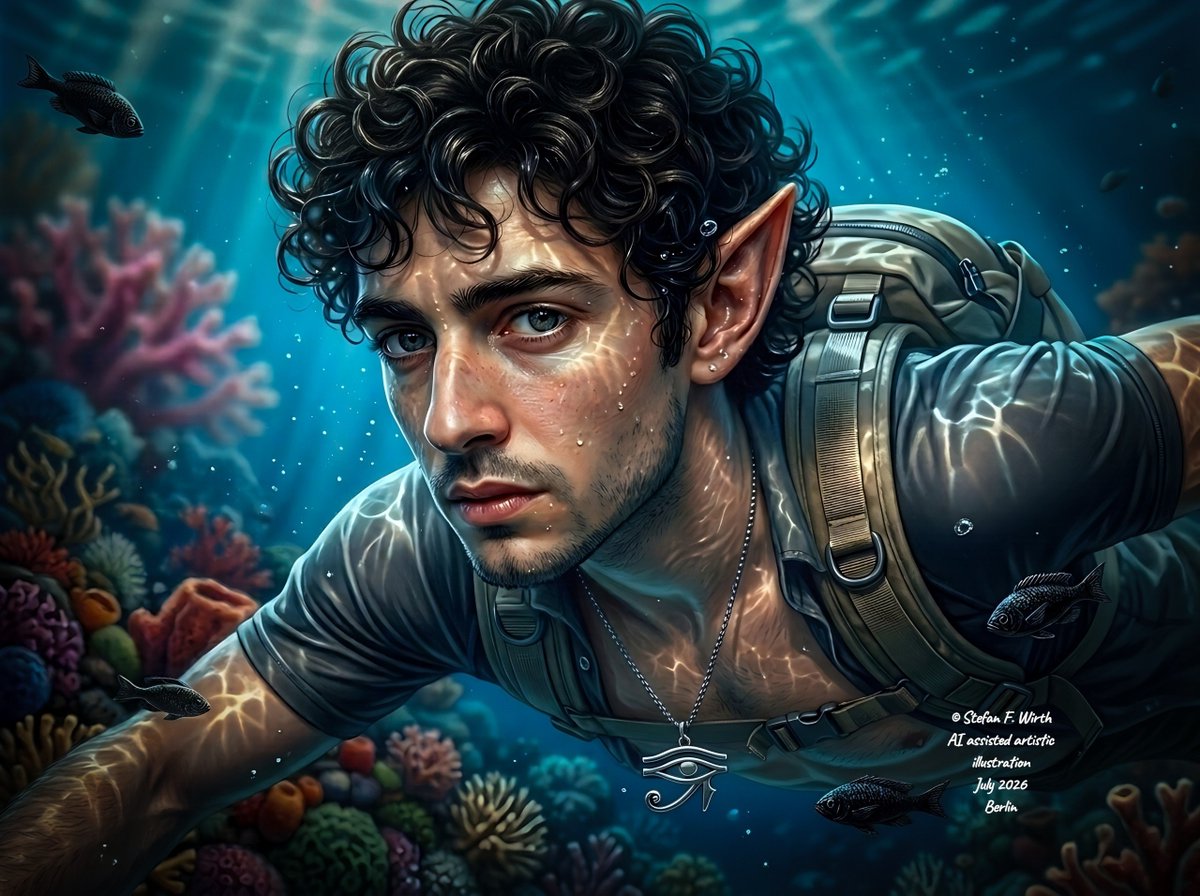
#Cephalopods are related to #snails and #mussels. Yet they are more similar to #vertebrates than one would expect. The interesting and insightful #sciencewriting article by Liam Drew (2026), which does justice to the #complexity of #cephalopod morphology, focuses on the #brain #anatomy and #neuronfunction of representatives such as the octopus and the cuttlefish. The unique feature of the cephalopod brain lies in its #size relative to body proportions and its complexity. But the brain of an octopus is impressive not only morphologically, but also functionally. These animals—I emphasize again, relatives of our garden snails—are highly #intelligent, capable of solving complex problems, and are both capable of #learning and generally curious. They can even use simple tools. What seems somehow familiar to us is, in reality, the result of #independent (#convergent) #evolution. Therefore, cephalopods like the octopus are very suitable and interesting subjects of #research. Different research disciplines with varying focuses are approaching the #neuralcapabilities of these animals, a topic the aforementioned author discusses in detail and with much clarity. Key questions arise concerning the selective evolutionary pressures that enabled the emergence of such powerful brains during evolution. However the function and communication of the neurons themselves are also subjects of other research projects. Since this is an independent evolutionary process in relation to vertebrates, the question naturally arises whether an intelligent animal group with large brains functions according to the same neural, #physiological, and morphological principles. Or, put another way: how profound are the seemingly striking similarities really, again considering that we deal with convergent evolution? This text: Stefan F Wirth, Berlin, April 2026 Reference: Liam Drew (2026): doi.org/10.1038/d41586… #Illustrations: © Stefan F. Wirth, Berlin, 2025 - April 2026, #AI assisted illustrations, no photos, of the common octopus (O. vulgaris), based on my hand sketched storyboards, created via Adobe Firefly and later manually edited via Adobe Lightroom and Photoshop. 1) Common Octopus during #mating 2) Common Octopus interacting with a human diver 3) Common Octopus during swimming from behind 4) Common Octopus, a human #foodsource since #ancienttimes, but biologically not fully understood until today. The illustration shows a scenery in the ancient harbor of Alexandria (#ancient #Egypt)
Stefan F. Wirth tweet mediaStefan F. Wirth tweet mediaStefan F. Wirth tweet mediaStefan F. Wirth tweet media
English
1
4
99
333
Stefan F. Wirth
Stefan F. Wirth@wirthstef·
It is fantastic getting the feeling to accompany the #Curiosity #rover on #Mars based on this #timelapse sequence, in reality containing #footage captured within 6 #years. It might be not too long in the future that we will see livestream footage showing people performing scientific research and other works on Mars. Text Stefan F. Wirth, Berlin May 2026 Further information: The timelapse Rover footage on YouTube by #NASA: youtube.com/shorts/l6PAhdK… about the rover's look: Wikipedia: "The mosaic shows the rover at "#Rocknest," the spot in #GaleCrater where the mission's first scoop sampling took place. Four scoop scars can be seen in the regolith in front of the rover." commons.wikimedia.org/wiki/File:PIA1
YouTube video
YouTube
English
0
0
8
132
NASA
NASA@NASA·
POV: you're rolling around on the Red Planet You’re looking at six years on Mars in around two minutes. This timelapse contains images captured by our Curiosity rover between 2020 and 2026 from one of its navigation cameras. go.nasa.gov/4cH4mrt
English
1.2K
4.8K
30.1K
1.9M
Stefan F. Wirth
Stefan F. Wirth@wirthstef·
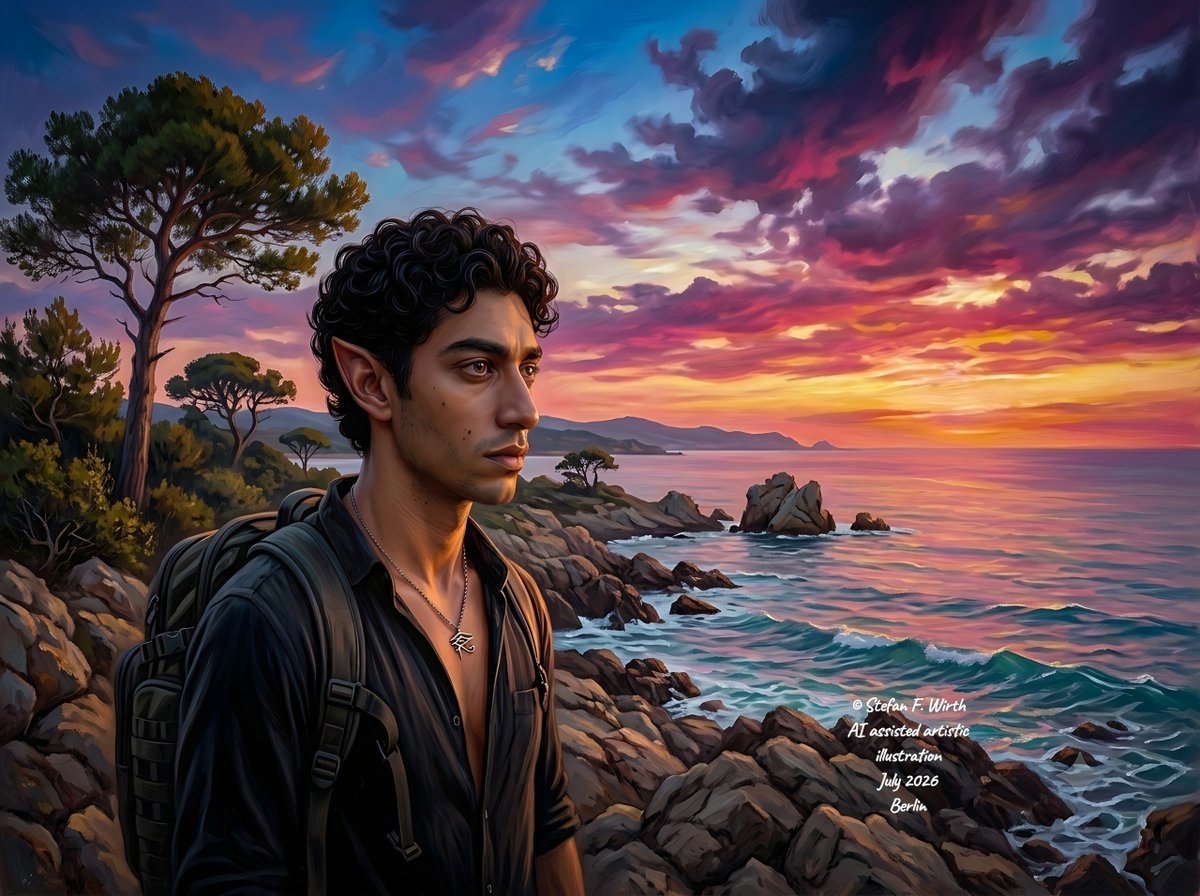
The fact that progress is continually being made in #dreamresearch is not due to it being a new #research discipline—because it certainly isn't—nor is it necessarily because new technologies open up new avenues. It is primarily new questions and new methodological approaches that lead to new insights. Can #dreaming be assigned to a specific #wakingstate? Dream research, if we are talking about the modern era, began with an explicit contribution in book form: Sigmund #Freud's "The #InterpretationofDreams" (published in 1899). But dreams have preoccupied humankind since their very inception. The #dreambooks in #ancient #Egypt (since about 1300 BC) were interpreted as messages from the gods. N. Decat et al. (2026) investigated the extent to which the popular association of dreaming with the period of (nightly) #sleep is actually accurate. The results show that it is not. In fact, dreams can occur in any waking state, just as, for example, concrete #careerplanning can certainly take place during sleep. Above, I wrote that new insights into dream formation are not primarily attributable to new technologies. However, this isn't entirely true. At least, sophisticated #AI played an important role in this research approach. An AI #algorithm identified #four different #thoughtclusters (#mentalstates), among which C3 is the actual #dreamstate. According to the authors, all of these mental states occur both while awake and during #N1 and #N2 sleep. Therefore, dreams can also occur while awake. The researchers explain this by stating that the #brainsignatures responsible for the emergence of the four mental states identified by the AI ​​are not dependent on the dream stages. Text by Stefan F. Wirth, Berlin, May 2026 Reference: N. Decat et al. (2026): doi.org/10.1016/j.celr… #Artistic #illustrations: © Stefan F. Wirth, #AIassisted illustrations, based in my hand drawn storyboard sketches, manually edited. 1-3) A #man #dreams while being awake and sitting at the Mediterranean Sea about magpies growing out of a human hand and flying into the interstellar space.
Stefan F. Wirth tweet mediaStefan F. Wirth tweet mediaStefan F. Wirth tweet media
English
1
3
43
160
Neuroscience News
Neuroscience News@NeuroscienceNew·
Why Your Brain “Dreams” Even When You’re Awake We usually think of wakefulness and sleep as two separate worlds, but new research proves the boundary is an illusion. Using an experimental setup inspired by Thomas Edison, researchers analyzed 92 participants drifting into sleep and found that “dreaming” isn’t exclusive to the night. By identifying four distinct mental states, including a “bizarre” dream state, the team discovered that these experiences occur across all levels of alertness. Whether you’re fully awake or in light sleep, your brain can flip into a “dream narrative” at any moment, suggesting that the content of our thoughts is independent of our state of vigilance. neurosciencenews.com/dream-continuu… #neuroscience #science #brain (1/3)
English
10
62
188
8.5K
nature
nature@Nature·
Octopuses and squid have elaborate brains. How did their intelligence evolve? go.nature.com/4cVsG7K
English
5
48
148
10.9K
Stefan F. Wirth
Stefan F. Wirth@wirthstef·
#Timmy, the #humpback #whale who repeatedly ran #aground on #sandbanks in the #BalticSea off the coast of #Germany, swam into the prepared #barge, filled with water, on April 28th after repeated encouragement from helpers. Some criticize the #rescue efforts, for which I have little understanding. Should the animal die in the #NorthSea, its body would be, where both living and dead whales are part of an #ecosystem. Should it survive, it will be able to contribute to the #preservation of its #species for decades. But there is also something else at stake. When you see close-up video footage of Timmy swimming into the barge with impressive #elegance and #majesty, he demonstrates his own vitality and with it the #power and #grandeur of #nature, which stubbornly and demonstratively wants to survive the consequences of human #carelessness. Look, I should have been dead long ago, but I don't want to die, not because of your ghost nets, not because of your noise and your ship propellers. Look at me closely, because seeing something with own eyes, something living, something capable of suffering, is different from only knowing, reading, or hearing. It is also about #empathy, which, alongside lust for power, greed for violence, and a love of war, is one of the deepest #human needs. A #need that is made difficult for us to fulfill in today's turbulent global times. For whom exactly should we feel empathy now, who is certainly not guilty, at least in any slightest way? It too often seems debatable; and if not, we are manipulated to think that it is debatable, we are due to our nature so susceptible to influence, and our thirst to feel for others, to suffer with them, to hope with them, increasingly gets stuck in our throats. But if we don't want to lose the ability to fully embrace our urge for empathy in the face of the hatred and envy everywhere in the world, we should look for alternative channels, and that can, may, and should even be a whale, whose body, covered in wounded skin, rises almost motionless from the Baltic Sea for weeks, crying and weeping heart-rendingly when we risk becoming accustomed to its sight. This whale demonstrably bears not the slightest guilt. Its suffering and its #willtolive deserved our compassion. For it was the truth and purity of this compassion that connected people and led them to strive for the seemingly impossible, and thereby actually making it possible despite and against so many expectations. © Text Stefan F. Wirth Reference Rheinische Post (28 April 2026): rp-online.de/panorama/deuts…
English
5
4
33
1.3K
Reuters
Reuters@Reuters·
Relief and joy were palpable as rescue workers tugged and guided a humpback whale stranded off Germany's Baltic coast into a floating tank within a barge that will later be pulled out to the North Sea reut.rs/4n0Hzuf
English
33
176
757
80.1K
Stefan F. Wirth
Stefan F. Wirth@wirthstef·
This #sciencewriting and science communication #article discusses #parasitic #flies that attach themselves to #bats and transform into a #sacklike structure that lives embedded in the #host's skin. A new species description from the #bat #Rhinolophus #stheno will also be presented. Rhinolophus stheno belongs to a taxon in which the species are distinguished by a strikingly #modified #nose (#Rhinolophidae). The leaf-like structures surrounding the #nostrils serve as a means of #vocalcommunication between the animals. R. stheno is found in tropical and subtropical #Asia, specifically in #China, Sumatra, Laos, Vietnam, Thailand, Myanmar, and Java. Its head and body length ranges from 44 to 56 mm. Its #calls are in the 85 to 96.5 kHz range. The female gives birth to a single young in summer, which is carried by its mother for about two months. They are nocturnal and hunt spiders and insects. Their #habitat consists of #forests with mature trees near #limestonecliffs. There, they stay under rock overhangs. Like almost all multicellular organisms, bats are associated with various other organisms. Not always voluntarily. #Parasites can be bacteria or viruses, mites, but also #insects. Host and parasite often share a long #evolutionaryhistory, in which the host develops countermeasures against its parasite through natural selection, while the parasite responds with its own new #evolutionary #adaptations. Flies of the genus Rhinolophus (phylogenetical position unclear, seemingly related to the Nycteriboscinae), which belong to the do called #batflies. Rhinolophus species are distributed throughout the eastern tropical and subtropical hemisphere, and approximately 17 species are known. The biological peculiarity lies in the fact that adult #females undergo a process called #neosomy. This refers to morphological changes that occur during an active arthropod stage that would normally no longer be capable of growth, since growth in arthropods is usually associated with molting. Their neosomy involves the females changing their form during their adult lifetime. They lose limbs and wings and, using their mouthparts, burrow into the skin of their bat hosts, transforming into a predominantly sac-like structure through abdominal enlargement. They feed on the blood of their hosts. The sac-like abdomen, with its anus and respiratory openings, protrudes from the skin. The female also releases her larvae in this state. Authors H. Sun et al. (2026) described a new Rhinolophus species on the bat Rhinolophus stheno from Yunnan Province, China. This new species, Ascodipteron #euryale, parasitizes bats in the area of ​​the base of the #ears. The authors characterized the new species morphologically and by #DNA analysis. A. euryale is the only known species of its genus on R. stheno. Within the parasitic genus Ascodipteron, five other species are known to parasitize bat ears. Some of their neosomes are surrounded by a cyst-like, tough skin material of the host, which it develops as a reaction to the parasitism. However, this is according to the authors not the case with A. euryale; the surrounding skin of the host is rather soft, so the parasites could be easily removed. © #StefanFWirth, April 2026, Berlin Please, I urgently depend as Freelancer from support, as I do much of my work for free, I much appreciate each small coffee donation: ko-fi.com/sfwirth Reference: H. Sun et al. (2026): doi.org/10.3897/zookey… Illustrations: My attached figures have only an illustrative character. I created them with #AI assistance, based on my hand drawn sketches, illustrations were then manually edited and modified via Lightroom. They intend to show Rhinolophus stheno in the area of a limestone rock face surrounded by a forest in a not closer determined subtropical Asian region. The neosome of a parasitic fly of genus Ascodipteron is the last illustration. Iit is simplified , but inspired by different photos of different species, which I saw.
Stefan F. Wirth tweet mediaStefan F. Wirth tweet mediaStefan F. Wirth tweet mediaStefan F. Wirth tweet media
English
0
12
205
940
Stefan F. Wirth retweetledi
News from Science
News from Science@NewsfromScience·
Most land plants team with mycorrhizal fungi to survive. This ancient partnership has helped both plants and fungi thrive over much of Earth. Learn more: scim.ag/4d0vrpu #ScienceMagArchives
News from Science tweet media
English
0
69
256
8.6K
Stefan F. Wirth retweetledi
News from Science
News from Science@NewsfromScience·
Ammonia gas from penguins’ feces sets off a reaction that potentially blunts some local effects of climate change. Learn more: scim.ag/4aYy3DS #WorldPenguinDay
News from Science tweet media
English
2
18
129
5.9K
Stefan F. Wirth retweetledi
Black Hole
Black Hole@konstructivizm·
A graphical representation showing the region around a black hole.
English
8
128
933
39.3K
Stefan F. Wirth retweetledi
Curiosity
Curiosity@CuriosityonX·
The Moon isn't just a rock in the sky. It's the reason you exist. Without it, Earth would wobble out of control. Days would shrink to a few chaotic hours. Tides would vanish. Life as we know it would never have evolved. It sits 238,855 miles away at 2,288 mph And the wild part: it's slowly escaping. The Moon moves about 3.8 centimeters farther from Earth every single year. Its surface holds footprints that will outlast every human civilization. With no wind, no rain, no erosion, the boot prints from Apollo 11 in 1969 are still perfectly preserved up there. The same Moon that lit up the path of every ancient traveler is the exact one glowing outside your window tonight. Caesar saw it. Cleopatra saw it. Your great-great-grandparents saw it. It has watched empires rise, oceans shift, and entire species come and go, all without saying a word. A silent witness to everything.
English
299
1.5K
8.5K
330.8K
Stefan F. Wirth retweetledi
Interesting STEM
Interesting STEM@InterestingSTEM·
When a human egg is fertilized, it emits a tiny flash of light, known as the “zinc spark,” a release of zinc atoms that marks the beginning of life.
English
38
301
1.4K
56.8K
Stefan F. Wirth retweetledi
Geology Page
Geology Page@GeologyPage·
Extremely well-preserved fossil sawfly sheds new light on co-evolution of insects and toxic plants This fossilised sawfly, which is between 11 and 16 million years old from the Miocene Period, was the first of its kind discovered in ... Read More: geologypage.com/2024/11/extrem…
English
1
6
46
1.3K
Stefan F. Wirth retweetledi
Reid Wiseman
Reid Wiseman@astro_reid·
Only one chance in this lifetime… Like watching sunset at the beach from the most foreign seat in the cosmos, I couldn’t resist a cell phone video of Earthset. You can hear the shutter on the Nikon as @Astro_Christina is hammering away on 3-shot brackets and capturing those exceptional Earthset photos through the 400mm lens. @AstroVicGlover was in window 3 watching with @Astro_Jeremy next to him. I could barely see the Moon through the docking hatch window but the iPhone was the perfect size to catch the view…this is uncropped, uncut with 8x zoom which is quite comparable to the view of the human eye. Enjoy.
English
4.1K
45.6K
265.5K
18.8M
Stefan F. Wirth retweetledi
Sheila Macrine, Ph.D.
Sheila Macrine, Ph.D.@MacrinePhD·
Ever wondered why memories feel as vivid as photographs? Groundbreaking research has cracked the "neural code" of imagination! Scientists found that your brain reactivates the exact same neurons to imagine an object as it does to actually see it. This discovery isn't just cool—it’s a roadmap for treating PTSD and OCD by helping us understand how to manage intrusive mental imagery. #Neuroscience #BrainPower #MentalHealth #Innovation #ScienceDaily #ScienceTwitter - neurosciencenews.com/imagination-ne…
English
14
71
235
13.3K
Stefan F. Wirth retweetledi
Anza-Borrego DRC
Anza-Borrego DRC@AnzaBResearch·
A California quail on an ocotillo at Borrego Palm Canyon (Sicco Rood).
Anza-Borrego DRC tweet media
English
6
59
427
5.6K
Stefan F. Wirth retweetledi
Anza-Borrego DRC
Anza-Borrego DRC@AnzaBResearch·
A master blister beetle chewing up brittlebush flowers (video: Sicco Rood).
English
1
17
122
2.1K