
Sabitlenmiş Tweet
x444
46 posts


x444
@x4four4
Powering the AI economy on @BNBChain x444 Standard
Katılım Ekim 2025
2 Takip Edilen1.1K Takipçiler
GM to all the community
We have worked diligently for 5 days and were able to build something unique on the @BNBCHAIN
The x444 standard, first x402 transaction on BNB.
We are extremely proud of the community we built. Team HODL all tokens in dev wallet.
bscscan.com/address/0x4620…
Keep building. Updates coming.
English
Everyone, stay SAFU!
Only trust info coming from @x4four4 and @GaryMcAfoz here on X and from our official telegram channel.
Official links:
Telegram: t.me/x444bnbportal
Website: x444.ai
CA: 0x15272209c6996e7dfa88c7463b899f4754794444
English

We built the first AI Facilitator on BNB and turned it into a live product you can actually use.
It connects AI agents, payments, and data sources through x402, letting them transact in real time.
Frictionless, machines paying machines.
Here’s video of the x444 function for P2P transactions.
@BNBCHAIN @cz_binance @ellazhang516 @yzilabs @DanaBuidl
English
@DaCryptoAgency @XAgentBSC We shipped our facilitator. Now working on integrating x444 with as many AI agents as possible. Keep building.
English

2 small projects that have been doing well in terms of utility on BSC ecosytem are
@XAgentBSC which will tweet and post according to its customer profile. Agents mimics your profile and analyse it to post
@x4four4 First USD1 baseless transaction proven onchain with a successful transaction. Agents can transact without fees
Its just need the right eyes and they shall fly
English
It is a great feeling to see projects in the same ecosystem learning and using each other as inspiration.
@soraoracle using the x444 standard for gasless fees with USD1.
This technology not only enables AI agents to transact seamlessly but works perfectly for any high tx volume operation.
The future standard of AI and onchain global payments.
Here's the transaction that founded this standard on the @BNBCHAIN
bscscan.com/tx/0x54261a8ca…
Sora 🔶@soraoracle
Introducing Sora S402 (x402)- Gasless Micropayments on BNB Chain Try it out here: s402.soraoracle.com We just deployed the first production-ready S402 payment protocol using @worldlibertyfi USD1. A critical part of our overarching Oracle infrastructure. ✨ What makes it special: • One signature, zero gas fees • Pay only in USD1 stablecoin • 1% platform fee (vs traditional 3%+) • Verified smart contract on BSCScan 💡 How it works: Instead of the broken EIP-2612 permit flow, we use pre-approved allowances. Users approve once, then make unlimited payments with just one signature per transaction. 🔬 What's next: We're exploring an L2 rollup on BSC dedicated to x402-style payments. Execute from BSC → process through L2 → settle back on BSC. This would enable the same x402 capabilities as Base, while keeping everything on BNB Chain. Still analyzing fees/gas economics to validate the approach. 🔗 Live on mainnet: Contract (UPDATED): 0x605c5c8d83152bd98ecAc9B77a845349DA3c48a3 bscscan.com/address/0x605c… Built for the future of Web3 payments. No MetaMask gas pop-ups. No BNB required. Just sign and pay. 🎯
English
x444 retweetledi

So many people asked what we’re building and how big this can get
Instead of a short thread, I made something better
A full section showing why x444 exists — including a deep comparison with the biggest payment infra projects out there
We’re not playing small. This is just the beginning
docs.x444.ai/documentation/…
English
x444 retweetledi

first project doing gasless fees for AI agents on BSC with x402 is solid positioning. that dormant wallet waking up with 10 BNB after 50 days is interesting smart money behavior
x402 usage up 175000% in two weeks, Circle and Polygon integrating, Coinbase backing Kite AI in the ecosystem. the narrative is real
but "only legit" might be a stretch. Pieverse dropped x402b on BNB Chain as first autonomy-focused payment protocol. Unibase building with x402 and ERC-8004 on BNB too. calling themselves "PayAI of BSC" means they see competition
gasless implementation is a real differentiator for agent adoption though. just early stage with other projects gunning for the same space
English
Some built patches. We built the framework.
@AEON_Community solves for EIP-3009 gaps. @pieverse_io wraps tokens. @soraoracle parallelizes permits.
All valuable, but each one stops at the transaction layer.
x444 goes deeper.
We’re not just moving tokens, we’re rewiring HTTP itself to speak natively with blockchains. An economic interface where AI agents can authenticate, negotiate, and settle value automatically.
It’s the foundation for a new internet layer where digital agents don’t just communicate, they transact, creating a real-time economy between machines, data feeds, and autonomous services.
This is the missing bridge between the web , onchain value and it’s live on BNB.
BNB Chain Developers@BNBChainDevs
Let’s talk about x402: the protocol turning HTTP into a native onchain payment layer. For years, “HTTP 402 Payment Required” sat unused but the x402 protocol changes this. It turns standard HTTP into a native value protocol, allowing websites and apps to request and settle payments directly onchain. Here’s what that means: Instead of the usual “401 Unauthorized” that requires a static API key, a server can now respond with “402 Payment Required” and include an onchain invoice. It’s a simple, stateless, and machine-readable way for digital services to exchange value over the web. For builders on BNB Chain, this unlocks a new layer of utility: • Monetize API endpoints directly • Charge per query, per token, or per compute unit • Enable autonomous agents to pay each other instantly without pre-set keys This is where the @BNBCHAIN ecosystem impact begins. x402 enables a real machine-to-machine economy where agents, data sources, and services interact and pay each other automatically. Think of an AI agent buying data to complete a task, a DePIN node charging per compute request, or an LLM billing per-token inference, settled in real time. Each interaction creates thousands of small, automated payments that drive constant blockspace demand and long-term utility for $BNB. The Core Technical Challenge The x402 gasless flow relies on EIP-3009 (transferWithAuthorization). This allows a client (agent) to sign a payment, which a third-party facilitator can then submit, covering the gas. The problem: major stablecoins on BNB Chain, like USDT, are standard ERC-20s and don’t support this function. Solution 1: Universal Facilitator Contract (via @AEON_Community) AEON’s approach introduces a facilitator contract that supports both EIP-3009-enabled tokens and standard ERC-20s. For standard ERC-20 tokens (pre-step): users authorize the facilitator contract to handle the transaction. (It’s important to verify the correct contract address and only authorize small token amounts.) Signature Verification: The AEON Facilitator Contract verifies the signature from the client. Token Transfer: After successful verification, it interacts with the token contract by calling the standard transferFrom function. Transaction Execution: The transferFrom function moves the funds — for example, “10U from A to B.” This works because the client’s wallet pre-approved the AEON Facilitator Contract to spend the tokens. Solution 2: Asset-Level Wrapper (via @pieverse_io) Pieverse’s x402b protocol introduces pieUSD, an EIP-3009-compliant wrapper for USDT. Flow: • Client → Resource Server: Sends an HTTP request with an X-PAYMENT header that includes the payment and optional compliance metadata. • Resource Server → Facilitator: Verifies the signature and initiates settlement via /settle. • Facilitator → Blockchain: Uses the user’s signed authorization to call transferWithAuthorization on the pieUSD contract (gasless). • Facilitator → BNB Greenfield (optional): Uploads a compliance receipt to Greenfield, creating an immutable and audit-proof record. • Facilitator → Resource Server → Client: Returns a standard x402 response, optionally including the Greenfield receipt URL. In simple terms, users sign, facilitators submit, and BNB Greenfield preserves the proof — all within a single, seamless, web-native payment flow. Solution 3: S402 via MultiWallet Pool with EIP-2612 (the permit function) (via @SoraOracle) Client-side (User): The user or agent wants to access an API. Instead of signing an EIP-3009 message, they sign an EIP-2612 permit message, authorizing the S402Facilitator contract to spend their tokens. Backend (Middleware): The S402 service receives this signed permit, verifies the signature to confirm payment intent, but doesn’t wait for onchain settlement. Backend (API): Once the signature is verified, the API optimistically serves the requested data. Backend (Settlement): The middleware passes the permit to the MultiWalletS402Pool. One of ten worker wallets (each with its own nonce) submits the transferFrom transaction to the S402Facilitator contract, which pulls the funds and settles the payment onchain, taking its 1% fee. This setup cleverly works around the EIP-3009 limitation. The core trade-off: Instead of the unavailable EIP-3009 (transferWithAuthorization), it uses EIP-2612 (permit). Why this works: EIP-2612 is more common and supported by many ERC-20 tokens on BNB Chain. It also provides a gasless user experience by allowing a signed approval that a relayer can later execute via transferFrom. The new problem: A single relayer wallet would face a sequential nonce bottleneck. Sora’s solution: The MultiWalletS402Pool uses ten parallel wallets to bypass the single-nonce limit, enabling up to 10x concurrent transactions. This design achieves high throughput and reduces cost per payment from about $0.12 to roughly $0.003 by amortizing gas fees. To make this even simpler, native EIP-3009 enabled assets are in the pipeline. The autonomous agent economy is being built on the BNB Chain now.
English
🚀 Just submitted our request to list $x444 on @CoinGecko !
🎫 Request ID: CL2810250008
🔗 GeckoTerminal URL: geckoterminal.com/bsc/pools/0xb7…
English
Documentation is now live
x444 is bridging to BNB the tools to power the AI economy. V1 with @worldlibertyfi USD1. USDF coming soon from @Aster_DEX
Here's a complete guide to integrating decentralized, feeless payments using the x444 API on @BNBCHAIN
docs.x444.ai
English
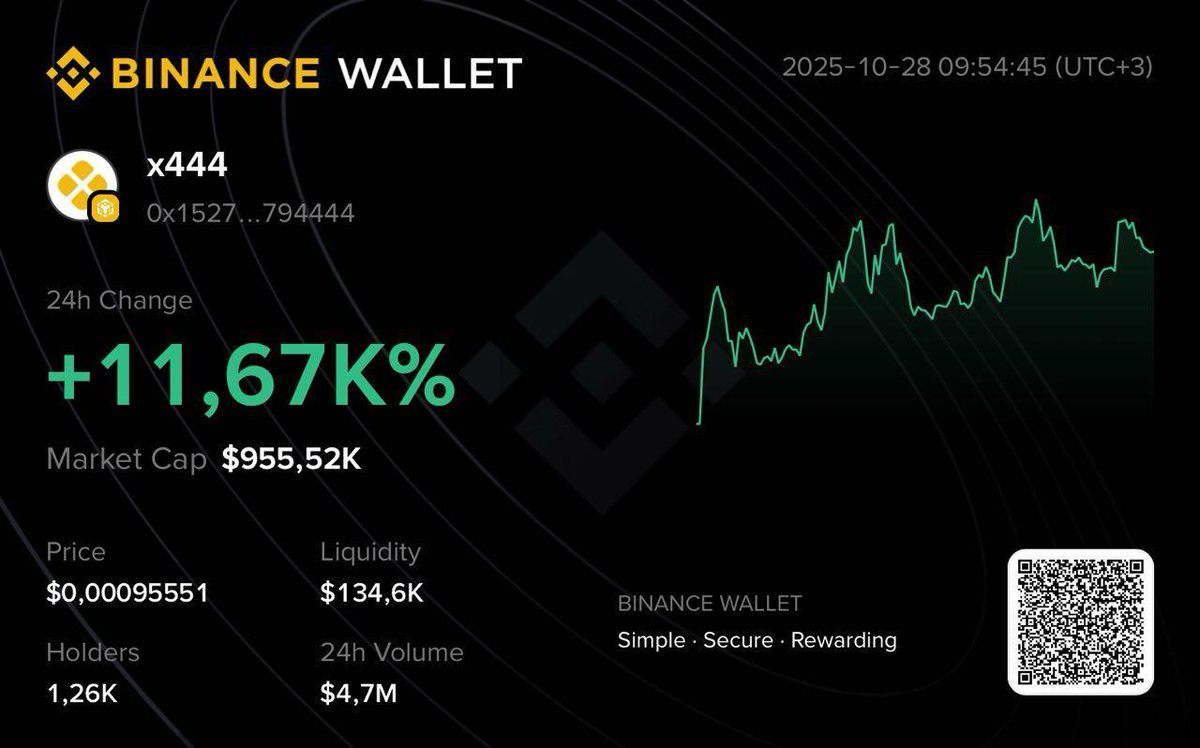
x444 retweetledi

⚡ 月兔雷霆 - Moontok Xpress
x444 ( $x444 )
moontok.io/coins/x444
0x15272209C6996e7DFA88C7463B899F4754794444
LIQ: $140,645 | MC: $1,077,813
#altcoin #memecoins @x4four4 @moontokofficial

中文