Sabitlenmiş Tweet
Jerónimo Xavier Cassanello
9.6K posts

Jerónimo Xavier Cassanello
@xass76
Internista - Intensivista, Magister Gerencia Hospitalaria y Salud Pública 🇪🇨🇦🇷🇺🇾🇮🇹
Guayaquil, Ecuador Katılım Mart 2012
740 Takip Edilen4.8K Takipçiler
Jerónimo Xavier Cassanello retweetledi

Un comandante de avión planteó una comparación necesaria: en la aviación, los tiempos de trabajo у descanso están estrictamente regulados para garantizar la seguridad. Sin embargo, en el sistema de salud, se naturalizan jornadas que van en contra de ese mismo principio.
Guardias de 24 horas, seguidas de otros turnos, en contextos donde se espera tomar decisiones críticas. El problema no es solo laboral, es estructural: un profesional agotado difícilmente pueda rendir al máximo.
La seguridad del paciente también empieza por algo básico: que quien lo atiende esté en condiciones de hacerlo.

Español
Jerónimo Xavier Cassanello retweetledi

97 años de un sentimiento eterno. 🔵⚡️
De generación en generación, el orgullo sigue intacto.
¡Feliz aniversario, Club Sport Emelec!
#VolviendoASerEmelec 🔵
#MesDelEmelecismo
Español
Jerónimo Xavier Cassanello retweetledi

🔝I presented on my TOP 10 LIFESAVING PAPERS in critical care at @CC_Symposium last week!
🎖️Which papers made it in? Why? What did they change for ICU care?
#FOAMed #POCUS #FOAMcc @veerappan91050
Lets take you on a little journey!
English
Jerónimo Xavier Cassanello retweetledi

I sat down with my mentor Dr. Eugene Braunwald for a 3 part series about his life.
In part 1 we talk about his early years:
"Everything changed on March 12, 1938 when Hitler marched in with the Nazis & my father was arrested"
Hear how they escaped here
For better video quality view here: clinicaltrialresults.org/interview-seri…
English
Jerónimo Xavier Cassanello retweetledi

The American Heart Association mourns the passing of the legendary cardiologist Eugene Braunwald, M.D., widely recognized as one of the most influential figures in the history of cardiovascular medicine. Over seven decades, his work reshaped the understanding and treatment of heart disease, leading many to call him the father of modern cardiology.
Braunwald was a lifelong contributor to the American Heart Association, helping advance its research and scientific mission, and was honored with some of the Association’s highest honors for his lasting influence on cardiovascular care and research. His influence extended well beyond his own discoveries, as generations of Association‑supported investigators, clinicians and academic leaders were trained by Braunwald or guided by the clinical trial standards and mentorship models he helped establish.
newsroom.heart.org/news/american-…
English
Jerónimo Xavier Cassanello retweetledi

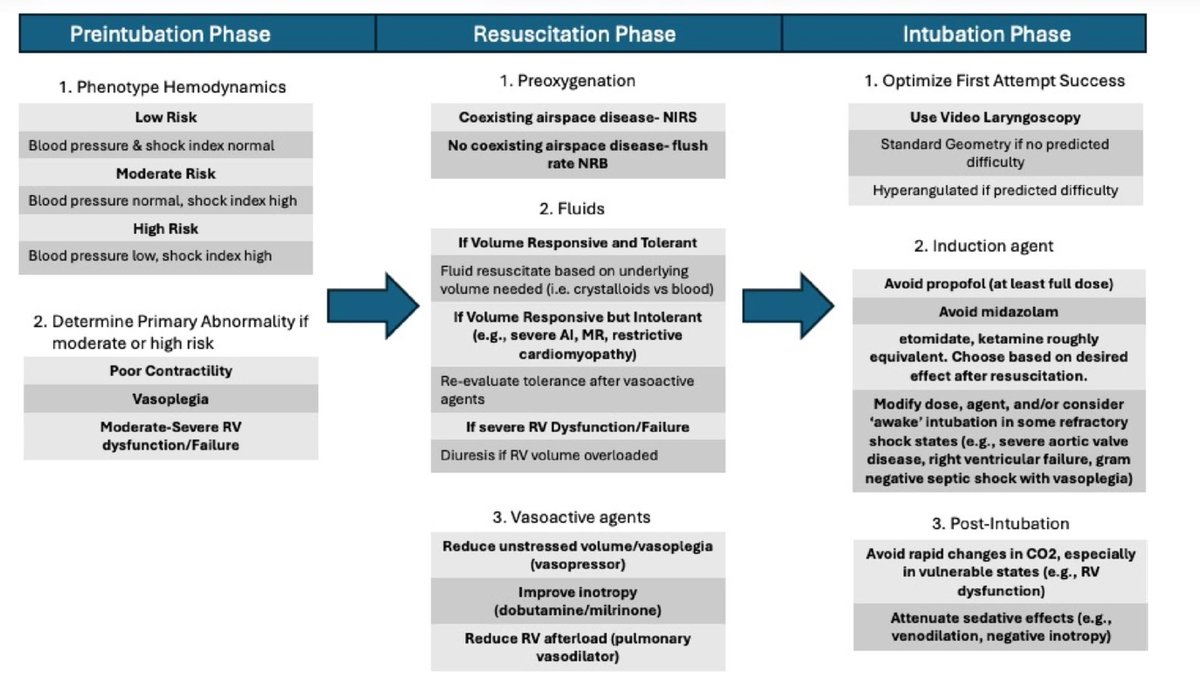
From:
Current Anesthesiology Reports (2024) 14: 446-57. doi.org/10.1007/s40140…
Just one of the personalized peri-intubation resuscitation approaches:

English
Jerónimo Xavier Cassanello retweetledi

"Hospitals cost $1 to $2 million per bed to build. A single hospital can routinely exceed $1-2 billion. Their floor plans are rigid, fixed for decades. AI is about to make those floor plans obsolete."
Having now been on the front line of clinical care delivery, designing hospitals and building agentic AI infrastructure -- the collision is hard to ignore. We're spending $70B a year on hospitals with designs that may be obsolete before construction is done.
linkedin.com/pulse/hospital…
English
Jerónimo Xavier Cassanello retweetledi

We should be moving to ketamine faster for refractory status. In this meta-analysis
1. Response rate was 64%
2. Median maintenance dose 2.5 mg/kg/hr,
3. Dose was the same between responders and non-responders. But... responders were started on KET earlier (3.2 vs 4.3 days)
4. Avg duration of KET 5 days
5. Minimal complications (<1%)
#curingcoma
neurology.org/doi/10.1212/CP…
English
Jerónimo Xavier Cassanello retweetledi

AKI guidelines hadn’t been updated since 2012.
The KDIGO 2026 AKI/AKD Public Review Draft just dropped and it changes how we define, diagnose, and follow up after acute kidney injury.
Here’s what every nephrologist, intensivist, and internist needs to know 🧵
⚠️ Public review draft only · Not yet final guidelines
English
Jerónimo Xavier Cassanello retweetledi

💉🩺Rapid sequence intubation in 2026: we are no longer “protecting the airway.”
We are managing physiology under extreme stress.
The latest evidence challenges one of the oldest dogmas in critical care.
RSI was designed to prevent aspiration.
But today, the real enemy is often hypoxemia and cardiovascular collapse.
1. Aspiration is no longer the central problem
For decades, RSI was built around one fear: aspiration.
But emerging data suggest:
RSI may not significantly reduce aspiration
It may increase hypoxemia and hemodynamic instability
The paradigm is shifting:
👉 From aspiration avoidance → to physiologic optimization
2. First-pass success is everything
Every additional attempt increases:
Hypoxia
Hemodynamic collapse
Mortality
Modern RSI is built around one goal:
Get it right the first time.
That means:
Videolaryngoscopy first-line
Stylet routinely
Team choreography, not improvisation
3. Preoxygenation is now a therapeutic intervention
Not just a step—a determinant of survival
NIV > face mask
HFNO as adjunct
Semi-upright positioning
And one key shift:
👉 Gentle ventilation is no longer taboo
Done correctly, it reduces hypoxemia without increasing aspiration risk.
4. Hemodynamics matter more than ever
Up to 40–50% of patients experience peri-intubation instability.
The modern approach:
Avoid propofol in unstable patients
Favor etomidate or ketamine
Consider prophylactic vasopressors
Fluid loading?
Not routinely beneficial.
5. Cricoid pressure: from dogma to doubt
No clear benefit in preventing aspiration
May worsen laryngoscopy and ventilation
Current thinking:
👉 Use selectively, or not at all
6. RSI is no longer a rigid protocol
It is now:
Patient-specific
Physiology-driven
Team-dependent
With tools like:
Gastric ultrasound
POCUS-guided decisions
Structured airway protocols
7. The real determinant of success: human factors
Preparation, communication, and coordination matter as much as drugs.
Because in critical care:
The airway is not just anatomy.
It is a moment of systemic vulnerability.
🤓Final message
RSI has evolved:
From speed → to precision
From protocol → to physiology
From individual skill → to team performance
And ultimately:
The goal is no longer just to intubate.
It is to intubate without killing the patient.
📃Reference
Boulos NM et al. Anaesth Crit Care Pain Med. 2026. doi.org/10.1016/j.accp…

English
Jerónimo Xavier Cassanello retweetledi

🔥⚠️We are fighting fever… when we should be using it 🤓
Every day in ICU...Paracetamol, Cooling blankets, Aggressive temperature control
But what if fever is not the problem 🤔
*Fever is not a failure of physiology
It is an adaptive response
Driven by cytokines and Controlled by the hypothalamus
🫀 Clinical implication
Fever is not noise...It is a signal
*Heat boosts immunity
At 38–41°C:
• ↑ Neutrophil activation
• ↑ NK cell activity
• ↑ Antigen presentation
• ↑ T-cell interaction
🫀 Clinical implication
You are suppressing immune function when you suppress fever
*Bacteria don’t like heat
Most pathogens:
• Optimal growth ~37°C
• Growth impairment near 40°C
Even more interesting
β-lactams work better at higher temperatures
🫀 Clinical implication
Fever may act as a natural antibiotic enhancer
*The paradox: treating fever may worsen outcomes
Observational data show:
• Higher fever → lower mortality
• Hypothermia → worse outcomes
And even more concerning
Antipyretics in sepsis → ↑ mortality
🫀 Clinical implication
We may be harming patients with “routine care”
*The myth of temperature control
Antipyretics reduce temperature by 0.3–0.5°C
No mortality benefit
Sometimes harm
🫀 Clinical implication
We are treating a number, not a patient
*The real strategy: permissive hyperthermia
Target:
~38–40°C
Not normothermia
Not aggressive cooling
🫀 Clinical implication
Fever should be tolerated, not eliminated
*When should we treat fever?
✔ Extreme hyperthermia (>40°C)
✔ Patient discomfort
✔ Cardiovascular stress
❌ Routine suppression in sepsis
🫀 Clinical implication
Treat symptoms, not physiology
*The uncomfortable truth
We were trained that fever is dangerous, but evidence suggests that Fever is PROTECTIVE and its suppression may be HARMFUL 🫨
🤓Final reflection
In sepsis, the goal is not comfort alone. The goal is survival, and sometimes survival requires heat😎🔥
📚 Tilanus A, Villamil W. Open Forum Infectious Diseases, 2025
“Fever in Sepsis Revisited: Is a Little Heat What We Need?”
doi.org/10.1093/ofid/o…


English
Jerónimo Xavier Cassanello retweetledi