Xata 🦋

1.4K posts

Xata 🦋 banner
Xata 🦋

Xata 🦋

@xata

Postgres at scale — with copy-on-write branching, data masking, separated storage & compute , 100% Postgres and your own cloud

🌏 Earth Katılım Kasım 2020
420 Takip Edilen4.1K Takipçiler
Sabitlenmiş Tweet
Xata 🦋
Xata 🦋@xata·
@monicasarbu and the Xata team are at AWS Summit Hamburg today, in the AWS Startup Zone, Hall 4. If you're thinking about Postgres for agent scale, come find us.
Xata 🦋 tweet media
English
0
1
2
134
Xata 🦋
Xata 🦋@xata·
DeltaX is a Postgres extension that adds columnar storage and time-series compression. Data lives in regular Postgres tables. pg_dump, replication, and crash recovery all keep working without change. Under the hood: → Type-specific codecs (Gorilla XOR, delta-of-delta, dictionary, block-LZ4) → Vectorized Rust execution, bypasses per-row ExecQual → Segment pruning with bloom filters → Parallel aggregation → Shared-memory blob cache Status is alpha, PostgreSQL 17 and 18. Star the project: github.com/xataio/deltax
English
1
1
2
988
Xata 🦋
Xata 🦋@xata·
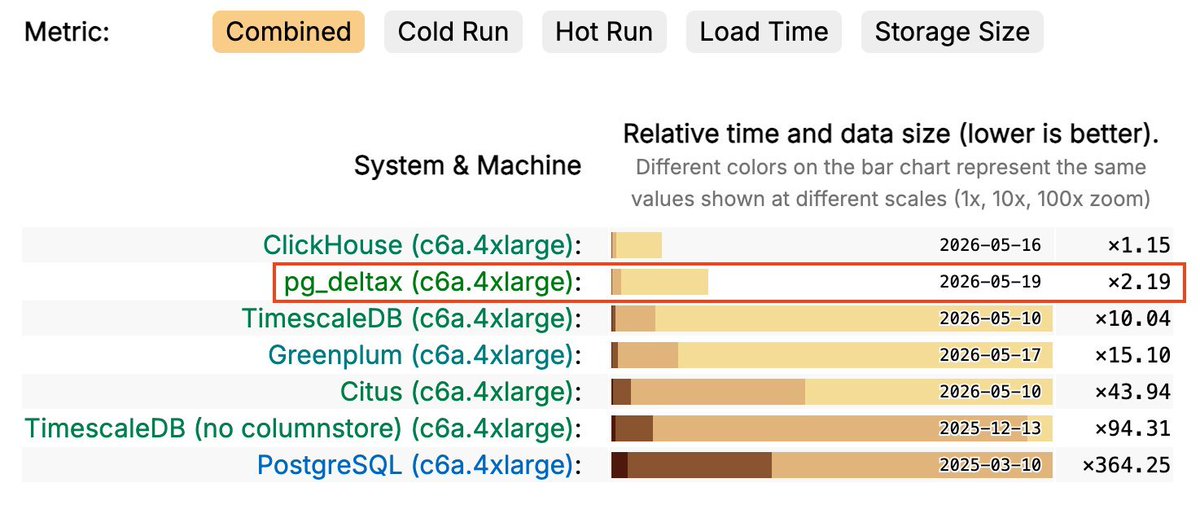
DeltaX is now public: the TimescaleDB alternative with Apache 2.0. Preliminary ClickBench: ~4.7× faster on analytical queries.
Xata 🦋 tweet media
English
1
2
25
1M
Xata 🦋
Xata 🦋@xata·
pgstream v1.0.2 is out. Post-snapshot catch-up no longer stalls on bulk INSERT or DELETE tables (Postgres sink coalesces flushes now). You can also filter tables at decode time inside the source Postgres via wal2json. Plus Go 1.26.3 security fixes; v0.9.12 backports that one too.
English
1
3
4
889
Xata 🦋
Xata 🦋@xata·
Every Xata Postgres branch now ships with a managed PgBouncer endpoint, included. A Postgres connection costs about 5MB of backend memory. Fine when traffic comes from a handful of app servers. Breaks when traffic comes from serverless functions, edge workers, or AI agents that open a connection per request. Postgres wants fewer, long-lived connections. Modern apps produce many short-lived ones. A pooler reconciles that. We chose to ship one PgBouncer pod per branch, on the same node as the database, in the same memory budget. Pool size auto-tunes to 0.9 of max_connections and re-tunes when the instance changes. If you connect directly to Postgres, append -pooler to your branch ID: > postgresql[:]//user:pass@branch-id-pooler[.]us-east-1[.]xata[.]sh:5432/postgres One-line change in your connection string. Branching gives you cheap copies of Postgres. Pooling gives those copies somewhere to take traffic. We needed both. xata.io/blog/a-connect…
English
0
4
5
1.4K
Xata 🦋 retweetledi
Tudor Golubenco
Tudor Golubenco@tudor_g·
We needed a storage layer that can scale to a huge number of volumes (think millions) for our Postgres platform. Most of the existing storage systems are optimized for a few volumes with really high performance. But we needed the opposite: a very large number of mostly idle volumes. So we wrote our own. It’s called Xatastor and it enables Postgres-per-tenant use cases, “ephemeral” dbs for agents, free tiers, etc. Supports copy-on-write snapshots, clones, and thin provisioning. It’s based on ZFS and NVMe-oF as key technologies. Link with all the details in the first reply.
Tudor Golubenco tweet media
English
2
13
30
7.5K
Xata 🦋 retweetledi
Monica 🦋
Monica 🦋@monicasarbu·
We’re seeing this firsthand with AI platforms we partner with: 👉 every agent needs its own isolated Postgres DB 👉 at scale, that’s millions of databases 👉 many on free tiers → cost matters a lot That combination breaks traditional storage. Most systems are built for a few always-on volumes. Agents need the opposite: millions of mostly idle ones. So we built Xatastor. It enables Postgres-per-tenant use cases, ephemeral DBs for agents, free tiers, and supports copy-on-write snapshots, clones, and thin provisioning.
Monica 🦋 tweet media
English
1
5
14
1K
Xata 🦋
Xata 🦋@xata·
AI codes. Humans engineer. AI is already good at boilerplate, search, command line, simple fixes with feedback loops. Outsource it. Engineers still own decisions, distillation, organizational context, code review, and breaking out of incorrect assumptions.
English
2
0
4
296
Xata 🦋
Xata 🦋@xata·
Two new per-branch settings in Xata: • Upgrade your Postgres minor version from the UI or CLI (`xata branch set postgres-version`). • Rotate your database password with `xata branch rotate-password`. New password active in under 1 second.
English
0
0
6
373
Xata 🦋 retweetledi
Xata 🦋
Xata 🦋@xata·
The practical version: keep PRs small (3-7 screen-heights of diff), self-review before requesting review, write titles by hand, and ask for direction early if you're out of your depth. Full guide: xata.io/blog/code-revi…
English
0
0
0
90
Xata 🦋
Xata 🦋@xata·
The consequences for reviewers are real: • If the PR breaks something, it's the reviewer's responsibility • Review time pulls them off their own work • Bad code creates tech debt that engineers pay for months later Understanding these stakes changes how you write PRs.
English
1
0
0
105
Xata 🦋
Xata 🦋@xata·
Code review is a negotiation. The submitter trades shipping speed for the reviewer's confidence that this won't cause pain later. Most new coders don't realize this. They optimize for "does it work" when they should optimize for "can my reviewer approve this safely."
English
3
0
6
327
Xata 🦋 retweetledi
Tudor Golubenco
Tudor Golubenco@tudor_g·
This is a good read & summary, and I agree they all have their place. I used to dismiss the cluster-per-customer idea as too complex to manage, but now at @xata we can create Postgres clusters in <1 second, thousands to millions of them and all independently scalable, perfectly isolated, and controlled via APIs. So if you need very strong noisy-neighbor isolation for arbitrary queries, that is now a viable option. Personally not a fan of RLS, but it's still a good tool in the toolbox in particular situations.
Marc Brooker@MarcJBrooker

Some thoughts on the RLS discourse. If I'm building a multi-tenant online service backed by a database, I can choose from four basic architectural patterns: control-plane seperation, table-per-customer, explicit user info in schema, or fine-grained DB security features.

English
0
3
8
1.7K
Xata 🦋
Xata 🦋@xata·
Remote teams don’t get stronger from more meetings. They get stronger from time together that actually feels human. At Xata, we design offsites around conversation, shared meals, walks, creative activities, and the unplanned moments in between. Club Xata France 2026 was a good reminder: culture isn’t what you write down. It’s what people feel when they’re there. We’re building the kind of company we’d want to work at.
English
1
2
12
1.2K