
Sabitlenmiş Tweet
RAGE𝕏
76K posts


RAGE𝕏
@xcouragecrypto
Strictly Crypto | Web3 geek | No financial Advise | All tweets are my personal opinions | DYOR
BLOCKCHAIN Katılım Ocak 2020
5K Takip Edilen30.2K Takipçiler

RAGE𝕏 retweetledi

I went through KelpDAO’s report, and they were spot on: LayerZero’s out‑of‑the‑box defaults effectively turned this into a systemic risk.
LayerZero ships with a 1/1 DVN default, and roughly 47% of protocols are still running that exact configuration according to @Dune .
x.com/i/status/20462…
The exploit was highly sophisticated, but it reads as “simple” in hindsight because the attacker leaned into the weakest point of the core design as 3 rpcs got compromised on LZ's infrastructure.
If you also read my write‑up, you’ll see it began with a forged LayerZero packet that slipped past detection and still got validated by the DVN.
x.com/i/status/20461…
However, Kelp has been trying to make things right as they worked with arbitrum and seal to secure 30k ETH.
It's a rough time for DeFi but efforts are being made towards recovering all lost funds so kudos to Kelp for trying rather than attributing blames.
Kelp@KelpDAO
English
RAGE𝕏 retweetledi

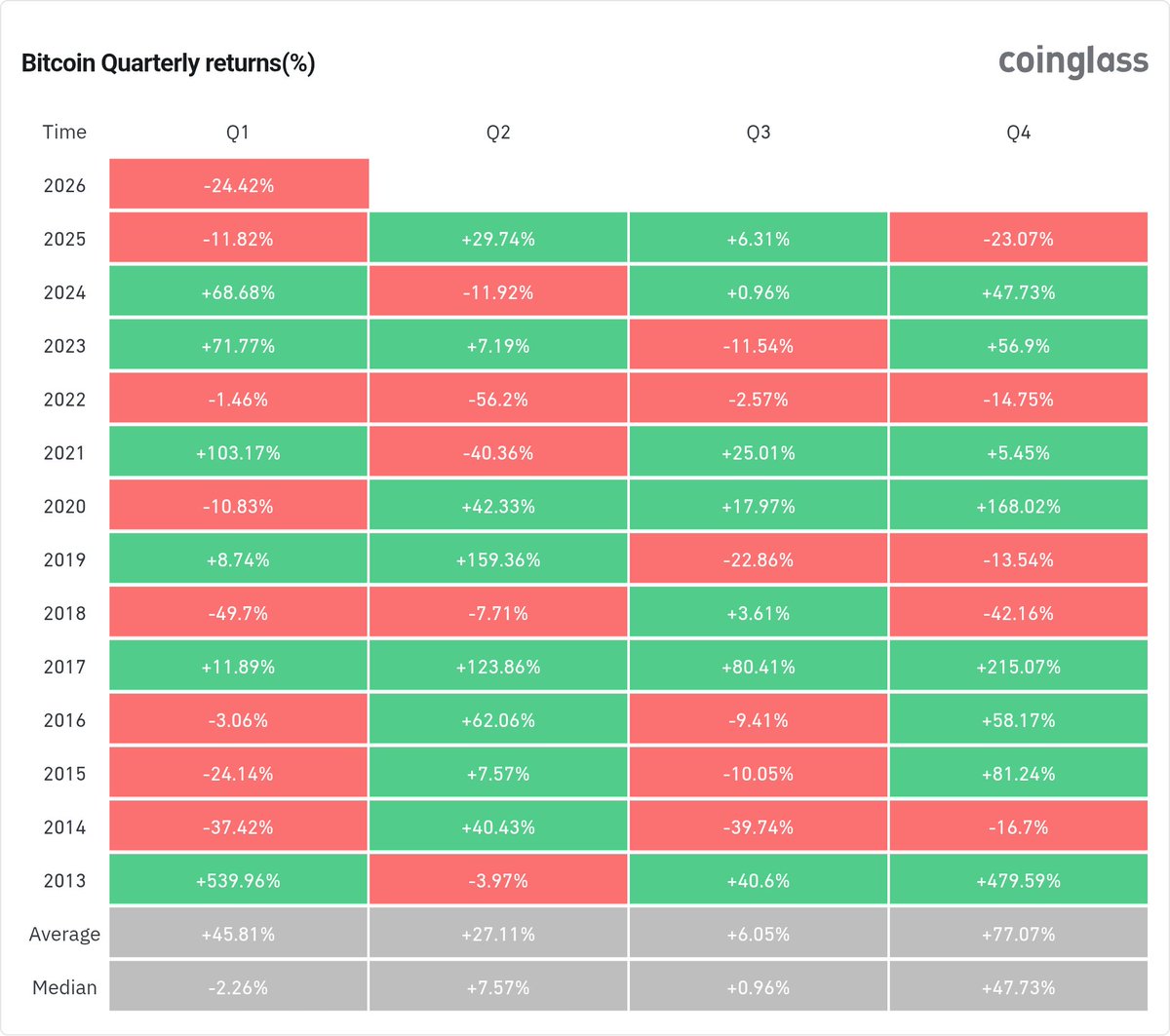
Bitcoin closed Q1 at $66.7K.
Fear & Greed: 11
Second-most extreme fear reading in 18 months.
Total market cap: $2.38T
Down -24.42% from the Q1 peak.
What’s intriguing isn’t the price.
It’s the mismatch.
You have:
➤ Regulation getting clearer
➤ Institutions still expanding infrastructure
➤ RWAs and stablecoins quietly scaling
At the same time:
➤ Price can’t hold momentum
➤ Sentiment is washed out
➤ Positioning feels defensive
That combination doesn’t show up often.
Usually, when structure improves, price follows.
Or when price breaks, it reflects structural weakness.
Right now, it’s neither.
This looks more like a confidence gap than a fundamental one.
Capital isn’t gone.
It’s just not expressing yet.
And crypto rarely stays in that state for long.
These setups tend to resolve with a decisive move, not a slow drift.
Either fear is correctly pricing something the market hasn’t surfaced yet.
Or the market is underpricing how much has changed underneath.
Q1 didn’t give an answer.
It just widened the gap.
Q2 is where that gap gets forced closed.
English
RAGE𝕏 retweetledi

➥ Stablecoins already won distribution and so does Stablecoin chains
~ $310B+ market cap
~ 30% of onchain volume
- expanding into payroll, remittance, B2B, even AI-agent payments
IMHO, where that activity settles matter more than the stablecoins themselves, that’s why stablecoin chains will be the next frontier
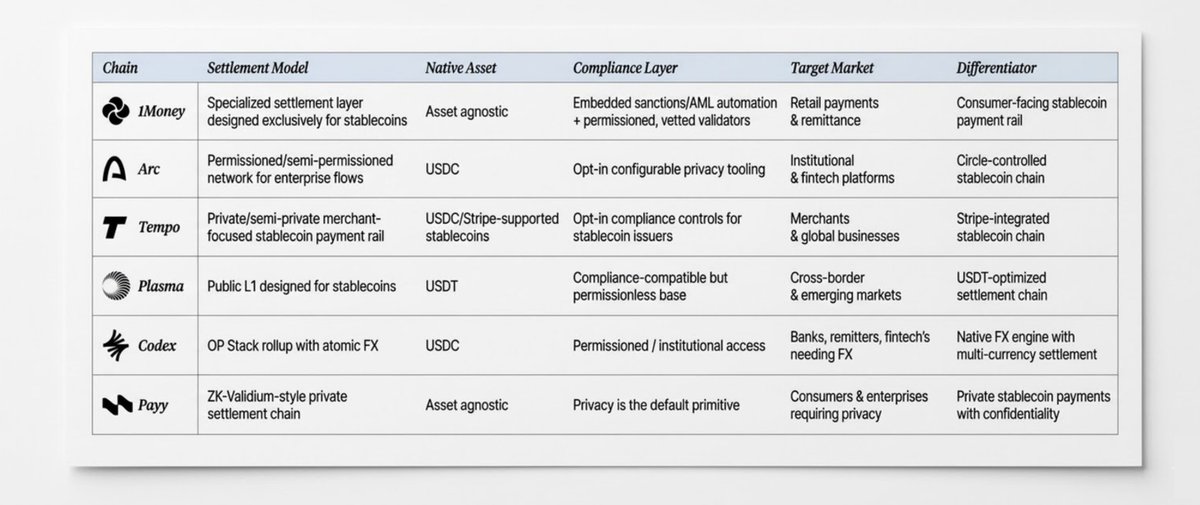
I’ve made a quick revisit-journey on the key players in this rail and here’s what I found
[1] Key Trends & Growth Drivers in Early 2026
→ Only @Plasma has meaningful live volume
- others are in testnet or very fresh mainnet like Tempo
- but its TVL has cooled post-hype/unlocks, shifting focus to sustainable payment usage vs. yield farming
→ @tempo's mainnet launch is the biggest recent catalyst
- Stripe's eco + AI-agent protocol could drive real merchant adoption fast
- early signs point to B2B/cross-border focus
→ @arc builds institutional credibility through testnet partnerships but needs mainnet to generate volume
→ Broader eco:
- Stablecoins now power ~30% of onchain volume
- Growth in yield-bearing models, card integrations such as Visa/Mastercard settling in stables & programmable B2B rails
- Competition intensifies as chains differentiate with retail vs. merchant vs. institutional vs. FX vs. privacy
[2] Overview of the Key Players
Here's a recap with current status and key updates:
> @1MoneyNetwork
- asset-agnostic, with embedded sanctions/AML automation and permissioned/vetted validators
- targets retail payments & remittance via a consumer-facing stablecoin payment rail
> @arc by Circle
- termissioned/semi-permissioned network for enterprise flows
- targets institutional & fintech platforms + aims for stablecoin-native finance as an "Economic OS"
> @tempo incubated by Stripe + Paradigm
- private/semi-private merchant-focused stablecoin payment rail
- targets merchants & global businesses
- early partners include Visa, Shopify, Nubank, and others for payouts, embedded finance & remittances
> @Plasma Tether-backed
- public L1 designed specifically for stablecoins, centered on USDT
- compliance-compatible but permissionless base
- targets cross-border & emerging markets
> @CodexFX
- permissioned/institutional access
- targets banks, remitters, fintechs needing FX.
- onchain FX has already processed $1B+ in stablecoin FX volume
> @payy_link
- ZK-validium-style private settlement chain
- asset-agnostic, with privacy as the default primitive
- targets consumers & enterprises requiring confidentiality
- emphasizes private stablecoin payments with compliance-friendly design
I’ve already seen Visa settling in stablecoins, Mastercard integrating rails, Stripe pushing merchant adoption & onchain FX
At this point, fading these signals feels outdated
So I’ll keep my eyes peeled to the stablechain landscape and share you alfa
English
RAGE𝕏 retweetledi

RAGE𝕏 retweetledi

RAGE𝕏 retweetledi

OH THE IRONY!!
The same influencers who dislike 🇳🇬 & 🇮🇳 and pushed for geo restrictions
crashed tf out when they learned that X would not let them profit off these same people
(In Nikita's comments on the monetization update)
Lessons their parents should have taught them
1. Hypocrisy always catches up with you
2. You reap what you sow.
3. Generalizing people is wrong
4. Segregation will not magically solve your problems
5. You can’t build an audience while disrespecting the very people in it

Deebs DeFi 🛰@Deebs_DeFi
If you are racist, you are not my friend If you belittle people based on country, economic status, you are not my friend I am white and I did not grow up in poverty But I still have compassion for my common man CT has a real freaking problem, and it's high time some of us called it out more.
English
RAGE𝕏 retweetledi
The biggest shift in onchain lending is not who is lending.
It is what is being priced.
While 2024 was defined by the recovery of over-collateralized giants like Aave, 2025 and early 2026 have belonged to the black horse of the cycle: @maplefinance.
By bridging the gap between institutional credit expertise and DeFi liquidity, Maple has transitioned from a niche lending venue into one of the primary engines for onchain private credit.
Over the past 14 months, the protocol has expanded its credit platform at a pace rarely seen in DeFi lending.
● How Maple Became a Scaled Credit Platform
As of March 24, 2026, Maple is managing roughly $806.7M in active loans across its lending markets.
The broader platform has scaled even further when including its yield products and liquidity infrastructure.
Platform AUM expanded from roughly $516M at the start of 2025 to over $4.5B by the end of 2025, before moving beyond $5B in total AUM entering 2026.
This distinction matters.
Maple did not simply attract deposits. It built a full credit platform that combines institutional lending, tokenized yield products, and distribution across major DeFi liquidity venues.
● The Catalyst That Unlocked Distribution
The structural turning point for Maple came with the launch of Syrup.
Syrup effectively permissionless-ized Maple’s credit infrastructure by allowing retail users, DAOs, and onchain allocators to access yield sourced from Maple’s institutional lending strategies.
By the end of 2025, the Syrup ecosystem had already reached meaningful scale:
➤ syrupUSDC AUM: $2.7B
➤ syrupUSDT AUM: $1.29B
➤ Combined Syrup dollar-product AUM: $4.06B
Instead of relying solely on institutional allocators, Maple now distributes institutional-grade credit yield across the broader DeFi liquidity base.
● Institutional Mandates
Institutional participation accelerated in 2025.
Bitwise allocated capital into Maple’s lending infrastructure, followed by family offices, trading firms, and hedge funds exploring onchain credit markets.
Operational performance strengthened confidence:
➤ Zero losses across secured lending products
➤ Zero forced liquidations
➤ All margin calls resolved within hours
For institutional allocators, resilience during volatility matters more than headline yields.
● Revenue and Token Alignment
Maple’s financial profile has scaled alongside its loan book.
➤ Protocol ARR: $30M+ by end of 2025
➤ Target: $100M ARR in 2026
Value capture is tied directly to the token economy.
➤ 25% of protocol revenue flows to the Syrup Strategic Fund
➤ The fund supports token buybacks and balance sheet expansion
Protocol growth now feeds directly into token value capture.
● Where Maple Goes From Here
Maple’s evolution signals a broader shift in the structure of onchain finance.
The protocol has moved beyond the early DeFi model of purely over-collateralized lending between crypto natives.
Instead, it is building a scalable marketplace for institutional credit onchain.
If that trajectory continues, Maple may ultimately become something larger than a lending protocol.
It may become the credit layer that connects traditional capital markets with the liquidity rails of DeFi.

English
RAGE𝕏 retweetledi

I think one of the most ignored risks in crypto right now is still protocol security.
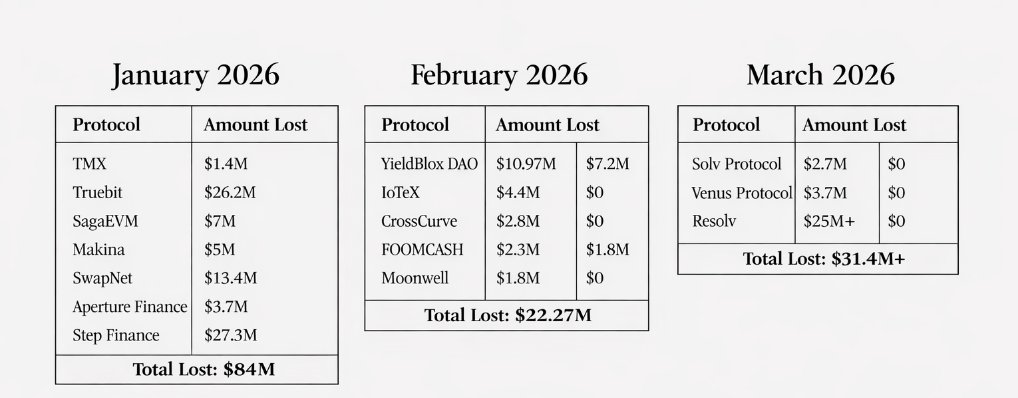
Using the 15 major DeFi exploits on my list, the market has already lost around $137.7M in 2026, and we are only in March.
January was the worst month so far at about $84M
TMX $1.4M.
Truebit $26.2M.
SagaEVM $7M.
Makina $5M.
SwapNet $13.4M.
Aperture Finance $3.7M.
Step Finance $27.3M.
February cooled to about $22.27M
YieldBlox $10.97M.
IoTeX $4.4M.
CrossCurve $2.8M.
FOOMCASH $2.3M.
Moonwell $1.8M.
March has already added about $31.4M+
Solv Protocol $2.7M.
Venus Protocol $3.7M.
Resolv $25M+.
That brings the running total to roughly $137.7M lost across major DeFi exploits in less than 3 months.
The pattern is still the same.
- Private keys fail.
- Oracles get manipulated.
- Approval design gets abused.
- Unaudited code breaks under pressure.
The market keeps chasing new narratives.
Attackers keep farming old mistakes.
In crypto, security is still one of the clearest edges, and one of the most expensive things to ignore.
English
RAGE𝕏 retweetledi

RAGE𝕏 retweetledi

$1T+ asset.
Zero yield.
That never made sense to me.
Being the most valuable asset in crypto, Bitcoin still sits largely idle.
There is no yield, no credit markets, and not even a meaningful DeFi integration.
Personally, I think this is a huge gap that’s been overlooked for too long.
It doesn’t make sense that the largest asset in crypto is still this underutilised.
That’s what Hashi is trying to change.
Hashi is a new Bitcoin finance built on @SuiNetwork.
It is designed to unlock institutional Bitcoin participation at scale, bringing lending and credit origination into a transparent, compliant onchain environment.
And the backing and infrastructure on it is serious:
➢ Custody & wallets: @BitGo, @BlockdaemonHQ, @Cobo_Global, @FordefiHQ, @Ledger
➢ Brokerages & liquidity: @Bullish, @ereborbank, @FalconXGlobal
➢ Infrastructure & security: @CFBenchmarks, @Certora, @OpenZeppelin
➢ Security: @AsymptoticTech, @Certora, @osec_io
You and I can see the system is stacked, and it is ready to work.
Personally, I think this is what real BTC DeFi infrastructure should look like.
With Hashi, BTC holders can earn yield, lend BTC, and borrow against their Bitcoin.
And it’s not launching in isolation.
I like that it’s coming with an ecosystem from day one, not trying to build demand later.
Protocols like @AlphaLendSui, @navi_protocol, @Scallop_io, and @suilendprotocol are already building on top.
The major unlock DeFi might need is activating Bitcoin.
And Hashi is just what we all need right now.

Sui@SuiNetwork
Introducing Hashi: a new era of Bitcoin finance on Sui. Bitcoin's market cap exceeds $1 trillion. < 0.5% of it is used in DeFi. Hashi is here to change that, with commitments from industry leaders including BitGo, Bullish, Erebor Bank, FalconX, Fordefi, Ledger, and more.
English
RAGE𝕏 retweetledi

attention in crypto doesn’t go to the best project.
it goes to the project with the best distribution system.
you can have:
• great art
• strong tech
• solid vision
if nobody sees it, it doesn’t matter
meanwhile, average projects win because:
they understand how to:
• capture attention
• keep people engaged
• turn participation into momentum
this is the part most builders ignore
they build in silence and hope people will notice
they won’t. attention is not given.
it’s engineered.
English
RAGE𝕏 retweetledi

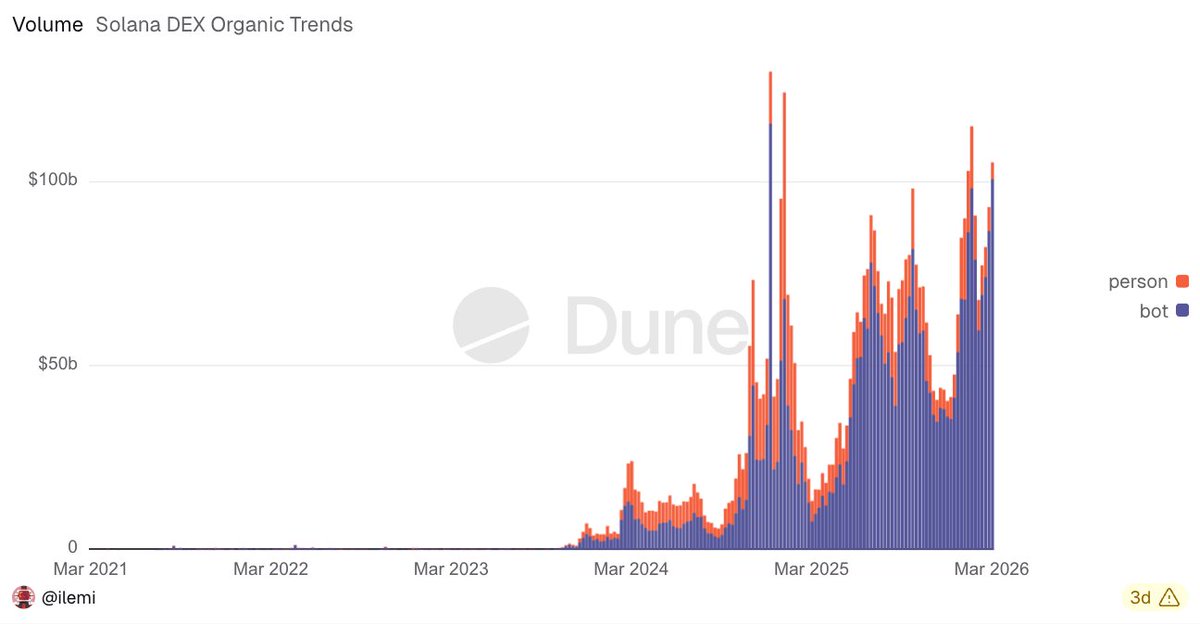
95%+ of DEX volume on Solana is generated by trading bots.
This is who you're trading against.
English
RAGE𝕏 retweetledi

RAGE𝕏 retweetledi
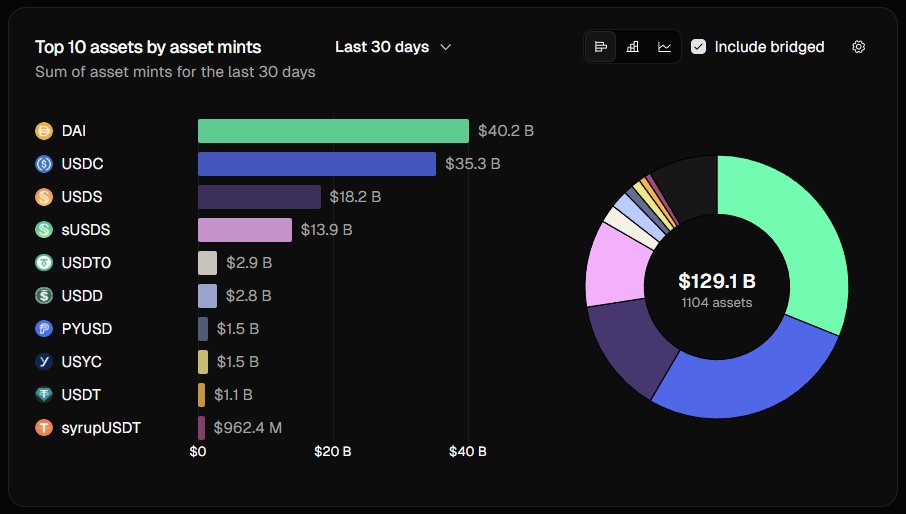
Stablecoin supply growth is accelerating.
I've ranked them by 30-day mint volume:
1. @SkyEcosystem: DAI – $40.2B
2. @circle: USDC – $35.3B
3. @SkyEcosystem: USDS – $18.2B
4. @SkyEcosystem: sUSDS – $13.9B
5. @tether: USDT0 – $2.9B
6. @usddio: USDD – $2.8B
7. @Paxos + @PayPal: PYUSD – $1.5B
8. @circle: USYC – $1.5B
9. @tether: USDT – $1.1B
10. @maplefinance: syrupUSDT – $962M
The established names still dominate total supply, but new demand is diversifying.
English
RAGE𝕏 retweetledi
As stablecoin issuance becomes more standardized, value is shifting away from mint-and-burn mechanics and toward regulation, reserve management, distribution, and payment utility.
Rather than comparing all providers as if they do the same thing, the market is better understood as three adjacent layers:
• Regulated issuers of record: @Paxos , @Anchorage , @brale_xyz , @circle , @Ripple , @withAUSD
• Issuance and orchestration infrastructure: @Stablecoin , @Bastion , @zerohashx , @FireblocksHQ , @OpenPayd , @BVNKFinance
• Distribution, liquidity, and network layers: @coinbase , @SoFi , @Fiserv , @m0 , @tassatgroup
That is why the white-label stablecoin market is no longer defined only by who legally issues the token.
The core differences across providers are regulatory posture, reserve design, target customer, control of the issuance stack, and access to liquidity and payment rails.
h/t : @Delphi_Digital's stablecoin report served as a source for most of the information while I added more details.

English
RAGE𝕏 retweetledi
RAGE𝕏 retweetledi
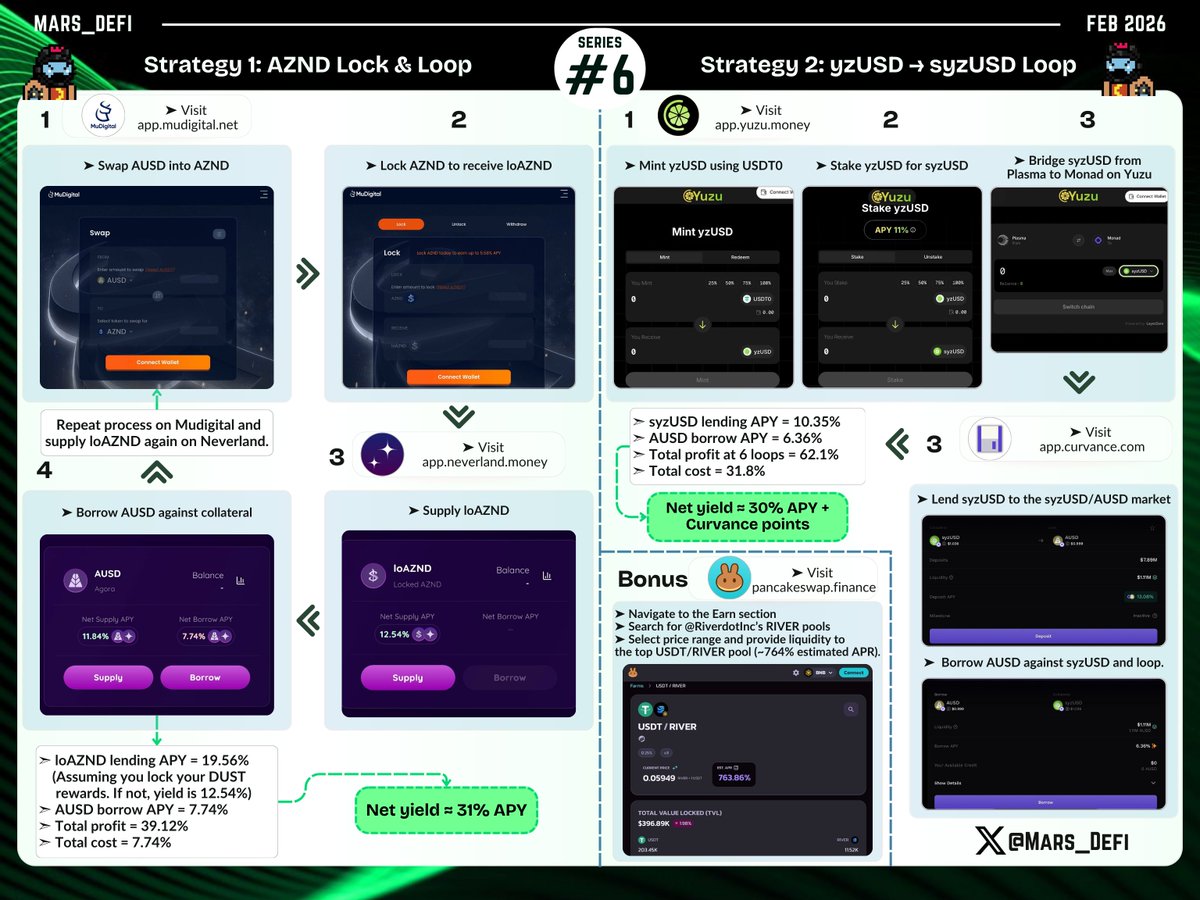
Yield Infographic Series #6
Strategy 1: 31% APY
Strategy 2: 30% APY + Points
Bonus strategy: 763% APR
Protocols Highlighted:
@MuDigitalHQ - RWA platform that tokenizes Asian credit markets to provide on-chain yields
@Neverland_Money - @monad-native lending protocol built on the Aave V3 framework
@YuzuMoneyX - Yield protocol that integrates high-yield DeFi strategies into an overcollateralized stablecoin
@Curvance - Modular, multichain money market protocol for optimized yield and capital efficiency
@PancakeSwap - Multi-chain DEX on @BNBCHAIN that operates on an AMM model
English



RAGE𝕏 retweetledi
The crypto market is not waiting for a catalyst.
It is processing one.
As of February 4, 2026, U.S. spot Bitcoin ETFs have recorded approximately $1.61B in net monthly outflows, with a single-day peak redemption of $817M (Jan 29). This is not discretionary selling. It is the mechanical execution of institutional mandates.
The flow profile reflects programmatic transmission, not sentiment reversal.
● The Macro Condition That Activated the Flows
The trigger is external to crypto.
Following 2025 easing, the Federal Reserve and 70% of global central banks have shifted into a synchronized rate-hold regime, maintaining policy rates in the 3.5%–3.75% range. That decision resets the global risk-free rate floor.
In institutional portfolio construction, this matters because:
➣ Higher terminal rates raise required returns for high-beta allocations
➣ Value-at-Risk (VaR) models automatically compress risk budgets
➣ Bitcoin, as the most liquid high-beta asset, is repriced first
The ETF vehicle is the cleanest transmission layer for that repricing.
● Why These Flows Aren’t Emotional
ETF outflows are driven by rules, not conviction.
Three mechanics explain the current flow pattern:
1. Weight Rebalancing Most multi-asset portfolios cap crypto exposure at 1–3%. Bitcoin’s rally into the high-$90Ks in mid-January mechanically breached those bands, forcing rebalancing irrespective of outlook.
2. Cost-Basis Breach The estimated average cost basis for U.S. spot BTC ETFs sits near $90,200. With spot trading around $76,000, ETF holders are 15–16% underwater, a common trigger for mandated risk reduction.
3. January Capital Rotation January 2026 saw approximately $165B in inflows into broader equity ETFs, concentrated in mid-caps, small-caps, and international equities. Crypto is no longer the default marginal risk allocation.
These decisions occur on calendar schedules, not intraday price signals.
● Flow Receipts (January–Early February 2026)
- $BTC ETF net flow (30D): −$1.61B
- Largest single-day outflow: $817M (Jan 29)
- Estimated ETF cost basis: $90,200
- $BTC Jan peak-to-trough drawdown: −22.3%
These are settlement flows, not paper marks.
● Why Supply Is Pressuring Price
At current run-rates, the market is absorbing approximately $2.1B/month in net sell pressure across ETFs and corporate treasury rebalancing. That equates to roughly 27,000–28,000 $BTC per month at current prices.
➣ Post-halving issuance is approximately 13,500 $BTC/month.
➣ ETF-driven supply is therefore running at 2× new issuance.
This mismatch explains why spot stabilization has lagged narrative stabilization.
● Why This Isn’t Indecision
Capital is not idle.
- ETF redemptions are being settled
- Treasury holdings are being offered to meet obligations
- Portfolios are being resized to new rate assumptions
This is the transition from a speculative inflow regime (2024–2025) to a maintenance and rebalancing regime (2026).
Price finds support only when mandated selling completes and flows equilibrate with long-term balance-sheet buyers.
● Conclusion
ETF outflows are not signaling abandonment.
They are signaling completion of a rules-based adjustment cycle.
Bitcoin is being repriced as a high-beta allocation in a higher-for-longer rate world. Until institutional mandates finish transmitting, price discovery remains mechanical, not narrative-driven.
This is not waiting.
This is the system clearing.

English