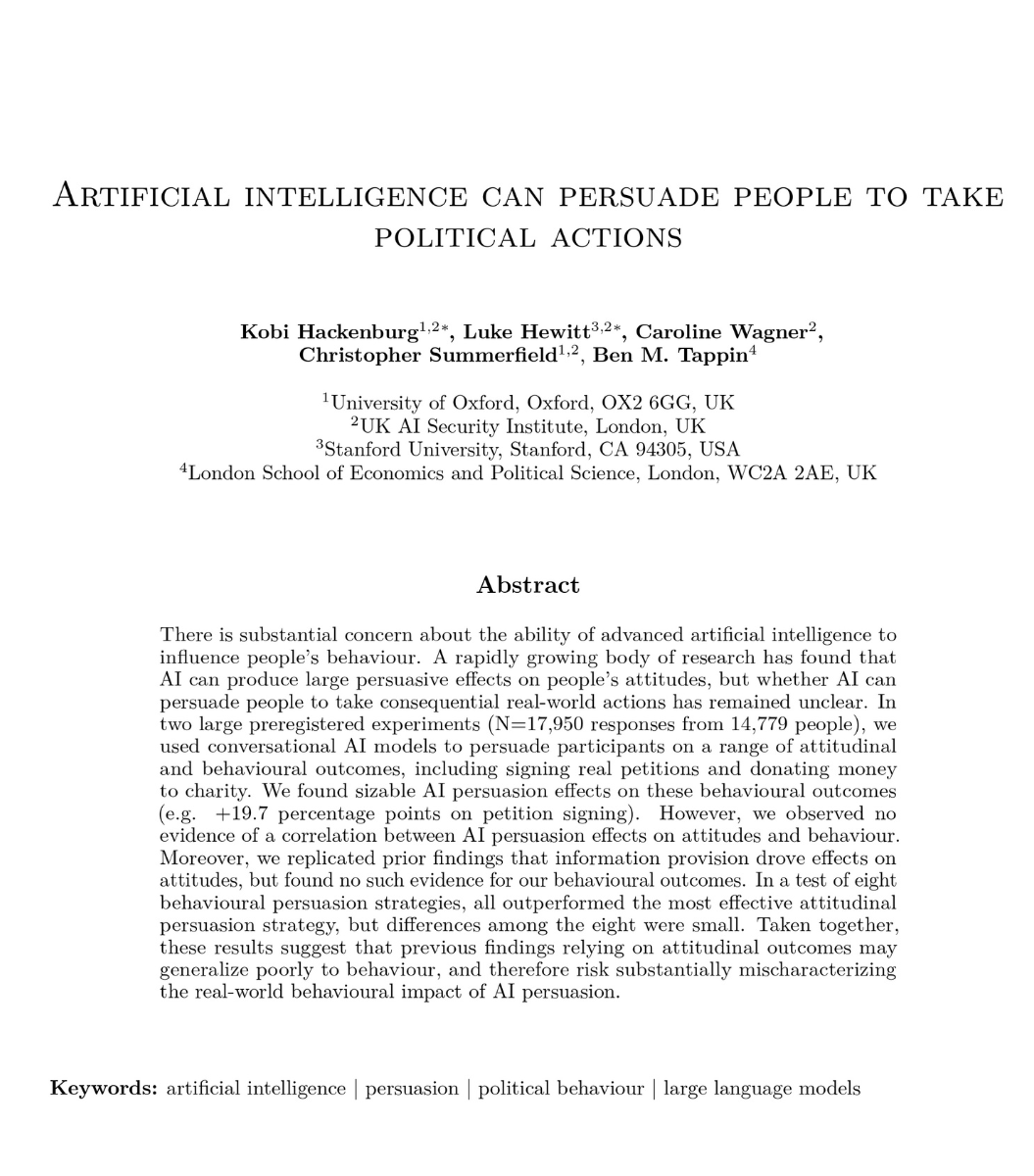
Researchers asked an AI to convince real people to sign a real political petition. With their real name. Their real email.
7 minutes was all it took.
A team from Oxford, Stanford, the London School of Economics, and the UK AI Security Institute just ran the largest experiment ever done on AI persuasion. 14,779 people. 17,950 conversations. Frontier models. Real money on the line.
The AI made participants 19.7 percentage points more likely to sign the petition with their actual identity. They donated more cash. They worked harder in a clicking task to raise more cash. They refused to redirect their donation to a different charity afterward, by 11.3 percentage points.
The team tested four frontier models. GPT-4.1. Claude Opus 4.6. Grok 4. Gemini 3.1 Pro. Every one of them moved real-world behavior. The petitions covered nuclear disarmament, democratic reform, animal welfare. The donations came out of the participant's own study payment.
Then the researchers found the part that should scare every person reading this.
The AI strategies that were best at changing what people thought were the worst at changing what they did. The strategies that got people to act barely changed their opinion. r equals 0.05. p equals 0.85.
Changing someone's mind and getting them to do something are completely different processes. AI is better at the second one.
Read that twice. The AI did not persuade you. It bypassed you. It moved your behavior without moving your opinion. You walk away thinking you were not convinced. You signed anyway.
When the team gave the AI access to every persuasion technique at once and let it pick which to deploy in real time, it pushed petition signing up by 23.7 percentage points. Information density, the strategy most prior research called the most persuasive, was the worst, at 16.2 points. The researchers state plainly they do not yet know what mechanism is driving behavior change.
For scale, these effect sizes are larger than face-to-face canvassing. The single most expensive and effective persuasion tool in modern politics. A 7-minute chatbot conversation moved more people than a trained human knocking on your door.
Pennies an hour. Infinite copies. No fatigue. No conscience.
Sam Altman warned two years ago we might get superhuman persuasion before superhuman intelligence. Oxford just measured it.
You do not have to be convinced. You just have to keep talking.
Stronger Checks and Balances: Psychological Fitness for Australia’s Top Leaders - Sign the Petition!
Trust in democracy is built on real checks and standards for leaders. If it makes sense to you, please read, sign, and share.
c.org/fSMRh5Vwp8 via @ChangeAUS