
Yannick Morvan @[email protected]

7.9K posts

Yannick Morvan @ymorvan@bsky.social banner
Yannick Morvan @ymorvan@bsky.social

Yannick Morvan @[email protected]

@yannick_morvan

Psychologist PhD - Professor Université Paris Nanterre / Associate researcher Inserm CESP - Clinical FSEF & St-Anne Hospital - SHU - C3RP

Paris - France Katılım Haziran 2014
1.3K Takip Edilen930 Takipçiler
Yannick Morvan @[email protected] retweetledi

Hudson Golino
Hudson Golino@GolinoHudson·
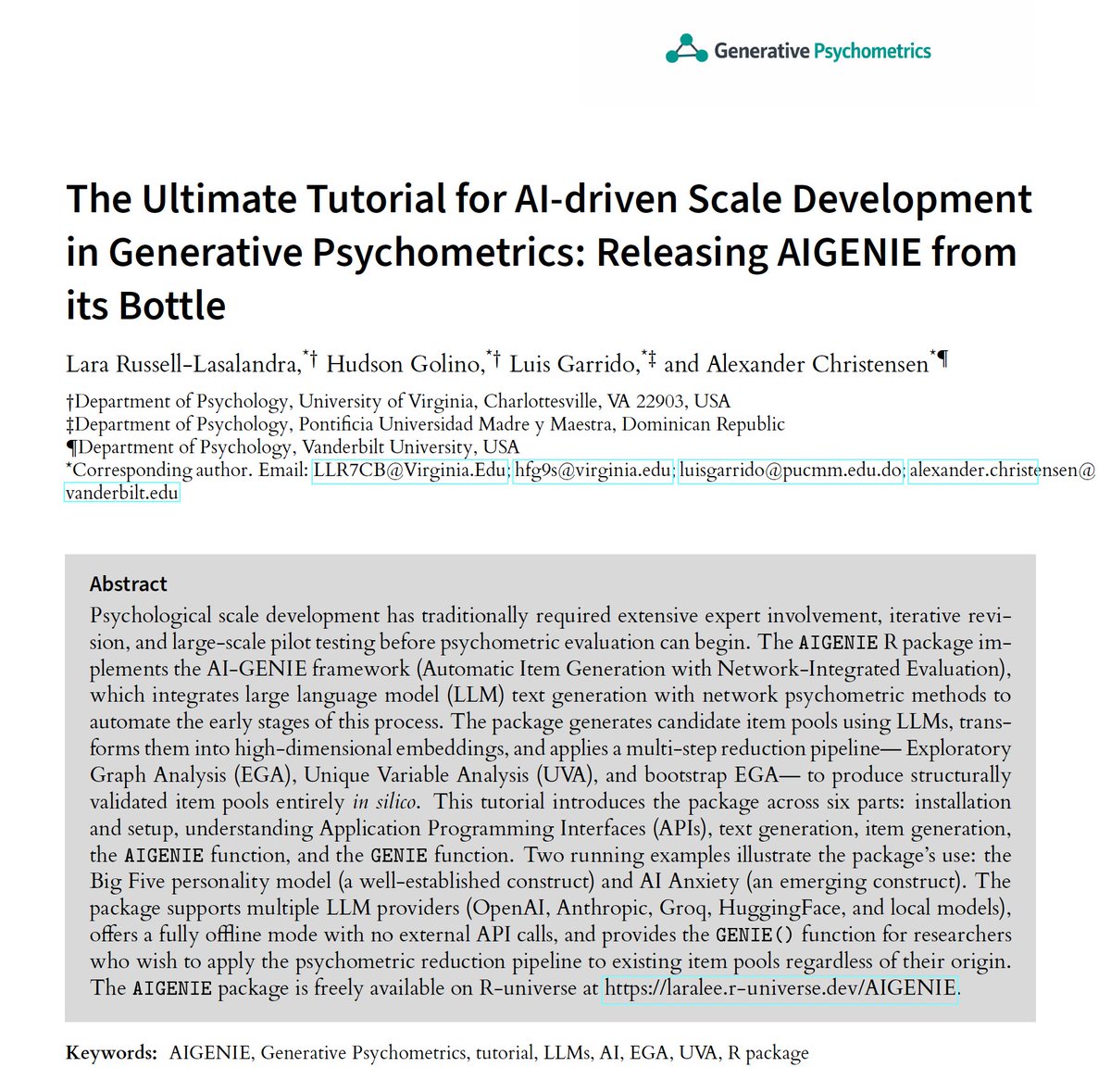
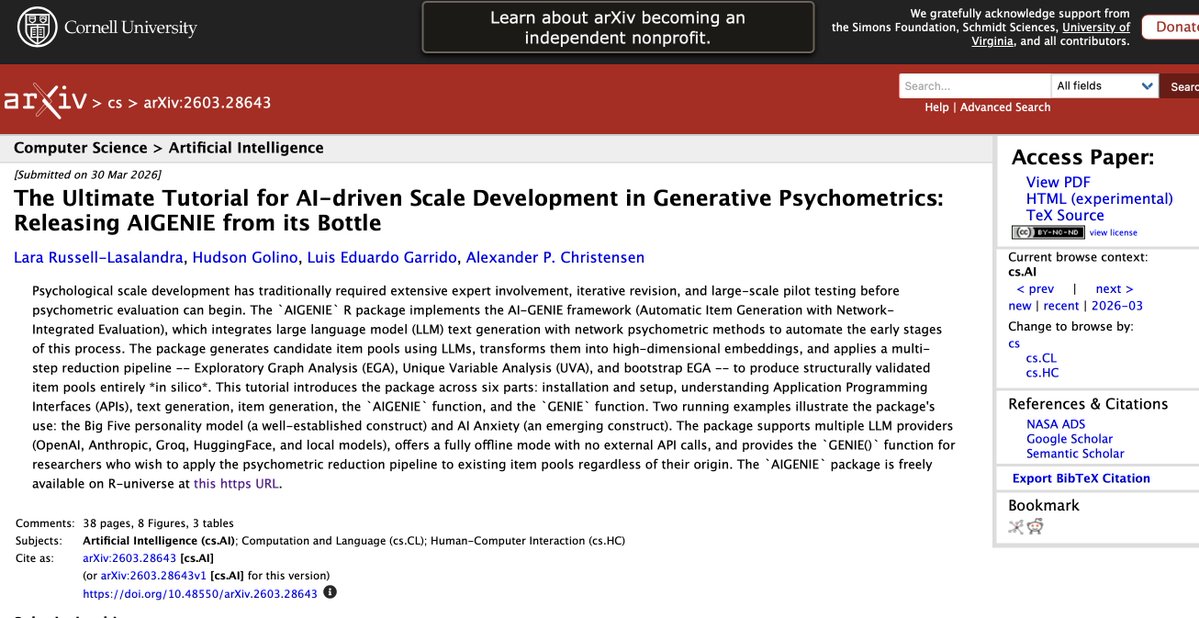
The Ultimate Tutorial for AI-driven Scale Development in Generative Psychometrics: Releasing AIGENIE from its Bottle, is now available on @arxiv_org !! Learn how to use our AIGENIE R Package for Automatic Item Generation and Validation with Network Integrated Evaluation! Check it out! Another gem led by @larafromUVA !
Hudson Golino tweet mediaHudson Golino tweet media
English
3
7
25
1.1K
Yannick Morvan @[email protected] retweetledi
Hudson Golino
Hudson Golino@GolinoHudson·
Very interesting new paper by Mariana Teles and Aleksandar Tomašević (@atomasevic), recently published at College Teaching (link below). They used our transforEmotion R package to apply LLM-based text classification via zero-shot classification of open-ended student feedback, revealing large effect sizes across engagement and learning dimensions THAT TRADITIONAL LIKERT SCALES OF STUDENTS EVALUATION OF TEACHING missed! Very cool and innovative paper: tandfonline.com/doi/full/10.10…
Hudson Golino tweet media
English
0
6
29
2.4K
Yannick Morvan @[email protected] retweetledi
Hudson Golino
Hudson Golino@GolinoHudson·
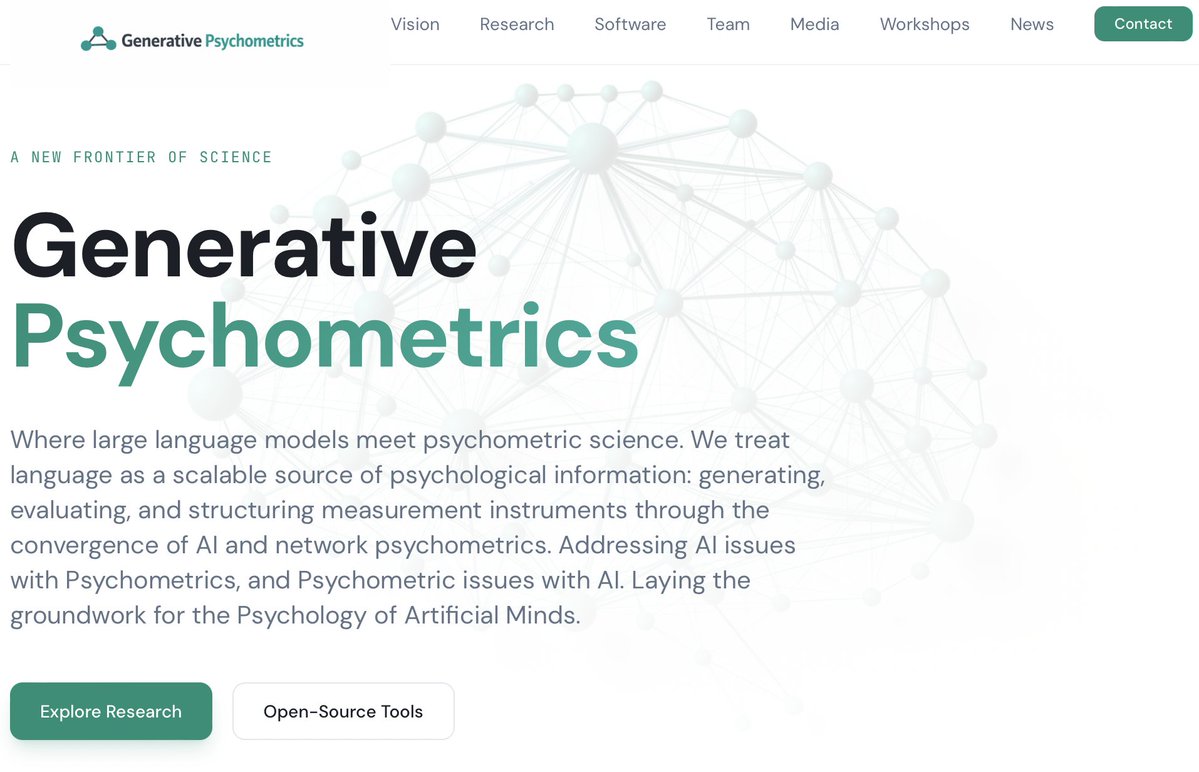
I'm thrilled to announce the launch of our Generative Psychometrics website, a new frontier where large language models meet psychometric science. Link Below! Our interdisciplinary team treats language as a scalable source of psychological information: generating, evaluating, and structuring measurement instruments through the convergence of AI and network psychometrics. We're addressing AI issues with Psychometrics, and Psychometric issues with AI - laying the groundwork for the Psychology of Artificial Minds. Explore our research, open-source tools (like the `AI-GENIE` and `transforEmotion` R packages), and upcoming workshops at 👉 generativepsychometrics.com #Psychometrics #ArtificialIntelligence #NetworkScience #OpenSource #ComputationalPsychology
Hudson Golino tweet media
English
8
40
196
22.9K
Yannick Morvan @[email protected] retweetledi
Sacha Epskamp
Sacha Epskamp@SachaEpskamp·
mlVAR #Rstats 📦 version 0.6.1 is now on CRAN! Some major updates in this version include the mlGGM function for multi-level GGM estimation on nested cross-sectional data (e.g., students nested in classrooms) and the inclusion of residuals + predicted values from the mlVAR results. cran.r-project.org/web/packages/m…
English
1
7
31
2K
Yannick Morvan @[email protected] retweetledi
Agustin Ibañez
Agustin Ibañez@AgustinMIbanez·
Music helps to understand the mind and the brain. Throughout the history of science, metaphors have shaped how we understand complex phenomena. The brain-as-computer metaphor has guided decades of theories and research. We propose music as a scientific metaphor for understanding the mind and brain via triplicate interfaces (listener, performer, composer) and a compound set of predictions. Multiple domains of music can be mapped onto different neural, cognitive and intersubjective processes such as network coordination, prediction, emotion and meaning. Neurocognition is not static but a dynamic, embodied, and time-sensitive system, much like a self-organized orchestra in which multiple processes interact simultaneously. Drawing on synergetics, predictive processing, and embodied cognition, we outline musical principles illuminating cognitive and action integration across time, offering new conceptual frameworks and testable predictions for future research. I enjoyed writing this piece with these stellar authors: @Kaiameye, @acolverson1, Christopher Bailey, @brucemillerucsf, @dafneduron90, Nicholas Johnson, Olga Castaner, @PierLuigiSacco, Eoin Cotter and Lucia Melloni. Science, like music, advances through new ways of listening to complex systems: doi.org/10.1016/j.neub…
Agustin Ibañez tweet media
English
33
671
2.5K
95.7K
Yannick Morvan @[email protected] retweetledi
Dr. Mick 🕊️
Dr. Mick 🕊️@mickael_sp·
🗣️ Adrien Fillon nous parle de conflits d'intérêts, biais de publication, statistiques mal maîtrisées, interprétations et gold standard pas si gold. ℹ️ À retrouver dans « Communiquer en santé mentale : repères pour de nouvelles stratégies et pratiques » communication-santementale.fr/2026/03/16/com…
Français
1
4
4
410
Yannick Morvan @[email protected] retweetledi
Awais Aftab
Awais Aftab@awaisaftab·
A new paper from the HiTOP Revisions Workgroup (and yours truly) on the conceptual and philosophical underpinnings of the framework. Recommended reading for anyone interested in questions of classification and psychopathology! Here’s the journal article: muse.jhu.edu/pub/1/article/…
Awais Aftab tweet media
English
4
44
101
16.1K
Yannick Morvan @[email protected] retweetledi
JAMA Psychiatry
JAMA Psychiatry@JAMAPsych·
This narrative review suggests mental disorders are statistical clusters of biopsychosocial properties, not sharply defined categories, mirroring concepts in species classification and supporting dimensional #MentalHealth frameworks. ja.ma/4sJvGuj
JAMA Psychiatry tweet media
English
8
53
233
18K
Yannick Morvan @[email protected] retweetledi
Shirley B. Wang
Shirley B. Wang@ShirleyBWang·
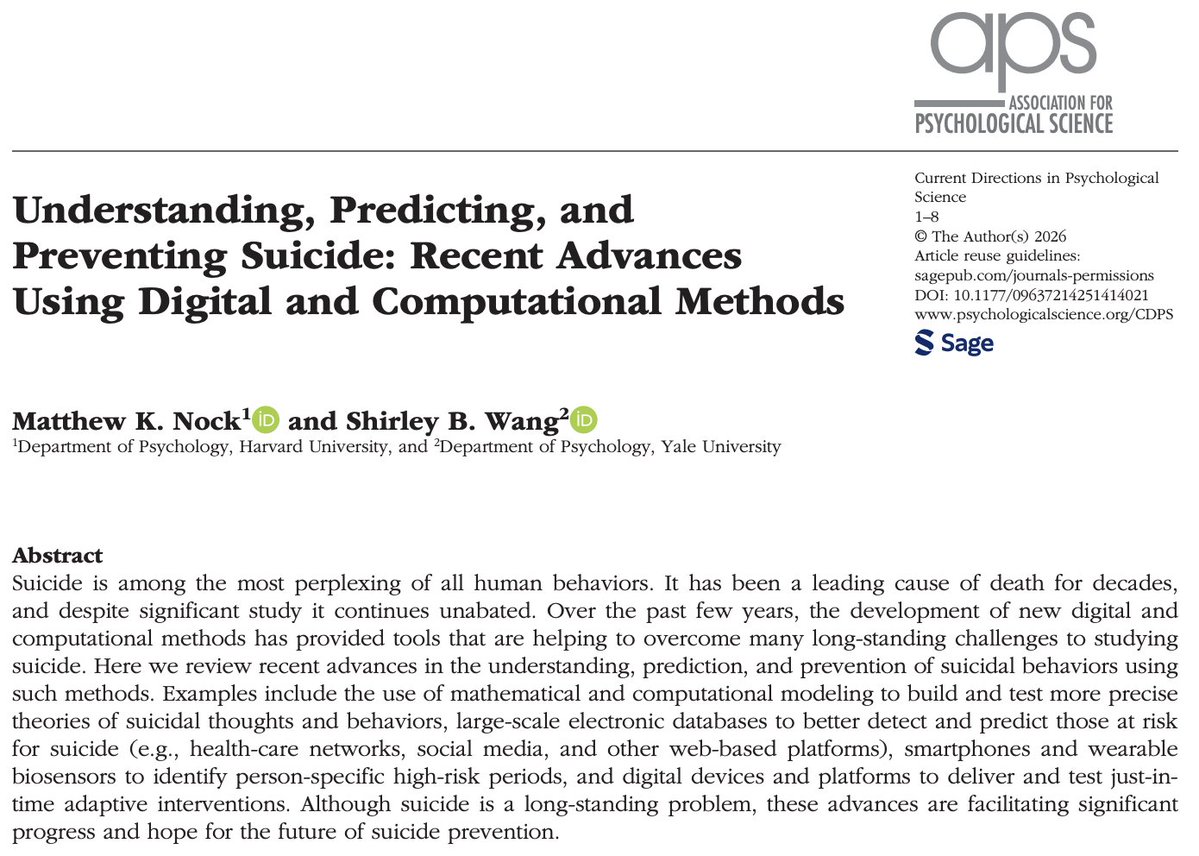
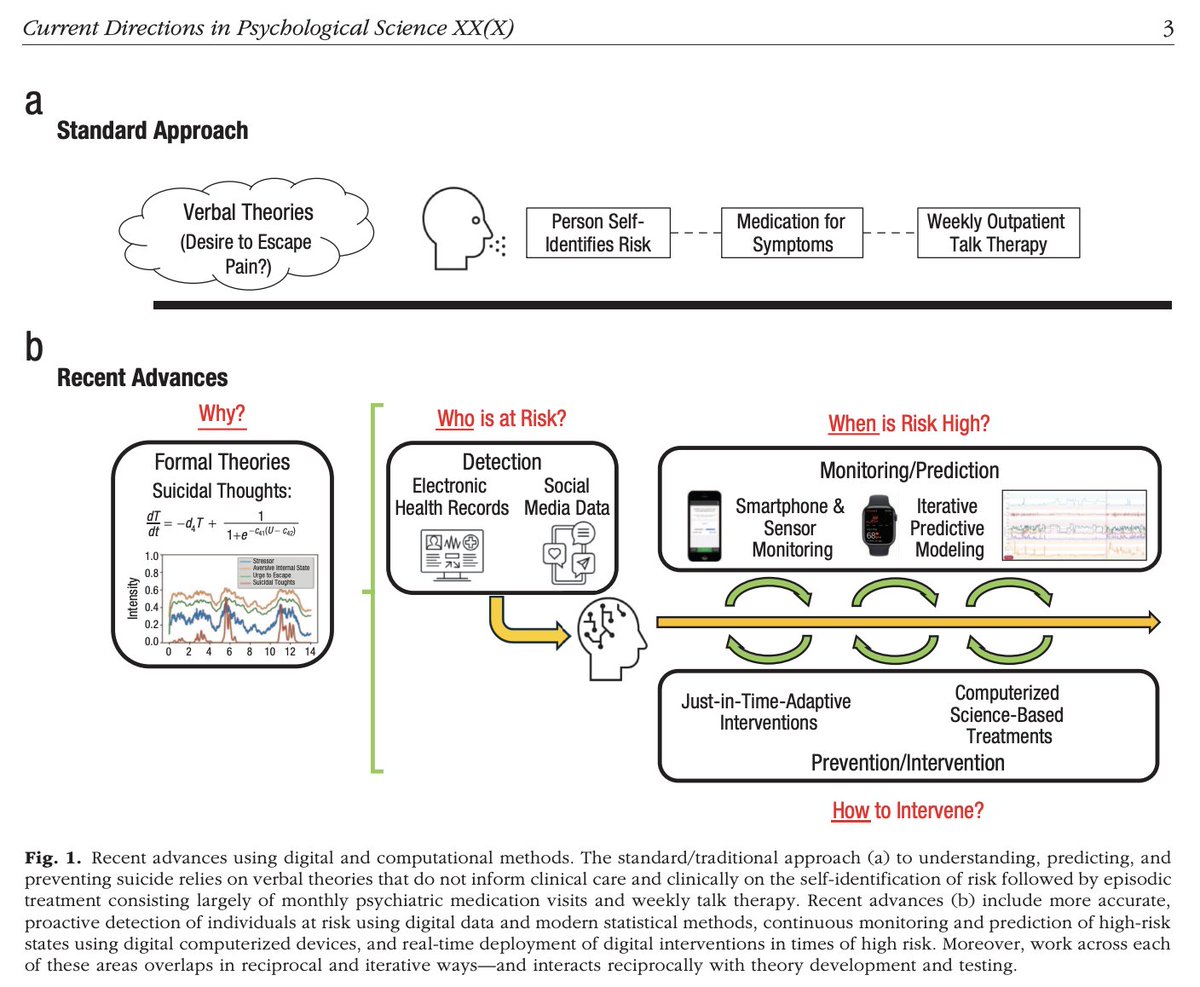
🚨 New paper out in Current Directions in Psychological Science, with @mk_nock! We review recent advances in digital & computational methods for understanding, predicting, and preventing suicide.
Shirley B. Wang tweet mediaShirley B. Wang tweet media
English
2
22
87
5.8K
Yannick Morvan @[email protected] retweetledi
JAMA Psychiatry
JAMA Psychiatry@JAMAPsych·
This narrative review suggests mental disorders are statistical clusters of biopsychosocial properties, not sharply defined categories, mirroring concepts in species classification and supporting dimensional #MentalHealth frameworks. ja.ma/4rrTJgk
JAMA Psychiatry tweet media
English
10
94
448
27.3K
Yannick Morvan @[email protected] retweetledi
Hudson Golino
Hudson Golino@GolinoHudson·
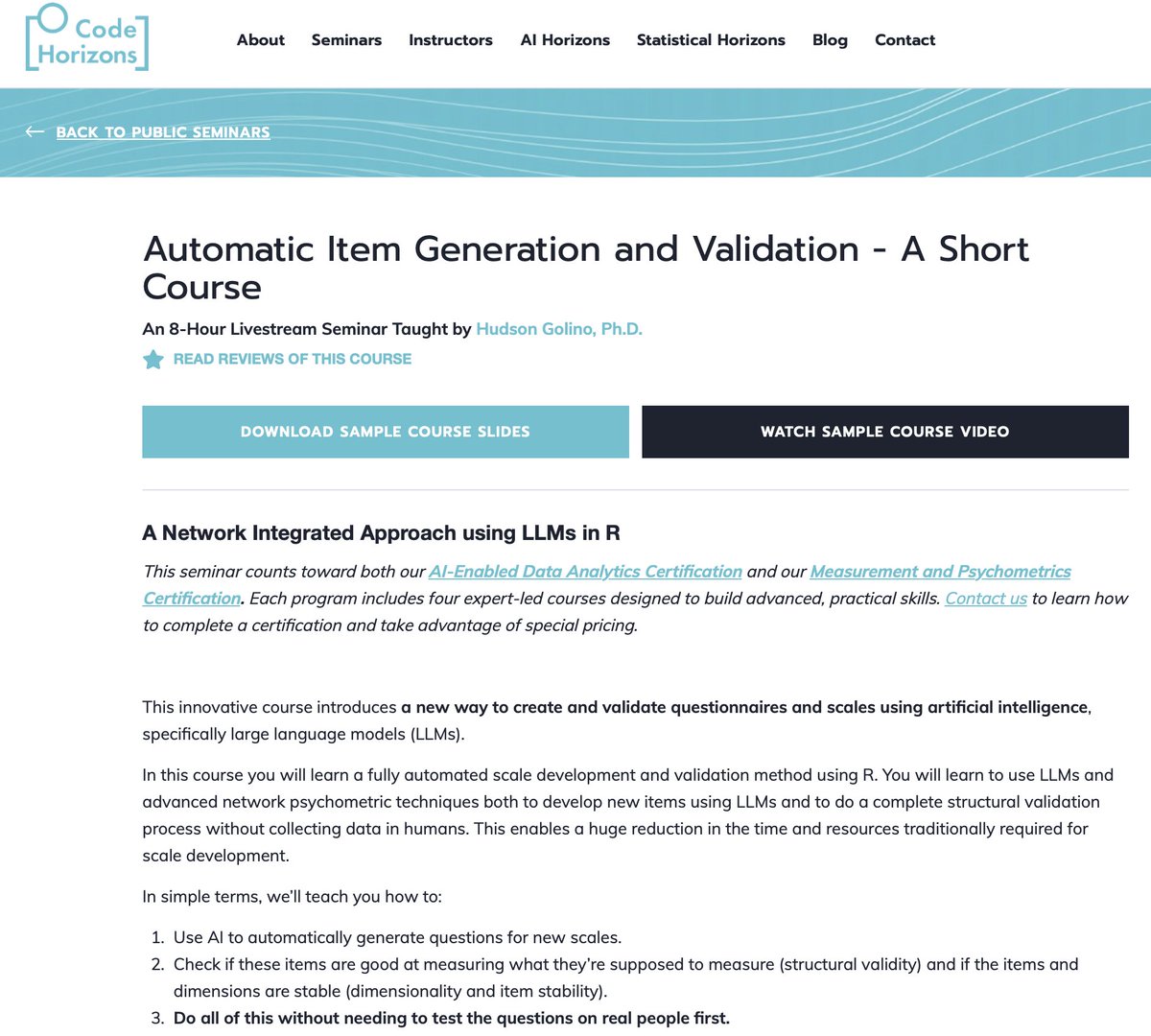
March 11 and 13th: Automatic Item Generation and Validation - A Short Course An 8-Hour Livestream Seminar Taught by Hudson Golino, Ph.D. A Network Integrated Approach using LLMs in R: This innovative course introduces a new way to create and validate questionnaires and scales using artificial intelligence, specifically large language models (LLMs). More interestingly, you'll have EXCLUSIVE access to the final version of the AI-GENIE package for R!! In this course you will learn a fully automated scale development and validation method using R. You will learn to use LLMs and advanced network psychometric techniques both to develop new items using LLMs and to do a complete structural validation process without collecting data in humans. This enables a huge reduction in the time and resources traditionally required for scale development. In simple terms, we’ll teach you how to: Use AI to automatically generate questions for new scales. Check if these items are good at measuring what they’re supposed to measure (structural validity) and if the items and dimensions are stable (dimensionality and item stability). Do all of this without needing to test the questions on real people first. Traditionally, creating a good questionnaire or test (usually called a “scale” in research) takes a lot of time and money. It usually involves writing many questions, testing them on hundreds of people, and then using complex statistics to figure out which questions work best. Our course shows you how to do all this using R and AI using a method called AI-GENIE (Automatic Item Generation and Validation via Network Integrated Evaluation). Link below:
Hudson Golino tweet media
English
2
3
6
549