Yunmin Cha

227 posts

Yunmin Cha banner
Yunmin Cha

Yunmin Cha

@ynmncha

BBA + CS @ Yonsei Interested in data-driven product and AI strategy. Posting notes, code snippets, and readings. Open to research collabs.

Seoul, Republic of Korea Katılım Eylül 2025
70 Takip Edilen84 Takipçiler
Yunmin Cha retweetledi
Xindi Wu
Xindi Wu@cindy_x_wu·
New #NVIDIA Paper We introduce Motive, a motion-centric, gradient-based data attribution method that traces which training videos help or hurt video generation. By isolating temporal dynamics from static appearance, Motive identifies which training videos shape motion in video generation. 🔗 research.nvidia.com/labs/sil/proje… 1/10
English
11
112
539
72.8K
Yunmin Cha retweetledi
Kyunghyun Cho
Kyunghyun Cho@kchonyc·
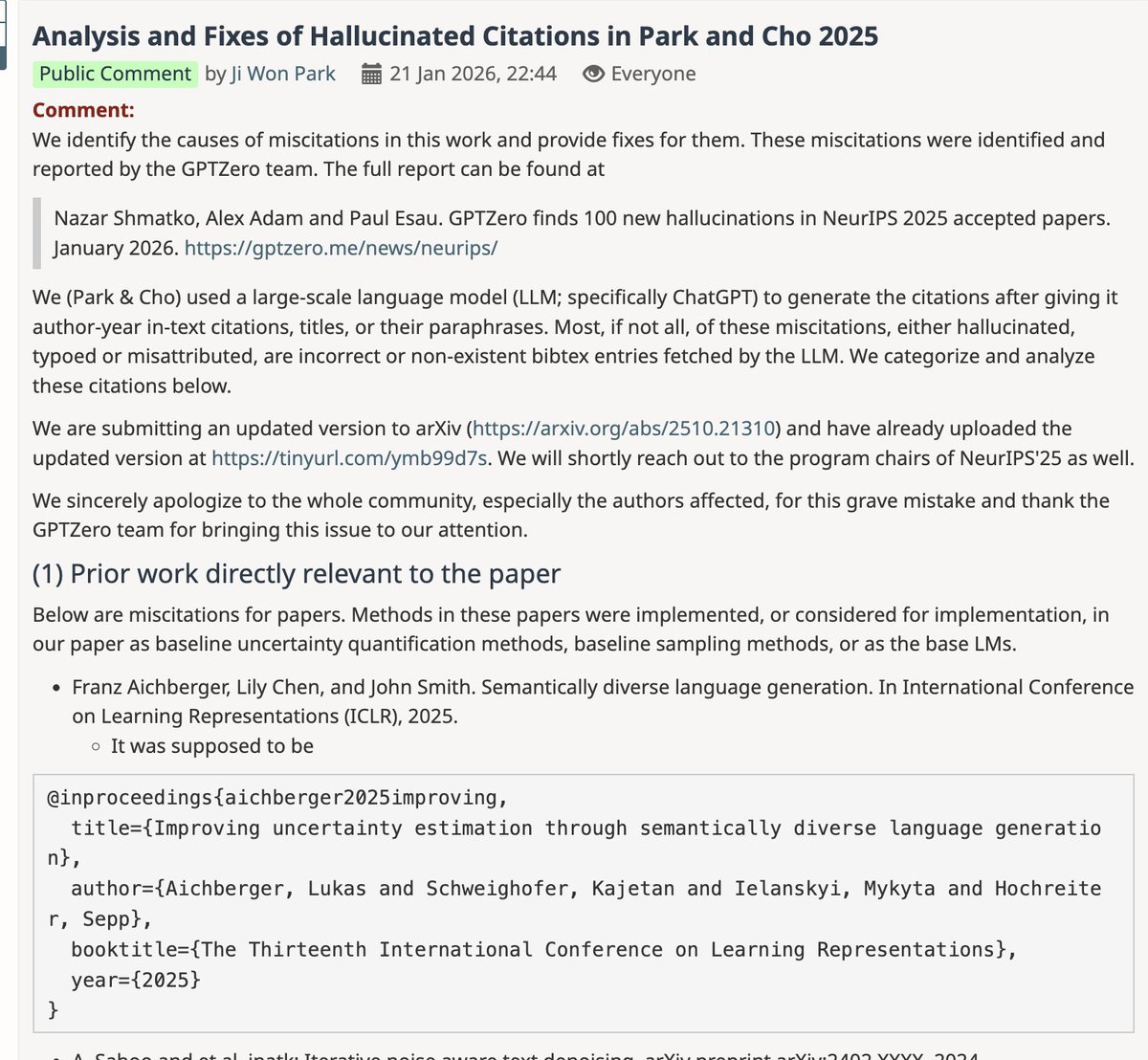
i was made aware of miscitations thanks to the GPTZero team (cc @alexcdot). ji won and i quickly checked them ourselves and have posted what happened on openreview: openreview.net/forum?id=IiEtQ…. we have already notified NeurIPS'25 PC's about this issue. i truly thank the GPTZero team for bringing this to our attention as well as raising the awareness of this serious issue (gptzero.me/news/neurips/), and at the same time i sincerely apologize to all for our error.
Kyunghyun Cho tweet media
English
20
23
294
84.8K
Yunmin Cha retweetledi
Andrej Karpathy
Andrej Karpathy@karpathy·
nanochat d32, i.e. the depth 32 version that I specced for $1000, up from $100 has finished training after ~33 hours, and looks good. All the metrics go up quite a bit across pretraining, SFT and RL. CORE score of 0.31 is now well above GPT-2 at ~0.26. GSM8K went ~8% -> ~20%, etc. So that's encouraging. The model is pretty fun to talk to, but judging from some early interactions I think people have a little bit too much expectation for these micro models. There is a reason that frontier LLM labs raise billions to train their models. nanochat models cost $100 - $1000 to train from scratch. The $100 nanochat is 1/1000th the size of GPT-3 in parameters, which came out 5 years ago. So I urge some perspective. Talking to micro models you have to imagine you're talking to a kindergarten child. They say cute things, wrong things, they are a bit confused, a bit naive, sometimes a little non-sensical, they hallucinate a ton (but it's amusing), etc. Full detail/report on this run is here: github.com/karpathy/nanoc… And I pushed the new script run1000 sh to the nanochat repo if anyone would like to reproduce. Totally understand if you'd like to spend $1000 on something else :D If you like, I am currently hosting the model so you can talk to it on a webchat as you'd talk to ChatGPT. I'm not going to post the URL here because I'm afraid it will get crushed. You'll have to look for it if you care enough. I'm also attaching a few funny conversations I had with the model earlier into the image, just to give a sense. Next up, I am going to do one pass of tuning and optimizing the training throughput, then maybe return back to scaling and maybe training the next tier of a bigger model.
Andrej Karpathy tweet media
English
146
348
3.7K
267.1K
Yunmin Cha retweetledi
God of Prompt
God of Prompt@godofprompt·
🚨 This paper might be the bridge between logic and intelligence. It’s called Tensor Logic, and it turns logical reasoning into pure tensor algebra no symbols, no heuristics, just math. Here’s the wild part: Logical propositions become vectors. Inference rules become tensor contractions. Truth values propagate as continuous operations meaning deduction and neural computation now speak the same language. This isn’t symbolic AI or deep learning. It’s both. Tensor Logic proves that Boolean reasoning, probabilistic inference, and even predicate logic can all be embedded inside a single differentiable framework. Every major AI model today struggles with consistency and reasoning because logic is discrete and gradients are continuous. Tensor Logic erases that boundary. In experiments, the system performs logical inference as matrix math, allowing neural nets to reason with symbolic precision — and symbolic systems to learn like neural nets. If this scales, we might finally get models that don’t just predict truths — they can prove them. The fusion of logic and learning just got real. Paper: “Tensor Logic: A Unified Framework for Differentiable Reasoning”
God of Prompt tweet media
English
107
285
1.6K
146.9K
Yunmin Cha
Yunmin Cha@ynmncha·
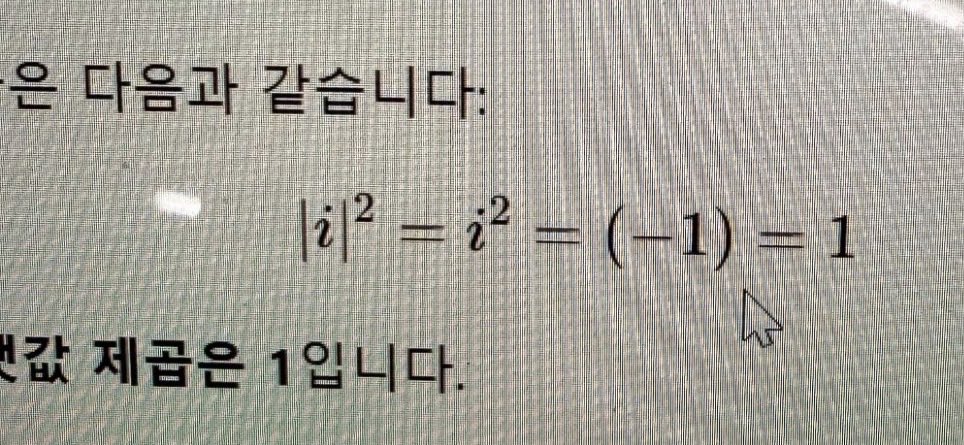
seems like agi is far away
Yunmin Cha tweet media
English
0
0
1
40
Yunmin Cha
Yunmin Cha@ynmncha·
@sdrzn @AnthropicAI your strategy is flawed. I'd rather use chatgpt pro than your $200 plan. you can use gpt-5 pro if you pay $200 to OpenAI. why pay $200 to you?
English
0
0
0
112
Saoud Rizwan
Saoud Rizwan@sdrzn·
Claude Code’s last update now auto-compacts more aggressively, using less of the context window to reduce costs. Users are also reporting stricter rate-limits, all of a sudden getting cooldown periods of 4 days. Anthropic dug themselves a grave getting everyone to sign up for their $200 max plan—it misaligned business and product incentives, forcing them to cost optimize and degrade quality. Claude Code is no longer the best harness for their model anymore and their users can feel it:
Saoud Rizwan tweet mediaSaoud Rizwan tweet media
English
113
72
898
262.7K
Yunmin Cha
Yunmin Cha@ynmncha·
@rohanpaul_ai nobody: Om Dobariya and Akhil Kumar: Ok let's say something really rude to llms it's gonna improve them
English
0
0
0
24
Rohan Paul
Rohan Paul@rohanpaul_ai·
Rude prompts to LLMs consistently lead to better results than polite ones 🤯 The authors found that very polite and polite tones reduced accuracy, while neutral, rude, and very rude tones improved it. Statistical tests confirmed that the differences were significant, not random, across repeated runs. The top score reported was 84.8% for very rude prompts and the lowest was 80.8% for very polite. They compared their results with earlier studies and noted that older models (like GPT-3.5 and Llama-2) behaved differently, but GPT-4-based models like ChatGPT-4o show this clear reversal where harsh tone works better. ---- Paper – arxiv. org/abs/2510.04950 Paper Title: "Mind Your Tone: Investigating How Prompt Politeness Affects LLM Accuracy (short paper)"
Rohan Paul tweet media
English
344
632
4.3K
885.2K
Ky-Nam
Ky-Nam@withkynam·
if you are in your 20s, don't get a job vibe-code a chatgpt wrapper and raise a million $
English
9
0
16
852
Yunmin Cha retweetledi
tetsuo
tetsuo@tetsuoai·
ZXX
53
33
276
14.5K
Science girl
Science girl@sciencegirl·
You have to name him the last thing you ate
Science girl tweet media
English
48.1K
7.7K
156.8K
11.1M
Kr$na
Kr$na@krishdotdev·
Is this enough to print "Hello World" ?
Kr$na tweet media
English
303
20
1.2K
35.2K
Yunmin Cha
Yunmin Cha@ynmncha·
I just thought I should sell what vibe coders want. Today so many people are vibe coding, few go to production most not. I think this is the main reason of its rapid growth. It’s easy for you to create something, but it’s 50 50 luck/insight for the project to be fully functional business. See vercel & supabase. They benefit from numerous vibe coded projects that just simply doesn’t even go to production.
English
0
0
2
69
Yunmin Cha retweetledi
Carlos E. Perez
Carlos E. Perez@IntuitMachine·
You know that frustrating moment when you're talking to an AI, and it almost gets what you want, but not quite? You try to correct it—"No, make it more creative," or "Add some stats"—and it feels like you're talking to a wall. Well, what if your corrections actually made the AI smarter? A new paper shows how. 🧵 1/12 For years, we've trained AI on massive, static datasets. Think of it like studying from a textbook. It's full of "correct" answers labeled by experts, but it's totally disconnected from how you actually talk and think. This is why AI can feel so generic and impersonal. 2/12 But researchers at Meta & Johns Hopkins just flipped the script with a method called RLHI (Reinforcement Learning from Human Interaction). Instead of textbooks, the AI learns directly from our messy, real-world conversations. It's like learning on the job instead of just in the classroom. 3/12 Here's how it works. When you say, "That's not right, add more statistics," the AI doesn't just try again from scratch. It creates a preference pair: 👎 The original, unhelpful response. 👍 A new response that incorporates your feedback. It learns from the correction itself. 4/12 This is already a huge leap. The AI is learning to adapt in real-time based on your specific needs in that moment. But that's not even the most interesting part. What about making the AI feel like it actually knows you across conversations? 5/12 This is where it gets brilliant. The system creates a "user persona" by summarizing your entire chat history. Do you prefer casual or formal tones? Do you like bullet points or long paragraphs? Do you ask for code, or for poems? It builds a profile of your unique preferences. 6/12 Now, when you ask a question, the AI doesn't just give a generic answer. It generates several options and uses your "persona" to pick the one you're most likely to prefer. It's aiming for personalized quality, not just general correctness. (I know, right?) 7/12 Now, you might be thinking: "But my chats are messy and full of typos!" The researchers knew this. A critical part of the system is a quality filter that sifts through the noise to find the genuinely useful feedback, so the AI doesn't learn bad habits from our chaotic conversations. 8/12 And it works. In tests, models trained with RLHI were significantly better at personalization and instruction-following. They even got better at reasoning tasks just by learning from simulated users pointing out mistakes in math problems. 9/12 So what does this mean for you? It means the future of AI assistants might feel a lot less like a clunky tool and more like an adaptive partner that learns your style. Next time an AI seems to remember your preferences, this is the kind of tech making it happen.
Carlos E. Perez tweet media
English
13
36
251
18.3K
VraserX e/acc
VraserX e/acc@VraserX·
A 7 million parameter model from Samsung just outperformed DeepSeek-R1, Gemini 2.5 Pro, and o3-mini on reasoning benchmarks like ARC-AGI. Let that sink in. It’s 10,000x smaller yet smarter. The secret is recursion. Instead of brute-forcing answers like giant LLMs, it drafts a full solution, then “thinks” about it, revising, self-critiquing, and improving up to 16 times. It literally learns to reason like a mind that pauses, reflects, and corrects itself. This could be the first real step toward thinking architectures instead of just scaling architectures. Less compute, more thought. Less size, more intelligence. The future of AI might not be bigger. It might be recursive.
VraserX e/acc tweet media
English
56
264
1.6K
134.6K
Yunmin Cha retweetledi
Jason Weston
Jason Weston@jaseweston·
I'm at COLM! I'm doing: - COCONUT poster (Tues 11am) - Multi-Token Attention poster (Weds 11am) - 🐏Organizing RAM 2 workshop🐏(Friday) facebookresearch.github.io/RAM/workshop/C… Reasoning, Attention & Memory – 10 Years On. Invited speakers: -Yoshua Bengio, Univ. of Montreal -Juergen Schmidhuber, KAUST -Kyunghyun Cho, NYU & Prescient Design -Yejin Choi, Stanford & NVIDIA -Azalia Mirhoseini, Stanford -Sainbayar Sukhbaatar, Meta
English
0
13
148
11.1K
Yunmin Cha
Yunmin Cha@ynmncha·
thank you and welcome new followers! I don’t really check the app frequently so it’d be great if you let me know that you want me to follow you back with brief self introduction and interests. thank you again!
English
1
0
3
504