Joel

202 posts

Joel banner
Joel

Joel

@yoelsays

New dad. Building product @eraserlabs.

Katılım Ocak 2022
552 Takip Edilen91 Takipçiler
Joel
Joel@yoelsays·
@DKThomp Disagree with this framing. Much of the token usage is on the internal process of thinking and iterating. As the saying goes, "I would have written a shorter letter, but I did not have the time".
English
0
0
0
14
Derek Thompson
Derek Thompson@DKThomp·
New newsletter: The transcript of my AI bubble conversation, with @pkedrosky. Feat.: - Why did the Mag7 equity miracle suddenly stop? - The growing private credit crisis, explained - Why the enormous revenue boom from new agents like Claude Code might be a sugar high, in which explosive revenue growth today precedes much slower revenue growth after AI adoption among software engineers peaks - Where equity value is flowing if it’s leaving software - Why US productivity seems to be rising but actually isn't derekthompson.org/p/yes-ai-is-a-…
English
9
8
88
103.5K
Joel
Joel@yoelsays·
And all the solutions are familiar (as are their costs). Settings dropdown become "See more" tool calls. Cmnd + K becomes Tool Search. The extra click cost is now tokens and latency.
English
0
0
1
26
Joel
Joel@yoelsays·
Its cool how all the existing product design concepts have agent analogs. Too many features > crowded UI, bad UX Too many tools > selection quality drops
English
1
0
1
14
Joel
Joel@yoelsays·
@HarryStebbings Generally like the pod, but is this really groundbreaking?
English
0
0
0
180
Harry Stebbings
Harry Stebbings@HarryStebbings·
Why a 3x is simply not enough upside to be attractive "A 3x is not enough to be exciting. If I want to deliver a 3x net fund, any 1x means I need a 5x elsewhere, any 0 means I need a 6x. I need to believe that after I make my 3x, someone else can make their 3x, otherwise I will not get the 6x plus outcomes I need. Every investment has to pass the test that my public counterpart would want to own this stock over everything else in their book." @LucasSwisher1 How have your expectations on upside changed in the last 24 months @altcap @Mkclements @ninaachadjian @SethGRosenberg @pueokeffer
Harry Stebbings@HarryStebbings

I am so fricking bored of guests that go on 10 podcasts and say the same frameworks again and again. Coatue manages $30BN on the private side. Their growth fund is $7BN. They have investments in Revolut, Anthropic, OpenEvidence, Canva and more. And yet, the Co-Head of Coatue, Lucas Swisher, never does podcasts. That changes today. @LucasSwisher1👇 Spotify 👉 open.spotify.com/episode/5QxHPw… Youtube 👉 youtu.be/Hom5OMMzOQ0 Apple Podcasts 👉 podcasts.apple.com/us/podcast/20v… Timestamps: 00:00 Intro 01:04 Why Public SaaS Is Getting Crushed in the AI Wave 07:35 Durability of Revenue in AI 15:28 Market Size vs Founder Quality: What Wins? 16:52 Why Price is the Last Thing to Matter 23:32 Mega-Funds Math: Can $5B+ Funds Still Generate Venture Returns? 27:01 What Returns Are 'Enough'? Why 3x Isn't Exciting at Growth 29:54 When Double-Downs Go Wrong: Overestimating TAM and Multi-Product Expansion 32:37 Margin Matters… But at Scale: AI Gross Margins, Cost Curves & Efficiency 37:11 Why it has never been harder to be a seed investor 40:11 Is 'Kingmaking' a Myth: When Capital Helps (and When It Hurts) 45:23 Is Canva Really a Platform Company? Multi S-Curves and Leaning into AI Early 46:52 Lessons from Mary Meeker 50:08 Lessons from Mamoon Hamid 51:34 LP 'Pick One' Games: Mamoon Hamid, Mary Meeker, Insight Partners 53:40 OpenAI vs Anthropic: Who Wins? 59:17 Most Memorable Founder Meeting 01:01:35 Career Decisions & Misses

English
6
8
92
52.6K
Joel
Joel@yoelsays·
@jbsteinberg @rbrtrmstrng This isn't a great rebuttal - a major thrust of the vision was "investment lags behind real economic change". Besides, it is also possible for consumption to become shifted towards a shrinking segment of the economy.
English
0
0
5
427
Joel
Joel@yoelsays·
good API design is just more token efficient
English
0
0
0
24
Joel
Joel@yoelsays·
@zain_hoda This assumes that the system of record is directly exposing its underlying data. For complex systems, it's more like it exposes some useful visual or report and a layer of RPC tool calls. It's not "here's my SQL table".
English
0
0
0
22
Joel
Joel@yoelsays·
@emollick Been thinking about the same! Working with AI can feel so easy because you get to make the decisions (no "consensus"). Then you realize that the hard part is synchronizing understanding and surfacing misalignment rapidly.
English
0
0
1
31
Ethan Mollick
Ethan Mollick@emollick·
I think agentic AI would work much better if people took lessons from organizational theory, which has actually spent a lot of time understanding how to deal with complex hierarchies, information limits, and spans of control. Right now most agentic AI systems seem to pretend that models have basically unlimited ability to manage subagents when that is clearly not true. We need measures of spans of control for AI. A human tops out at less than 10 direct reports. I am pretty sure that 100 subagents is too much for an orchestrator agent - suspect we need middle management agents (yes, I get it, insert middle management joke here). Similarly, we need more attention to boundary objects. These are what is handed between groups (marketing to IT to sales) in organizations to convey meaning as a project crosses group boundaries, like a prototype or a user story. Right now agents pass raw text & maybe code back and forth. Structured boundary objects that multiple agents of different ability levels can read and write to would solve a huge number of coordination failures & reduce token use. I also think aboht coupling, which is how tightly units inside organizations are bound. Most agentic systems are either too tightly coupled (every step needs approval) or too loose (Moltbook). This tradeoff is well-studied in organizations, I bet a lot would apply to agents. Other known issues like bounded rationality also apply, I suspect. Everyone is rushing towards the (terribly named) agent swarm, but the issue won’t just be how good the model is, it will be org design choices. I am not sure the labs see this, but we definitely need a lot more experiments with organizing agents done by people who understand real coordination issues.
English
170
208
1.9K
145.1K
Joel
Joel@yoelsays·
@MarcosPolanco @eraserlabs Hi Marcos - I just tried in multiple browsers and cannot repro. Are you still seeing same?
English
0
0
0
9
Joel
Joel@yoelsays·
@kevinmanase @eraserlabs Do you mean top-down? Our flow charts do work that way, you can easily switch any diagram in the web-app or ask the AI to make it top down (let us know if that doesn't work, and as a workaround ask it to add "direction down" to the top)
English
0
0
0
8
kevin manase
kevin manase@kevinmanase·
@eraserlabs we’re using your text-to-diagram API and love it, but why isn’t there a way to generate TD diagrams? it feels like we’re locked into one mode. seems like a fairly small change. would love to see this added.
English
1
0
1
13
Joel
Joel@yoelsays·
Editing diagrams via our point-and-click GUI is easier than ever! When a diagram is selected, you can add new elements, groups, and connections. Try out smart duplication by using the “+” buttons to insta-create connected elements. All 100% compatible with our auto-layout and AI tools.
English
0
0
0
16
Joel
Joel@yoelsays·
Links are also live! Select any element or group in a diagram and you can link it to: - Anything in Eraser (other diagrams, other files, specific markdown headers) - Your own docs site - Your git repo Amazing for enabling deeper dives.
English
1
0
0
10
Joel
Joel@yoelsays·
Excited to announce a few big recent releases @eraserlabs . We’ve added support for Claude Opus 4.5 via Premium requests - simply select “Premium” in the dropdown when making a new diagram or editing an existing one. In our internal benchmarking, we’ve seen similar or better quality outputs at 2x - 4x perf.
English
1
0
0
30
Peter Thomson
Peter Thomson@PeterJThomson·
Experimenting with @tldraw, @xyflowdev & @mermaidjs_ as visual ways to interact with a code base for interactive modern code review. Claude & Codex can generate so much code so quickly that we are going to need new ways to review and understand their work. Markdown documents, ERDs, tree-maps, flow-charts, systems architecture diagrams, process maps. These could be the new lingua franca of a higher level abstraction of software development. What you're seeing below is a visualisation of the database structure of a @laravelphp app, automatically generated in a visual code review tool to help with the review of a new feature.
English
21
26
366
27K
Tech Fusionist
Tech Fusionist@techyoutbe·
Do you know the better alternative to this?
Tech Fusionist tweet media
English
62
20
389
65K
Eric Chan | CRE Construction
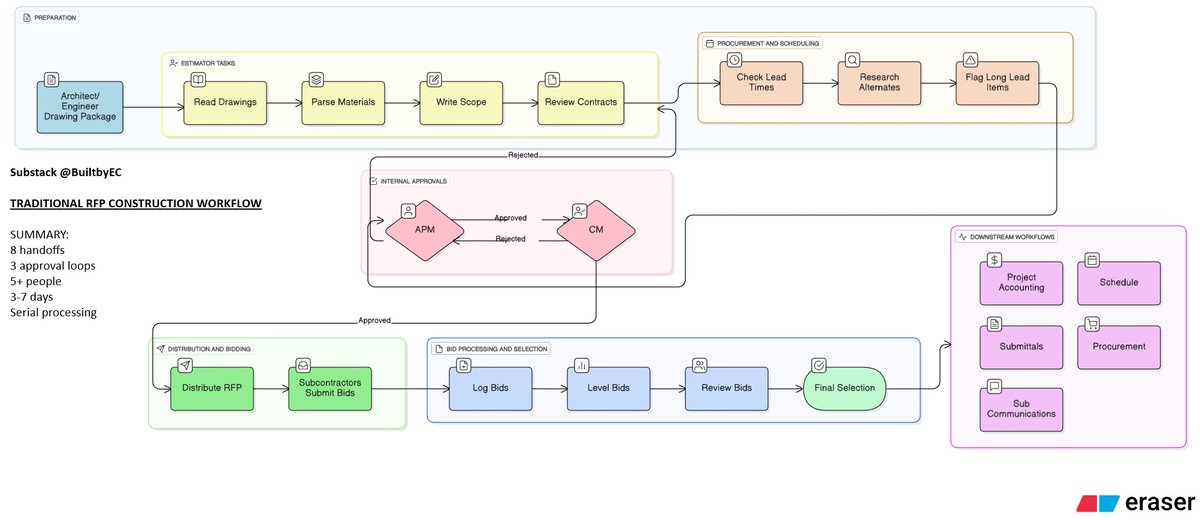
Here's the traditional workflow: 8 handoffs, 3 approval loops, 5-7 days. Serial processing = bottleneck. Also, @eraserlabs👌on the diagram creation (11/13)
Eric Chan | CRE Construction tweet media
English
2
0
1
48
Eric Chan | CRE Construction
I'm building 5 @claudeai specialists using Claude Skills to replace my traditional construction management workflow. Not to replace consultants or expertise—but to eliminate the administrative time bloat that hinders effective project management. 🧵 (1/13)
English
1
0
0
77
Ben Dicken
Ben Dicken@BenjDicken·
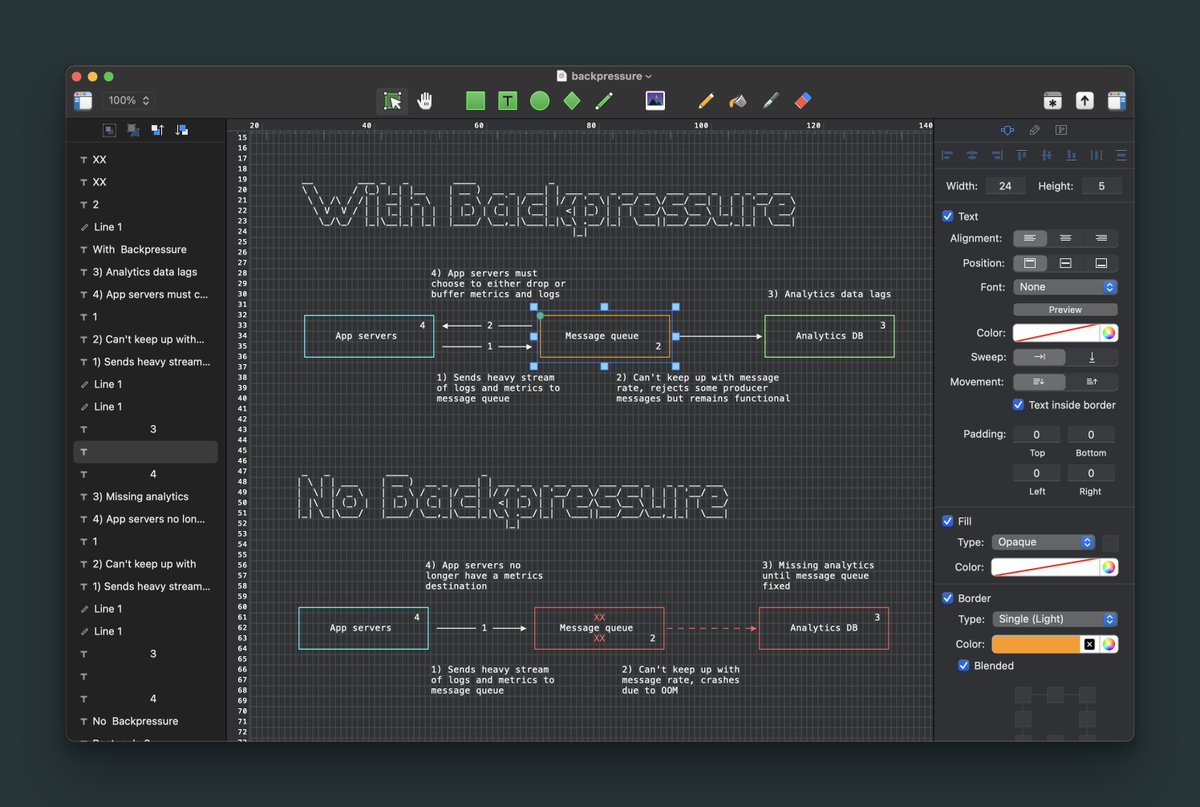
Most common non-database question these days: What do you use to make your diagrams!? Monodraw. Amazing tool + well worth the $10 license. Share your favorite use of diagrams in technical writing with me. The "best" gets a Monodraw license, on me.
Ben Dicken tweet media
English
66
65
1.3K
109.6K
Carlos Mendez
Carlos Mendez@charlesmendez·
I had to create a diagram for a presentation. A well-designed architecture diagram. I tried v0, Gemini, Genspark, ChatGPT. All failed miserably. The only way I was able to achieve what I wanted was creating a Next.js app in Cursor and using different models like Opus, Gemini Pro, etc. Interesting to see why such a difference.
English
2
0
2
165
Shin Kim
Shin Kim@_shinkim·
Love this idea from the @lennysan podcast: "Jeanne DeWitt Grosser replaced boring discovery calls at Stripe with collaborative whiteboarding sessions where customers drew their payment architecture." I’m planning to run live whiteboarding sessions (with @eraserlabs, naturally) in future discovery calls to map out customers’ current workflows.
Lenny Rachitsky@lennysan

My biggest learnings from Jeanne DeWitt Grosser (ex-Chief Business Officer at @Stripe, now @Vercel COO): 1. What failed seven years ago now works with AI. In 2017, Jeanne tried to build a system at Stripe that would automatically personalize outbound emails based on company data. Despite working with world-class data scientists, it failed due to too many errors. Today, that exact same approach works. This shows how AI has made previously impossible ideas suddenly viable. 2. A single GTM engineer at Vercel reduced a 10-person sales team to 1 (in just 6 weeks). Jeanne’s team at Vercel had an engineer build an AI agent that handles inbound lead qualification, outbound prospecting, and deal loss evaluation. The agent costs $1,000 per year to run versus over $1 million in salaries for the sales team. The nine displaced team members moved to higher-value work rather than being laid off, and the remaining salesperson is 10 times more efficient. 3. Their AI deal-loss bot has become better at understanding what went wrong than humans. When Jeanne analyzed her biggest loss of the quarter, the salesperson blamed pricing. But an AI agent reviewed every email, call transcript, and Slack message and discovered the real reason: they never spoke to the person who controls the budget, and when ROI came up, the customer clearly didn’t believe the value claims. They are now using AI to analyze sales calls in real time and send alerts like “You’re halfway through the sales process and haven’t talked to a budget decision-maker yet.” 4. Wait until $1 million in revenue before hiring your first salesperson. Founders should continue selling themselves until they reach around $1 million in annual revenue with a repeatable process. The key is having a defined ideal customer profile—customers who look alike. 5. Segment customers on what drives their buying decisions, not just company size. OpenAI has roughly 3,000 employees, which would typically put them in the “mid-market” category. But they’re a top-25 website globally by traffic, so Vercel treats them as enterprise customers requiring complex sales. Effective segmentation combines company size with growth rate, web traffic, workload type, and industry—because selling to e-commerce companies requires completely different language than selling to crypto companies. 6. Most customers buy to avoid risk, not to gain opportunity. About 80% of customers purchase to reduce pain or avoid problems, while only 20% buy to increase upside. This means you should focus your sales messaging on what could go wrong without your product—like falling behind competitors or damaging their reputation—rather than just talking about exciting features. This is especially true when selling to larger companies, where individual careers are on the line. 7. Sales teams should be indistinguishable from product managers—for a bit. Jeanne hires salespeople who have such deep product knowledge that if you put one in front of a group of engineers, it should take 10 minutes to realize they’re not a product manager. This credibility allows sales teams to serve as an extension of research and development—a 20-person sales team talks to hundreds of customers weekly and can translate those conversations into product insights at scale. 8. Building your own AI sales tools may beat buying off-the-shelf software. Because AI is so new and every company’s sales process is unique, Jeanne finds that building custom internal agents often delivers more value than buying vendor solutions. A single go-to-market engineer built their deal analysis bot in just two days, perfectly tailored to their specific workflow. These engineers shadow top salespeople to understand their workflows, then build automation that would have taken months or been impossible just a few years ago. 9. Make every sales interaction great, whether customers buy or not. Jeanne replaced boring discovery calls at Stripe with collaborative whiteboarding sessions where customers drew their payment architecture. Many customers had never visualized their own systems before. They left with a useful asset and a feeling of collaboration, regardless of whether they bought. Many returned years later to purchase. Think about your go-to-market process like a product, not just a sales function. 10. Product-led growth has a ceiling—no $100 billion company runs on it alone. While product-led growth (where users can sign up and start using a product without talking to sales) works well for early growth, customers generally won’t spend a million dollars through a self-service flow. Every major technology company eventually builds a sales team for larger deals. The mistake is waiting too long, since building a predictable sales process takes time.

English
1
0
5
912