
Sabitlenmiş Tweet
yonks|🤖🏛️🪙|Jason Younker
5.4K posts

yonks|🤖🏛️🪙|Jason Younker
@yonks
We are @YonksTEAM ● #buildinpublic ● SUPERPOWER = @MrsYonks ❤️🔥uBabe ● ✝️ #Christ believer ● Co-Founder of: @pTokenAssets @WeOwnNet @WeOwnAI @3winSocial
#NoDe (North Denver) Katılım Ekim 2010
4.6K Takip Edilen2.6K Takipçiler


Amazing insights Greg!! Thanks for sharing!!
GREG ISENBERG@gregisenberg
I just got back from SF and I FEEL INSPIRED. I spent 5 days with frontier AI model teams, AI startup founders, and 3 billionaires. My takeaways: 1. I had lunch with 3 billionaires. All of them are buying SaaS companies and rebuilding them agent-first. They were deeply inspired by Bending Spoons and Ryan Cohen's eBay deal. Buy the company, cut the headcount, rebuild the tech, add agents, add features, make more valuable experience, raise prices. 2. The frontier model companies are hungry for usage data from the field. They can see API calls and token counts. They can't see the actual workflows. If you're deep in a niche using these models in ways the model companies haven't seen, that understanding is incredibly valuable. Usage intelligence is the new alpha. 3. Consumer AI is massively underbuilt. Every billboard in SF is either B2B inference infrastructure or vertical agent companies. The entire city is optimized for enterprise. Meanwhile you have companies like Cal AI doing $50M ARR in 18 months as a consumer app. I met with a cool few teams doing consumer AI (@paulscherer / @ekuyda) 4. MCP came up in literally every conversation. The companies exposing their product as MCP endpoints are getting pulled into deals they never pitched for. The ones that aren't are becoming invisible to agents. This is the new SEO. If agents can't find you, you don't exist. Building products for agents is the new zeitgeist in general. 5. Not uncommon for hot seed rounds to be $25-50 million valuations. I saw a Series A at $450 million 6. If I had a dollar every time someone mentioned "forward-deployed engineer" this trip I could have funded a seed round. It's the hottest role in SF right now. The person who sits between the agent and the customer, making sure everything actually works. 7. The mood around open source shifted. A year ago it felt like open source was chasing the frontier models. Now founders are telling me Gemma and DeepSeek are good enough for 80% of what they need at a fraction of the cost. The "which model do you use" conversation is being replaced by "which model for which task." Model loyalty kinda feels dead. 8. Voice agents came up more than I expected. Multiple founders told me voice is the interface for the next billion users. The billion people who will never type a prompt will absolutely talk to one. 9. The Obsidian community in SF is weirdly intense. Multiple founders showed me their vaults unprompted. Like showing someone your home gym. It's a flex now. The quality of your knowledge base (second brain?) is becoming a status symbol among builders. 10. Maybe it was just the people I met but the age of the founders is shifting. I met more founders over 40 this trip than any trip before and more founders under age 21 than ever before. Founders getting older and younger at the same time. 11. I spoke to a lot of fast-growing startups, VCs and frontier models who are hiring content creators right now. 12. The restaurant scene in SF is actually better than it's been in years. Founders are going out more. Alcohol is out, not surprisingly. 13. SF doesn't feel like the only place anymore. We all have access to the same frontier models. We all read the same X feed. A founder in NYC or Lagos is calling the same APIs as a founder in SoMa. So in the past it felt like SF was always lightyears ahead, doesn't feel that way anymore. It's okay not to live in SF and have BIG DREAMS. 14. The coworking spaces in SF are half empty but the coffee shops are packed. People want to be around people. I had a few startup ideas here.... 15. Walking around the Mission I noticed something: the street-level businesses, the taquerias, the barbershops, the laundromats, none of them use any AI at all. 16. I heard the phrase "agent debt" for the first time. Like technical debt but for agents. When you hack together an agent workflow fast and never clean it up, the system prompts conflict, the memory gets polluted, the tools overlap. 6 months later the agent is doing weird things and nobody knows why lol. 17. Met a few people who carry two phones now. One for personal. One that's basically an agent terminal running Telegram or iMessage connections to their agent fleet. It's always amazing to get that dose of inspiration in SF. I FEEL INSPIRED. But I'm so happy to be back home, locked in and building. We're 12-18 months into a shift that will take 15 years to play out. The urgency in every conversation was real. What an incredible time to be building.
English
yonks|🤖🏛️🪙|Jason Younker retweetledi

I just got back from SF and I FEEL INSPIRED.
I spent 5 days with frontier AI model teams, AI startup founders, and 3 billionaires.
My takeaways:
1. I had lunch with 3 billionaires. All of them are buying SaaS companies and rebuilding them agent-first. They were deeply inspired by Bending Spoons and Ryan Cohen's eBay deal. Buy the company, cut the headcount, rebuild the tech, add agents, add features, make more valuable experience, raise prices.
2. The frontier model companies are hungry for usage data from the field. They can see API calls and token counts. They can't see the actual workflows. If you're deep in a niche using these models in ways the model companies haven't seen, that understanding is incredibly valuable. Usage intelligence is the new alpha.
3. Consumer AI is massively underbuilt. Every billboard in SF is either B2B inference infrastructure or vertical agent companies. The entire city is optimized for enterprise. Meanwhile you have companies like Cal AI doing $50M ARR in 18 months as a consumer app. I met with a cool few teams doing consumer AI (@paulscherer / @ekuyda)
4. MCP came up in literally every conversation. The companies exposing their product as MCP endpoints are getting pulled into deals they never pitched for. The ones that aren't are becoming invisible to agents. This is the new SEO. If agents can't find you, you don't exist. Building products for agents is the new zeitgeist in general.
5. Not uncommon for hot seed rounds to be $25-50 million valuations. I saw a Series A at $450 million
6. If I had a dollar every time someone mentioned "forward-deployed engineer" this trip I could have funded a seed round. It's the hottest role in SF right now. The person who sits between the agent and the customer, making sure everything actually works.
7. The mood around open source shifted. A year ago it felt like open source was chasing the frontier models. Now founders are telling me Gemma and DeepSeek are good enough for 80% of what they need at a fraction of the cost. The "which model do you use" conversation is being replaced by "which model for which task." Model loyalty kinda feels dead.
8. Voice agents came up more than I expected. Multiple founders told me voice is the interface for the next billion users. The billion people who will never type a prompt will absolutely talk to one.
9. The Obsidian community in SF is weirdly intense. Multiple founders showed me their vaults unprompted. Like showing someone your home gym. It's a flex now. The quality of your knowledge base (second brain?) is becoming a status symbol among builders.
10. Maybe it was just the people I met but the age of the founders is shifting. I met more founders over 40 this trip than any trip before and more founders under age 21 than ever before. Founders getting older and younger at the same time.
11. I spoke to a lot of fast-growing startups, VCs and frontier models who are hiring content creators right now.
12. The restaurant scene in SF is actually better than it's been in years. Founders are going out more. Alcohol is out, not surprisingly.
13. SF doesn't feel like the only place anymore. We all have access to the same frontier models. We all read the same X feed. A founder in NYC or Lagos is calling the same APIs as a founder in SoMa. So in the past it felt like SF was always lightyears ahead, doesn't feel that way anymore. It's okay not to live in SF and have BIG DREAMS.
14. The coworking spaces in SF are half empty but the coffee shops are packed. People want to be around people. I had a few startup ideas here....
15. Walking around the Mission I noticed something: the street-level businesses, the taquerias, the barbershops, the laundromats, none of them use any AI at all.
16. I heard the phrase "agent debt" for the first time. Like technical debt but for agents. When you hack together an agent workflow fast and never clean it up, the system prompts conflict, the memory gets polluted, the tools overlap. 6 months later the agent is doing weird things and nobody knows why lol.
17. Met a few people who carry two phones now. One for personal. One that's basically an agent terminal running Telegram or iMessage connections to their agent fleet.
It's always amazing to get that dose of inspiration in SF. I FEEL INSPIRED.
But I'm so happy to be back home, locked in and building.
We're 12-18 months into a shift that will take 15 years to play out. The urgency in every conversation was real.
What an incredible time to be building.

English

Jensen Huang runs a $3 trillion company and just said every SaaS company will become an agentic company - no question about it.
Most people will scroll past this and wonder why their business model stopped working.
bookmark & watch today. free. straight from the GTC keynote.
Khairallah AL-Awady@eng_khairallah1
English
yonks|🤖🏛️🪙|Jason Younker retweetledi
How to build a vertical AI agent cash-flowing startup:
find painful workflow in a boring industry → talk to 10 people who do that workflow every day → map every step, every tool, every spreadsheet, every phone call →
do the workflow manually first → be the agent before you build the agent → find the edge cases that break everything → document them in obsidian as structured markdown →
set up your agent stack → hermes for the harness → obsidian vault as the knowledge base → composio for authentication across apps → build your first 1-3 skills that solve the core pain →
use claude code or codex to build the product → use agents to set up other agents → use perplexity MCP and context7 for up-to-date docs → let the agent handle the scaffolding while you focus on the workflow logic →
ship the agent to your first 5 customers for free → watch what they actually use it for → they will surprise you → the thing you built for isn't always the thing they need most →
build content around the niche → not "building in public" content → useful content → the tips, the shortcuts, the pain points that only someone who does this workflow would know → become the person for that niche →
charge per outcome not per seat → per lease renewed, per claim processed, per candidate sourced → the ROI conversation takes 10 seconds when it's tied to a result →
set up watchdogs and alerts → your agent emails you when a cron job breaks or a skill fails → the customer should never have to tell you something is broken →
connect to open router → see exact costs per model per task → use GPT 5.5 for tool calls → use open source for lightweight tasks → route the right model to the right job → watch your margins double →
let hermes write to its own memory after every task → the agent compounds → the longer it runs the better it gets → that accumulated memory becomes your moat → a competitor can clone your product but they can't clone 6 months of context →
expand the workflow → you started with one step → add the next → then the next → now you own the entire workflow end to end → you went from a tool to the operating system for that vertical →
stack the agents → one agent is a side project → five agents across five customers is a business → each one runs in its own environment → you check in once a day →
raise only if you need capital not credibility → most agent businesses should never raise → the margins are too good to give away equity → stay lean → stay profitable → repeat
i'm rooting for you
English
yonks|🤖🏛️🪙|Jason Younker retweetledi

the anatomy of the perfect 𝗦𝗢𝗨𝗟.𝗺𝗱 file for AI agents.
𝗦𝗢𝗨𝗟.𝗺𝗱 is the one file you write yourself for an AI agent.
it sits at the top of the system prompt, before memory, before skills, before tools. it defines who the agent is when it shows up.
an hour spent on it changes every conversation that follows. most other layers update themselves. this one is yours.
i just broke down what a 𝗦𝗢𝗨𝗟.𝗺𝗱 file that actually works looks like.
here are the 8 sections that matter:
→ identity (a one-line statement of who, not what)
→ core truths (imperative principles, each with a one-line unpacking)
→ worldview (opinionated takes by domain, sharp enough to predict)
→ voice (concrete rules for how the agent talks, not adjectives)
→ expertise (primary domain, fluent tools, where it defers)
→ boundaries (explicit "won't" lines, no soft language)
→ memory policy (what persists, what stays private)
→ pet peeves (phrases and tones the agent never produces)
generally people write "be helpful and professional" and call it done.
that changes nothing. every model already tries to be helpful and professional by default.
the agents that compound have 𝗦𝗢𝗨𝗟.𝗺𝗱 files with real opinions, hard limits, and a voice you can predict before you read the response.
a strong 𝗦𝗢𝗨𝗟.𝗺𝗱 is 30 to 80 lines. specificity beats coverage.
bookmark this. the first agent you build will need it.
i wrote a full masterclass on Hermes Agent that walks through the 𝗦𝗢𝗨𝗟.𝗺𝗱 layer, the three-tier memory system, the self-evolving skills loop, and how to run three specialized agents on your machine 24/7.
the article is quoted below.

Akshay 🚀@akshay_pachaar
English
yonks|🤖🏛️🪙|Jason Younker retweetledi

🚨 You can now deploy unlimited AI voice agents on your own infrastructure for $0.
Stop bleeding margin to per-minute SaaS rentals.
A team of YC alumni just built an open-source exit hatch, and I've been really excited to be involved with it.
Dograh is a fully self-hosted voice AI platform.
One Docker command deploys your infrastructure.
Drag and drop your workflow, define your prompt, and launch a production-ready bot in 120 seconds.
Your stack, your rules!
> Bring your own LLM
> Any Speech-to-Text
> Any Text-to-Speech
> Inbound and outbound calls
> WebRTC and standard phone numbers
Built on Pipecat, FastAPI, and Next.js.
SaaS platforms charge sales teams $10,000+ annually for this.
Dograh is 100% free and open-source.
... and almost 3k GitHub stars already.
repo in 🧵↓
English
yonks|🤖🏛️🪙|Jason Younker retweetledi

Leopold Aschenbrenner is literally giving you insider trading info
He turned $225M into $5.5B in less than 12 months
In 2025 he bought:
$BE at $18 & is now $297
$LITE at $59 & is now $935
$SNDK at $42 & is now $1,466
Now in 2026, he’s telling you to buy:
1) Applied Digital $APLD
2) Bloom Energy $BE
3)CleanSpark $CLSK
4)CoreWeave $CRWV
5)Intel $INTC
6) IREN $IREN
7) Keel Infrastructure $KEEL
8) Micron $MU
9) Riot $RIOT
10) Sandisk $SNDK
11) T1 Energy $TE
12) Taiwan Semiconductor $TSM
Don’t miss out on a generational run
English
yonks|🤖🏛️🪙|Jason Younker retweetledi

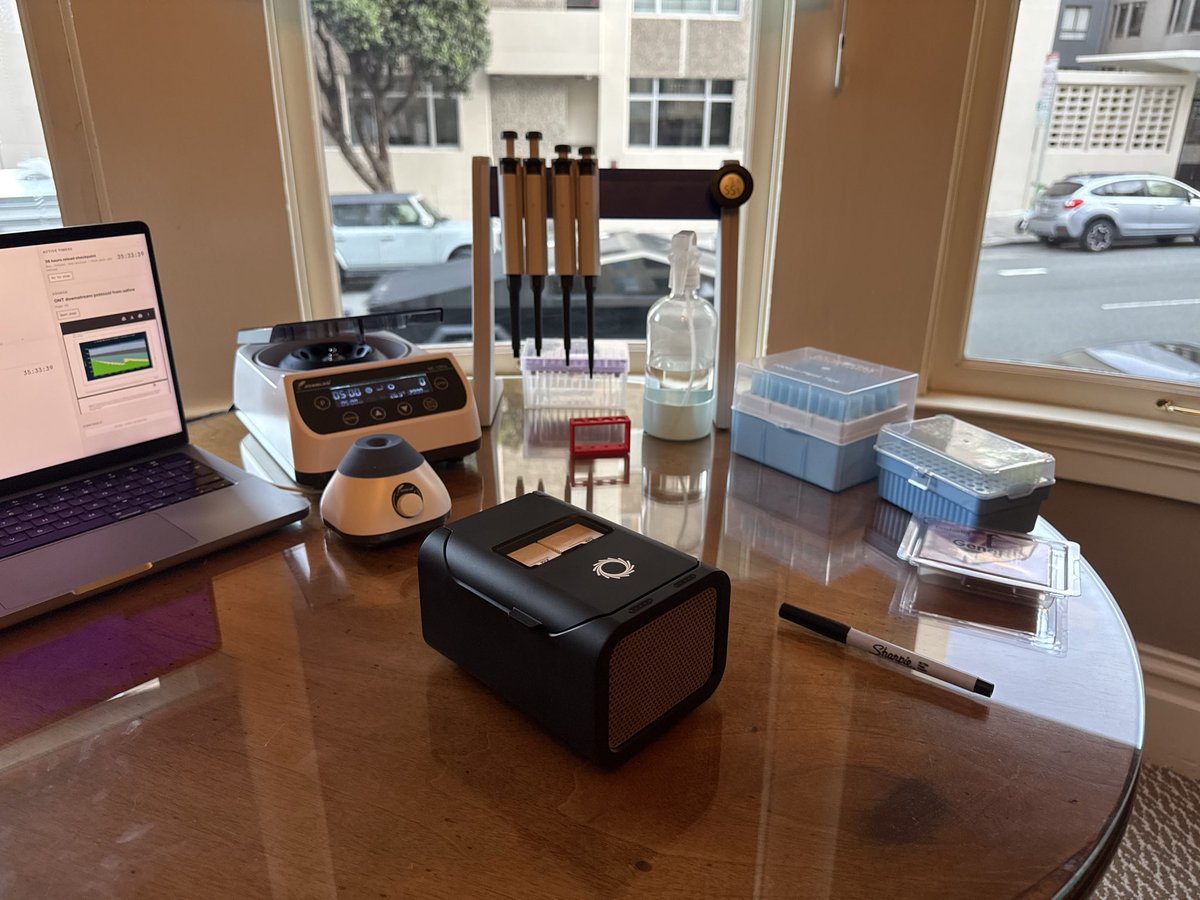
I just sequenced a human genome to 30× coverage entirely at home.
As far as I know, this is the first time this has been done.
I didn’t step foot in a lab once. Every step - from saliva collection, to running the sequencer - took place in a single room with a dining table + kitchenette.
Six weeks ago, I had never done wet lab biology before.
I used an Oxford Nanopore P2 Solo - the only commercially available sequencing device portable enough to do 30x human genome sequencing at home.
Biggest takeaway - I could build something that combined software, hardware, and molecular biology far faster than I thought was possible.
I can name >100 specific instances where AI helped me solve a technical problem that would previously have blocked me because I lacked access to a domain expert.
For example: how do I save my sequencing run when my DNA extraction yield is 4x lower than I need it to be, and I have this limited set of reagents to hand?
To make this work, I had to navigate multiple disciplines:
- writing software to monitor sequencing runs and orchestrate remote GPU infra for basecalling
- learning + executing 5 hour long molecular biology protocols
- building a hardware device to quantify DNA concentration
Apologies for the hyperbole, but I feel super lucky to be living in 2026.
A few weeks ago I decided to sequence a human genome to 30x at home.
Then I actually did it. And I did it really quickly.

English
yonks|🤖🏛️🪙|Jason Younker retweetledi
if you want to design with AI agents, these skills are amazing
- impeccable impeccable.style
- taste tasteskill.dev
- layers layers.jamiemill.com
- superdesign app.superdesign.dev
I also made a plugin based on Refactoring UI (use for polish): github.com/gnurio/refacto…
find more here: prodmgmt.world/resources
English
@brian_armstrong @MS_NFTy ❤️🔥 seeing tokenized RWAs as #1 on your list!!
We are excited to launch @WeOwnCash, a @pTokenAssets in the @WeOwnNet ecosystem in 2nd half of 2026
🟦 built on @base + ⚫️ @MidnightNtwrk
English

Major areas where the financial system still needs an update:
1. Tokenization of real-world assets - Real estate, stocks, bonds, funds, etc. onchain for instant settlement, fractional ownership & massive distribution.
2. 24/7 Global trading - Pooled global liquidity, every asset, every person, with great leverage and capital efficiency.
3. Next-gen payments - Near-instant, low-cost global transfers using stablecoins, including for Agentic payments.
4. AI-powered risk, credit, compliance, and advice - Better decisions, less fraud, and broader access to capital. Everyone gets access to a great financial advisor.
5. Innovation friendly regulation - Move from one-size-fits-all to risk-based rules that encourage innovation and competition instead of stifling it.
6. Expanded access - Open protocols that reduce middlemen and self-custodial wallets to expand access to everyone with a smartphone.
7. Capital formation - Low cost and turnkey for anyone to raise money for a good idea, increasing the number of startups.
8. Sound money - A refuge from inflation, when discipline is lost in fiat money.
Jobs not done until we get these working for all.
Will require lots of tech innovation and policy work to get there.
English
yonks|🤖🏛️🪙|Jason Younker retweetledi

SOMEONE OPEN SOURCED THE INTEGRATIONS LAYER EVERY SAAS COMPANY HAS BEEN PAYING $50,000 A YEAR TO RENT.
It's called Nango. And it just made the entire "unified API" industry look like a tax on developers.
700+ APIs. Salesforce, HubSpot, Slack, Notion, Gmail, GitHub, Stripe, Jira, Linear. Every OAuth flow, every token refresh, every rate limit, every retry. Handled.
The thing companies like Merge.dev charge $40K-$100K/year to manage? Sitting on GitHub. 7.4K stars. 726 forks. 6,418 commits. Already used in production by Replit, Ramp, and Mercor.
Here's what it actually does:
→ Managed OAuth for 700+ APIs out of the box
→ One proxy call to authenticate to any API
→ Write TypeScript integration functions, deploy to their runtime
→ AI builder generates the integration code from a natural language prompt
→ Built-in retries, rate limit handling, per-tenant isolation
→ Works with Claude Code, Cursor, Codex, MCP, LangChain
→ Self-hostable for free
→ SOC 2 Type II, HIPAA, GDPR compliant
The pitch that should make every founder uncomfortable:
You give it a description like "sync GitHub issues to my database every 5 minutes." It writes the TypeScript. You read it. You edit it. You ship it.
It is not a black box. It is not a wrapper. It is readable code you own and version control.
Here's the wildest part:
The "unified API" startups raised hundreds of millions of dollars selling exactly this. Closed source. Per-API pricing. Per-customer pricing. Limits on calls. Limits on integrations.
Nango ships the same primitive under the Elastic License. Self-host the core for $0. Pay them only if you want their cloud and enterprise features.
189 releases. Latest one on May 15, 2026. Still shipping aggressively.
One honest note: the license is Elastic, not MIT. You can self-host and use it commercially, but you cannot resell it as a competing service. For 99% of teams building integrations into their product, that restriction does not matter.
Every B2B SaaS company in the world has a Jira-style "we connect to your tools" page. Most of them paid an "integration platform" half a million dollars to build it.
This repo is the thing those platforms are quietly running underneath.
Link in the first comment.

English
yonks|🤖🏛️🪙|Jason Younker retweetledi

We are on every New Tab in the @brave browser for the coming 24 hours!
Agents need names and the Agent Community's nr1 goal is to ensure that we create a builder governed naming layer for the agentic web.

English
yonks|🤖🏛️🪙|Jason Younker retweetledi

🚨 CEO Anthropic Dario Amodei właśnie dostał nokaut na oczach całego świata.
Chiński founder Moonshot AI Yang Zhilin wziął i wrzucił za darmo całą rewolucyjną architekturę Kimi Agent Swarm.
Rój ponad 100 agentów działających równolegle. 1500 wywołań narzędzi jednocześnie.
Zadania, które Claude 4.5 i GPT-5.2 robią w godzinę, Kimi załatwia w 15 minut.
40-minutowy masterclass na NVIDIA GTC, w którym Yang tłumaczy wszystko krok po kroku:
• Orchestrator + parallel reinforcement learning
• MoE na bilionach parametrów
• Kimi Linear i 3D-synergia kontekstu
Efekt?
Kimi K2.5 miażdży Zachód w kluczowych benchmarkach agentycznych (HLE-Full, MathVista, OCRBench, multimodal) i robi to 4–5× taniej.
Kirill@kirillk_web3
instead of watching 2 hours of Netflix tonight, watch this 40-minute masterclass from the founder of a $20B China AI company it's the clearest explanation I've seen of how Agent Swarms and AI systems actually work at scale useful whether you've never built an agent in your life or have been using Claude every day for the past year I took the key ideas and turned them into a practical guide on how to actually build with Kimi find it below
Polski

My girlfriend says she'll buy and hold $SPCX like marriage when it IPO on June 12.
She'd have $40,000,000 if she held $NVDA since its IPO with $10,000.
There's 10 stocks with direct SPACEX partnerships:
1. $SATS — EchoStar
The most direct SpaceX proxy. Sold spectrum licenses to SpaceX in a $19.6B deal and received an $8.4B SpaceX equity stake in return. Buying SATS = buying pre-IPO SpaceX exposure with a public ticker.
2. $TMUS — T-Mobile
SpaceX partnership delivers Starlink Direct-to-Cell coverage across 500K+ square miles of dead zones no special hardware needed. Guides $77B in service revenue and $37–37.5B EBITDA for 2026. Most financially dominant carrier riding the Starlink wave.
3. $FLTCF — Filtronic (OTC / AIM: FTC.L)
Pure-play SpaceX hardware supplier. Five-year supply agreement with SpaceX; revenue more than doubled to £56.3M in FY2025 with £13.4M operating profit. Landmark £47.3M contract to supply next-gen GaN E-band amplifiers for Starlink cumulative SpaceX contracts now exceed $115M. Biggest hidden gem on this list.
4. $GOOGL — Alphabet
Owns ~7.5% of SpaceX worth tens of billions at SpaceX's $1.75T IPO valuation. When SpaceX lists, Alphabet's balance sheet gets a massive mark-up. Sleeping SpaceX exposure inside a mega-cap.
5. $LUNR — Intuitive Machines
Guiding 2026 revenue of $900M–$1B nearly 5x trailing revenue from NASA lunar contracts that rely on SpaceX Falcon 9 as the launch vehicle. Every LUNR mission = a SpaceX launch. Growth is structurally tied to SpaceX cadence.
6. $RKLB — Rocket Lab
NASA formally partnered Rocket Lab alongside SpaceX for test flights and reusability research. FY2025: $602M revenue, 44.3% non-GAAP gross margins, $1.85B backlog. Also benefits directly from any SpaceX IPO-driven capital surge into the sector.
7. $FLY — Firefly Aerospace
Q1 2026 revenue $80.9M (+40% QoQ), full-year guidance $420M–$450M. Blue Ghost lunar lander launches on SpaceX rockets. Both compete together on Golden Dome contracts operationally intertwined.
8. $TSLA — Tesla
SpaceX and xAI bought ~$650M in Tesla goods in 2025, including $506M in Megapack battery systems. Tesla is effectively a major SpaceX supplier. The Musk ecosystem cross-transaction flows are now publicly disclosed and massive.
9. $WKEY — WISeKey (parent of $LAES)
WISeSat has launched multiple satellites aboard SpaceX Falcon 9 Transporter missions, with the latest embedding SEALSQ's QS7001 post-quantum chip into LEO. SpaceX is their exclusive launch partner — every new satellite = another SpaceX contract.
10. $RDW — Redwire
Q1 2026: $97M revenue (+57.9% YoY), record $498M backlog, 1.92 book-to-bill ratio. Builds in-space hardware that rides aboard SpaceX launches for defense and commercial customers. Winning large IDIQ defense contracts alongside SpaceX.
♻️ RESHARE this post and make 1 comment for my list of 1000% movers like $ASTS and $IONQ.

English
yonks|🤖🏛️🪙|Jason Younker retweetledi

I spent the entire week building 3 Hermes agents from scratch.
The full architecture:
4 separates Gbrains as the foundation:
-1 shared brain (company knowledge base, shared among the 3 agents)
-3 private brains (role-specific working memory)
3 separate Hermes profiles:
-CFO
-Ops
-Marketing
Agent/brain mapping:
CFO -> Finance brain + Shared brain
Ops -> Ops brain + Shared brain
Content -> Content brain + shared brain
What feeds the Shared brain:
-Context repo (company docs, offers, brand voice, ICPs, team roles, etc.)
-Call/meeting transcripts (syncs every 2 hours)
-Gmail (syncs every 2 hours)
-Google Calendar (syncs daily)
Cron jobs handle the syncs which makes upkeep hands off for me.
Each Hermes profile owns its own config, .env, SOUL.md, memory, logs, sessions, home dir, Telegram bot, and gateway process.
Local wrapper scripts force GBrain routing to the right private + shared brain.
I created the 3 separate profiles to have role separation. Each profile is a specialist in a specific role but all 3 share the same business context underneath.

English
yonks|🤖🏛️🪙|Jason Younker retweetledi

the fastest growing GitHub repos in finance this week:
1. TauricResearch / TradingAgents (+3,500 ⭐)
A multi-agent LLM framework for financial trading: multiple AI agents (analyst, risk manager, trader) collaboratively make investment decisions based on news and market data.
2. brokermr810 / QuantDinger (+989 ⭐)
An AI-powered quantitative trading platform for crypto, stocks, and forex: backtesting, live trading, multi-agent market research, with support for Binance, Alpaca, and MT5.
3. himself65 / finance-skills (+510 ⭐)
A collection of AI skills for financial analysis and trading: ready-to-use tools for agents (Claude Code, MCP) as technical analysis, stock valuation, financial report parsing.
4. OpenBB-finance / OpenBB (+200 ⭐)
An open-source financial analysis platform with AI agent support: data on stocks, crypto, derivatives, and macro indicators; Python SDK + terminal; a Bloomberg alternative for developers.
5. ericosiu / ai-marketing-skills (+107 ⭐)
Open-source AI skills for marketing and finance automation: growth experiments, sales pipeline, SEO, outbound, and financial ops. All powered by AI agents.
6. AI4Finance-Foundation / FinGPT (20,300 ⭐)
Open-source financial large language models: fine-tuned LLMs on financial data, sentiment analysis, robo-advisor, technical analysis; models published on HuggingFace.
7. microsoft / qlib (43,400 ⭐)
Microsoft's AI-oriented quantitative investment platform: end-to-end pipeline from idea to strategy execution; machine learning for quant research, backtesting, and live trading.
8. AI4Finance-Foundation / FinRL (15,200 ⭐)
A reinforcement learning framework for finance: automated trading strategies, portfolio management, training agents on real market data.
9. KylinMountain / TradingAgents-AShare (+80 ⭐)
A multi-agent investment research system for the Chinese A-Share stock market: 15 AI agents simulating an investment bank workflow — debates, visualization, integration with Claude Code.
10. Lumiwealth / lumibot (1,592 ⭐)
Backtestable AI trading agents: support for stocks, options, crypto, futures, and forex; integrations with Interactive Brokers and Alpaca; LLM agents for SEC filing analysis and macro data.
bookmark this and start today.

wincy.eth@gusik4ever
the fastest growing GitHub repos in finance this week: 1. TradingAgents (+3,822 ★) multi-agent LLM trading framework built for financial research and execution. combines analyst agents, sentiment models, portfolio reasoning, and provider integrations into a single trading stack. 2. AI-Trader (+2,434 ★) fully automated agent-native trading system. built around autonomous decision-making, price fetching, execution, and monitoring workflows. focused on end-to-end AI-driven trading infrastructure. 3. scientific-agent-skills (+2,286 ★) plug-and-play agent skills for finance, research, science, engineering, and writing. integrates with multiple agent frameworks and supports web research, bioinformatics, cheminformatics, and analysis pipelines. 4. daily_stock_analysis (+1,272 ★) LLM-powered stock analysis platform covering US, Hong Kong, and Chinese equities. combines market data, real-time news, AI dashboards, automated reporting, and multi-channel notifications with near-zero operating cost. 5. QuantDinger (+1,242 ★) AI quantitative trading platform for crypto, stocks, and forex. includes live trading, strategy backtesting, market analytics, and broker integrations. built for traders experimenting with AI-assisted quant workflows. 6. Vibe-Trading (+1,148 ★) personal AI trading agent focused on algorithmic trading and backtesting. combines lightweight automation with agent-style portfolio management and strategy experimentation. 7. FinceptTerminal (+878 ★) modern open-source finance terminal inspired by Bloomberg-style workflows. provides market analytics, investment research, trading tools, and AI-powered financial infrastructure in one interface. 8. TradingAgents-CN (+739 ★) Chinese-enhanced version of TradingAgents. adapts the multi-agent LLM trading framework for Chinese financial markets, datasets, and workflows. rapidly growing among Chinese quant and AI communities. 9. last30days-skill (+694 ★) AI agent skill for researching trends across Reddit, X, YouTube, Hacker News, Polymarket, and the broader web. designed for signal discovery, narrative tracking, and internet-wide monitoring. 10. qlib (+680 ★) Microsoft’s AI-oriented quant investment platform. covers the entire quant pipeline from data collection to alpha generation, portfolio construction, and execution. still one of the strongest open-source quant ecosystems available. bookmark this and start today.
English
yonks|🤖🏛️🪙|Jason Younker retweetledi
2010: 10,000 BTC = two pizzas
2026: 10,000 BTC = ~$768M
Turns out it was a better store of value than medium of exchange (so far!), but shout out to Laszlo Hanyecz, and Happy Bitcoin pizza day.
English
@CiroxEth Be sure to follow @pTokenAssets!!
We are still in #StealthMode building #ResponsibleAgenticAI but will EXPLODE in 2027+
English

yonks|🤖🏛️🪙|Jason Younker retweetledi

Personal update: I've joined Anthropic. I think the next few years at the frontier of LLMs will be especially formative. I am very excited to join the team here and get back to R&D. I remain deeply passionate about education and plan to resume my work on it in time.
English