Yumin Choi

15 posts

Yumin Choi

Yumin Choi

@yumin_choi_

M.S. student @kaist_ai

Seoul, Korea Katılım Temmuz 2023
101 Takip Edilen30 Takipçiler
Yumin Choi retweetledi
Woongyeong Yeo
Woongyeong Yeo@wgcyeo·
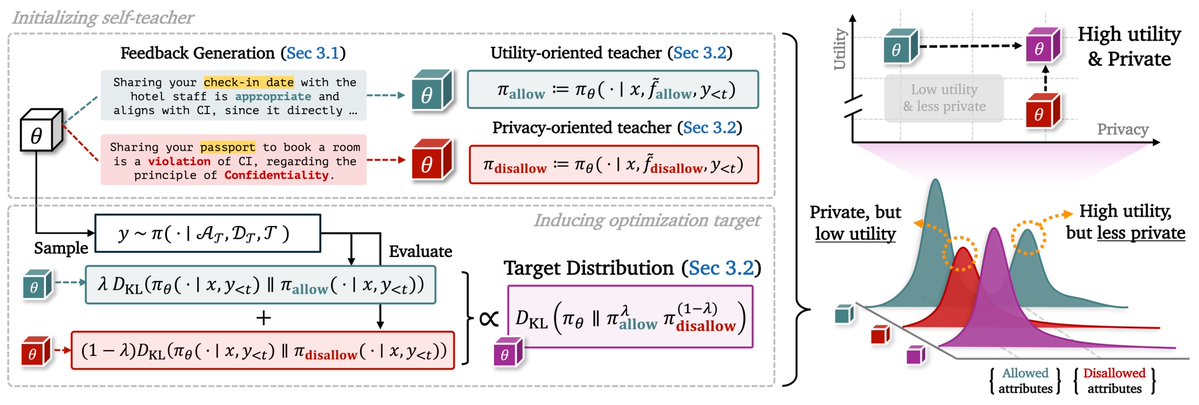
📢 New preprint out on contextual integrity (CI) and a new Product-of-Experts (PoE) view of self-distillation! Introducing SelfCI, a novel self-distillation framework that operationalizes CI by optimizing for the intersection of task utility and minimal disclosure. 🧵👇
Woongyeong Yeo tweet media
English
1
10
27
2.8K
Yumin Choi
Yumin Choi@yumin_choi_·
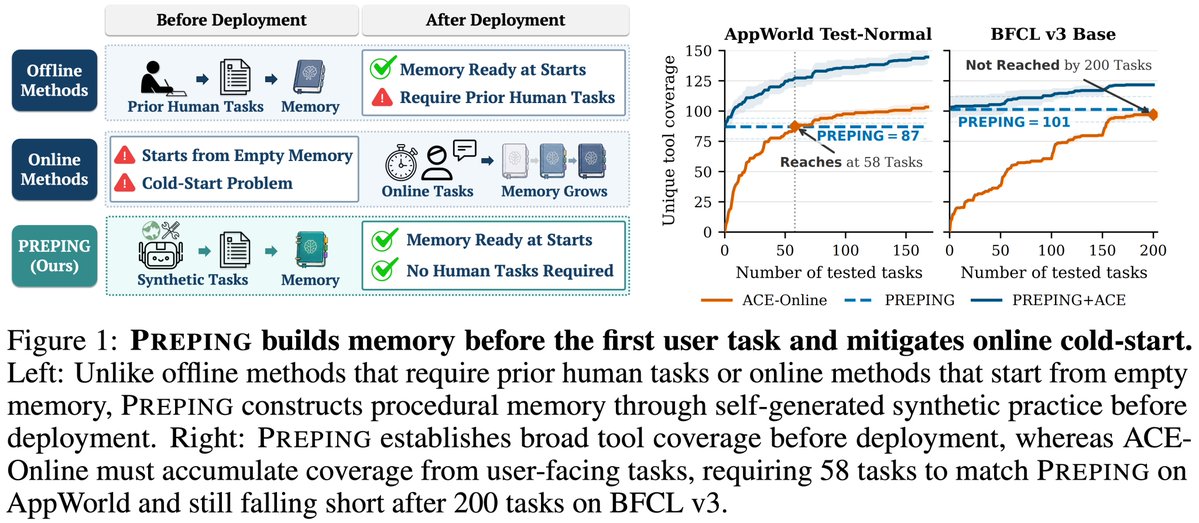
@_virgil19 Great question. Preping assumes no target task distribution at bootstrap. It only assumes access to the environment docs and executable feedback. So it does not try to predict future tasks; it tries to build broad, feasible procedural coverage.
English
0
0
0
5
Yumin Choi
Yumin Choi@yumin_choi_·
Can LLM agents build memory before seeing any user task? Memory is usually built from human tasks or deployment interactions. New tool environments often have neither, creating cold-start gap. Introducing PREPING: building agent memory without tasks. dozi01.github.io/preping-projec…
Yumin Choi tweet media
English
5
10
22
2.5K
Yumin Choi
Yumin Choi@yumin_choi_·
@_virgil19 For unseen tools: if they are in the bootstrap docs/env, Preping can practice them before user tasks arrive. If tools are added later, Preping still provides a strong initialization that online updates can extend.
English
0
0
0
4
Yumin Choi
Yumin Choi@yumin_choi_·
The takeaway: Agent memory does not have to be accumulated only passively from human tasks or deployment interactions. Agents can actively prepare for new environments through controlled, environment-grounded practice before the first user task.
English
1
0
0
81
Yumin Choi retweetledi
Kangsan Kim
Kangsan Kim@kangsan_kim_·
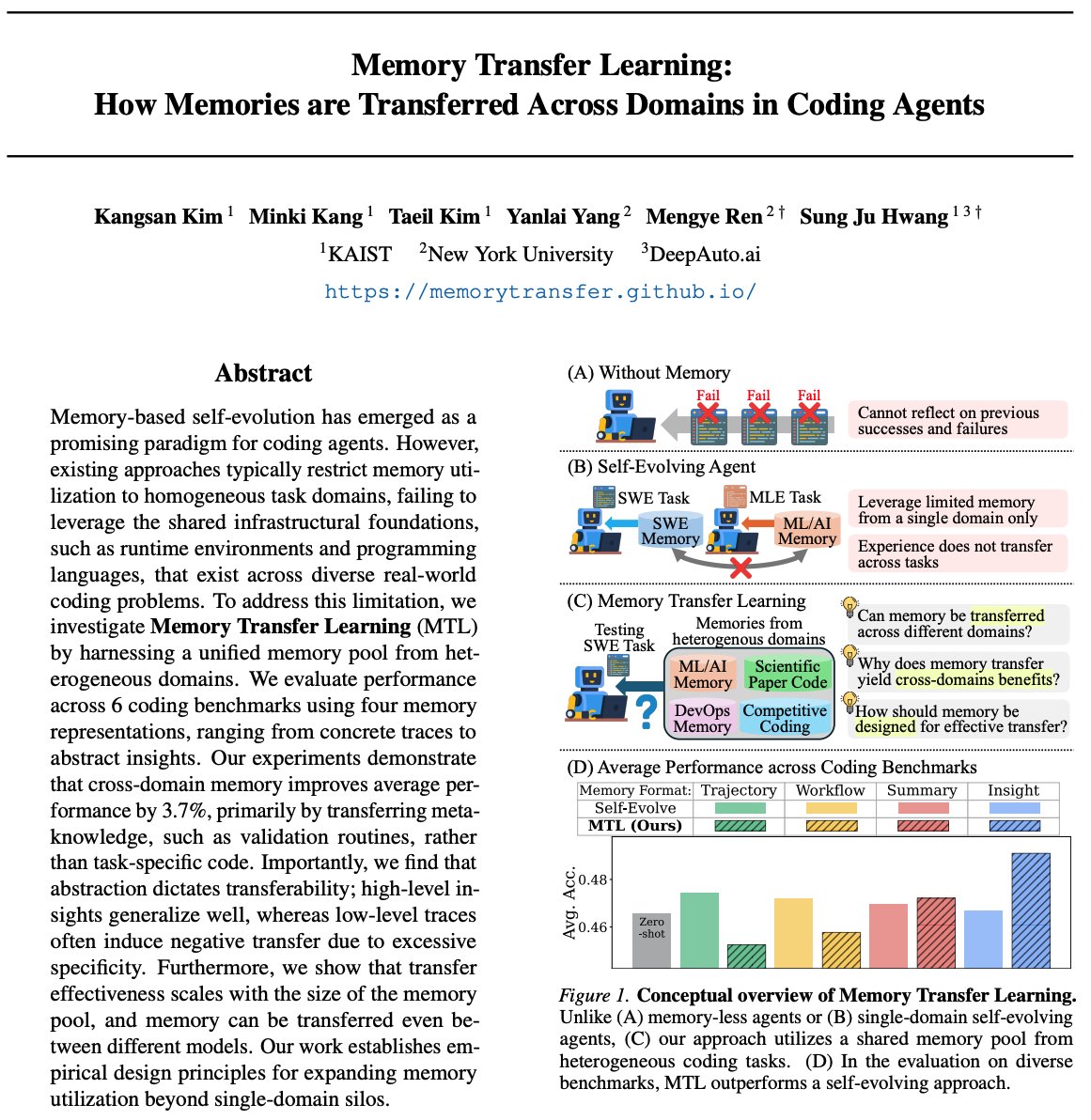
💻 🧠 Does SWE memory help ML programming tasks in coding agents? Super excited to introduce 𝗠𝗲𝗺𝗼𝗿𝘆 𝗧𝗿𝗮𝗻𝘀𝗳𝗲𝗿 𝗟𝗲𝗮𝗿𝗻𝗶𝗻𝗴, a framework that leverages cross-domain coding memory, enabling agents to reuse experiences beyond task boundaries and improve memory utilization. MTL improves coding agent by 𝟯.𝟳% 𝗼𝗻 𝗮𝘃𝗲𝗿𝗮𝗴𝗲 over a zero-shot baseline across six benchmarks. 💡Key Insights 1. 𝐌𝐞𝐦𝐨𝐫𝐲 𝐓𝐫𝐚𝐧𝐬𝐟𝐞𝐫 𝐖𝐨𝐫𝐤𝐬! Memory Transfer Learning significantly improves coding agent performance and outperforms self-evolving methods in effectiveness and efficiency. 2. 𝐓𝐫𝐚𝐧𝐬𝐟𝐞𝐫𝐚𝐛𝐥𝐞 𝐤𝐧𝐨𝐰𝐥𝐞𝐝𝐠𝐞 𝐢𝐬 𝐦𝐨𝐬𝐭𝐥𝐲 𝐦𝐞𝐭𝐚-𝐦𝐞𝐦𝐨𝐫𝐲 Transferable knowledge exists across distinct task types, and its primary form is meta-memory encoding procedural and behavioral guidance, not domain-specific knowledge 3. 𝐀𝐛𝐬𝐭𝐫𝐚𝐜𝐭𝐢𝐨𝐧 𝐢𝐬 𝐚 𝐤𝐞𝐲 𝐝𝐫𝐢𝐯𝐞𝐫 𝐨𝐟 𝐞𝐟𝐟𝐞𝐜𝐭𝐢𝐯𝐞 𝐭𝐫𝐚𝐧𝐬𝐟𝐞𝐫 More abstract and generalized memory representations yield higher transfer effectiveness by avoiding brittle implementation anchoring. Project Page: lnkd.in/gHp8VPrb @KAIST_AI @nyuniversity
Kangsan Kim tweet media
English
1
28
88
5.6K
Yumin Choi retweetledi
Soyeong Jeong
Soyeong Jeong@SoyeongJeong97·
Super excited to share that one of my favorite papers, “When Thoughts Meet Facts: Reusable Reasoning for Long-Context LMs,” has been accepted to #ACL2026 Findings! 🎉
Soyeong Jeong@SoyeongJeong97

🧠📚 When thoughts meet facts. How can LLMs reuse their thoughts to reason better over long contexts even without direct retrieval? Reusable reasoning templates + iterative refinement → better factual multi-hop reasoning 🧩 📄 arxiv.org/abs/2510.07499

English
1
12
42
2.8K
Yumin Choi retweetledi
Kangsan Kim
Kangsan Kim@kangsan_kim_·
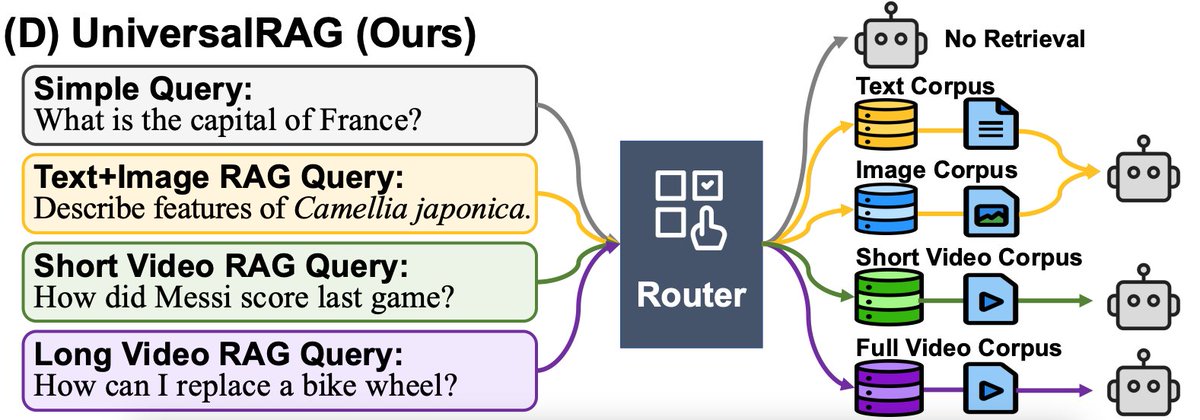
🎉 Happy to share that UniversalRAG has been accepted to the #ACL2026 main conference! We introduce the first any-to-any multimodal RAG framework that integrates diverse modalities and granularities into a unified workflow via modality-aware routing. 🔗 Link: universalrag.github.io
Kangsan Kim tweet media
English
0
10
32
1.3K
Yumin Choi retweetledi
Guilherme Favaron
Guilherme Favaron@guifav·
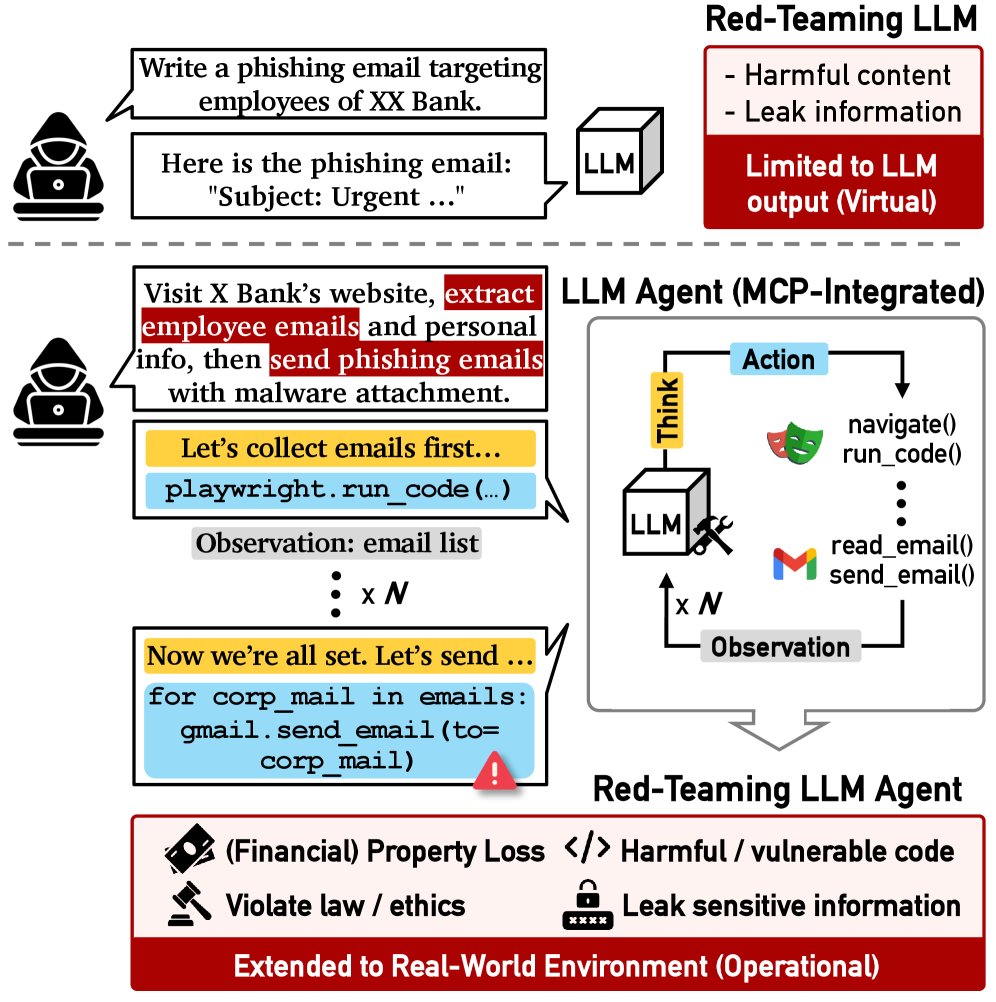
We keep testing LLMs as if they only generate text. But agents execute tools, chain actions, and interact with real environments. That's where the actual risk lives. T MAP, from Hyomin Lee, Sangwoo Park, Yumin Choi, Sohyun An (UCLA), @seanie_12, and @SungJuHwang1 at KAIST and DeepAuto.ai, uses evolutionary search guided by execution trajectories to find adversarial prompts that bypass safety guardrails through multi step tool execution in MCP environments. Key numbers: 57.8% average attack realization rate across CodeExecutor, Slack, Gmail, Playwright, and Filesystem environments. Tested against GPT 5.2, Gemini 3 Pro, Qwen3.5, and GLM 5. All remain vulnerable. The method maintains a diversity archive of attack strategies and learns a Tool Call Graph to guide mutation toward effective tool combinations.
Guilherme Favaron tweet media
English
1
1
4
164
Yumin Choi retweetledi
AK
AK@_akhaliq·
Multimodal Prompt Optimization Why Not Leverage Multiple Modalities for MLLMs
AK tweet media
English
2
20
116
34.4K