z

3K posts

z banner
z

z

@z80856488

professional reply guy // Founder of Falling Knife Catchers, Inc.

Katılım Mayıs 2021
703 Takip Edilen100 Takipçiler
z
z@z80856488·
@WalhallaMann My dad before he whoops my ass w the belt
English
0
0
0
8
Dan
Dan@Daniel_Farinax·
After hammering Grok 4.5 nonstop for the last 24 hours, here's the verdict: No other model comes close. Mythos is painfully slow by comparison, and I've executed every single idea in my head with zero friction. I'm fully comfortable cancelling my Claude Max subscription and keeping Grok Heavy instead. Not kidding. This feels fundamentally different. I was genuinely concerned when Claude announced they'd move Mythos to à la carte and pull it from Pro. Those worries are gone. Thanks, xAI. I've been calling this shift all year, but it landed faster than expected.
Dan tweet media
English
215
120
2.6K
138.3K
z
z@z80856488·
@Pentosh1 Europeng returns
English
1
0
1
104
🐧
🐧@Pentosh1·
Congrats to Belgium 🇧🇪 They capitalized on mistakes and errors and played a great all around game This World Cup was my first time watching football ever and I enjoyed it. Haaland, for Norway is just a beast and I think people like him will do a great job of bringing people into the sport
English
55
4
465
80K
z
z@z80856488·
@FirstSquawk Bro needs to shut up lmao
English
0
0
0
12
First Squawk
First Squawk@FirstSquawk·
ANTHROPIC CEO WARNS OPEN-SOURCE AI IS ON A "VERY DANGEROUS PATH"
English
307
77
906
1.5M
z
z@z80856488·
@abc7abigail Imagine apologizing over this lmao you snowflake
English
0
0
1
15
z
z@z80856488·
@METR_Evals Called SOL cause it’s a scam
English
0
0
0
31
METR
METR@METR_Evals·
OpenAI gave METR early access to GPT-5.6 Sol for testing including raw chain-of-thought, a railfree version of the model, and internal information about the model. With this access, METR conducted a pre-deployment evaluation of GPT-5.6 Sol, including an attempted measurement of its 50%-Time Horizon. However, the measurement depends heavily on our treatment of cheating attempts, and GPT-5.6 Sol’s detected cheating rate was higher than any public model we have evaluated.
OpenAI@OpenAI

Introducing a limited preview of GPT-5.6 Sol, our next generation frontier model, as well as GPT-5.6 Terra, a balanced model for efficient, everyday work, and GPT-5.6 Luna, a fast and affordable model for high-volume work. openai.com/index/previewi…

English
74
208
2.6K
586.7K
z
z@z80856488·
@ItsEthanRay The second half of the video is AI generated lmao shameless
English
0
0
1
33
Ethan Ray
Ethan Ray@ItsEthanRay·
She isn’t wrong. Accountability for everyone!!!👏👏🔥🔥
English
552
411
8K
155.2K
z
z@z80856488·
@ClaudeDevs Yeah maybe it’ll be useful when it operates on Fable
English
0
0
0
23
ClaudeDevs
ClaudeDevs@ClaudeDevs·
Claude Tag is the next evolution of agents. It's a proactive, multiplayer agent with memory and identity, built on top of Claude Code. Learn more about how Claude Tag works and best practices for using it in this deep dive.
English

185
190
2.4K
448.1K
z
z@z80856488·
@CL207 Have you watched Turkey play like what
English
0
0
0
444
CL
CL@CL207·
going to slam turkey to draw/win vs usa, the odds right now is crazy, turkey 4.2x return to win, like what
English
34
0
220
66K
Corey
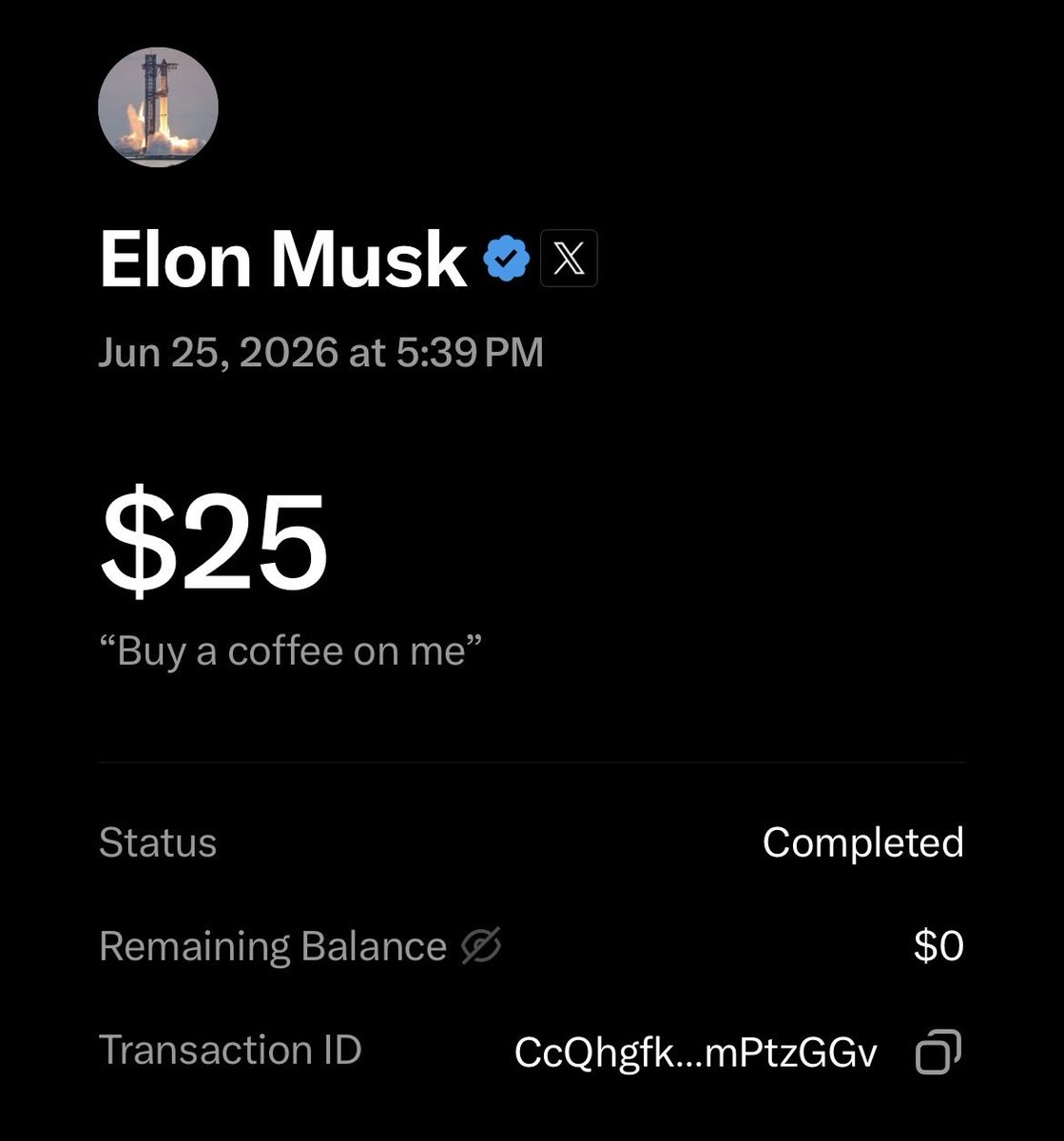
Corey@CoreyTheX·
@glamfika @XMoney I don’t care if he sees it lol. I can say I personally gave $25 to the richest man on earth. Such a flex
English
400
15
984
269.9K
Corey
Corey@CoreyTheX·
Call me an idiot, but I just sent $25 directly to Elon Musk, the richest man in the world using @XMoney for no other reason than I just can. lol
Corey tweet media
English
7.6K
1.5K
45.2K
19.6M
z
z@z80856488·
@FirstSquawk This is the part in Leopolds thesis where China catches up
English
0
0
0
78
First Squawk
First Squawk@FirstSquawk·
TRUMP ADMINISTRATION REPORTEDLY URGES OPENAI TO DELAY ITS NEXT AI MODEL RELEASE OVER NATIONAL SECURITY CONCERNS – THE INFORMATION.
English
19
26
384
69K
Evanss6
Evanss6@Evan_ss6·
MicroStrategy is GBTC 2.0
English
24
4
229
37.2K
z
z@z80856488·
@karpathy Bring back Fable please
English
0
0
0
19
Andrej Karpathy
Andrej Karpathy@karpathy·
This is a new paradigm for interacting with Claude that is significantly more "inline" with all the other human activity org-wide. Once you do all of the under the hood engineering work to make this "just work" (e.g. across tools, integrations, compute environments, memory, security, etc.), Claude basically joins the team in a seamless way - you can talk to it as you would talk to a person and it can help with a very large variety of workloads. Imo this is the 3rd major redesign of LLM UIUX. The first paradigm was that the LLM is a website you go to, the second was that it is an app you download to your computer. This third one is that it is a self-contained, persistent, asynchronous entity with org-wide tools and context, working alongside teams of humans. It really takes a while to wrap your head around it, but it works and it is awesome.
Claude@claudeai

Introducing Claude Tag, a new way for teams to work with Claude. In Slack, Claude joins as a team member with access to the channels and tools you choose. Tag Claude in and delegate tasks to it while you focus on other work.

English
1.4K
1.9K
23.1K
7.9M
z
z@z80856488·
@yacineMTB That’s wrong - Anthropic probably don’t want to release the model and reserve the compute to further accelerate development of their internal models We just aren’t worthy of them, and they don’t rly care
English
0
0
0
215
kache
kache@yacineMTB·
Extremely brutal. I genuinely thought they would let up the beatdown after a single weekend. Now it's looking like it's going to be months. Two months of losing the frontier. Two months is the difference between having complete and total Mindshare supremacy. Brutal..
Zvi Mowshowitz@TheZvi

Odds of Fable by July 1 further down to 24%, only 57% by July 31 or 72% by August 31. It's not looking like an easy fix and this suggests non-US persons might actually stay locked out indefinitely.

English

36
9
487
53.8K
z
z@z80856488·
@Evan_ss6 Agreed on the long term bullish take, it’s clear investing in these companies will have massive pay-off, the future is young! Therefore I shall be putting my money in a valueless cryptographic meme coins - CryptoTwitter
English
0
0
1
20
Evanss6
Evanss6@Evan_ss6·
Also super bullish on the 10 to 20 year timeframe. 1. AI will replace or augment most knowledge work. 2. AI spend as a proportion of knowledge-work comp is minuscule today, close enough to zero. 3. AI will revolutionize fields beyond software: robotics, biotech, materials science, physics, defense/military, etc. David’s argument is that coding revenue falls off → other revenue doesn’t replace it in time → air pocket. Given (2), even if coding softens, penetration into the broader knowledge-work base is still coming. AI spend should broaden over time. 4. All of this requires tremendous amounts of memory and compute for inference. Falling compute costs (his #2) are also demand-expanding: cheaper inference makes more workloads economic, a Jevons-style effect. 5. Even if you don’t believe any of this, winning the AI race is seen as existential by the US. The government is already turning from regulator into stakeholder: OpenAI is in active equity talks with Washington, and the Intel and IBM stakes are done. Expect more direct state support across the leading labs (Anthropic, DeepMind and peers), whether through equity, contracts, or otherwise. A key crux of his argument is that 1) app revenue funds the buildout and 2) hyperscalers exercise normal ROI discipline. 1. understates it. The buildout isn’t underwritten by coding revenue specifically; it’s a bet on aggregate compute demand across every use case, made by hyperscalers and labs, not by the app-layer software firms whose code moats could erode. That moat erosion is an app-layer story. It doesn’t subtract from infra compute demand, which is broadening (see 2) and getting cheaper to serve (see 4). A SaaS-multiple shakeout isn’t an infra-capex collapse. 2. may not hold either. Spending here probably won’t be as disciplined as a strict microeconomic context would imply, given the strategic and geopolitical stakes. That may break, or at least delay, the “market realizes → spending stops” step. For these reasons, I suspect the tailwind remains strong. The 2028 election matters a lot for the buildout, future regulation, taxation/UBI, etc. So much can still go wrong: safety, high energy costs, rates and credit, employment disruption, liquidity, issuance. Whether we get a boom/bust over the next few years is hard to say. History suggests that’s often what happens, but I don’t think this argument is sufficient to conclude it. Coding is only the first killer use case. AI spend is tiny relative to the knowledge work wage pool, cheaper inference may expand demand faster than costs fall, and compute is becoming strategic infrastructure. None of these arguments eliminate the need for eventual returns. It may simply make the cycle longer, less disciplined, and more political. All in all, I’m very bullish on human (and machine) ingenuity united toward a common goal.
David Orr@orrdavid

I'm very bullish on AI over 20 years. But now I'm confident that AI is most likely going to be a boom/bust cycle in the shorter term. Probably within a few years. The issue: 1. Most AI end user spend is just on coding. **Coding is where the money is actually coming from to pay for today's extreme capex**. 2. Compute costs will keep dropping a lot because hardware keeps improving rapidly. Even if the volume of capex doesn't keep going up (and it is today), the cost of software development will keep going down as the hardware gets better. Software developement isn't that hard a problem and it's easy to how **AI is going to drive development costs very low long term**. 3. **Back in 2020, it made sense for software companies to continuously improve their products because the cost of developing software was going to be roughly flat long term**. Thus, money invested into development was a moat because it would cost a competitor way too much to ever catch up. The bet was that each niche piece of software would be winner takes all and it would never make sense for anyone to catch up. 4. But now because of 2, 3 is no longer the case. If you assume software will cost 99% less to develop in 10 years (I do), software's moat sucks. You keep investing into something, where the future cost of that thing is going to be lower. At some point the market will realize all of this. And then software companies will stop making this poor investment. And then AI capex will overshoot almost for sure vs the short term demand. And then AI companies are going to drop hard / we have a bear market. Longer term, I expect companies to spend big on compute on things besides software. But this dominating variable is key today. 3 years ago I wrote that $NVDA would become the most valuable company in the world on the back of AI. Today, I'm nearly as confidently calling a short term boom/bust cycle, unless companies quickly find something else to spend huge on AI.

English

21
21
245
43.1K
z
z@z80856488·
@WIRED Retards
English
0
0
0
132
WIRED
WIRED@WIRED·
Trump administration officials tell WIRED that if Anthropic wants to rerelease Fable 5, it will need to ensure the model's guardrails can't be circumvented. Security experts say that can't be done. wired.com/story/the-whit…
English
148
171
1.4K
1.8M
z
z@z80856488·
@Pentosh1 Quick everyone bid a valueless AI scam meme shitcoin that will teleport to zero that’s surely the best way to capture the alpha
English
0
0
0
26
🐧
🐧@Pentosh1·
6.8 billion people have never used ai a single time that's how late you are to it and all the ideas, and advancements that will come from it
English
57
16
325
41.4K
z
z@z80856488·
@garrytan Breaking: Guy with money says money doesn’t make you happy
English
0
0
0
19
Garry Tan
Garry Tan@garrytan·
Attention is all you need
Garry Tan tweet media
Ihtesham Ali@ihteshamali

Does money buy happiness? A Princeton Nobel laureate said no above $75,000. A Penn researcher with 1.7 million data points said yes. The day they sat down together to settle the fight, the answer they reached should change how you think about your own life. The Nobel laureate is Daniel Kahneman. The Penn researcher is Matthew Killingsworth. The fight between them lasted 13 years, and the way it ended is one of the cleanest examples in modern science of two smart people being wrong in opposite directions about the same question. In 2010 Kahneman and his Princeton colleague Angus Deaton published a paper that became one of the most quoted findings in the history of social science. They analyzed 450,000 responses to the Gallup-Healthways Well-Being Index and concluded that emotional well-being rose steadily with income up to about $75,000 a year, and then flattened out completely. Above that line, the extra money was not buying any more daily happiness. The headline traveled around the world. Every news outlet ran the number. A CEO in Seattle famously cut his own salary to raise his employees to that exact threshold. The 75,000 dollar figure became cultural shorthand for the idea that the rich are not actually any happier than the rest of us once basic needs are met. For 11 years almost nobody seriously challenged it. Kahneman had a Nobel Prize in Economics, the sample size was massive, and the conclusion was emotionally satisfying in a way that made everyone feel a little better about not being wealthy. Then in 2021 a 33 year old researcher at the University of Pennsylvania published a paper that quietly destroyed the entire finding. His name is Matthew Killingsworth. He had spent the previous decade building a smartphone app called Track Your Happiness that pinged users at random moments during their day and asked them a simple question. How do you feel right now, on a scale from very bad to very good. The app was designed to catch happiness in the act, not to ask people to recall it later. By 2021 he had collected over 1.7 million real-time happiness reports from 33,000 adults. When he plotted income against in-the-moment well-being, there was no plateau anywhere. The line just kept rising. People earning $200,000 were happier on average than people earning $100,000. People earning $400,000 were happier than people earning $200,000. The curve flattened slightly but never stopped climbing. The famous $75,000 ceiling that the world had been quoting for 11 years simply did not exist in his data. Now there were two Nobel-quality findings sitting in direct contradiction with each other. One of them had to be wrong, and neither researcher was willing to walk away. What happened next is the part of the story almost nobody knows. Kahneman called Killingsworth and proposed something rare in academic science. He called it an adversarial collaboration. The two of them, joined by Penn psychologist Barbara Mellers as a neutral referee, would sit down together and reanalyze the raw data from both studies, line by line, until they figured out which one of them was wrong. The paper they co-authored was published in March 2023 in the Proceedings of the National Academy of Sciences. And the answer they reached was not what either of them had expected. Both of them had been right at the same time. They had been measuring two different populations without realizing it. When the team broke Killingsworth's 1.7 million data points apart by baseline happiness, the picture clarified completely. For the happiest 70 percent of people, more money kept buying more happiness all the way up to $500,000 a year, with no sign of slowing down. For people in the middle, the same pattern held. But for the bottom 20 percent of the sample, the ones who were already unhappy before the question of money even came up, the curve flattened almost exactly where Kahneman's original paper had said it would. Above roughly $100,000 a year, adjusted for inflation, more money did nothing for them. This is the finding that changes how the question should be asked. If you are not already unhappy, money keeps buying happiness for a much longer stretch than Kahneman's original paper suggested. The runway is wider than the world has been telling itself for a decade. If you are already unhappy, money does almost nothing past a certain point. There is a ceiling, but the ceiling is not about income. It is about the underlying state of the person collecting it. The deeper insight in Killingsworth's original research, the one almost nobody talks about, is the part that should sit with you longer than the income numbers. The Track Your Happiness app had been telling him for years that the single biggest predictor of in-the-moment well-being is not money at all. It is whether your mind is on the thing you are doing. His most cited paper, written with Daniel Gilbert at Harvard, is titled A Wandering Mind Is an Unhappy Mind. The data from the app showed that people are mentally absent from what they are doing 47 percent of the time, and that mental absence is one of the strongest predictors of unhappiness in the entire dataset. More predictive than income. More predictive than the activity itself. More predictive than almost any demographic variable you could measure. Which means the unhappy 20 percent that Kahneman's plateau actually described were probably not unhappy because they did not have enough money. They were unhappy for reasons that more money could not reach. The reason the curve flattened for them at $100,000 a year is the same reason it would have flattened at $300,000 or $700,000. The thing they were missing was not buyable. The most uncomfortable line in the entire 2023 paper is the one that nobody on the internet quotes. The authors note that the relationship between income and happiness, while real, is much weaker than the relationship between attention and happiness. A person earning $40,000 who is fully present in their own life will, on average, report higher in-the-moment well-being than a person earning $400,000 whose mind is somewhere else. The fight about money was the wrong fight the entire time. The two researchers spent 13 years arguing over whether the dollar ceiling was at $75,000 or $500,000, and the data from Killingsworth's own app was sitting there the whole time saying the ceiling was not about dollars at all. The ceiling is whether you can hold your attention on the life you actually have. You can run the experiment yourself the next time you catch your mind drifting. Stop. Put your phone down. Look at the room you are in, the person across from you, the food in front of you, the work you are actually doing. That is the part the apps cannot sell you and the salary cannot buy you. The data has been clear for over a decade. The plateau is not in your bank account. It is in your attention.

English
51
118
1.3K
133.2K