Zelva

59 posts

Zelva banner
Zelva

Zelva

@zelvaio

Observing the shift from search to answers. Building @aeolens

Katılım Haziran 2013
605 Takip Edilen383 Takipçiler
Zelva
Zelva@zelvaio·
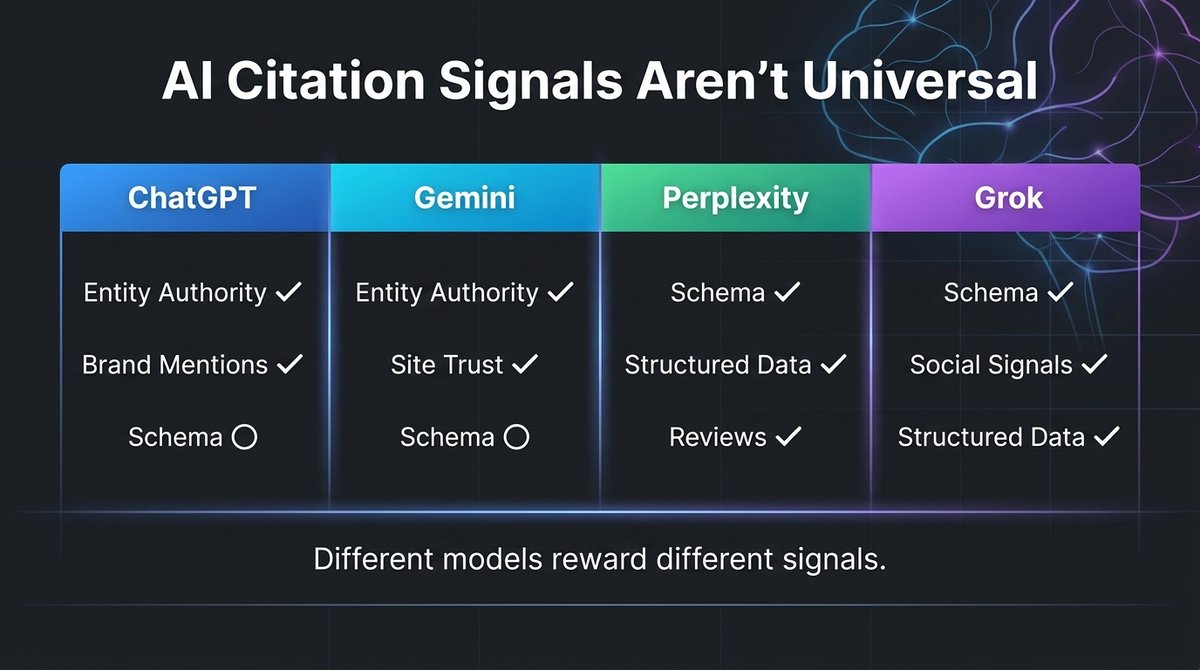
Spent the week testing what makes AI engines cite a page. One thing surprised me: Schema markup seems to matter a lot more for Grok and Perplexity than it does for ChatGPT or Gemini. Which means there probably isn’t a universal “AI SEO” checklist. The signals that earn citations depend on which model you’re trying to influence.
Zelva tweet media
English
1
0
0
28
Zelva
Zelva@zelvaio·
Exactly. Traffic from AI is becoming easier to attribute over time. But understanding why a brand is cited in the first place still feels like the bigger challenge. Citation visibility exists before the click, and I think the industry is still very early in understanding and measuring it.
English
0
0
0
6
Dominic Frei | Freistyle AI
Dominic Frei | Freistyle AI@Freistyle_AI·
AI Overviews now appear on nearly half of Google searches (BrightEdge, April 2026). Around 60% of all Google searches end without a click (SparkToro). Two trends, same outcome: if you’re measuring success by website traffic alone, you’re measuring the old internet. The new metric is citation — does your business get named in the AI answer? Are you measuring the right thing?
English
1
0
1
31
Zelva
Zelva@zelvaio·
@hridoyreh Plot twist: the SEO team was protecting the traffic all along.
English
0
0
0
10
Hridoy Reh
Hridoy Reh@hridoyreh·
I fired my SEO team last year. And, used Claude to automate SEO. Here is the result:
English
121
66
1.7K
611K
Zelva
Zelva@zelvaio·
@AICommerceGuy_ Exactly. Traffic tells you what happened. Visibility data helps explain why it happened. Feels like AI search needs both layers.
English
0
0
1
7
The Agentic Commerce Guy
The Agentic Commerce Guy@AICommerceGuy_·
@zelvaio That's true there are no tools for monitoring the traffic coming from these LLMs but even though this channel converts 5X than traditional search
English
1
0
0
19
The Agentic Commerce Guy
The Agentic Commerce Guy@AICommerceGuy_·
AI Search Decoded — Day 4 of 10 Where AI pulls "truth" about your brand. Your website matters. A lot. It's where your structured data, schema markup, product specs, and policies live. It's the source AI cross-references everything else against. But it's not the only place AI looks. And that's the part most brands miss. 85% of brand mentions in AI answers reference external sources alongside the brand's own site. AI builds a picture of your brand from multiple surfaces, not just one. Your website is the foundation. These platforms are the amplifiers: Reddit — 24% of all Perplexity citations come from Reddit. But 99% of those point to real discussion threads, not brand pages. AI cites genuine conversations about your product. YouTube — Strongest single predictor of AI visibility at 0.737 correlation across 75,000 brands. AI reads transcripts and descriptions. Product reviews and demos are now search content. LinkedIn — Moved from #11 to #5 on ChatGPT in three months. Cited in 14.3% of ChatGPT responses. Your posts are now dual-purpose: audience building and AI training data. Wikipedia — Top 3 source across every platform. If your brand has an entry, AI treats you as a verified entity. That changes everything. Review platforms — Brands on G2, Capterra, Trustpilot, and Yelp see a 3x citation multiplier vs brands without those profiles. How it actually works: Your website provides the structured truth. Product data, schema, pricing, policies. This is what AI reads first to understand what you sell. External sources provide the validation. Reddit, YouTube, reviews, press. This is how AI decides whether to trust what your website says. If your website data is clean but nobody talks about you externally, AI has the facts but not the confidence to recommend. If external sources mention you but your website data is messy, AI has the buzz but can't verify the details. You still get filtered out. You need both. The website is the source of truth. External presence is the trust signal. The part most people get wrong: There is no universal top source. Reddit leads on Perplexity but barely registers on Gemini. LinkedIn skews heavy on ChatGPT but not on others. Each AI engine pulls from different places. Treating "AI visibility" as one channel is a mistake. What to do about it: First: get your website right. Structured data, schema markup, complete product information, machine-readable policies. This is the non-negotiable foundation. Then: build real presence on the surfaces AI reads. Not brand accounts posting promotions. Real discussions. Real content. Real reviews mentioning specific product attributes. Your website tells AI what's true. Everything else tells AI whether to believe it. Tomorrow Day 5: 93% of AI sessions end without a click. Your traffic is dropping and your dashboard can't explain why. Bookmark this series. By Day 10 you'll understand AI visibility better than 95% of marketers.
The Agentic Commerce Guy tweet media
English
1
0
6
102
Zelva
Zelva@zelvaio·
@bloggersarvesh @MasculineEgo_ We’re entering a weird phase where creating content is almost free, but earning citations and mentions is becoming the scarce resource.
English
0
0
0
4
Zelva
Zelva@zelvaio·
@Oblivious9021 Most teams look at cost per token. I’d start with cost per successful task. Once you measure that, you quickly find a lot of prompts are carrying unnecessary context and duplicate retrieval data.
English
0
0
0
15
Shreya
Shreya@Oblivious9021·
Interviewed an AI Engineer Candidate today. Me: How would you optimize LLM costs? Candidate: Use a cheaper model. Me: The model is fixed. Candidate: Use different models. Me: You can't change the model. What now? Candidate: 🤐 Your turn: How would you cut LLM costs while keeping the same model, same traffic, and same output quality? 👇
English
134
18
468
258.3K
Zelva
Zelva@zelvaio·
@glenngabe @kmadhavan77 We’ve been talking about AI visibility, but measurement has always been the missing piece. Intents + Topics + Citation Share seems much more actionable than raw citation counts alone. Curious to see how teams start using this data to guide content strategy.
English
0
0
0
16
Glenn Gabe
Glenn Gabe@glenngabe·
Big news from Bing. And you can compare changes over time. This is what @kmadhavan77 shared in April and now it's rolling out -> New AI Visibility Insights in Bing Webmaster Tools: Intents, Topics, Citation Share, Compare "AI-generated answers are dynamic, contextual, and often synthesized from many sources at once. Understanding visibility in these systems requires more than a single metric or surface-level citation count. With these expanded preview capabilities, Bing Webmaster Tools is expanding first-party reporting to provide deeper insight into the query context, thematic patterns, relative citation presence, and changes over time that shape how content appears in AI-powered experiences." "With the new Intents feature, grounding queries in the AI Performance Report are now classified into broader categories such as Informational, Commercial, Navigational, Learn and Solve, Research, Creation, Local, and more. This helps publishers move beyond simply seeing which queries triggered citations and begin understanding the broader query context our systems associate with those citation appearances." "We are also introducing Topics, which group related grounding queries into broader thematic clusters. AI systems reason across concepts and themes rather than isolated keywords. Topics help publishers understand visibility in the same thematic structure that modern AI systems use to organize information." "While total citation counts show how often your content appears in AI-generated answers, Citation Share shows how much of the citation space your site receives for a specific grounding query. It is calculated as the percentage of citations attributed to your site out of all citations shown across all sites for that same grounding query." blogs.bing.com/search/June-20…
Glenn Gabe tweet mediaGlenn Gabe tweet media
English
10
29
114
29.4K
Zelva
Zelva@zelvaio·
@vidyamadhavan2 I actually know a few people who use Perplexity daily, but you’re right - nobody talks about it the way they talk about ChatGPT. Feels like a distribution problem more than a product problem.
English
0
0
0
13
Vidya Madhavan 😶‍🌫️
Perplexity is at $450M ARR and $22B valuation. I have never once heard anyone say "let me Perplexity that." Claude is everywhere. ChatGPT is everywhere. In fact even Gemini is everywhere. Perplexity is the most successful product nobody talks about using. Who is the $450M?
English
307
28
1.6K
344K
Zelva
Zelva@zelvaio·
@dee_naliaks The human behind the prompt may become more important than the prompt itself. That’s a fascinating shift AI search is forcing us to think about.
English
0
0
0
5
Doreen
Doreen@dee_naliaks·
One aspect of PallasAI that stood out during testing was the User → Scenario → Intent framework. Most conversations around visibility focus on keywords, rankings, or citations. This workflow approaches the problem from a different angle by starting with the people behind the search. The platform maps potential user personas, the situations they may be in, and the search intents that could lead them to AI assistants while evaluating solutions. Seeing these relationships visualized helped clarify how customer journeys might translate into AI-powered discovery. What I found particularly interesting is that the process doesn't stop at identifying audiences. The framework is designed to connect those audiences to specific intents and touchpoints, creating a structured way to think about how brands may appear within AI-generated conversations. For teams exploring AEO, GEO, or broader AI visibility strategies, it's an interesting perspective because it shifts the discussion away from isolated keywords and toward the context behind user behavior. As AI search continues to mature, understanding those connections may become just as important as understanding traditional search queries.
English
26
138
196
88.4K
Zelva
Zelva@zelvaio·
@contentics The most interesting shift is that visibility and traffic are no longer the same thing. A brand can influence a purchase decision inside an AI answer and never receive a click. That’s a very different internet than the one marketers have been measuring for the last two decades.
English
0
0
1
6
Zelva
Zelva@zelvaio·
@Bha74142Shivani Prompting gets attention. Systems create leverage. That’s probably the biggest shift happening right now.
English
0
0
0
3
Shivani Bhatnagar
Shivani Bhatnagar@Bha74142Shivani·
Most people use AI like a search engine. Power users use it like an operating system. This "Claude Mastery Map" breaks the journey into 100 practical skills—from prompting and artifacts to automation, workflows, integrations, and AI-powered systems. Key takeaway: • Beginners ask questions. • Intermediate users create outputs. • Advanced users build workflows. • Power users automate decisions. The biggest shift isn't learning better prompts. It's learning how to: → Structure thinking → Create repeatable systems → Connect tools together → Automate repetitive work → Turn AI into a collaborative teammate The future belongs to people who can design systems, not just write prompts. The question is no longer: "Can you use AI?" It's: "Can you build a process that uses AI better than everyone else?" Where are you on this journey? 1. Beginner 2. Regular User 3. Advanced User 4. Power User #AI #ClaudeAI #ArtificialIntelligence #PromptEngineering #Automation #Productivity #FutureOfWork #AITools #GenerativeAI #Tech #Innovation #Learning #WorkSmart #DigitalTransformation
Shivani Bhatnagar tweet media
English
8
45
112
2.5K
Zelva
Zelva@zelvaio·
@neilpatel The attribution problem is going to be fascinating. A user asks an LLM for recommendations, doesn’t click a cited link, visits the brand later directly, and converts. Traditional analytics may never tell the full story of AI-driven discovery.
English
0
0
0
3
Neil Patel
Neil Patel@neilpatel·
How profitable is GEO? We looked at 100 businesses that leverage GEO. We found that as their visibility increased, so did their profit from that channel. Now there are 2 important things to keep in mind: 1. A lot of conversions happen from people who find you through LLMs, but you can't track them. Ex: they go directly to your site. (so the real revenue number should be higher) 2. More people are using LLMs each month, so the growing user base also helps your profitability number, assuming your visibility is maintained.
Neil Patel tweet media
English
19
13
71
21.6K
Zelva
Zelva@zelvaio·
@losfigur Ranking and recommendation are becoming two different games. I think that’s one of the biggest misconceptions people still have about AI search.
English
0
0
0
4
Los Figur
Los Figur@losfigur·
SEO got you ranked. AEO gets you recommended — by ChatGPT, Gemini, Perplexity. When a customer asks an AI "who's the best ___ near me," is it saying your name? For 99% of local businesses right now: no. That's the whole opening.
English
6
0
4
171
Zelva
Zelva@zelvaio·
@iamkarolk @jakezward Think of it as a robots.txt for LLMs. It lets websites provide AI systems with structured guidance on what content exists and how it should be interpreted. Still very early though - and it’s definitely not the magic bullet for AI search that many people think it is.
English
0
0
0
5
Jake Ward
Jake Ward@jakezward·
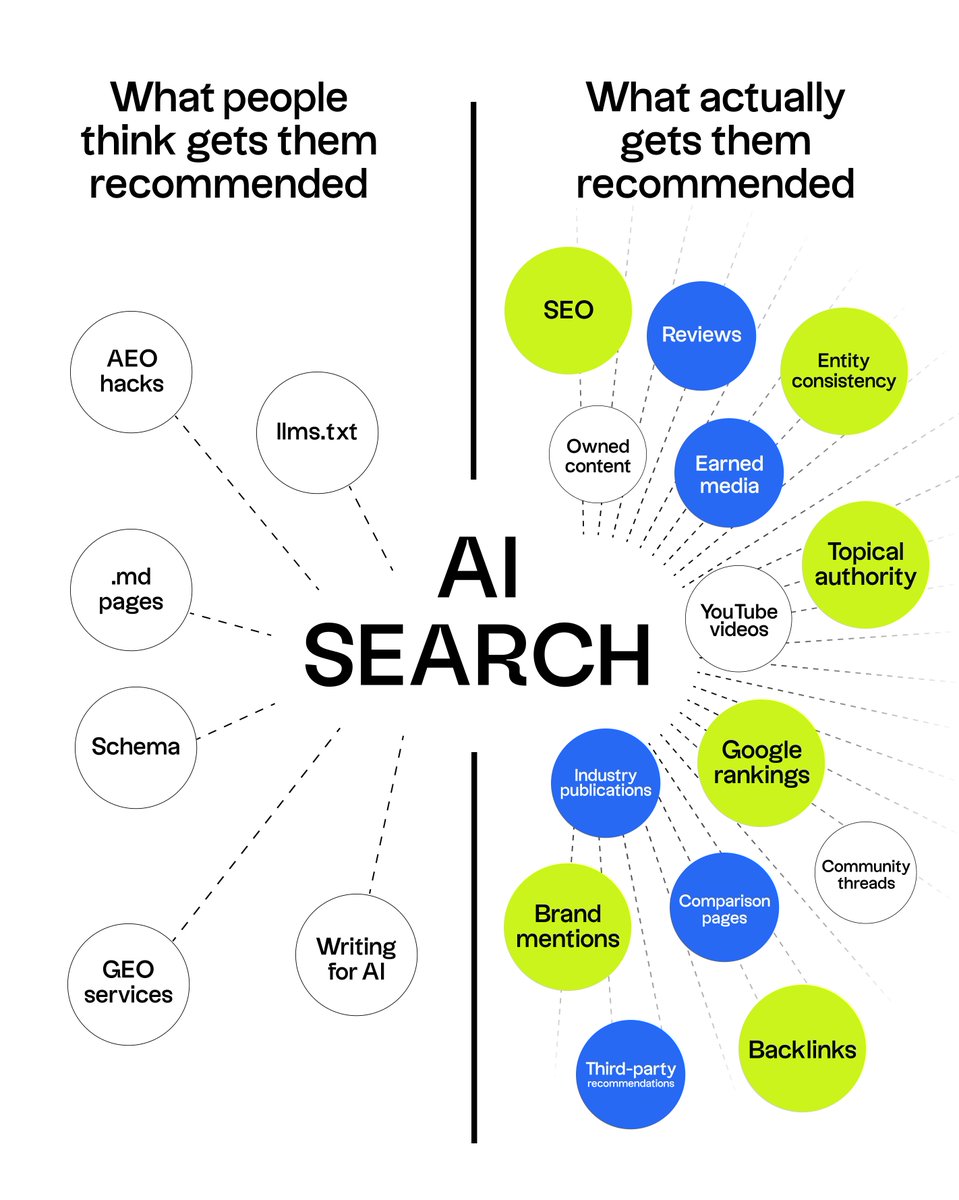
What people think AI search is: - llms.txt - Schema - .md pages - AEO hacks - Writing for AI - GEO services What AI search actually is: - SEO - Reviews - Backlinks - Earned media - Owned content - YouTube videos - Brand mentions - Google rankings - Topical authority - Entity consistency - Comparison pages - Community threads - Industry publications - Third-party recommendations AI search needs to be treated as an expansion of SEO, not a completely different channel.
Jake Ward tweet media
English
32
41
258
13.4K
Zelva
Zelva@zelvaio·
@jakezward I think the interesting part is that people are looking for a silver bullet for AI search. But LLMs seem to reward the same things humans trust: reputation, recommendations, topical authority, and consistent brand presence. The medium changed. Trust signals didn’t.
English
0
0
1
14
Zelva
Zelva@zelvaio·
Everyone’s still optimizing for Google. But ask ChatGPT “best [category] tool” and Google’s rules barely apply. LLMs don’t rank 10 blue links. They cite a handful of sources. Not one of them? That’s the problem.
Zelva tweet media
English
1
0
0
33
Zelva
Zelva@zelvaio·
@0x_Discover If they genuinely are making money with this, nobody will be posting it.
English
0
0
0
11
Discover
Discover@0x_Discover·
I told Claude I had $1,000 and one week to make something happen. No job. No plan. Just a number and a question. I expected the usual advice. Index funds. Savings accounts. Maybe stocks. Instead, Claude gave me something completely different. Find a bot on GitHub that buys events priced under 3 cents. Deploy it with $1,000. Let it run. Most bets will go to zero. The ones that hit will pay 100x–500x. I laughed. Then Claude added one line that changed everything: Someone is already doing this. Search “planktonXD”. So I did. Copy it here:t.me/KreoPolyBot?st… planktonXD. $95,502 profit. Joined February 2025. Bio: having fun. Starting capital? Just over $1,000. Same number I had. One trade: $15 on “zero earthquakes worldwide” Payout: $1,330 ROI: 8,742% At first it looked like luck. Then I saw the scale. 77,752 bets. $5 to $25 each. Most go to zero. But the rare ones… They don’t just win — they explode. Buying at fractions of a cent. Cashing out at 100x, 300x, sometimes 500x. I asked Claude to explain the logic. It broke it down simply: Bet $15 across 100 events at 1 cent. 99 go to zero. 1 hits — you break even. 2 hit — you double. 3 hit — you start compounding. planktonXD didn’t hit three. He hit way more. $1,000 → $95,502. Not by predicting the future. But by exploiting how people price it. I asked Claude the obvious question: Should I copy this? Claude replied: I can’t give financial advice. But mathematically, the edge exists as long as the crowd overprices fear and underprices chaos. That night I didn’t overthink it. Put in $100. Copied 9 positions under 1 cent. Went to sleep. Woke up. One hit. $100 → $580. No indicators. No charts. No “alpha”. Just asymmetry. I didn’t ask Claude what to buy. I asked where $1,000 goes the furthest. It pointed me to someone who already did it. 77,752 bets later… The bot is still running. The bio still says: having fun. I asked Claude one last question: What would you call this strategy? Claude said: Buying lottery tickets… where the math is on your side.
Discover tweet media
Discover@0x_Discover

x.com/i/article/2039…

English
14
38
361
190.9K
Zelva
Zelva@zelvaio·
@Skerved @itsPaulAi That’s frustrating to approve every powershell command to run. When I switched to mac it’s not asking for approvals.
English
0
0
0
7
Vincent Skerved
Vincent Skerved@Skerved·
It's now actually working. Not sure exactly what I did. I had issues with both with Agent and Agent (full access) after a restart of the IDE. Then after two painful sessions of pressing "approve", it stopped asking for my approval... 🤷‍♂️ There seem to be some bug, but it works after some time, and a couple of restarts. On Windows btw.
English
1
0
0
30
Paul Couvert
Paul Couvert@itsPaulAi·
OpenAI has just released GPT-5-Codex specifically for coding! Friendly reminder that they've a VS Code extension that you can use with your ChatGPT account at NO additional cost. Basically a strong alternative to Claude Code or Cursor. (Setup below)
English
99
183
1.8K
261.8K