
Sabitlenmiş Tweet
Zerops
1.2K posts


Zerops
@zeropsio
From local development to production. Zerops builds, deploys, runs and manages your apps, no matter the size, no matter the environment.
Prague, Czech Republic Katılım Ekim 2018
78 Takip Edilen976 Takipçiler
@NathanFlurry Agreed on the principle.
Zerops takes it further down the stack: real Linux containers you shell into, on bare metal we run ourselves, billed as cores and RAM per minute.
English

You should always be able to control your compute
Accidents happen, but you’re in far more control with k8s, Railway, etc
That why we built Rivet as an open-source alternative to CF DO & Workflows that supports both:
- Our cloud, your compute (BYOC)
- Self-hosting
Ajay Sohmshetty@AjaySohmshetty
Woke up to see our @Cloudflare bill going from $35/month ➡️ $38,277/month "uhhh... This feels existential" - @andrewk17
English
@webdevcody That is a lot of reach in one session!
On Zerops the agent works in its own container scoped to the project network it is assigned, so the convenience does not come with a path to everything at once.
English
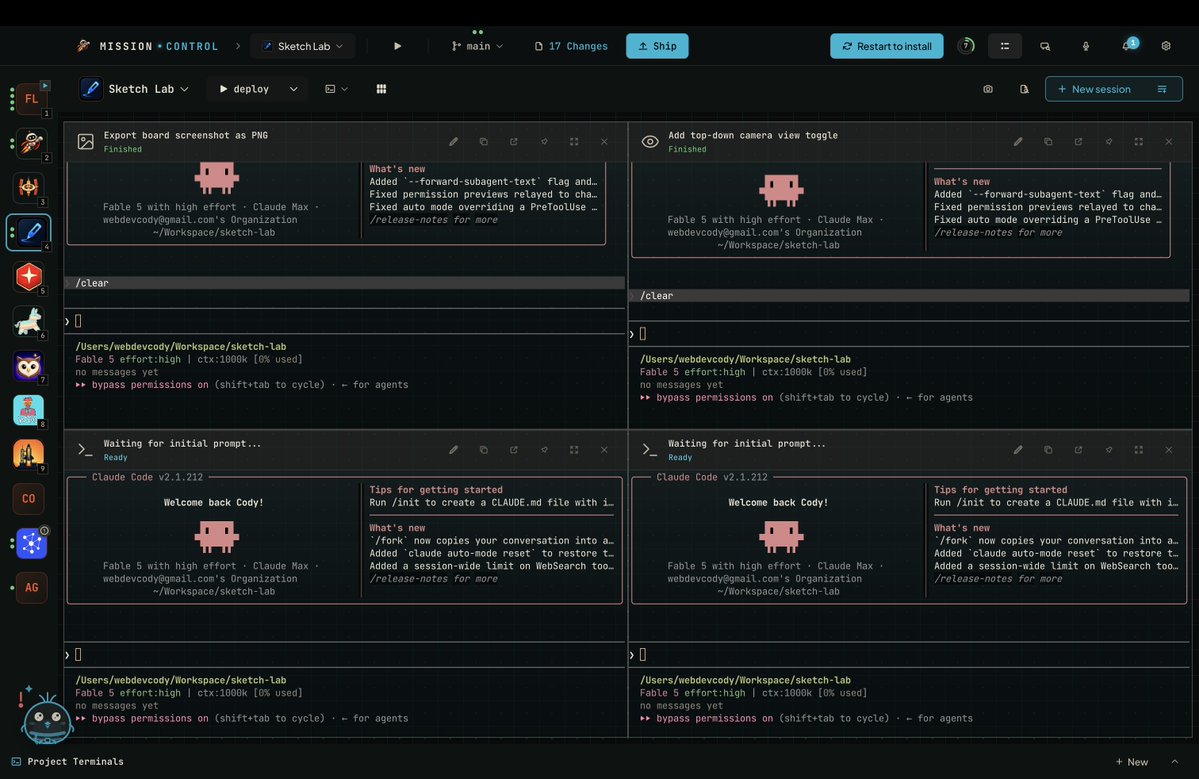
I just let claude interact with stripe mcp, with railway cli, aws cli, and my github actions & secrets. I haven't needed to laod their dashboard in a while.
English

kubectl-mcp-server lets AI assistants use natural language to inspect and manage Kubernetes clusters through kubectl operations, Docker support, kubeconfig mounting, and MCP-compatible tooling
➜ ku.bz/r2PJ8Y4zs
English
@bit2byteapp The 72 becomes one server, and that server becomes the thing worth placing carefully.
On Zerops it runs on a private network reaching only what you wired in.
English

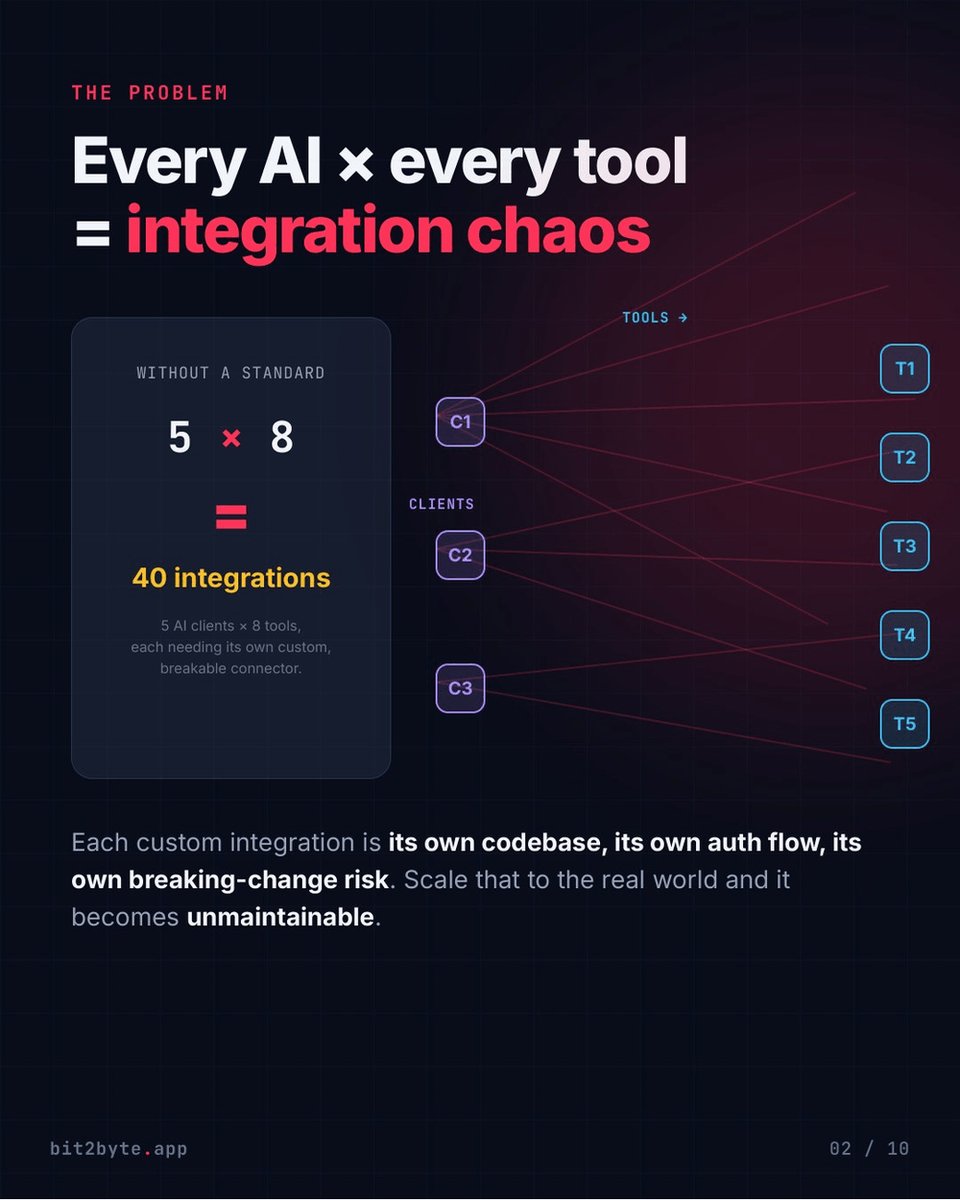
Every AI app I touch wants its own custom connector.
My agent needs to query a database? Write an integration. Read a GitHub repo? Different integration. Touch the filesystem? Another adapter. The math gets ugly fast — six apps times twelve tools is 72 integration surfaces someone has to build, debug, and babysit.
MCP replaces all of that with one spec.
You write a single server that exposes your tool, your data, whatever. Any AI app that speaks MCP connects to it. Claude, ChatGPT, VS Code, Cursor — they all support it today. No per-app glue code.
Best mental model: it's USB-C for AI. Before USB-C, every device shipped its own charger and cable. Now one port handles everything. MCP does the same for agents and tools.
Your AI app is the host. It spins up clients — one per server it connects to. Each server exposes three primitives: tools (things the AI can do), resources (data it can read), prompts (templates that frame the interaction). That's the whole model.
One database server → any agent queries your data. One GitHub server → any agent reads your repos. One filesystem server → any agent reads and writes files. Write the server once, it runs with any AI.
This isn't a roadmap. It works right now. If you ship tools, APIs, or data systems, you're going to write an MCP server eventually.
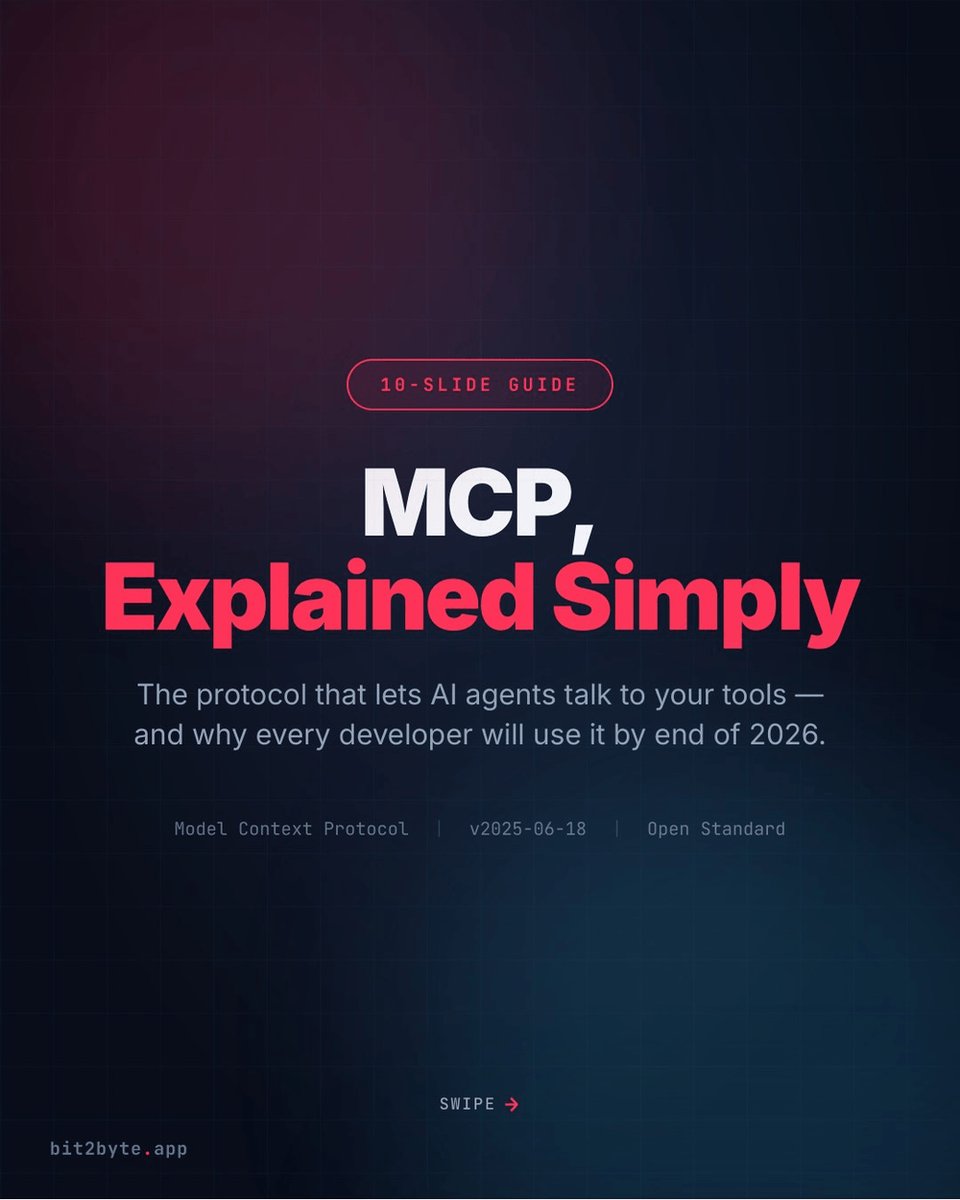
I built a carousel that walks through all of it — two minutes, slide by slide. Swipe through if you're tired of nodding along when someone drops "MCP" in a meeting.
Have you shipped an MCP server yet? Drop the link — I'm collecting the good ones.
#MCP #ModelContextProtocol #AI #Developers


English
@foursignalsdev Thanks for this artice!
Stateful means it needs to stay up rather than respawn, right?
On Zerops it runs as a persistent container on the private network your agents share.
English

One MCP server (~300 lines) serves three agents via FastMCP and gemini-3.1-flash-lite-image. No per-platform adapters; stateful API preserves context. MCP standardizes too...
foursignals.dev/wire/2026-07-1…
English

Wrote an MCP server for codex to use Kimi K3 via openrouter to do code review when asked: github.com/catid/k3mcp
English
@FitimBozar That loop needs somewhere safe to run, right?
On Zerops the agent builds and deploys inside its own project on a private network, so watch it fail and redeploy never touches anything outside.
English

An MCP server now gives Claude Code direct access to n8n's 2,174 workflow nodes.
That means an agent can build a workflow, deploy it, watch it fail, diagnose the failure, and redeploy — without a human touching a single node.
Workflow building just stopped being manual.
English

I built Fuse to speed up Claude Code on C# codebases.
It is an open source MCP server and CLI that keeps a local MSBuild and Roslyn index, so Claude can resolve symbols, references, .NET wiring, and project structure without repeatedly reading and searching the same files.

English
@Edmund_Works Nice work Edmund. Interface free products still need a runtime.
On Zerops a bidirectional MCP server runs as a real Linux container with managed Postgres on a private network, priced per minute of hardware.
English

I built a SaaS product with no intention of anyone using the interface.
When we built our AI headhunter (Superposition), the first thing I asked my cofounder: why would anyone leave their terminal or their Claude to go click around inside our UI?
So we shipped a bidirectional MCP server.
The best software disappears into the environment you already chose.
GIF
English
@chrisjdavis Hey Chris, worth backing it with network scope so the CMS server cannot reach anything else you run.
On Zerops that is the project boundary
English

quality of life improvement. I added a slim mcp server (tightly locked down) to my bespoke CMS. It allows me to make changes to settings, create new crons, etc from cursor, codex, etc. Basically every time I'm like, "hey I need to do x" I now ask the agent to take care of it.
English

Join today, 6 PM CEST, @FrancescoCiull4's livestream.
A surprise is waiting for you.🤫
Francesco Ciulla@FrancescoCiull4
It’s Friday, back to streaming! Today at 6 PM CEST, we’ll explore the newly open-sourced Grok Build, written 99.6% in Rust. We’ll: - Inspect its GitHub structure - Check dependencies - Run it locally. And there’s a surprise for those who tune in👀 @zeropsio Link below
English
@devops_blog Safely usually means read only tokens.
The other half is the database having no public endpoint at all.
On Zerops managed Postgres sits on the project's private network with the MCP server beside it. Let us know if you want to learn more.
English
MCP Server That Lets AI Query Your Database Safely ift.tt/OyW3zX9
#devops
English
@AIAppsAPI It converts because it is immediately useful, which is also why placement matters.
On Zerops the Postgres MCP server and managed Postgres share a private network, so the database answers agents without a public endpoint. :)
English

Postgres through MCP is the use case that converts people. The first time someone asks their own database a question in plain English and gets the right join back, the argument is over. Smart to demo it across Claude Code and Cursor too, one server working for every client is the whole point of the protocol.
English

Into Postgres, agentic AI, open source tooling, distributed databases, or just building things with data? We make videos about all of it.
🤖 pgEdge MCP Server for PostgreSQL: query your database through Claude Code, Cursor, or any MCP-compatible client. 15 min, full demo.
🧊 ColdFront data tiering: transparent hot/cold storage, same SQL, no app changes. Analytics on a Postgres table spanning years of data.
🔍 AI DBA Workbench: open source monitoring with AI. We ran real comparisons against Citus, AlloyDB, Amazon RDS, and Azure Flexible Server.
🐘 PostgreSQL 18 deep dive: performance, indexing, replication enhancements. 54 min if you want to go deep.
And a lot more: HA strategies, Kubernetes deployments, cloud demos, quick-tip shorts, and "Don't Do This!": common Postgres mistakes, exactly what it sounds like.
🎥 hubs.la/Q04pP6HR0
Still growing... don't forget to subscribe to keep an eye out for new content. 🌱
#postgresql #postgres #agenticai #mcp #opensource #dataengineering #aiengineering #analytics #developertools #database #appdev #tech #learntocode

English

we didn't build an MCP server for our product. we shipped a CLI instead
MCP is great, but for a lot of products a CLI is the lower-friction way to reach an agent:
- almost every agent already has a Bash tool (Codex, Claude Code, Cursor, CowAgent, etc). the product doesn't need to stand up an MCP server, and the client side doesn't need to support an MCP client either
- the CLI wraps auth, params, pagination and errors into the command, the agent doesn't construct HTTP calls
- it doesn't need the full API reference in context. you integrate it as a skill — a short command description is enough to pick the right command, which saves tokens and cuts mistakes
not a replacement for MCP, just a cheaper path when the agent already has a shell.
open-sourced the CLI project here: github.com/MinimalFuture/…
Yujie Zha@zhayujie
English
@stretchcloud The harness argument extends to infrastructure. A generic agent with a CLI beats a vendor's AI box.
On Zerops the agent gets a real Linux container and zCLI, so the platform is scriptable rather than a UI.
English
The shift I keep watching in how developers actually use AI tooling just got named precisely.
Mitchell Hashimoto posted this today: using a generic agent harness with CLI and MCP beats every product-specific AI chat box he has tried. Two reasons: you can always use the latest frontier model, and you can mix in more context from wherever you need it.
This is a structural point, not a preference.
Product AI boxes are frozen at the model version the vendor ships. A generic harness running Codex, Claude, or OpenCode via CLI/MCP is one config change from the current frontier. For developer tools, a one-generation model gap translates directly into worse completion quality, lower code understanding, and inferior long-context reasoning.
The context mixing point matters just as much. Product chat boxes have a fixed tool graph and a fixed set of context sources. A CLI/MCP harness can reach across the codebase, shell history, git log, running processes, CI output, and any custom MCP server the team builds. That breadth changes what questions you can actually answer.
The companies building around this pattern: Claude Code, OpenAI Codex, OpenCode, Zed's native agent mode, and Cursor all compete for the same harness role. The harness that wins is not the one with the best default UX. It is the one that connects to any tool, any model, any context source without friction.
Ghostty became popular for the same reason. Granular control over something that most others wrapped in defaults.
The instinct is consistent.
x.com/mitchellh/stat…
Mitchell Hashimoto@mitchellh
Using a generic agent harness (e.g. Codex, Claude, OpenCode) + CLI/MCP is better than "Ask me anything" built-in product chat boxes in every product I've ever tried. A big reason is I can use the latest frontier models, another is mixing more context. Why your box over mine?
English

Boris is right™, agent automation requires you "encode domain knowledge as infrastructure"
This is true not just of the context that lives in internal systems, but of that which lives with vendors as well
Every vendor has a CLI and an MCP server, but an API wrapper and a skill is not enough to encode domain knowledge as infra
The best vendors for agent automation will be the ones that let you represent their infra as code—declarative, versioned, reviewable
IaC means vendor context lives alongside the rest of your system, not behind a wall of api and tool calls
Boris Cherny@bcherny
Something I have been thinking about: in the past, the best engineers I knew spent a lot of time automating their work in various ways. Better vim/emacs automations, writing lint rules to catch repeat code issues, building up a suite of e2e tests so they don't need to smoke test the app manually. These kinds of things were the highest leverage activities an engineer could do, because it multiplied their own output, which in turn meant they could build more things. I think many of these automations have become even more important now. This is true for a number of reasons. First, infra and DevX automation speeds you up. And if you are running an army of agents, each of those agents will be sped up also. More automation == more output per unit of time. Second, moving things to code improves efficiency. Your agent could fix an issue every time it sees that issue happen, but that uses tokens and might miss cases. If Claude instead writes a lint rule, CI step, or routine, that class of issue can be fully automated forever. This is really what people are talking about when they talk about loops -- it's about automating entire types of busywork rather than solving them one off. This isn't a new idea at all. Engineers have been doing this for a long time! Third and most importantly, automation makes it possible for others to contribute to the codebase more easily. Increasingly what I am seeing is engineers are contributing to codebases on day one because Claude can navigate the codebase for them, and that non-engineers are able to contribute to a codebase as effectively as engineers can. What gets in the way of both of these is domain knowledge that lives in peoples' heads rather than in automation -- the stuff you used to have to learn when ramping up. What has changed thanks to agents is the domain knowledge that can be encoded as infrastructure is no longer limited to what is expressible in lint rules and types and tests; it can now capture nearly all domain knowledge, encoded as code comments and skills and CLAUDE.md rules and memories. If I put up a PR for an iOS codebase I don't know and a code reviewer rejects it because it doesn't use the right framework, or if a designer builds a new feature and it gets rejected because it doesn't follow the right architectural patterns, these are failures of automation. Every team should be writing the CLAUDE.md's, REVIEW.md's, skills, and docs that enable agents to productively work in their codebase with zero additional context from the prompter. This sounds crazy, and at the same time is a natural extension of the stuff engineers have always done: automate, and encode domain knowledge as infrastructure. As the model gets smarter and as the harness matures, this task becomes easier. In the meantime, it is on every team to look for ways to convert their domain knowledge to infra so that Claude can write code better, so that code review catches issues automatically, and so the next person working on your codebase can contribute more easily.
English
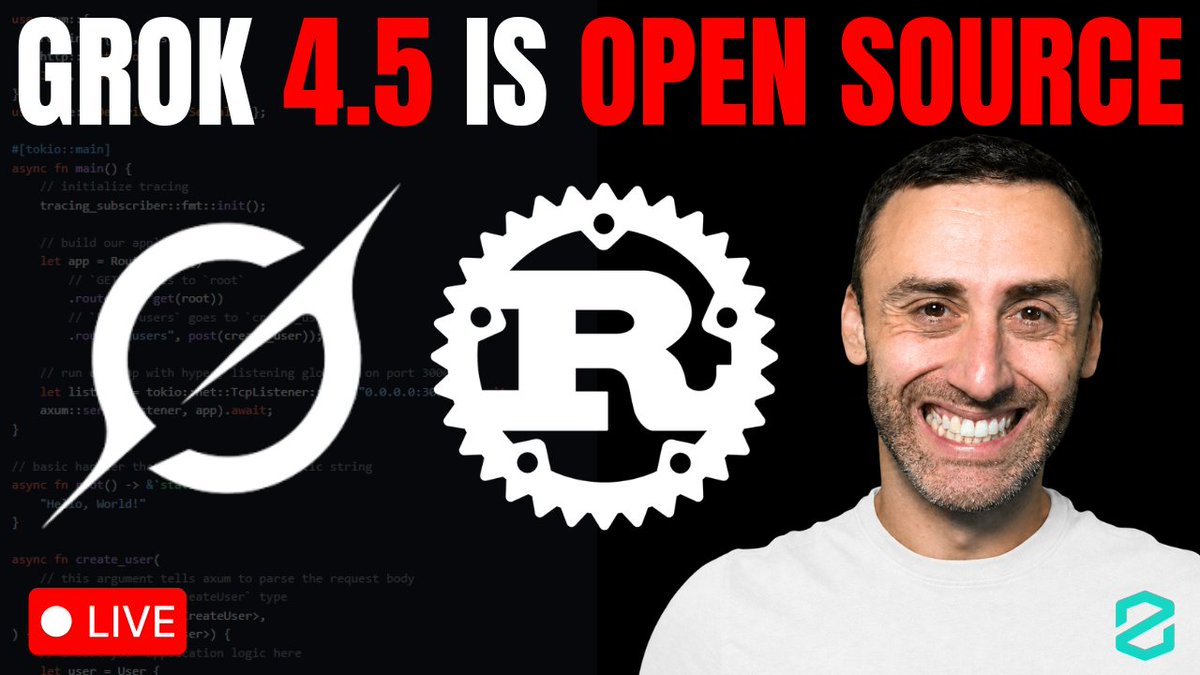
It’s Friday, back to streaming!
Today at 6 PM CEST, we’ll explore the newly open-sourced Grok Build, written 99.6% in Rust.
We’ll:
- Inspect its GitHub structure
- Check dependencies
- Run it locally.
And there’s a surprise for those who tune in👀
@zeropsio
Link below
English
@dynotable Right, and scoped consent still leaves the credential live in the process!
On Zerops that server sits on a private network reaching only what you wired in, so the credential's blast radius is the topology.
English

An MCP server holding AWS credentials is a different problem than a toy stdio server. Safe meant OAuth inside a desktop app, scoped consent, a region pinned at approval. dynotable.com/blog/building-…
English

@chesny Good explainer on MCP + Obsidian. Missing piece: who's auditing what tools an MCP server exposes before your agent starts calling them blind?
N×M becomes N+M for convenience, but it also means N+M places malicious tool definitions can slip in.
English
