
Zipeng Fu

353 posts

Zipeng Fu banner
Zipeng Fu

Zipeng Fu

@zipengfu

Stanford AI & Robotics PhD @StanfordAILab | Past: Google DeepMind, CMU

Palo Alto, CA Katılım Şubat 2014
1.3K Takip Edilen13.3K Takipçiler
Sabitlenmiş Tweet
Zipeng Fu
Zipeng Fu@zipengfu·
Mobile ALOHA's hardware is very capable. We brought it home yesterday and tried more tasks! It can: - do laundry👔👖 - self-charge⚡️ - use a vacuum - water plants🌳 - load and unload a dishwasher - use a coffee machine☕️ - obtain drinks from the fridge and open a beer🍺 - open doors🚪 - play with pets🐱 - throw away trash - turn on/off a lamp💡 Project website: mobile-aloha.github.io Co-lead @tonyzzhao, advised by @chelseabfinn (amazing photographing from @qingqing_zhao_ )
English

380
1.6K
6.9K
3M
Zipeng Fu retweetledi
Ken Liu
Ken Liu@kenziyuliu·
Can we build a blind, *unlinkable inference* layer where ChatGPT/Claude/Gemini can't tell which call came from which users, like a “VPN for AI inference”? Yes! Blog post below + we built it into open source infra/chat app and served >15k prompts at Stanford so far. How it helps with AI user privacy: # The AI user privacy problem If you ask AI to analyze your ChatGPT history today, it’s surprisingly easy to infer your demographics, health, immigration status, and political beliefs. Every prompt we send accumulates into an (identity-linked) profile that the AI lab controls completely and indefinitely. At a minimum this is a goldmine for ads (as we know now). A bigger issue is the concentration of power: AI labs can easily become (or asked to become) a Cambridge Analytica, whistleblow your immigration status, or work with health insurance to adjust your premium if they so choose. This is a uniquely worse problem than search engines because your average query is now more revealing (not just keywords), interactive, and intelligence is now cheap. Despite this, most of us still want these remote models; they’re just too good and convenient! (this is aka the "privacy paradox".) # Unlinkable inference as a user privacy architecture The idea of unlinkable inference is to add privacy while preserving access to the remote models controlled by someone else. A “privacy wrapper” or “VPN for AI inference”, so to speak. Concretely, it’s a blind inference middle layer that: (1) consists of decentralized proxies that anyone can operate; (2) blindly authenticates requests (via blind signatures / RFC9474,9578) so requests are provably sandboxed from each other and from user identity; (3) relays prompts over randomly chosen proxies that don’t see or log traffic (via client-side ephemeral keys or hosting in TEEs); and (4) the provider simply sees a mixed pool of anonymous prompts from the proxies. No state, pseudonyms, or linkable metadata. If you squint, an unlinkable inference layer is essentially a vendor for per-request, anonymous, ephemeral AI access credentials (for users or agents alike). It partitions your context so that user tracking is drastically harder. Obviously, unlinkability isn’t a silver bullet: the prompt itself still goes to the remote model and can leak privacy (so don't use our chat app for a therapy session!). It aims to combat *longitudinal tracking* as a major threat to user privacy, and its statistical power increases quickly by mixing more users and requests. Unlinkability can be applied at any granularity. For an AI chat app, you can unlinkably request a fresh ephemeral key for every session so tracking is virtually impossible. # The Open Anonymity Project We started this project with the belief that intelligence should be a truly public utility. Like water and electricity, providers should be compensated by usage, not who you are or what you do with it. We think unlinkable inference is a first step towards this “intelligence neutrality”. # Try it out! It’s quite practical - Chat app “oa-chat”: chat.openanonymity.ai (<20 seconds to get going) - Blog post that should be a fun read: openanonymity.ai/blog/unlinkabl… - Project page: openanonymity.ai - GitHub: github.com/OpenAnonymity
Ken Liu tweet media
English
62
157
831
375.5K
Zipeng Fu retweetledi
Boyuan Chen
Boyuan Chen@BoyuanChen0·
Introducing Large Video Planner (LVP-14B) — a robot foundation model that actually generalizes. LVP is built on video gen, not VLA. As my final work at @MIT, LVP has all its eval tasks proposed by third parties as a maximum stress test, but it excels!🤗 boyuan.space/large-video-pl…
English
23
97
576
94.5K
Zipeng Fu retweetledi
Ji Woong Kim
Ji Woong Kim@jwbkim·
Introducing Hierarchical Surgical Robot Transformer (SRT-H), a language-guided policy for autonomous surgery🤖🏥 On the da Vinci robot, we perform a real surgical procedure on animal tissue. Collaboration b/w @JohnsHopkins & @Stanford
Ji Woong Kim tweet media
English
4
26
120
34.1K
Zipeng Fu retweetledi
Qingqing Zhao
Qingqing Zhao@qingqing_zhao_·
Introduce CoT-VLA – Visual Chain-of-Thought reasoning for Robot Foundation Models! 🤖 By leveraging next-frame prediction as visual chain-of-thought reasoning, CoT-VLA uses future prediction to guide action generation and unlock large-scale video data for training. #CVPR2025
English
5
57
318
47.8K
Zipeng Fu retweetledi
Zhou Xian
Zhou Xian@zhou_xian_·
Everything you love about generative models — now powered by real physics! Announcing the Genesis project — after a 24-month large-scale research collaboration involving over 20 research labs — a generative physics engine able to generate 4D dynamical worlds powered by a physics simulation platform designed for general-purpose robotics and physical AI applications. Genesis's physics engine is developed in pure Python, while being 10-80x faster than existing GPU-accelerated stacks like Isaac Gym and MJX. It delivers a simulation speed ~430,000 faster than in real-time, and takes only 26 seconds to train a robotic locomotion policy transferrable to the real world on a single RTX4090 (see tutorial: genesis-world.readthedocs.io/en/latest/user…). The Genesis physics engine and simulation platform is fully open source at github.com/Genesis-Embodi…. We'll gradually roll out access to our generative framework in the near future. Genesis implements a unified simulation framework all from scratch, integrating a wide spectrum of state-of-the-art physics solvers, allowing simulation of the whole physical world in a virtual realm with the highest realism. We aim to build a universal data engine that leverages an upper-level generative framework to autonomously create physical worlds, together with various modes of data, including environments, camera motions, robotic task proposals, reward functions, robot policies, character motions, fully interactive 3D scenes, open-world articulated assets, and more, aiming towards fully automated data generation for robotics, physical AI and other applications. Open Source Code: github.com/Genesis-Embodi… Project webpage: genesis-embodied-ai.github.io Documentation: genesis-world.readthedocs.io 1/n
English
562
3K
16K
3.8M
Zipeng Fu
Zipeng Fu@zipengfu·
Introduce DoggyBot🐕series: quadrupeds can also do manipulation. It's a fruitful 4yr journey working on robot dogs from walking, to parkour, to now useful agility. We open-sourced everything. Hope others can build on our code and start a series of projects named "xxx DoggyBot".
Qi Wu@Qi_Wu577

Introducing Helpful DoggyBot🐕, a legged mobile manipulation system: - A quadruped with a mouth - Agile whole-body skills like climbing and tilting - Open-world object fetching using VLMs - No real-world training data required!

English
2
24
124
19.7K
Zipeng Fu retweetledi
xin duan
xin duan@xinduan926·
We can easily see a trained dog expertly chasing after a fast-moving frisbee and leaping up to catch it just before it hits the ground. Now, can robot join the fun? Introduce Playful DoggyBot🐶: Learning Agile and Precise Quadrupedal Locomotion 1/3
English
1
3
21
11.5K
Zipeng Fu retweetledi
Philipp Wu
Philipp Wu@philippswu·
Really nice article from @ericjang about actuators in robotics. Great to see @1x_tech place such an emphasis on design. Safety through compliance and backdrivability were some of the core themes behind our BLUE project back in the day (berkeleyopenrobotics.github.io). Some thoughts 👇
Philipp Wu tweet media
Eric Jang@ericjang11

Two robot arms move at the same speed, driven by different actuators with the same mass. The first arm collides with a table with a gentle tap. The second arm collides with the table, destroying both arm and table. Read this blog post to see why! 🦾💥 evjang.com/2024/08/31/mot…

English
7
27
272
58.6K
Zipeng Fu retweetledi
Wenlong Huang
Wenlong Huang@wenlong_huang·
What structural task representation enables multi-stage, in-the-wild, bimanual, reactive manipulation? Introducing ReKep: LVM to label keypoints & VLM to write keypoint-based constraints, solve w/ optimization for diverse tasks, w/o task-specific training or env models. 🧵👇
English
18
103
516
190.7K
Zipeng Fu retweetledi
Tairan He
Tairan He@TairanHe99·
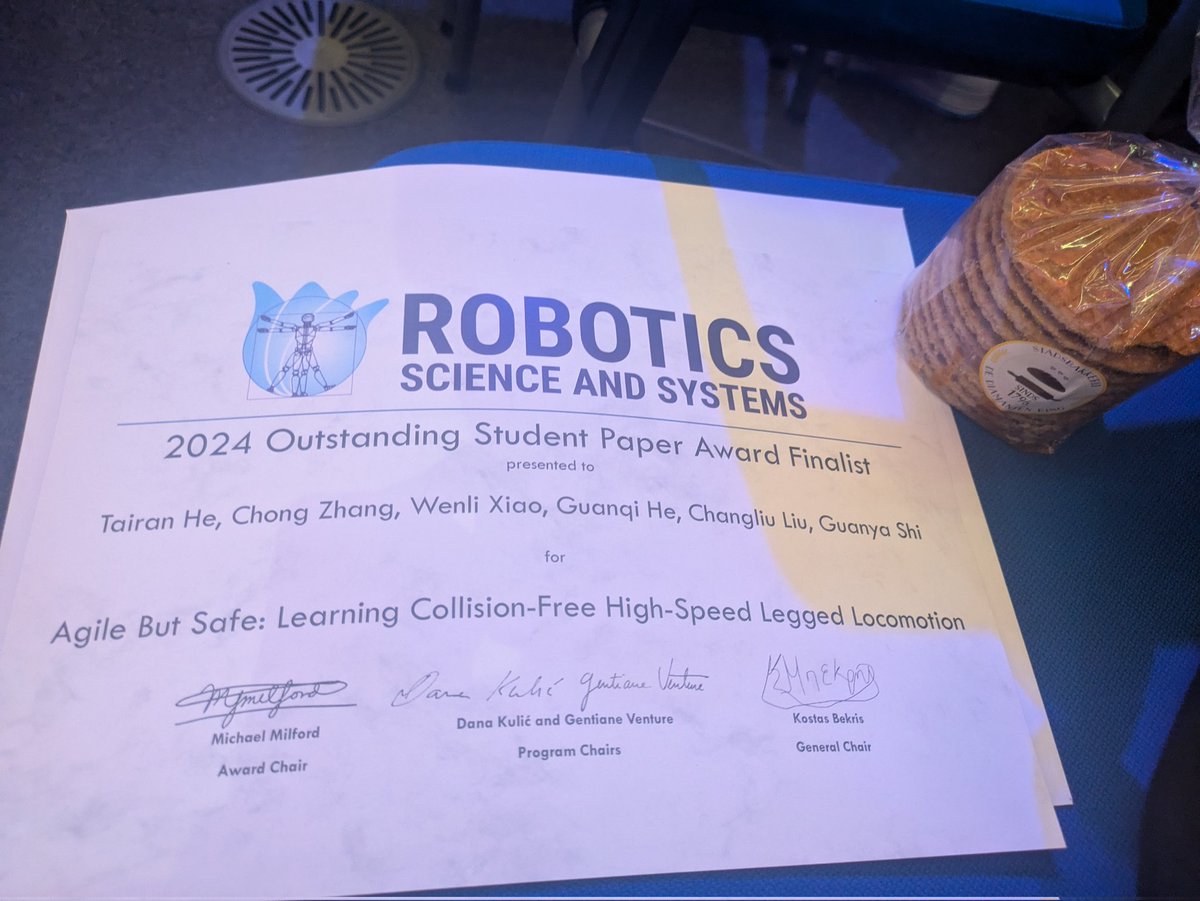
Agile But Safe (agile-but-safe.github.io) is selected as Outstanding Student Paper Award Finalist at RSS 2024! This is my first PhD project and my first paper award:) Thank my amazing coauthors and advisors!!! Everything is open-sourced: github.com/LeCAR-Lab/ABS
Tairan He tweet media
Tairan He@TairanHe99

How to break locomotion agile-safe tradeoffs?Introduce Agile But Safe: Learning Collision-Free High-Speed Legged Locomotion: - Fully onboard - Agile (>3m/s) - Safe (collision-free guarantee) - Robust & versatile How? RL + model-free reach-avoid value! 👉agile-but-safe.github.io

English
29
8
214
16.7K
Zipeng Fu retweetledi
Tony Zhao
Tony Zhao@tonyzzhao·
Excited to announce Surgical Robot Transformer🪡: Automating delicate surgical tasks with end-to-end imitation learning. It's still mind blowing to see robot autonomously tying knots, a task I did not think is possible even a few months before. Sharing some learnings in 🧵:
Ji Woong Kim@jwbkim

Introducing Surgical Robot Transformer (SRT): Automating surgical tasks with end-to-end imitation learning. On the da Vinci robot, we automate: - Knot tying - Needle manipulation - Soft-tissue manipulation Collaboration between @JohnsHopkins & @Stanford.

English
2
35
182
23.5K
Zipeng Fu
Zipeng Fu@zipengfu·
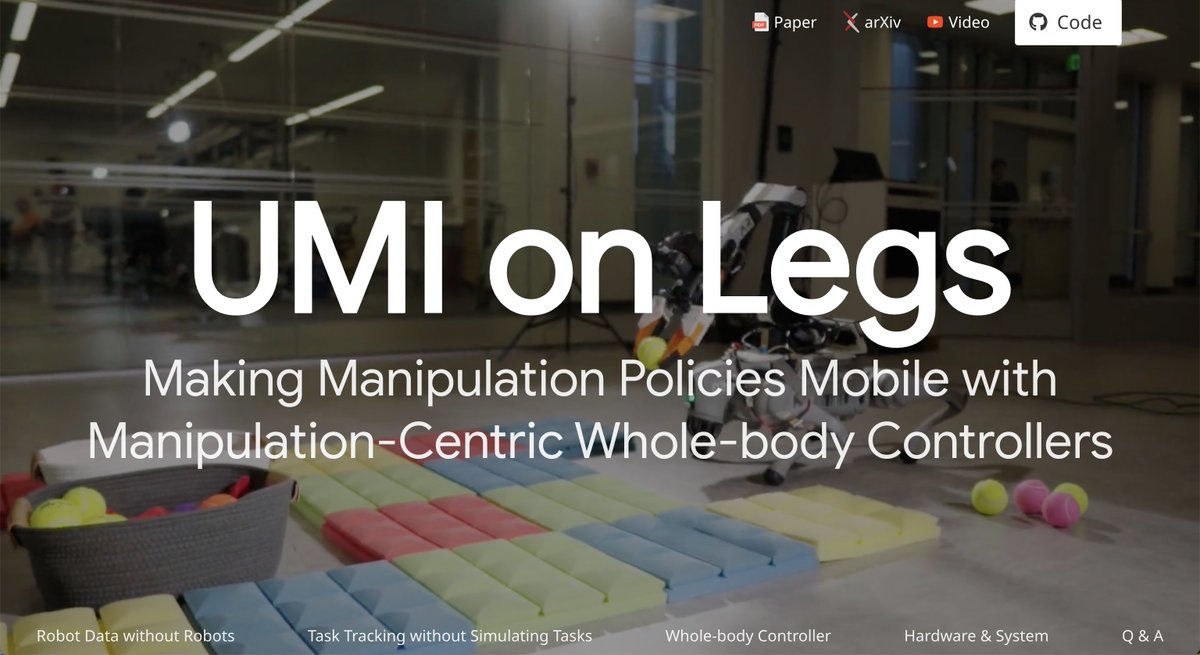
- RL in sim to train a task-agnostic whole-body controller - imitation learning in real for task-specific policies Advancing robotics demands a thoughtful integration of solutions, rather than overreliance on any single approach Glad to witness this year-long project completed!
Huy Ha@haqhuy

I’ve been training dogs since middle school. It’s about time I train robot dogs too 😛 Introducing, UMI on Legs, an approach for scaling manipulation skills on robot dogs🐶It can toss, push heavy weights, and make your ~existing~ visuo-motor policies mobile!

English
1
13
86
7.3K