
Sabitlenmiş Tweet
Zac
15.6K posts


Zac
@ztjio
fn main() -﹥ Result﹤(), Box﹤str﹥﹥ {Err(" bsky: @ztj.lol ")?}
Sol 3 (for now) Katılım Nisan 2008
102 Takip Edilen111 Takipçiler
@sudobunni Check out the “autopilot” section in the right column here eightsleep.com/product/pod-co… fools and their money, etc.
English

I don’t know what any of this means and I’m concerned
Victor Savkin@victorsavkin
Repaired my Eight Sleep leak. It's so satisfying to do basic things with your hands, given that most of the work is so abstract now with the agent handling so much of the implementation.
English

@nu_komori Driving in real life is much easier than in games, might be the only kind of game that’s like this.
English

@AlexJonesax Even that's just a step. What I'd really like to see is a return to the concept of correctness checks at change time, integrity checks for resource references, and really just a sense of being more... in an RDBMS than a ten million strong pile of random k/v pairs.
English
@AlexJonesax Now I think if I had everything my way, there would be near zero templating and a lot more operators. A lot more.
English


The cross_mark emoji is red (❌)
But the check_mark emoji is black/purple (✔️)
And the only green check is check_markbutton (✅)
How did we end up here?
English
@samokhvalov @kellabyte Besides pgQue being a misspelling of pgQueue, and assuming you meant it to be pronounced like that, they then have the same name when spoken. Needless confusion there. But the spelling choice is going to be a permanent black eye on the name too.
English

@kellabyte I'm bad with names
Thanks for the comment -- will think about it
Why is it confusing btw?
English
PgQue v0.1.0 is out.
PgQ -- the Postgres queue system built at Skype 20 years ago for 1B-user-scale workloads -- repackaged for the managed-Postgres era. One SQL file. No C extension. No external daemon. pg_cron to tick.
Why bother reviving a 2007 architecture?
Every major Postgres queue in production today uses some flavor of SKIP LOCKED + UPDATE/DELETE. It works under light load. When you have more data and higher load, it degrades predictably. Then you get posts like these:
- Brandur at Heroku, 2015: 60k job backlog in one hour from a single open transaction
- PlanetScale, 2026: death spiral at 800 jobs/sec
- River issue #59, awa issue #169 and so on, Oban's partitioning work, PGMQ's autovacuum tuning guide and duct-taping with pg_partman
The core issue is how Postgres MVCC is implemented and how we deal with it. Dead tuples in the hot path, xmin horizon pinned, vacuum falling behind, query performance quickly degrades. This happens every time you run pg_dump, execute an analytical query, or have a lagging/unused logical replication slot.
PgQ solved this in 2007 with snapshot-based batching and TRUNCATE rotation -- zero dead tuples in the event
path, by design.
But PgQ needed a C extension and an external daemon. Which means it doesn't run on RDS, Aurora, Cloud SQL, AlloyDB, Supabase, or Neon -- i.e., where most
Postgres lives now.
PgQue closes that gap.
💎 Pure SQL + PL/pgSQL (PgQ engine)
👩💻 \i sql/pgque.sql -- you're done
🕑 pg_cron replaces pgqd (optional, recommended)
💻 Python, Go, TypeScript client examples shipped
💙 Apache 2.0
Trade-off: end-to-end event delivery latency is up to a second, it depends on ticking frequency. If you need sub-3ms job dispatch, use River, Oban, or graphile-worker (and avoid anything that blocks xmin horizon). If you need high-throughput event streaming with fan-out inside Postgres -- Kafka-shaped, without Kafka and dealing with transactional outbox implementation -- this is the right shape of tool.
Kudos to Marko Kreen and Skype engineers who implemented this decades ago, for the original PgQ, and to Alexander Kukushkin whose recent "Rediscovering PgQ" talk brought this quiet corner of the Postgres ecosystem back into view.
Stars, issues, PRs, and honest criticism all welcome.
Link 👇
GIF
English
Zac retweetledi

Final Fantasy XII turns 20!
From Rabanastre’s bustling streets to the Great Crystal. From setting the first Gambit to taking down Yiazmat, the journey with Vaan, Ashe, Basche, Penelo, the leading man Balthier and Fran lives on even today. Artwork by Ryoma Ito.

English
@BrianRoemmele @ylecun Or, you know, the blue part is total bullshit hype to continue pumping the bubble.
English

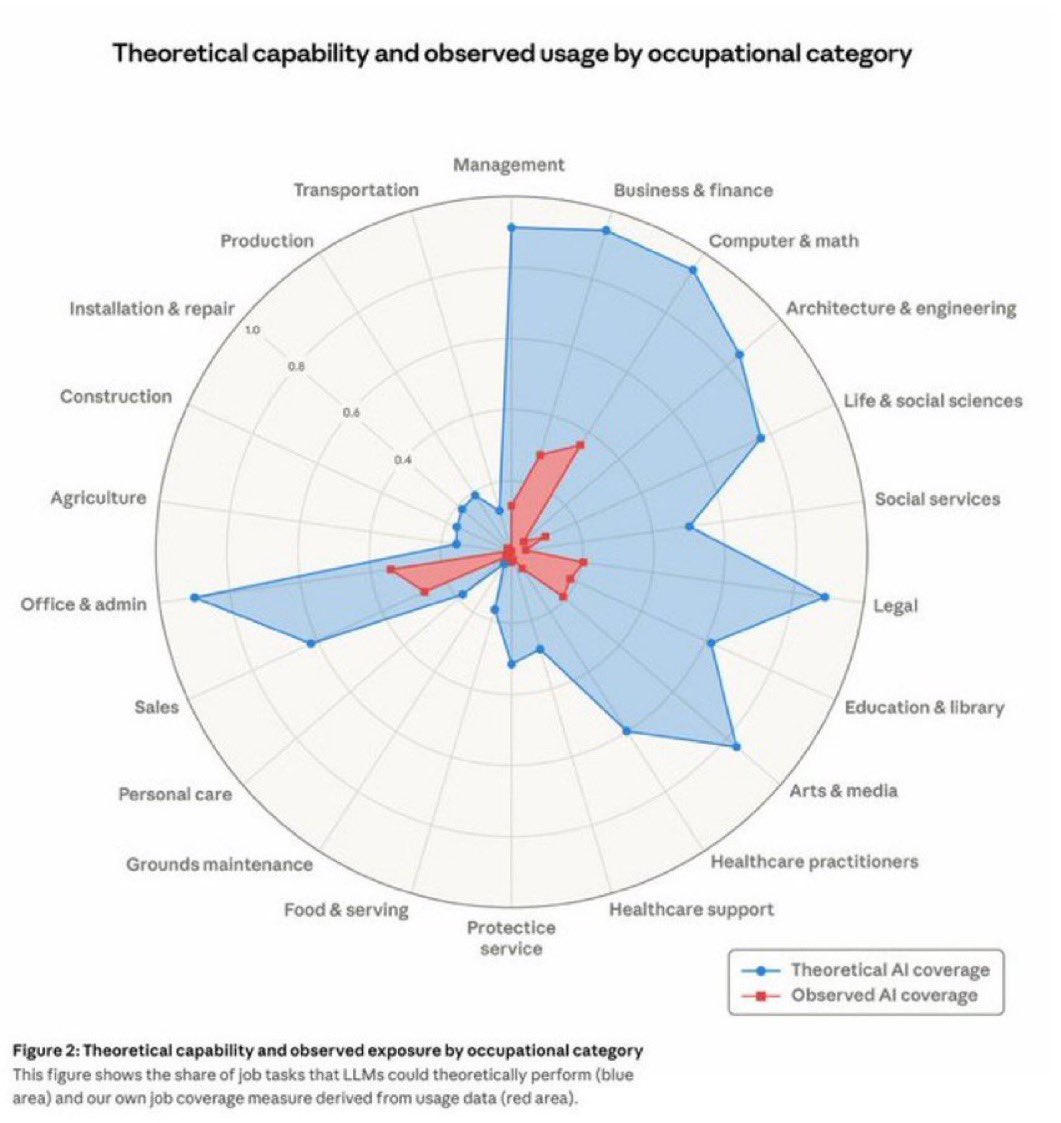
Anthropic's Revealing Chart on AI's Impact on Jobs
Anthropic has unveiled a pivotal chart that underscores the chasm between AI's capabilities and its real-world application in the workforce.
Derived from analyzing 2 million actual conversations with Claude, this radar chart, titled "Theoretical Capability and Observed Usage by Occupational Category," paints a stark picture of untapped automation potential across various job sectors.
At its core, the chart is a spider web diagram plotting occupational categories around a circular axis, with values ranging from 0 to 1.0 representing the share of job tasks.
The expansive blue area illustrates the theoretical coverage tasks that large language models (LLMs) like Claude could perform right now based on their inherent abilities. In contrast, the much smaller red area shows observed usage, drawn from real user interactions.
The visual disparity is immediate and profound: blue spikes outward significantly in fields like computer and math (reaching about 0.75), business and finance, and office administration, while red hugs close to the center, often below 0.2 across most categories.
This gap isn't just academic; it's a "career runway," as highlighted in discussions around the chart. For programmers, 75% of tasks are theoretically automatable, yet actual usage lags far behind.
Similar vulnerabilities appear in customer service, data entry, and financial analysis, roles traditionally seen as white-collar strongholds. Meanwhile, hands-on fields like construction, agriculture, and protective services show lower theoretical exposure, with blue areas dipping to around 0.1-0.3, suggesting AI's current limitations in physical or unpredictable environments.
Broader data amplifies the chart's message. As of early 2026, 49% of U.S. jobs expose at least 25% of tasks to AI, up from 36% a year prior. Yet, mass layoffs haven't materialized; unemployment in AI-vulnerable roles remains steady.
Instead, subtler shifts are underway: a 14% drop in hiring for 22-25-year-olds in exposed positions indicates companies are prioritizing experienced workers, shortening entry-level pathways for recent graduates.
The implications are clear: while AI's red footprint grows incrementally each month, the blue expanse signals accelerating change. College-educated, higher-earning professionals, once insulated are now most at risk, flipping the script on traditional labor disruptions.
Anthropic's chart isn't a doomsday prophecy but a wake-up call, urging workers and businesses to bridge the gap through adaptation, upskilling, and ethical integration of AI tools.
Please read the 5000 Days Series at ReadMultiplex.com for answers on how you can thrive in the Interregnum.
English
@AlexJonesax This but 4TB, finally replacing my near-maxxed Mac Studio M1 Ultra.
English

Zac retweetledi

Zac retweetledi

It’s important that you understand what happened last night.
Last night, Stephen Colbert interviewed Democratic Texas Senate candidate James Talarico, a candidate who, by all accounts, is on track in the polls to flip Texas blue.
In response, Trump’s FCC reportedly threatened CBS if the interview aired.
CBS caved and pulled the segment, citing “financial reasons.”
In modern American history, no president has been more hostile to free speech than Donald Trump.
But censorship always backfires.
Here’s the full segment Trump didn’t want you to see.
English
Zac retweetledi

You don’t need to justify wanting privacy.
You need to question why others want access.
English
Zac retweetledi

カスAIで女の子にスケベな服着させるんじゃなくてその子の欲しリスの中に入ってるスケベ衣装をプレゼントするくらいの行動しろや、ワイは去年あらゆる女性レイヤーの欲しリス見てその中の牛柄ビキニプレゼントしたし後々その子が牛柄ビキニ着た写真TLに流してくれたぞ。AIに乞食すんな弱者男性が




日本語