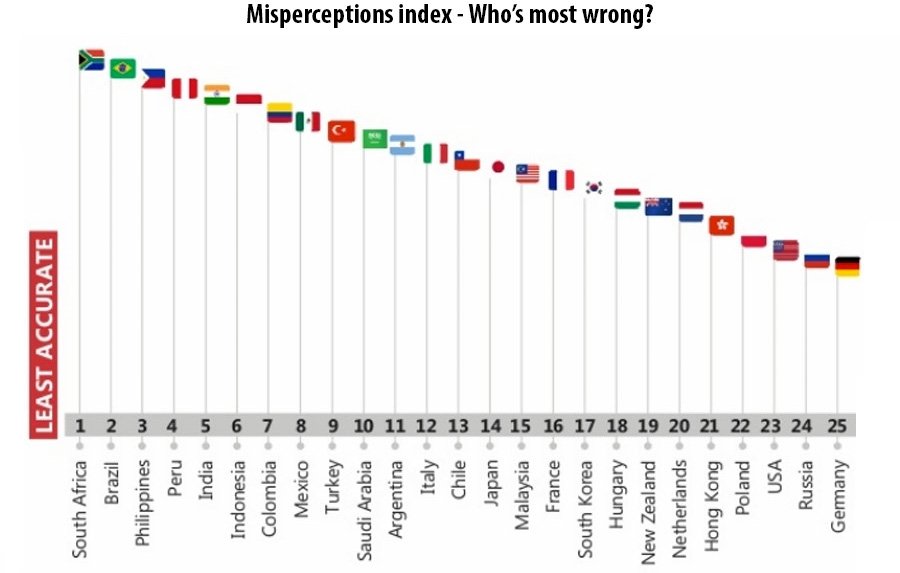
According to the Ipsos Perils of Perception index, South Africans are the most propagandised people in the world.
There is a huge gap between what they believe and what actual data shows.
In multiple versions of the Ipsos study, South Africa has ranked at the very top, meaning its citizens are among the most “misinformed” or “disconnected from reality” regarding the state of their own nation.
As Ipsos puts it, South Africans are the “most wrong” people in the world.
Worryingly, the disconnect isn’t just about minor details; it’s about the fundamental state of the country.
Data from various Ipsos studies shows how far off the public mark often is:
For example, when asked, most South Africans believe teen pregnancy is at about 44% of girls, when in reality it’s about 4%.
It’s a similar story with teen suicide, GBV, immigration, the murder rate, etc. South Africans simply believe things that are totally disconnected from reality, leading to a psychological crisis.
This crisis is largely due to how the media is set up.
We must remember that for decades before 1994, the media had one job: to distort the reality of what was really happening in the country.
Throughout Apartheid, the state used the SABC and strategic media “blackouts” to manufacture a “Total Onslaught” narrative, that is the idea that the country was under constant, existential threat. This created a high-anxiety public psyche that remains susceptible to fear-porn and sensationalism.
This media did not transform in 1994.
Therefore, South Africans are statistically some of the most pessimistic people on earth regarding their country’s direction.
While many problems are very real, this pessimism leads to catastrophism, where every problem is viewed as an omen of imminent total collapse.
This makes South Africans easy to mobilise against their own interests while expending a lot of energy fighting the wrong battles.
If for example, people believe immigrants are 30% of the population, instead of the real 4%, they focus an inordinate amount of time and resources on this rather than addressing structural policies of the state.
This leads to policy misdirection on many issues, not just immigration, where everyone is reacting to noisy perceptions rather than concrete problems, leading to phantom solutions that don’t solve the underlying issues.
Hugo Broos claims that South Africa struggled at AFCON because the country does not have players in European leagues.
Except, Egypt dominated AFCON in the late 2000s, with almost exclusively locally-based players, winning three titles in a row between 2006 and 2010.
Egypt’s Golden Generation of Mido, Hossam Ghaly, Essam El-Hadary, Wael Gomaa, Shikabala and Mohamed “The Smiling Assassin” Aboutrika were not playing in Europe.
In fact, Egyptian players only started moving abroad, not to become better, but because of the 2011 Arab Spring uprisings when there was a total suspension of football activities in the country.
The league was cancelled for two consecutive seasons (2011–12 and 2012–13).
Without ticket sales or TV revenue, Egyptian clubs faced a massive financial crisis. They could no longer afford the high salaries of their stars, forcing both players and clubs to look for overseas buyers just to survive.
The political instability and the banning of fans from stadiums for nearly a decade made the domestic environment unattractive for professional growth. This is how and why the likes of Salah, Elneny, Hegazi and Trezeguet arrive on the European stage.
If it wasn’t for the uprisings, Egypt would have just been fine in the continent with exclusively local players from just two clubs.
In fact, Egypt has not won AFCON since their players started moving abroad.
So, the idea that Bafana Bafana was underwhelming at this latest tournament has nothing to do with Europe.
It is either the players are not good enough as is, and in which case they’d never make it in Europe anyway. But the idea that going to Europe makes player better is ridiculous in the extreme. African players go there to escape poverty. Nothing less, nothing more.
As a mater of fact, prior to 2011, the Egyptian Premier League was one of the wealthiest and most stable in Africa, and clubs like Al Ahly and Zamalek paid salaries competitive enough to keep top talent at home. No one spoke about Europe because Egypt’s dominance put that myth to rest.
Egypt’s dominance was built on the back of Al Ahly and Zamalek because those players played together year-round in Cairo and their national team chemistry was essentially that of a club side.
Hugo Broos himself has tried to replicate this by filling his squad with players from Sundowns and Pirates, the two currently locally dominant sides.
But as soon as he fails to implement, he blames the same players.
Essentially, by blaming the lack of European players, madala is effectively saying his coaching cannot bridge the gap between local talent and international success.
His Europe argument feels like a convenient way to lower expectations and shift the blame away from tactical preparation and man-management.
In the end, the PSL today is the pre-2011 Egyptian Premier League of today. It is wealthy enough to keep its stars, and if Broos can’t win with the best players from the best-funded league in Africa, the problem isn’t the players’ passports, it’s the system they are being asked to play in.
In fact, I ventured too far with Egypt. In the 1996 AFCON-winning squad, South Africa used 16 local players out of a 22-man roster.
The overwhelming majority of the squad, and crucially, the core of the starting XI, played their football in the PSL, primarily for Pirates, Chiefs, Sundowns, and Cape Town Spurs.
In the final against Tunisia, 7 of the 11 starters were local-based players.
If Hugo Broos argues that he needs European players to succeed, he is ignoring the most successful era in South African history.
In 1996, just like today, the local league was strong, the players were stars at home, and they dismantled African giants who were already packed with European exports.
So, Broos needs to accept culpability and stop trying to hide behind nothing. South African players stay at home for the same reason Egyptian players stayed at home and dominated the continent: there’s enough money and it does not make them lesser.
Unless if he’s saying SA players are naturally ungifted, in which case, he should just say so.
When asked what democracy is, here’s what President Thomas Sankara of Burkina Faso 🇧🇫 had to say.
He also explained why he refused loans from the IMF and food aid.
According to Economics 101, once upon a time, before there was money, if you had a cow but you needed oranges, you would find someone with oranges who needed a cow, and that was the economic system.
Except, despite 200+ years of anthropological fieldwork, no one has ever found a community that actually operated this way.
Not a single example of a barter-based economy as the primary form of exchange has been documented.
The hypothetical scenario simply doesn’t appear in the historical record.
In any case, the barter theory posits that this system was inefficient. What if the cow owner didn’t want oranges or vice versa?
Well, to solve this problem, people collectively agreed on a commodity everyone wanted (like gold or silver) to use as a medium of exchange.
The state apparently later got involved in minting coins, standardising value, and often debasing the currency.
Eventually, more complex systems like credit and derivatives evolved from this monetary base.
This story was popularised by Adam Smith in 1776, who was just speculating with no evidence for this, and remains a foundational parable in economics because it presents money as a natural, market-driven solution to an obvious problem.
The barter system doesn’t make sense, and the fundamental flaw lies in its social context, as it assumes a society of strangers who engage in one-off, “spot” transactions and then walk away.
Why would neighbours treat each other like strangers in a “spot trade” with immediate exchange and then walk away?
They’re neighbours in small-scale communities where economic life is embedded in social relationships.
The idea of a neighbour refusing to give you a cow unless you had 4000 oranges right now is absurd. Social credit, obligations, and long-term reciprocity make far more sense.
According to David Graeber, in his book Debt: The First 5000 Years, when you’re part of a community, you know you’ll need things from each other repeatedly, so it’s actually beneficial to have your neighbour owe you something.
In this sense, gift-giving and informal credit relationships make more social sense.
Graeber offers a more realistic alternative: a system based on gift-giving and informal credit. In such societies, if you need a cow, you might take it, creating an obligation for you to help the owner when they need something in the future.
Another example would be if you praised someone’s possession, it created a powerful social or moral obligation for them to offer it to you, a phenomenon documented in many cultures even today.
This way, the “debt” is not a precise number of oranges, but a social bond where having your neighbour in your debt is a form of social security.
OK, but if money didn’t evolve from barter, where did it come from?
Anthropologists and historians suggest a different origin where the first “money” was often not a medium of everyday exchange but a standard of measurement used by ancient states and temples to calculate debts, taxes, and tributes.
For example, the Mesopotamian shekel was primarily a unit of weight for silver used to calculate obligations to the temple, not something used to buy a loaf of bread.
This suggests that money emerged as a way to manage complex social relationships and obligations, especially between strangers and between people and institutions
Money was a tool for central powers like kings and priests to organise economic life, not a spontaneous creation of the market.
Therefore, long-distance trade between strangers often happened through sophisticated credit systems, not barter. Merchants had ledger books, not carts full of goods to swap.
The myth of the origins of money from barter persists because it provides a simple evolutionary sequence which makes the modern monetary system seem natural by portraying money as a neutral, market-born tool that solves a problem.
More importantly, this myth is foundational. It’s the creation myth of modern economics, and to question it is to question the entire narrative structure of the discipline.
In conclusion, the barter origin of money is a thought experiment, not a historical reality.
The real history is that human economies have primarily run on systems of gift, credit and social obligation, with money emerging later as a tool for accounting and state power, not as a solution to the inconveniences of barter.
The patent system is one of the least understood but most important mechanisms of modern economic domination. It’s part of the reason Africa has not, and likely will not, industrialise.
As everyone is aware by now, most African countries do not lack raw materials, they lack the legal right to transform them.
Africa has cobalt, manganese, platinum and rare earths, but batteries, chips, refining processes, catalytic converters, medical devices, pharmaceuticals, and telecom equipment are patented by Western corporations.
So even if an African nation builds a factory, the legal structure prevents them from refining cobalt into cathodes, manufacturing solar cells from local silica, producing EV batteries, making pharmaceuticals or assembling semiconductors.
The Africans can mine all the cobalt they can, but they cannot legally make lithium-ion cells.
This is deliberate. The 1995 Trade-Related Aspects of Intellectual Property Rights Agreement (TRIPS) treaty pushed by the US and EU forced nearly all Global South nations to adopt Western-style patent protection.
Before TRIPS, many countries legally copied or reverse-engineered technology to industrialise, as Japan, South Korea, Taiwan, and even the US once did. After TRIPS, that strategy became illegal.
Before TRIPS, countries could copy technology to catch up because tech diffusion happened through imitation, and all industrialisation requires imitation. Patents outlaw this imitation.
After TRIPS, copying was a violation punished by sanctions. All tech was now controlled by licensing fees. This lack of technological development leads to dependency. That’s the abyss Africa is stuck in.
Seriously, African countries pay more in patent licensing fees than they earn from exporting raw materials used in those technologies.
This is particularly severe in pharmaceuticals with HIV meds, cancer drugs, insulin, etc.
In the 1990s and early 2000s, Western pharmaceutical companies used patents to prevent African states from producing generic drugs, even though they swore Africans were dying en masse from ‘HIV/AIDS’.
The US government even threatened trade sanctions against South Africa when it attempted to produce generics.
This revealed the true face of Western imperial capitalism: intellectual property patents matter more than African lives.
It’s a similar story with agriculture, where patents regulate GM seeds, fertilisers and pesticides. Then there’s telecom & mobile networks, where Africa provides 70% of the world’s cobalt but pays for battery IP from Panasonic, Samsung, Tesla and LG Chem.
Raw material flows out of Africa, intellectual property flows into the West, and value flows upward and out of Africa.
But there’s something even more crucial here, something called ‘technical IP’. Here, patents don’t just cover products, they cover methods too.
Meaning Africa cannot legally refine metals using patented processes, manufacture under proprietary standards, duplicate production machinery, use protected chemical formulations or reproduce chip lithography techniques.
Sure, Africans could build some factories, but they’d still be sued and sanctioned out of existence.
When countries attempt to move up the value chain, Western responses go beyond lawsuits and sanctions and include trade barriers, embargoes on machinery and withholding of technical licenses.
This is precisely what happened to Zimbabwe with platinum refining, South Africa with nuclear tech and pharmaceuticals, the DRC’s battery sector and Ethiopia’s pharma and telecom equipment.
Any attempts at industrialisation are blocked preemptively. The US Office of the USTR literally issues threat lists of countries whose development strategies clash with IP enforcement.
The Office of the United States Trade Representative literally issues threat lists of countries whose development strategies clash with America’s IP enforcement.
Like I said above, every industrialised nation violated patents when climbing the development ladder:
The US copied British textile tech illegally and grew to become the world’s strictest IP enforcer.
Japan reverse-engineered Western electronics to become an electronics giant. Japan now sues others for the same copying.
South Korea built chaebols (Samsung, Hyundai, LG) through imitation; now it jealously protects its own patents.
So, in essence, these countries don’t have a problem with copying, they just won’t allow late copying.
Africa’s position is uniquely hard because Asia industrialised before TRIPS, while Africa is trying to industrialise after IP imperialism became global law and has thus become the first continent asked to industrialise without imitation.
That’s like telling a child to learn a language without listening to anyone speak.
Yesterday, the United Nations voted on a resolution "Combating glorification of Nazism, neo-Nazism & other practices that contribute to fueling contemporary forms of racism, racial discrimination, xenophobia & related intolerance."
Virtually the entire West voted against it.
Western countries feel that the resolution undermines their support for Ukraine, and that the bill is a thinly-veiled Russian attempt to smear their ally.
The resolution has been voted on every year since 2012, where it overwhelmingly passed 129-3, with only the US🇺🇸, Canada 🇨🇦 and Palau 🇵🇼 voting against it.
The US remains the only country to vote "no" to the resolution every time since 2012.
The West's overwhelming rejection of anti-fascism as an ideology, coupled with the rise in far-right sentiment, hints at a very dark future.
What do you notice about this map? Comment below.