
Allen Kinsel

35.1K posts

Allen Kinsel banner
Allen Kinsel

Allen Kinsel

@AllenKinsel

Filp flop wanderer, Outdoor lover, Astros Fan, Texan, Rum and bilge water. Ex-SQL Server MVP

On an Island near Texas Entrou em Kasım 2008
572 Seguindo3.1K Seguidores
Allen Kinsel
Allen Kinsel@AllenKinsel·
@SowingAlphaSeed I don’t know the scale of your data but I’d probably stay local for a bit with something like SQLite or if cloud is preferred Amazon rds Postgres or Microsoft sqldb in azure. Google is great at many things but that product is meh
English

0
0
2
16
Allen Kinsel
Allen Kinsel@AllenKinsel·
@SowingAlphaSeed Sadly, the choice of provider has something to do with your experience here. Not bashing
English
1
0
1
22
Allen Kinsel
Allen Kinsel@AllenKinsel·
@BillyM2k Funny, like a lot of things this is repeated across the app yearly
English
0
0
0
32
Shibetoshi Nakamoto
Shibetoshi Nakamoto@BillyM2k·
i can’t tell if this app has lost 4/5ths of its real human users or if the dogshit algorithm has just murdered it beyond recognition but this app feels completely dead compared to 6 months ago
English
556
96
2.3K
179.2K
Allen Kinsel
Allen Kinsel@AllenKinsel·
@NASAAdmin Love the complete transparency on everything good bad or otherwise!
English
0
0
0
37
NASA Administrator Jared Isaacman
As an update to my earlier post. - The ICPS helium bottles are used to purge the engines, as well as for LH2 and LOX tank pressurization. The systems did work correctly during WDR1 and WDR2. - Last evening, the team was unable to get helium flow through the vehicle. This occurred during a routine operation to repressurize the system. - We observed a similar failure signature on Artemis I. - The Artemis II vehicle is in a safe configuration, using ground ECS purge for the engines versus the onboard helium supply. - Potential faults could include the final filter between the ground and flight vehicle, located on the umbilical, though this seems least likely based on the failure signature. It could also be a failed QD umbilical interface, where similar issues have been observed. It could also be a failed check valve onboard the vehicle, which would be consistent with Artemis I, though corrective actions were taken to minimize reoccurrence on Artemis II. Regardless of the potential fault, accessing and remediating any of these issues can only be performed in the VAB. As mentioned previously, we will begin preparations for rollback, and this will take the March launch window out of consideration. I understand people are disappointed by this development. That disappointment is felt most by the team at NASA, who have been working tirelessly to prepare for this great endeavor. During the 1960s, when NASA achieved what most thought was impossible, and what has never been repeated since, there were many setbacks. One historic example is that Neil Armstrong spent less than 11 hours in space on Gemini 8 before his mission ended prematurely due to a technical issue. A little over three years later, he became the first man to walk on the Moon. There are many differences between the 1960s and today, and expectations should rightfully be high after the time and expense invested in this program. I will say again, the President created Artemis as a program that will far surpass what America achieved during Apollo. We will return in the years ahead, we will build a Moon base, and undertake what should be continuous missions to and from the lunar environment. Where we begin with this architecture and flight rate is not where it will end. Please expect a more extensive briefing later this week as we outline the path forward, not just for Artemis II, but for subsequent missions, to ensure NASA meets the President’s vision to return to the Moon and, this time, to stay.
NASA Administrator Jared Isaacman@NASAAdmin

After overnight data showed an interruption in helium flow in the SLS interim cryogenic propulsion stage, teams are troubleshooting and preparing for a likely rollback of Artemis II to the VAB at @NASAKennedy. This will almost assuredly impact the March launch window. @NASA will continue to provide updates as they become available.

English
471
878
7.2K
1.5M
Allen Kinsel retweetou
Enguerrand VII de Coucy
Enguerrand VII de Coucy@ingelramdecoucy·
Thing of absolute beauty. Give whoever made this video a big fat raise, Wyze
English
161
4.4K
20.3K
2M
Allen Kinsel
Allen Kinsel@AllenKinsel·
@katelin_cruse I agree with this take but I think your timeline is off by about 3 years.
English
0
0
1
30
Katelin Holloway 💙
Katelin Holloway 💙@katelin_cruse·
A quiet prediction for 2026, from someone who has spent a lot of time studying how humans behave at work: I think we’re about to see an unprecedented quiet retirement of elder millennials from tech. Not dramatic exits. Not mass layoffs. Just a steady, largely unannounced backing away. Many elder millennials hit what was supposed to be the payoff phase of their careers—middle to senior roles, stable compensation, some accumulated growth—at the exact moment life got heavier. Kids entering adolescence. Parents aging or dying. Bodies changing. Energy changing. Perspective changing. (Read: perimenopause and midlife crises...) At the same time, the last decade didn’t quite deliver what was promised. Most stock options didn’t meaningfully materialize. Homeownership was delayed or derailed. Many relocated during the pandemic “temporarily” for childcare or sanity and never fully returned—to cities, to offices, or to the pace they once sustained. Then AI arrived. Not just as a new tool, but as a true platform shift. What I’m watching isn’t resistance or denial so much as a widening gap in orientation. Some people are instinctively reorganizing how they think, work, and create around this new substrate. Others are using it incrementally; helpful, but not transformative. Neither is a moral failure. But the gap compounds quickly. For a cohort already tired, already juggling more life outside of work, and already questioning the ROI of constant grinding, the incentive to retool themselves again—this time at platform speed—just isn’t there. So many will choose something else. They’ll frame it (honestly) as leaning into IRL, into human connection, into building tangible things. They’ll open coffee shops, take over family businesses, learn trades, consult selectively, or turn long-held hobbies into second careers. It will look intentional. And often, it will be. What fascinates me is not the “exit,” but the alignment: a generational life stage colliding with a technological inflection point that dramatically raises the bar for cognitive and adaptive load at work. From an HR lens, it’s one of the most interesting workforce transitions I’ve ever seen unfolding in real time... and I think we’re still underestimating how quietly, and how profoundly, it will reshape who stays, who leaves, and what “career success” even means next.
English
242
279
3K
476.4K
Sam Meech Ward
Sam Meech Ward@Meech_Ward·
Never ALTER TABLE again
English
16
14
320
86.3K
Crunchy Data
Crunchy Data@crunchydata·
Postgres 18 now has VIRTUAL generated columns. Generated STORED columns have been part of Postgres for several prior versions. Generated columns let you: - create a column based on other data - reference other columns - pre-format collations or calculations in the database instead of with the application The GENERATED ALWAYS AS syntax starts an expression clause. This is qualified at the end with the VIRTUAL or STORED tag. Virtual generated columns are computed each time they are read, so are not ideal for heavy computations. For that you’ll want a STORED generated column or maybe even an expression index. But they can be good for something used infrequently that should be calculated. # Example Syntax CREATE TABLE products ( id serial PRIMARY KEY, price numeric, tax_rate numeric DEFAULT 0.05, total_price numeric GENERATED ALWAYS AS (price * (1 + tax_rate)) VIRTUAL );
Crunchy Data tweet media
English
2
12
130
29.8K
Allen Kinsel
Allen Kinsel@AllenKinsel·
@JustDeezGuy Most interesting part to me is that this is mostly true for every "traditional" database platform. some more than others, obviously.
English
0
0
1
51
Paul Snively
Paul Snively@JustDeezGuy·
I remain a PostgreSQL maximalist for reasons like this. If you aren’t a FAANG, you almost certainly don’t need a “document DB” or a “hot read cache” in front of PostgreSQL… if you actually use PostgreSQL (i.e. don’t make the other popular mistake and “abstract away from it” because “you might switch databases.”)
Branko@brankopetric00

We chose PostgreSQL over MongoDB for our analytics platform. The context: - 50GB of time-series data daily - Complex queries with joins across multiple dimensions - Team had more SQL experience than NoSQL MongoDB seemed obvious for scale, but: - Query complexity made aggregation pipelines unwieldy - Horizontal scaling wasn't needed yet - PostgreSQL's JSON support gave us flexibility - TimescaleDB extension handled time-series perfectly 18 months later: PostgreSQL handles 2TB with sub-second queries. Sometimes boring technology wins.

English
37
41
840
148.5K
Allen Kinsel
Allen Kinsel@AllenKinsel·
Having to download an app to use a damn rental car is lunacy
English
0
0
1
50
Allen Kinsel
Allen Kinsel@AllenKinsel·
@sqL_handLe I actually agree, wish we could mix the two or something
English
0
0
1
25
Allen Kinsel
Allen Kinsel@AllenKinsel·
@iavins I can’t tell if there’s a /sarcasm missing
English
0
0
0
459
v
v@iavins·
Nothing comes close to the Postgres extensions ecosystem. Kinda insane that people have extended it with features you just can’t pull off with other databases: •Full-text search like Elasticsearch •Message queuing like RabbitMQ (and kinda Kafka like) •Job / task schedulers •Durable execution engines •Graph, time series, and geospatial databases •Vector databases •Foreign Data Wrappers (FDW)
English
12
20
365
28.8K
Allen Kinsel retweetou
Jessie Frazelle
Jessie Frazelle@jessfraz·
The weak underestimate and block the internet schizos, while the strong embrace them and their polarizing tendencies because the fact of the matter is… they are right A LOT
English
3
1
27
5.4K
@·
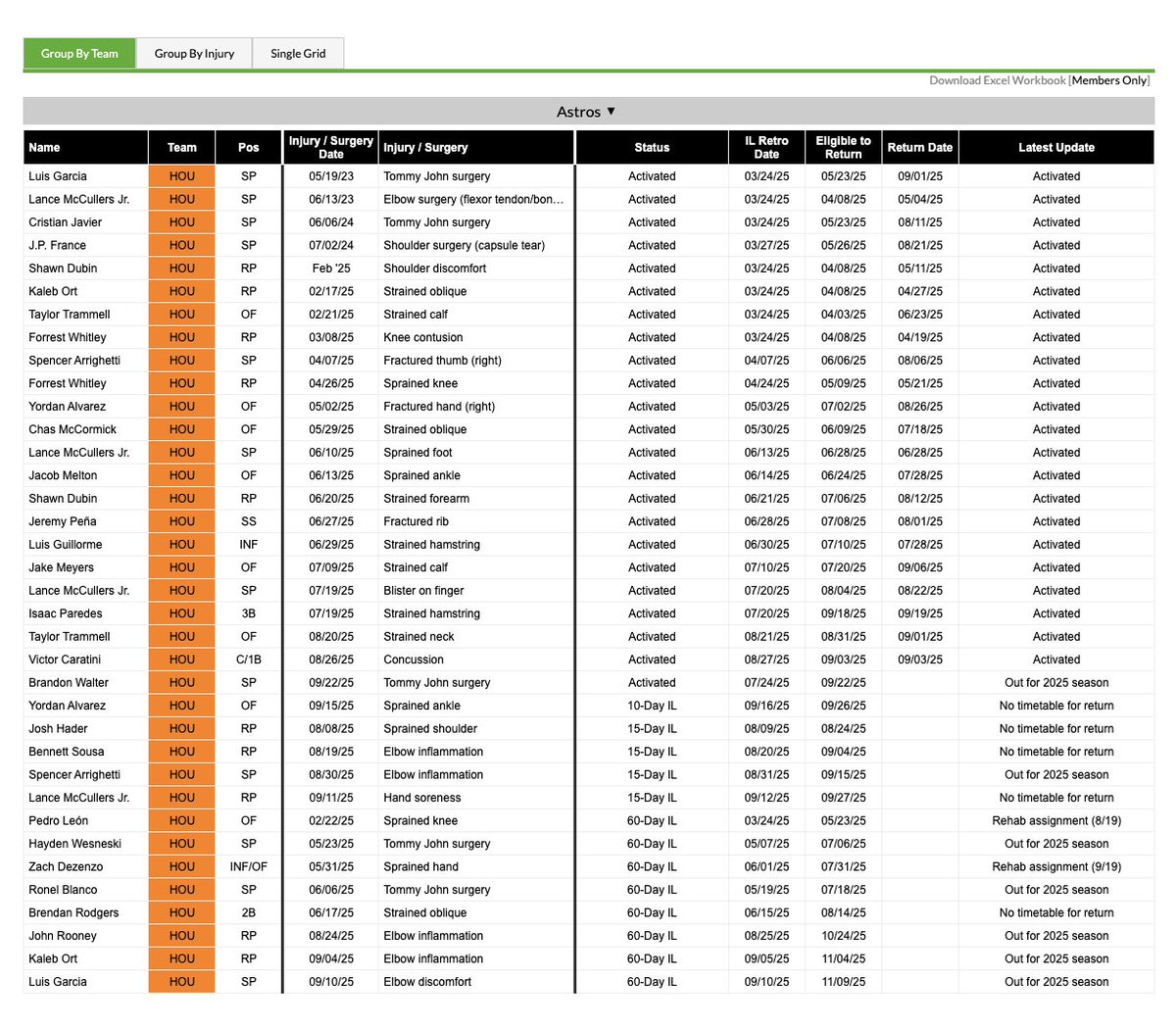
I had to zoom my web browser out to get all of the Astros injuries transactions on one page. There have been 36. How many in 2022? 17
 tweet media
English
18
10
205
16.8K
L_  N___
L_ N___@sqL_handLe·
Chucky’s Punch!
L_  N___ tweet media
English
1
0
1
87