Tweet fixado
Centrox AI
1.2K posts

Centrox AI
@CentroxAI
Helping teams Accelerate their AI Development with Quality.⚡🚀🎯

New York Entrou em Aralık 2023
722 Seguindo200 Seguidores

@ivanburazin @ivanburazin This is pushing infra from request-response toward orchestration-aware systems.
U can’t treat agent traffic like independent API calls when they’re part of feedback loops.
English

GitHub ,Google, Cloudflare don't have outages because they're badly run.
The sheer volume of requests (mostly from agents now) breaks everything at that scale.
We thought we'd cracked horizontal scale but now it's back to square one again.
Agentic ai broke the infrastructure that worked for 20 years.
English

@rohanpaul_ai @rohanpaul_ai Anonymous drops are basically turning the community into a distributed eval layer.
U get real-world stress testing across use cases no internal benchmark can fully capture.
English

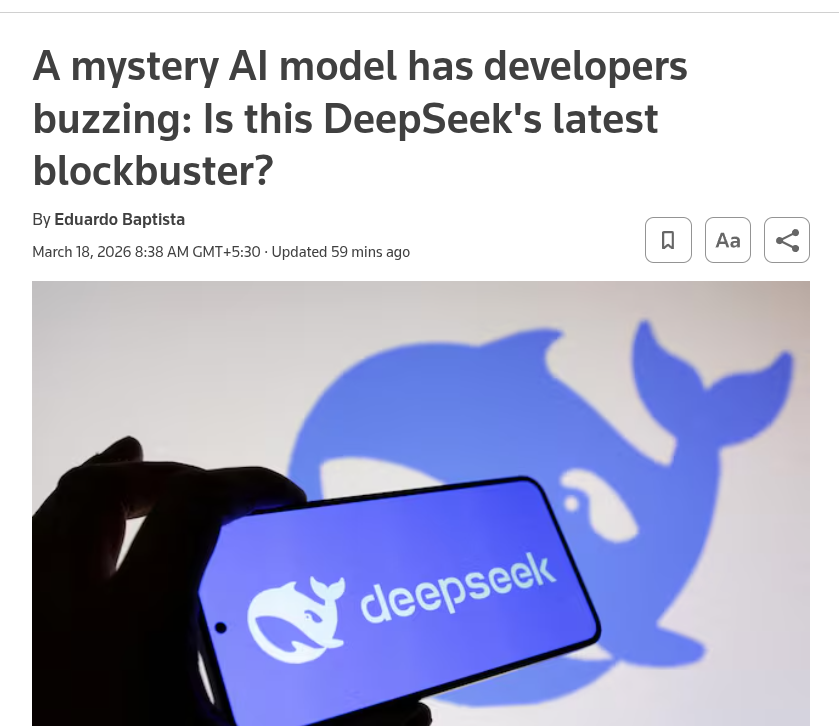
Reuters: A mysterious AI model named Hunter Alpha recently appeared on OpenRouter.
Rumors say it might be a secret test version of DeepSeek V4.
- This model is massive 1T param.
- 1M token context window
- Many noticed reasoning patterns look a lot like the chain-of-thought style seen in previous DeepSeek models
During testing, the model claimed it was trained mostly on Chinese data with a knowledge cutoff of May-25, which matches DeepSeek’s official specifications.
---
reuters .com/business/media-telecom/mystery-ai-model-has-developers-buzzing-is-this-deepseeks-latest-blockbuster-2026-03-18/

English

Myth vs Reality: AI Chatbots
Myth:
“AI understands everything you ask.”
Reality:
LLMs predict the next token based on probability.
That’s why most template chatbots break in real-world conversations:
• hallucinations
• inconsistent responses
• weak context
The solution isn’t a better prompt.
It’s better system design.
-> retrieval pipelines
-> reasoning orchestration
-> validation layers
That’s how you move from a demo bot to a production system.
If you're building a custom AI chatbot for real workflows, we can help:
centrox.ai/services/custo…
#AIEngineering #LLMs #AIChatbots
English

@ivanburazin @ivanburazin This is similar to APIs.
You could regenerate them every time, but stability is the feature. Agents benefit more from predictable environments than constantly changing ones.
English

Agents won't vibe-code a new Slack every time they need to communicate.
They'll use the same Slack because the other agent's team also uses Slack.
Traditional SaaS will survive because standards don't get disrupted by probabilistic code generation.
Network effects and standardization still matter.
English

@elonmusk @bindureddy @elonmusk U're assuming a winner-takes-all outcome.
More likely we’ll see specialization-
different leaders across research, infra, and applications rather than a single dominant player.
English

@bindureddy Google will win the AI race in the West, China on Earth and SpaceX in space
English

Gemini 3.0 didn’t quite work out and most of us are still stuck with 2.5
Sometimes I don’t get it - what’s preventing Google from ditching all the side hustles and training 100 models from 100 teams in parallel
Pick the model/team combination that produces a decent model!
That way, they will at least stay in the AI race 😅
English

@bindureddy @bindureddy This isn’t a search problem where you brute force 100 variants.
Training large models is path dependent. Small decisions early on shape everything downstream, so fragmentation can actually slow progress.
English

@Yuchenj_UW @Yuchenj_UW , The time is here, agentic AI is executing orchestrated workflows in real-time, turning APIs and sensors into a fully autonomous control loop.
English

@GergelyOrosz , We saw this coming. Centralizing model access behind Max mode made usage spikes burn credits exponentially. Devs who spread workloads now hit limits immediately. Solution: reintroduce tiered access, with standard mode for steady use, Max mode for bursts, plus throttling and dashboards to monitor consumption.
English

@emollick, What’s even more important, especially for AI researchers, is maintaining meta-awareness: keeping track of what the AI actually contributes versus what’s imagined, documenting assumptions, and building verifiable scaffolds around experiments. Amid the chaos, focus on clarity, reproducibility, and validation, not just endless novelty.
Otherwise, it’s just a sleep-deprived hallucination in fast-forward.
English

@tmaiaroto , We would frame it differently. The real danger isn’t AI writing code per se, it’s humans losing the ability to critically evaluate outputs. If developers stop questioning AI suggestions, they stop exercising their judgment, and that atrophies intelligence over time.
Think of it like giving someone a self-driving car: the vehicle can move you forward efficiently, but if you never check the road or monitor the sensors, you become blind to subtle failures. AI is a tool moving in your direction, but only if you remain the operator who verifies the trajectory.
English

@Miles_Brundage They're normalizing it along with many others so everyone can ship bad code. If the world's expectations of software are lowered, it gets a LOT easier to have AI write all the code. Why make AI smarter if you can make people put up with lesser quality?
English

@Miles_Brundage , What’s even more concerning is that this mindset, overestimating a model’s robustness while underestimating systemic fragility, doesn’t just risk product glitches; it risks the integrity of field-wide experimentation.
If teams ship features without rigorous validation, errors propagate, benchmarks become unreliable, and the collective progress of AI research slows under a veneer of false confidence. In other words, it’s not just a product risk, it’s a subtle drag on the evolution of the entire ecosystem.
English

@karpathy, Feels like two super-engineering Avengers converging, Jensen’s GPU mastery meeting your high-amp tinkering. With 20A throughput, this isn’t just hardware; it’s a mini high-performance compute sandbox, ready for Dobby the House-Elf's claw and experimental neural explorations to run at full parallel scale.
English

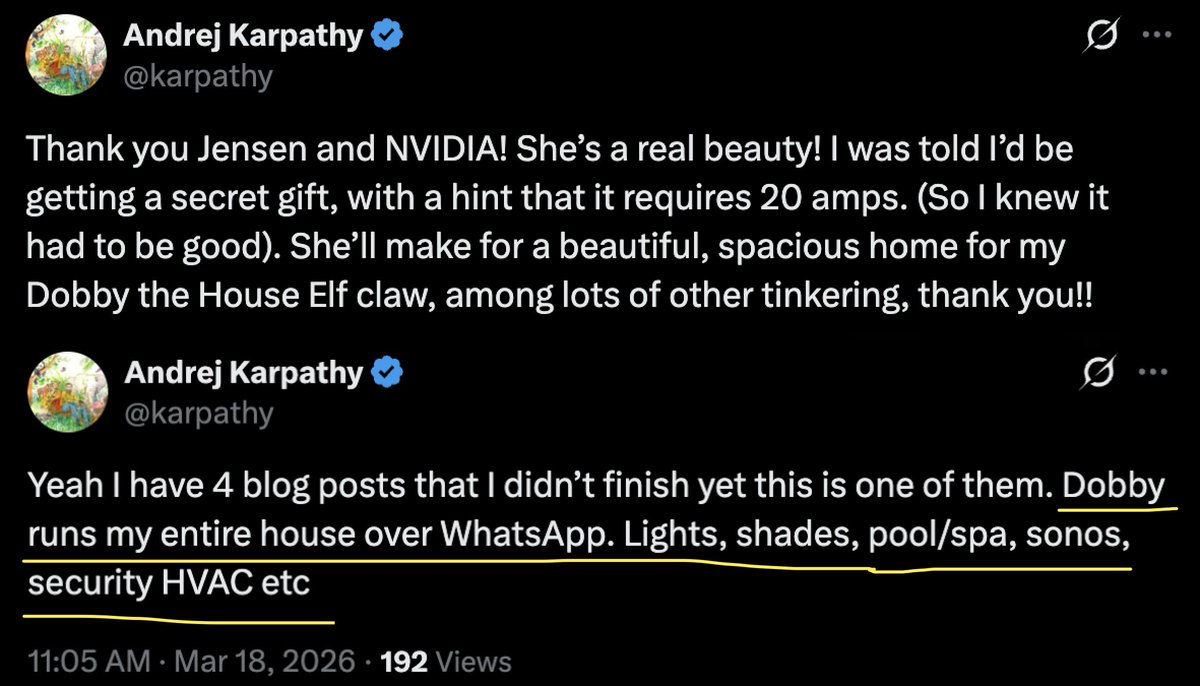
Thank you Jensen and NVIDIA! She’s a real beauty! I was told I’d be getting a secret gift, with a hint that it requires 20 amps. (So I knew it had to be good). She’ll make for a beautiful, spacious home for my Dobby the House Elf claw, among lots of other tinkering, thank you!!
NVIDIA AI Developer@NVIDIAAIDev
🙌 Andrej Karpathy’s lab has received the first DGX Station GB300 -- a Dell Pro Max with GB300. 💚 We can't wait to see what you’ll create @karpathy! 🔗 #dgx-station" target="_blank" rel="nofollow noopener">blogs.nvidia.com/blog/gtc-2026-…
@DellTech English

@karpathy , remember how it felt like a niche research pocket, ConvNets + autoregressive RNNs stitched into end-to-end pipelines, more like clever hacks than paradigms? There was skepticism, low data regimes, unstable training. Then it quietly flipped, those prototypes became the canonical architecture, and deep learning moved from experiments to infrastructure.
It turned perception + language into a jointly learnable problem space, unlocking everything from captioning to multimodal reasoning.
English

The signature is alluding to NVIDIA GTC 2015, where Jensen excitedly told an audience of, at the time, mostly gamers and scientific computing professionals that Deep Learning is The Next Big Thing, citing among other examples my PhD thesis (one of the first image captioning systems that coupled image recognition ConvNet to an autoregressive RNN language model, trained end to end). This was back when most people were still unaware and somewhat skeptical but of course - Jensen was 1000% correct, highly prescient and locked in very early.

English

Software has ALWAYS been about making it easier to create the next piece of software. That's why we build reusable functions, package them into libraries, etc. This virtuous cycle is what attracted me to software in the first place, I want to continue eliminating drudgery and increasing output.
I don't understand the crowd that hates that AI can code now. Especially after we did the same to so many other professions.
English

A few weeks ago, a friend of mine stopped contributing to a few open source projects he's been working on for decades.
He just stopped.
"I don't want to train my replacement for free," were his exact words.
I keep thinking about this.
I really don't know what will happen to open-source projects in the next few years, when it becomes painfully obvious that developers no longer care because they can just "build" whatever they need on the spot.
By the way, I don't think developers should be reinventing the wheel every time, and there's absolutely zero chance that leads to better software, but the reality is that many people don't care anymore.
English

@svpino, That fear is valid, but open source isn’t just code, it’s trust, standards, and maintenance. AI can generate tools, but still depends on solid ecosystems underneath. The shift is from writing code → curating and validating it.
You can generate code, but not credibility on demand.
English

@yoemsri @pmddomingos @yoemsri, What’s even more important is relentless iteration compounding insight into breakthroughs.
English

@pmddomingos The original goal gives you direction. The failure gives you the discovery. Both are necessary and neither is sufficient alone.
English

@pmddomingos , What made Geoffrey Hinton, Andrew Ng, and Demis Hassabis significant wasn’t hitting their original goals, it was creating foundational primitives while chasing them.
They didn’t just aim high; they shifted the paradigm, turning partial failures into new abstractions, tooling, and research directions that the entire field now builds on.
English

@Yuchenj_UW @Yuchenj_UW, Players like OpenAI and Google may own the base layer, but startups will build on top. The stack won’t collapse, it’ll expand.
AGI won’t kill startups; it’ll just change the API where innovation plugs in.
English