Intelligence & Cognitive Abilities

32 posts

Intelligence & Cognitive Abilities banner
Intelligence & Cognitive Abilities

Intelligence & Cognitive Abilities

@ICAJournal

A journal for intelligence researchers, by intelligence researchers Editor in Chief, Thomas Coyle (@ThomasRCoyle)

Entrou em Aralık 2024
26 Seguindo736 Seguidores
Intelligence & Cognitive Abilities retweetou

Richard Haier
Richard Haier@rjhaier·
Two new papers just published. One on an executive function Flynn Effect; the other on a reading-specific cognitive factor: icajournal.scholasticahq.com
English
1
12
40
3.7K
Intelligence & Cognitive Abilities retweetou
gen0m1cs
gen0m1cs@gen0m1cs·
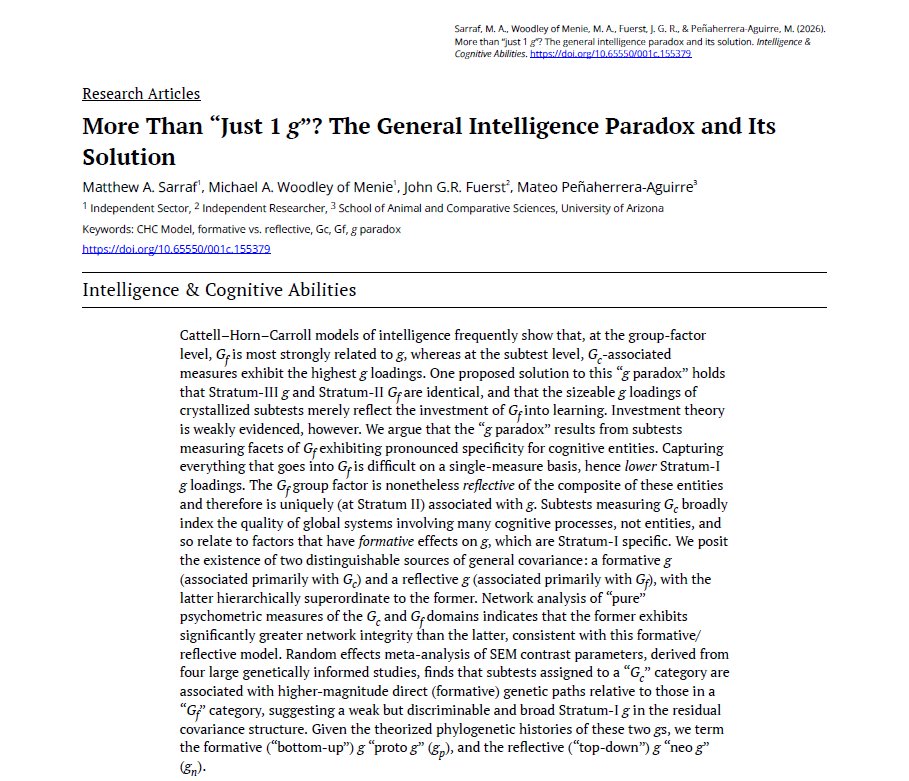
A new paper out today in ICA (@ICAJournal) argues that what we conventionally call the 'g factor' is best understood as a superposition of two distinct sources of general covariance, operating at different psychometric levels and carrying different causal interpretations.
gen0m1cs tweet media
English
7
18
139
13K
Intelligence & Cognitive Abilities retweetou
Richard Haier
Richard Haier@rjhaier·
Vol 1, Issue 2 of "Intelligence & Cognitive Abilities" is now published. All 8 papers are Open Access (no paywall) with topics including aging, sex differences, evolution, development, molecular biology & more: icajournal.scholasticahq.com/issue/13664.
English
4
43
201
42.2K
Intelligence & Cognitive Abilities retweetou
Richard Haier
Richard Haier@rjhaier·
A new paper on intelligence & evolutionary psychology: “Intelligence in Multiple Dimensions: Evolutionary Framework for the Study of Human Cognition” : icajournal.scholasticahq.com/article/154815…
English
6
29
114
9.9K
Intelligence & Cognitive Abilities retweetou
Riot IQ Research
Riot IQ Research@RiotIQ·
In this new podcast episode, Dr. Russell Warne talks with Dr. Thomas Coyle about a key finding in modern intelligence research. Some abilities predict STEM success better than a standard IQ score, and most people never heard about them. 🔗 youtu.be/tM7d7S1vwYE
YouTube video
YouTube
English
0
3
13
1.9K
Intelligence & Cognitive Abilities retweetou
Riot IQ Research
Riot IQ Research@RiotIQ·
Hot off the presses at @ICAJournal is a new article examining sex differences in achievement in reading, math and science across different countries and achievement levels. Using data from the international PISA assessment, the authors whether within-individual strengths and weaknesses impacted overall sex differences in these topics. Key findings: ➡️Boys show consistent edges in math (0.33–0.71 SD) & science (0.19–0.39 SD) strengths; girls dominate reading (0.52–0.94 SD). ➡️In countries with more gender equality, the sex differences in math, science, and reading are wider than in less equal countries. This is a phenomenon that is the exact opposite of what feminist and culture-only theories of sex differences predict and is known as the "gender equality paradox." ➡️For the most part, the same sex differences are observed among high, average, and low achievers (example below). Because it focuses on inter- and intraindividual differences, this article can shed light on how sex differences develop. Gender egalitarianism seems to encourage adolescents of both sexes to develop pre-existing strengths in reading and science even further (see below). This occurs, despite the fact that average achievement in all subjects tends to be higher in these countries. In a way, "the rich get richer" and "the poor get somewhat less poor." Finally, high-achievers have the same intraindividual strengths and weaknesses that the rest of the population does: females generally having their greatest strength in reading and males in science and math. As a result, even though these females have high math and science achievement, it's still usually lower than their reading achievement. The authors theorize that this may be one reason why bright women choose non-STEM careers: they have other options (e.g., verbal careers) that draw on their greater strengths. Read the full article (with no paywall) here: icajournal.scholasticahq.com/article/146580…
Riot IQ Research tweet mediaRiot IQ Research tweet mediaRiot IQ Research tweet media
English
1
18
68
5.9K
Intelligence & Cognitive Abilities retweetou
Riot IQ Research
Riot IQ Research@RiotIQ·
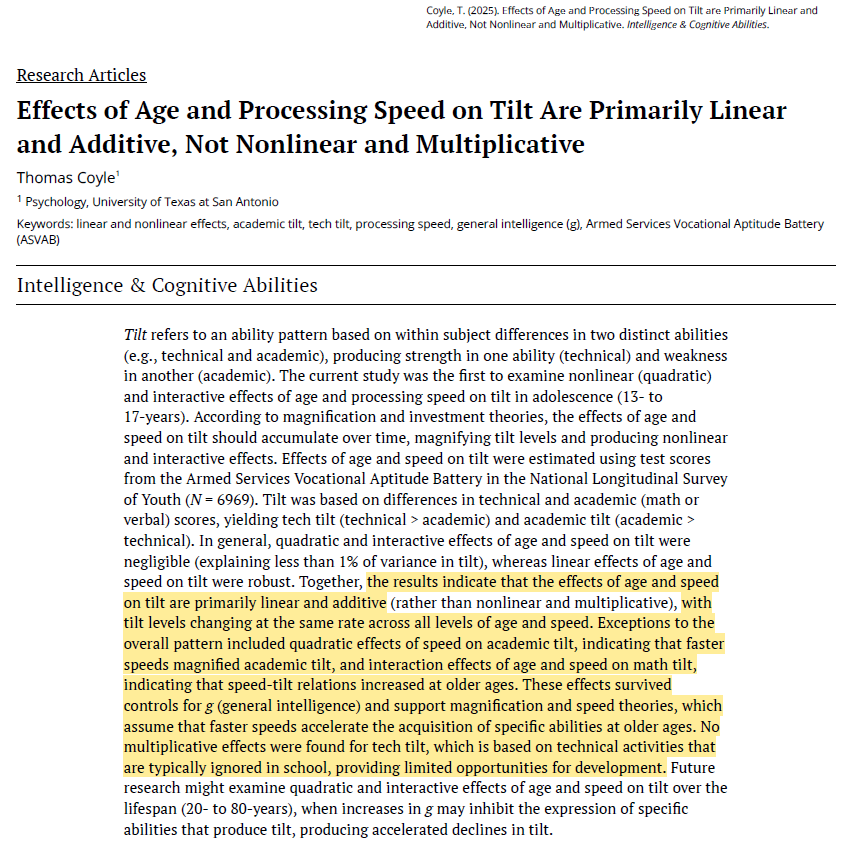
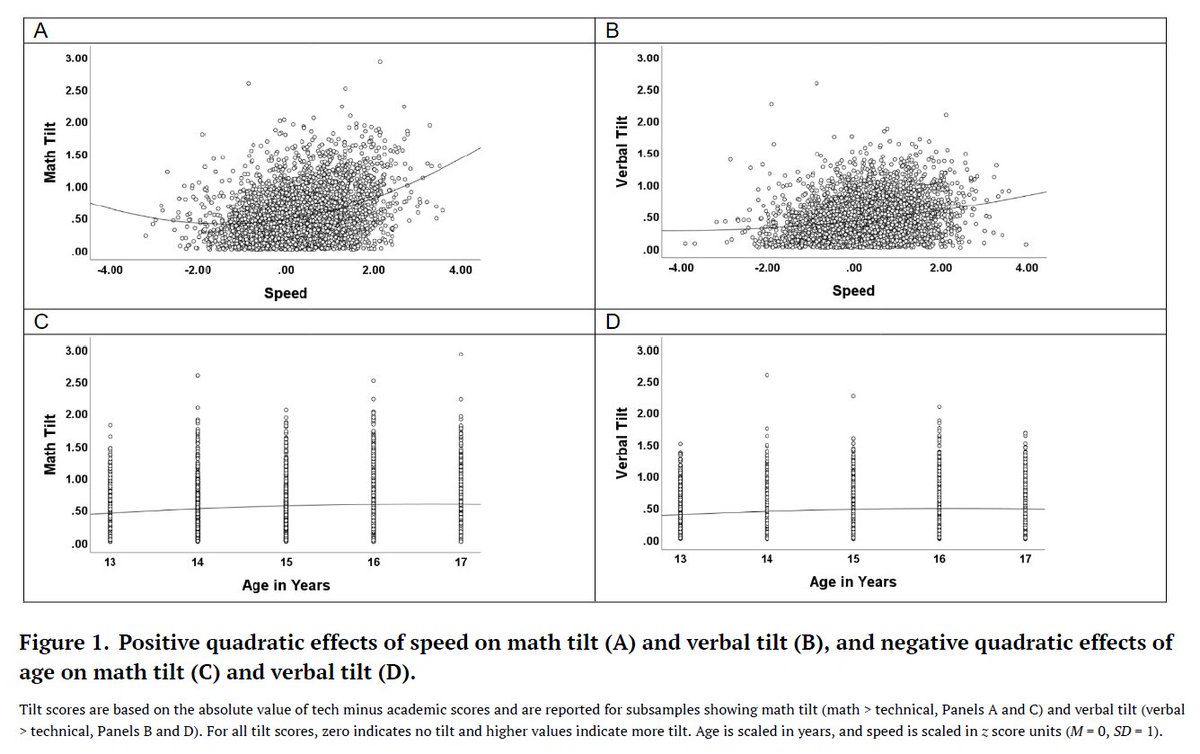
A new article written by @ThomasRCoyle and published in @ICAJournal provides more information about how personal strengths and weaknesses in academic abilities develop. Check it out! 👀⬇️ Using archival data, Coyle examined "tilt," which is the relative strength someone has in either technical or academic abilities, or in math vs. language. Previous research had already shown that tilt increases through adolescence, meaning that the difference between a person's strengths and their weaknesses grew larger over time. The question is whether this change is a linear effect, or whether the magnitude of tilt increased with age and processing speed levels (i.e., had nonlinear effects). The results indicated that effects were mostly linear, indicating that changes in tilt are mostly consistent from one age to another or from one processing speed level to another. However, there were some interesting exceptions: Processing speed had a non-linear effect on math and verbal tilt (pictured below), indicating that a faster mental speed facilitates building these academic abilities. There was also a weak age non-linear effect, but it is much weaker. This paper provides more evidence for the importance of considering test subscores in addition to global scores (like IQ). Because tilt is not related to IQ, it has unique predictive power and can provide insights that overall scores cannot. The full article is available (without a paywall) and can be read here: icajournal.scholasticahq.com/article/146460…
Riot IQ Research tweet mediaRiot IQ Research tweet media
English
0
11
44
4.5K
Intelligence & Cognitive Abilities retweetou
Riot IQ Research
Riot IQ Research@RiotIQ·
The @ICAJournal has a new article by @rjhaier about the connections between IQ scores, genes, and brain functioning (with some evolutionary biology and environmental influence thrown in, too). It's an information-packed article that connects findings from different branches of psychology, neuroscience, and biology to show (1) how humans evolved such smart brains and (2) the biological process that connects each individual's genetic blueprint to brains that show individual differences in intelligence. Here are some highlights: ➡️Regions of the brain that have experienced large changes in recent evolutionary history seem to be more important for intelligence. ➡️There has been a evolutionary tradeoff: in exchange for a larger, smarter brain (and enhanced regions of the brain), the brain has been more hungry for energy. Balancing these two conflicting demands has been an evolutionary tightrope that humans seem to have walked. ➡️There are specific genes (discussed in the paper) with common variants that are very likely to have biological functions that result in smarter brains. The function of these genes are understood, and though their relationship with IQ is modest, they give us important clues into how genes result in smarter brains. (After all, the genes don't whisper the answer to an IQ test question into your ear. Any impact they have on IQ must be via biology.) ➡️Fetal development seems to be fine tuned for building a smart brain (under normal conditions), especially in the timing of uptake of polyunsaturated fatty acids during the third trimester. There is a lot more in the article. It doesn't answer every question about how intelligence develops (either in the species at large or in individual humans), but it pulls together a great deal of interesting evidence in one place. Read it here (with no paywall): icajournal.scholasticahq.com/article/146520…
Riot IQ Research tweet media
English
3
26
117
107.8K
Intelligence & Cognitive Abilities retweetou
Riot IQ Research
Riot IQ Research@RiotIQ·
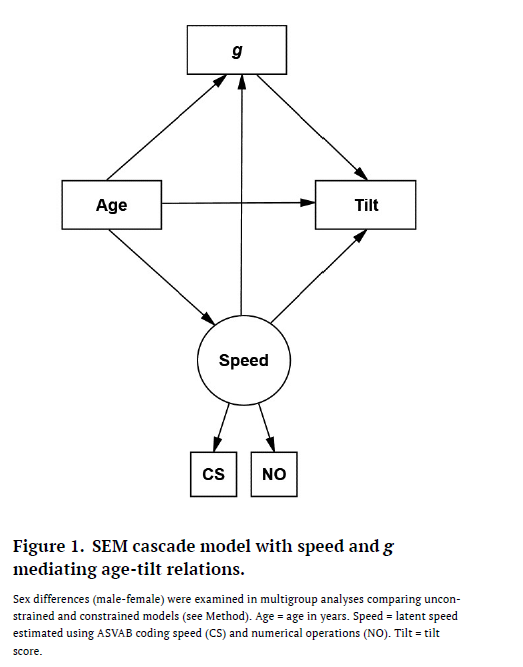
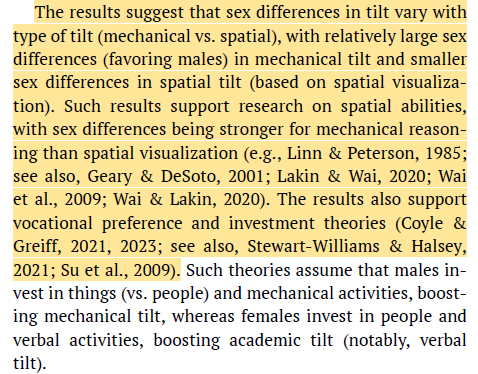
A new article in @ICAJournal by @ThomasRCoyle explores the development of intraindividual differences in cognitive abilities, called "tilt." The findings show the importance of understanding people's relative strengths and weaknesses. Coyle investigated the relative strengths of adolescents' mechanical, spatial, and academic strengths (or weaknesses). Among his findings: ➡️Sex differences were larger for mechanical tilt, with more males showing a relative strength in mechanical abilities (compared to academic abilities). But for spatial tilt, there were "negligible" sex differences. ➡️Processing speed and general intelligence (g) were important in developing mechanical tilt. The influence of processing speed and g were stronger for males than females. ➡️Sex differences in spatial tilt do not increase with age, indicating that the maturation and education processes do not have an impact on the relative #'s of males and females showing greater spatial tilt. The results were generally supporting of investment theory, which is that individuals' strengths are (partially) a product of what they invest their time into learning. It also supports cascade theory, which states that the development of tilt is mediated by both g and processing speed (not just speed). In the real world, this study has some implications because relative strengths and weaknesses are very common. This study shows that, to a degree, tilt may be malleable. In other words, it may be possible to work on your weaknesses and bring them closer to your typical cognitive ability level. It also raises the possibility that schools could see academic benefits from training students' spatial abilities, which are important for many STEM fields and vocations.
Riot IQ Research tweet media
English
1
2
12
1.3K
Intelligence & Cognitive Abilities retweetou
gen0m1cs
gen0m1cs@gen0m1cs·
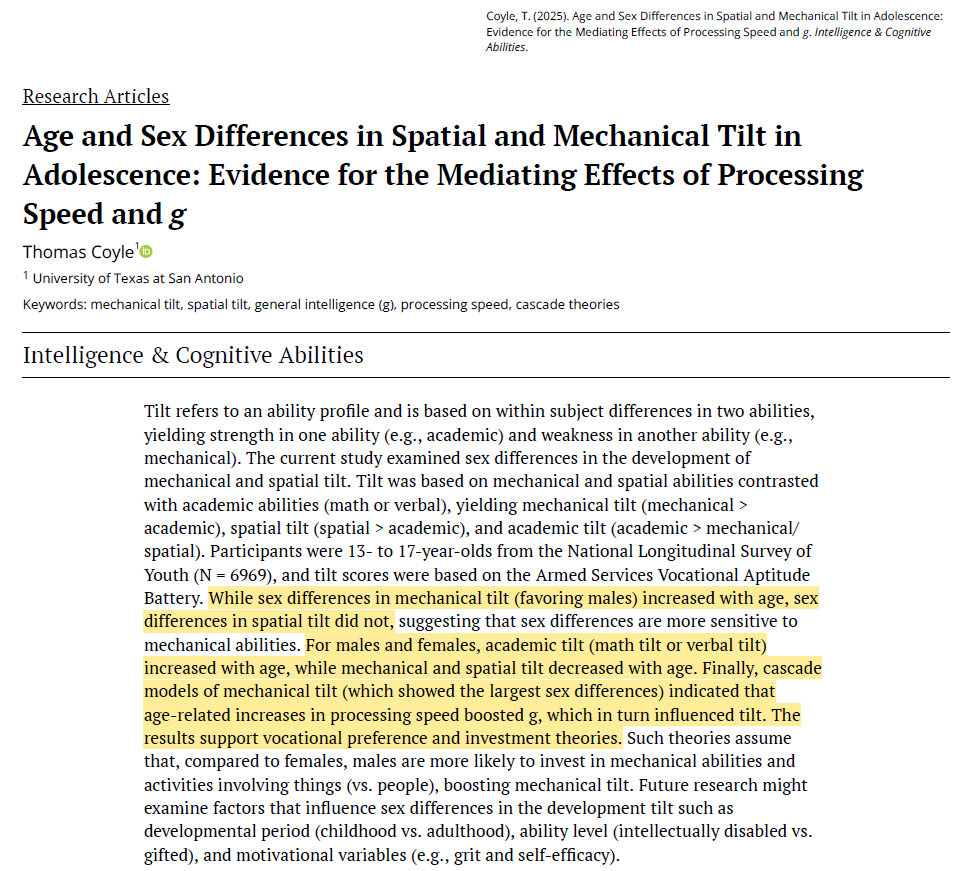
New paper out today in @ICAJournal on age and sex differences in spatial and mechanical tilt during adolescence. It found that adolescents show a shift toward academic tilt with age for both sexes; mechanical tilt is a clear male-leaning profile that diverges with age; spatial tilt shows small/negligible sex differences with little age-by-sex change. A speed → g → tilt cascade helps account for the age trends.
gen0m1cs tweet mediagen0m1cs tweet mediagen0m1cs tweet mediagen0m1cs tweet media
English
1
5
45
5.5K
Intelligence & Cognitive Abilities retweetou
Riot IQ Research
Riot IQ Research@RiotIQ·
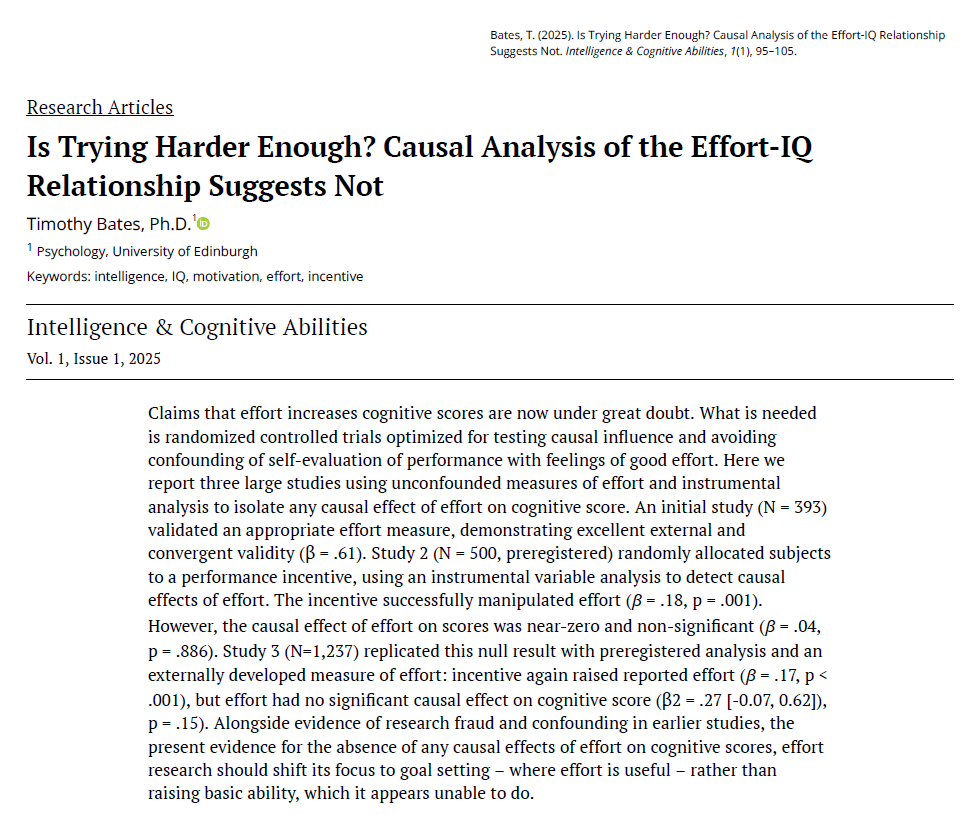
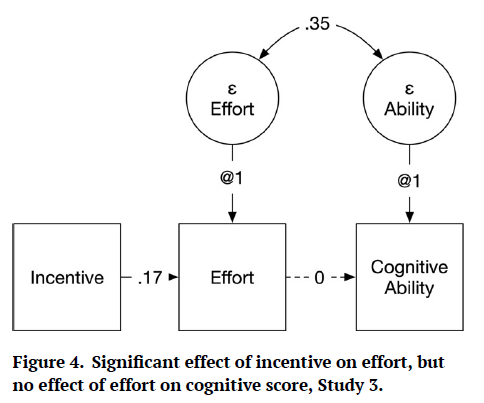
A major article by @timothycbates was just published in @ICAJournal showing that incentives make people more motivated when taking tests. But the higher motivation does NOT cause IQ to increase. And the finding was replicated (n=500 in 1st study; n = 1,237 in the replication). In both studies, self-reported effort was correlated with test performance, but only when the effort was reported after taking the test. Pre-test effort (e.g., "I will give my best effort on this test.") is NOT correlated with test performance. Therefore, the post-test effort reports are distorted by people's beliefs about how well they did on the test. Half of participants in both studies were randomly selected to receive an extra incentive in which they would be paid more if they did better on a second test. In both studies, the incentive was shown to impact pre-test effort. But this did NOT lead to higher test score in either study. This is seen in the value of "0" in the path leading from pre-test effort to cognitive test score in the figure below. Here is the same finding in the replication, which had more statistical to detect any effect that might have been present: The author stated, ". . . these findings support the hypothesis that effort does not causally raise cognitive score. Both studies, then, showed that, while incentives reliably and substantially manipulated effort, increased effort did not manifest in any statistically or theoretically significant causal effect on cognitive scores" (p. 101). These results don't mean that we shouldn't try on tests. Instead, they mean that claims that IQ scores are susceptible to changes in effort is incorrect. In other words, intelligence tests (including the online tests used in this article) are measuring cognitive ability--not test-taking effort. Another implication of this research is that motivating people to try harder won't change their underlying ability. Telling students to "try harder" on school tests is not a very effective strategy to raise scores (assuming that they were already putting some effort into their performance in the first place).
Riot IQ Research tweet mediaRiot IQ Research tweet mediaRiot IQ Research tweet media
English
3
16
74
8.5K