Thomas Coyle

309 posts

Thomas Coyle banner
Thomas Coyle

Thomas Coyle

@ThomasRCoyle

Professor of Psychology, University of Texas at San Antonio Editor in Chief, Intelligence & Cognitive Abilities (@ICAJournal)

Katılım Mart 2016
155 Takip Edilen334 Takipçiler
Thomas Coyle retweetledi

Richard Haier
Richard Haier@rjhaier·
Two new papers just published. One on an executive function Flynn Effect; the other on a reading-specific cognitive factor: icajournal.scholasticahq.com
English
1
12
40
3.7K
Thomas Coyle retweetledi
Richard Haier
Richard Haier@rjhaier·
Vol 1, Issue 2 of "Intelligence & Cognitive Abilities" is now published. All 8 papers are Open Access (no paywall) with topics including aging, sex differences, evolution, development, molecular biology & more: icajournal.scholasticahq.com/issue/13664.
English
4
43
201
42.2K
Thomas Coyle
Thomas Coyle@ThomasRCoyle·
@ASFleischman Former General Counsel for Chase. Good tennis player and Kaplan test prep instructor in HS and college. Not too shabby!
English
0
0
0
37
Andrew Fleischman
Andrew Fleischman@ASFleischman·
What happened to the smartest person you went to school with?
English
2K
220
2K
18M
Thomas Coyle retweetledi
Riot IQ Research
Riot IQ Research@RiotIQ·
In this new podcast episode, Dr. Russell Warne talks with Dr. Thomas Coyle about a key finding in modern intelligence research. Some abilities predict STEM success better than a standard IQ score, and most people never heard about them. 🔗 youtu.be/tM7d7S1vwYE
YouTube video
YouTube
English
0
3
13
1.9K
Thomas Coyle
Thomas Coyle@ThomasRCoyle·
@Derivatives_Ape Good opener, bad follow-through. When she laughed, you had her. Could've said (with a wry smile): "Some guy suggested it. Never doing THAT again! [Extend hand] Hi, I'm__. Happy to buy you a drink. Help me work on better openers!" I bet she'd love it! (Disclaimer: Married 27 yrs)
English
2
0
3
513
Derivatives Monke
Derivatives Monke@Derivatives_Ape·
I read this tweet by Bill Ackman.. the guy runs a hedge fund worth billions. He's got a wife and seems to have his life together. So I decided to give it a shot. Last night I'm at this bar and I see a brunette near the dartboard. She had on a denim jacket, looked friendly enough. I thought, alright, this is my moment. I walked over, tried to look confident, and said: "May I meet you?" She just looked at me. Blank stare, for like three full seconds. Then she absolutely lost her mind laughing. I mean full-on can't-breathe, tears-in-her-eyes laughing. Her two friends spun around and within seconds they were all dying. One of them had to put her drink down because she was shaking too hard. "MAY I MEET YOU?" the brunette repeated, mimicking my voice, and they all cracked up again. I stood there like a complete idiot. Said something like "never mind" and just walked back to my seat. I will never listen to Bill Ackman again. Never taking advice from a boomer again.. this shit doesn't work in 2025. And now here I am, same spot at the bar. Everyone has left at this point. Drinking the same cheap beer by myself like always.
Derivatives Monke tweet media
Bill Ackman@BillAckman

I hear from many young men that they find it difficult to meet young women in a public setting. In other words, the online culture has destroyed the ability to spontaneously meet strangers. As such, I thought I would share a few words that I used in my youth to meet someone that I found compelling. I would ask: “May I meet you?” before engaging further in a conversation. I almost never got a No. It inevitably enabled the opportunity for a further conversation. I met a lot of really interesting people this way. I think the combination of proper grammar and politeness was the key to its effectiveness. You might give it a try. And yes, I think it should also work for women seeking men as well as same sex interactions. Just two cents from an older happily married guy concerned about our next generation’s happiness and population replacement rates.

English
2K
665
18K
4.3M
Thomas Coyle retweetledi
Riot IQ Research
Riot IQ Research@RiotIQ·
Hot off the presses at @ICAJournal is a new article examining sex differences in achievement in reading, math and science across different countries and achievement levels. Using data from the international PISA assessment, the authors whether within-individual strengths and weaknesses impacted overall sex differences in these topics. Key findings: ➡️Boys show consistent edges in math (0.33–0.71 SD) & science (0.19–0.39 SD) strengths; girls dominate reading (0.52–0.94 SD). ➡️In countries with more gender equality, the sex differences in math, science, and reading are wider than in less equal countries. This is a phenomenon that is the exact opposite of what feminist and culture-only theories of sex differences predict and is known as the "gender equality paradox." ➡️For the most part, the same sex differences are observed among high, average, and low achievers (example below). Because it focuses on inter- and intraindividual differences, this article can shed light on how sex differences develop. Gender egalitarianism seems to encourage adolescents of both sexes to develop pre-existing strengths in reading and science even further (see below). This occurs, despite the fact that average achievement in all subjects tends to be higher in these countries. In a way, "the rich get richer" and "the poor get somewhat less poor." Finally, high-achievers have the same intraindividual strengths and weaknesses that the rest of the population does: females generally having their greatest strength in reading and males in science and math. As a result, even though these females have high math and science achievement, it's still usually lower than their reading achievement. The authors theorize that this may be one reason why bright women choose non-STEM careers: they have other options (e.g., verbal careers) that draw on their greater strengths. Read the full article (with no paywall) here: icajournal.scholasticahq.com/article/146580…
Riot IQ Research tweet mediaRiot IQ Research tweet mediaRiot IQ Research tweet media
English
1
18
68
5.9K
Thomas Coyle retweetledi
Riot IQ Research
Riot IQ Research@RiotIQ·
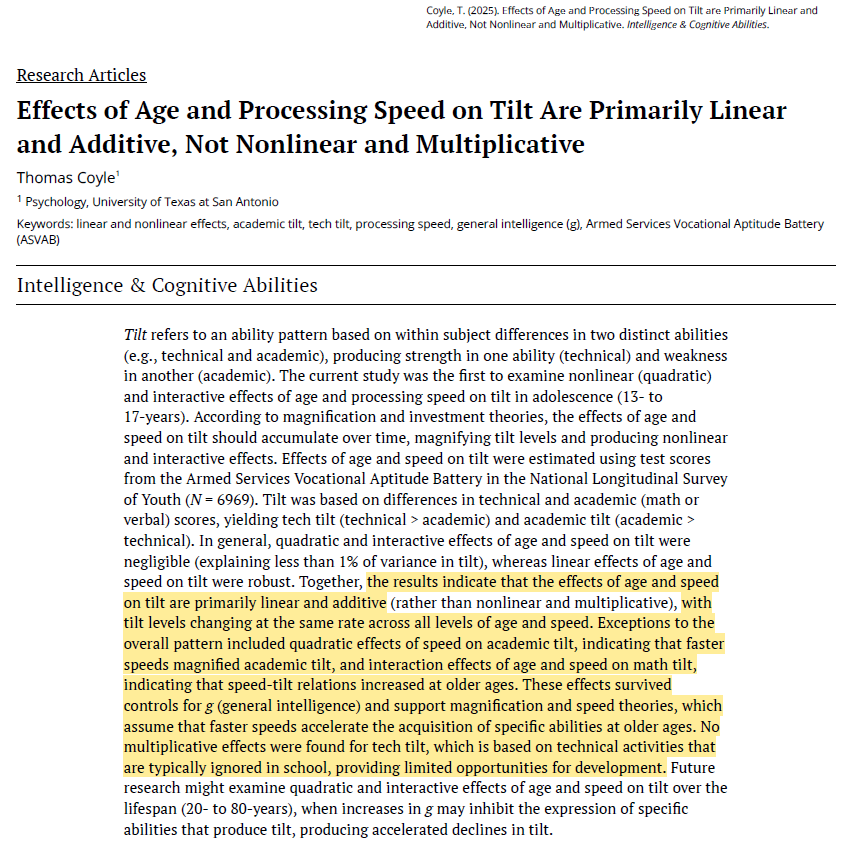
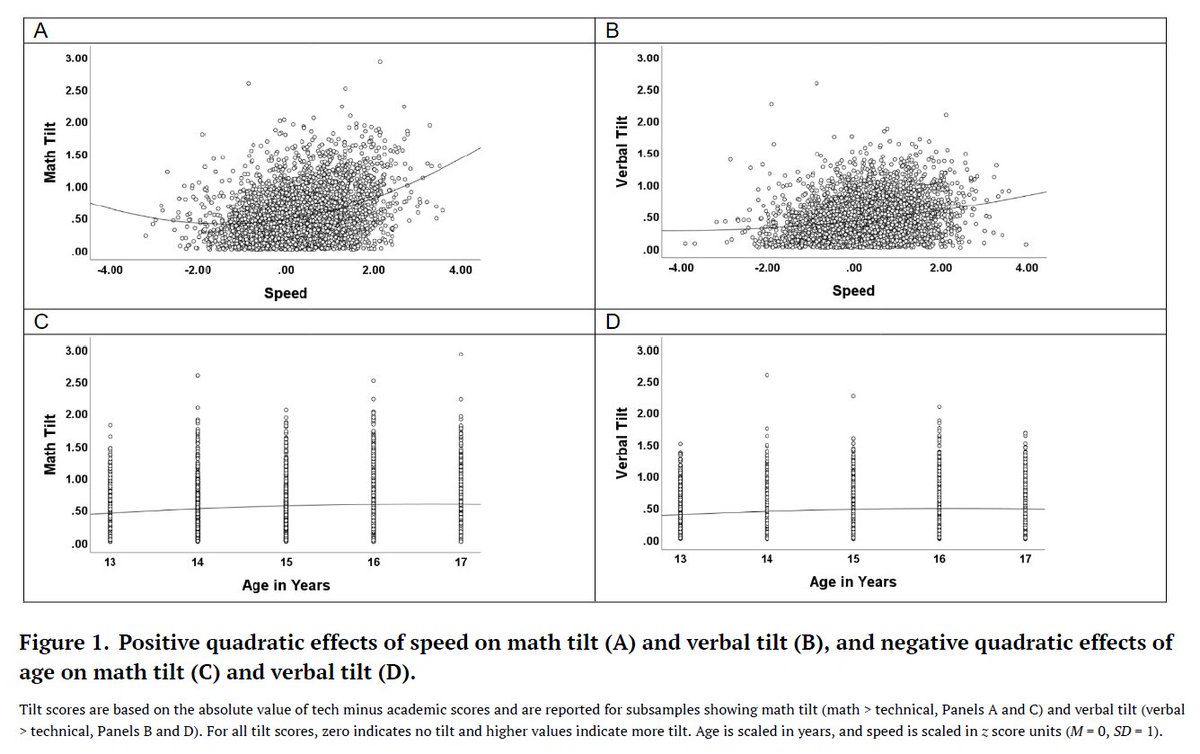
A new article written by @ThomasRCoyle and published in @ICAJournal provides more information about how personal strengths and weaknesses in academic abilities develop. Check it out! 👀⬇️ Using archival data, Coyle examined "tilt," which is the relative strength someone has in either technical or academic abilities, or in math vs. language. Previous research had already shown that tilt increases through adolescence, meaning that the difference between a person's strengths and their weaknesses grew larger over time. The question is whether this change is a linear effect, or whether the magnitude of tilt increased with age and processing speed levels (i.e., had nonlinear effects). The results indicated that effects were mostly linear, indicating that changes in tilt are mostly consistent from one age to another or from one processing speed level to another. However, there were some interesting exceptions: Processing speed had a non-linear effect on math and verbal tilt (pictured below), indicating that a faster mental speed facilitates building these academic abilities. There was also a weak age non-linear effect, but it is much weaker. This paper provides more evidence for the importance of considering test subscores in addition to global scores (like IQ). Because tilt is not related to IQ, it has unique predictive power and can provide insights that overall scores cannot. The full article is available (without a paywall) and can be read here: icajournal.scholasticahq.com/article/146460…
Riot IQ Research tweet mediaRiot IQ Research tweet media
English
0
11
44
4.5K
Thomas Coyle retweetledi
Riot IQ Research
Riot IQ Research@RiotIQ·
The @ICAJournal has a new article by @rjhaier about the connections between IQ scores, genes, and brain functioning (with some evolutionary biology and environmental influence thrown in, too). It's an information-packed article that connects findings from different branches of psychology, neuroscience, and biology to show (1) how humans evolved such smart brains and (2) the biological process that connects each individual's genetic blueprint to brains that show individual differences in intelligence. Here are some highlights: ➡️Regions of the brain that have experienced large changes in recent evolutionary history seem to be more important for intelligence. ➡️There has been a evolutionary tradeoff: in exchange for a larger, smarter brain (and enhanced regions of the brain), the brain has been more hungry for energy. Balancing these two conflicting demands has been an evolutionary tightrope that humans seem to have walked. ➡️There are specific genes (discussed in the paper) with common variants that are very likely to have biological functions that result in smarter brains. The function of these genes are understood, and though their relationship with IQ is modest, they give us important clues into how genes result in smarter brains. (After all, the genes don't whisper the answer to an IQ test question into your ear. Any impact they have on IQ must be via biology.) ➡️Fetal development seems to be fine tuned for building a smart brain (under normal conditions), especially in the timing of uptake of polyunsaturated fatty acids during the third trimester. There is a lot more in the article. It doesn't answer every question about how intelligence develops (either in the species at large or in individual humans), but it pulls together a great deal of interesting evidence in one place. Read it here (with no paywall): icajournal.scholasticahq.com/article/146520…
Riot IQ Research tweet media
English
3
26
118
107.8K
Thomas Coyle retweetledi
Riot IQ Research
Riot IQ Research@RiotIQ·
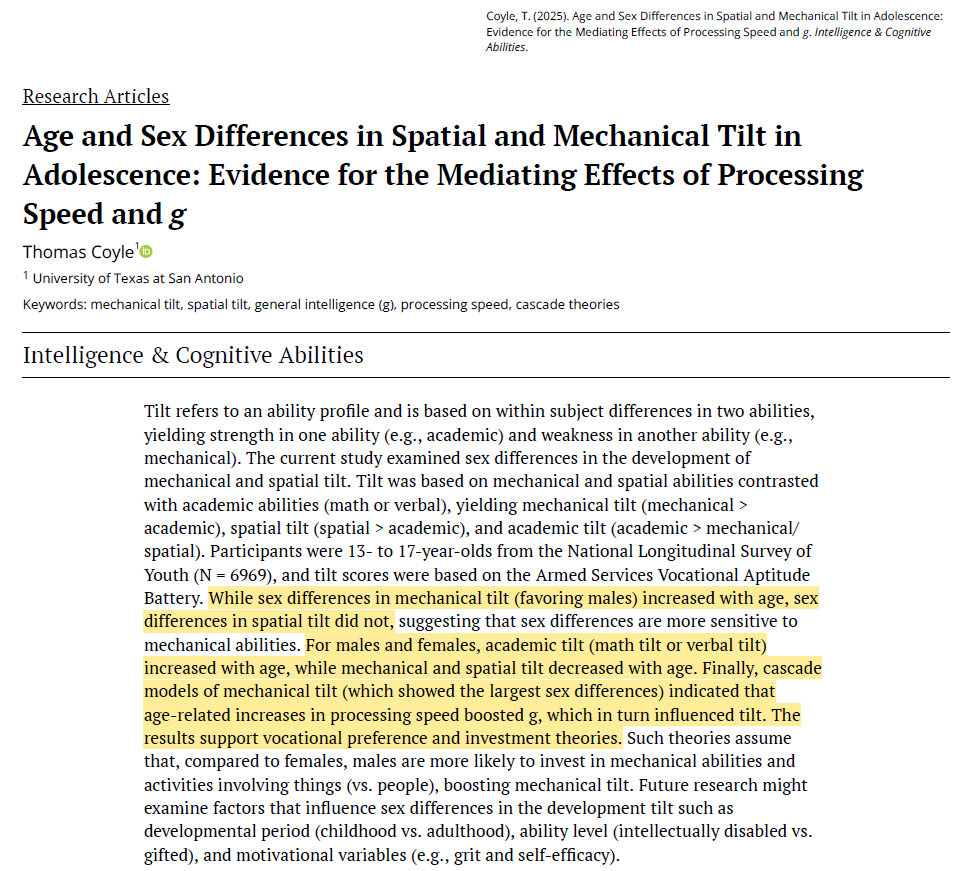
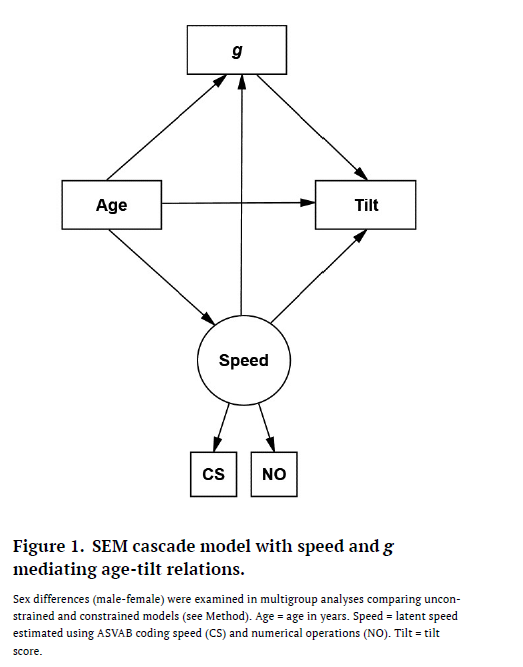
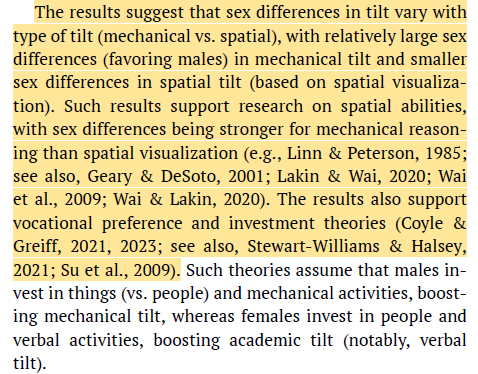
A new article in @ICAJournal by @ThomasRCoyle explores the development of intraindividual differences in cognitive abilities, called "tilt." The findings show the importance of understanding people's relative strengths and weaknesses. Coyle investigated the relative strengths of adolescents' mechanical, spatial, and academic strengths (or weaknesses). Among his findings: ➡️Sex differences were larger for mechanical tilt, with more males showing a relative strength in mechanical abilities (compared to academic abilities). But for spatial tilt, there were "negligible" sex differences. ➡️Processing speed and general intelligence (g) were important in developing mechanical tilt. The influence of processing speed and g were stronger for males than females. ➡️Sex differences in spatial tilt do not increase with age, indicating that the maturation and education processes do not have an impact on the relative #'s of males and females showing greater spatial tilt. The results were generally supporting of investment theory, which is that individuals' strengths are (partially) a product of what they invest their time into learning. It also supports cascade theory, which states that the development of tilt is mediated by both g and processing speed (not just speed). In the real world, this study has some implications because relative strengths and weaknesses are very common. This study shows that, to a degree, tilt may be malleable. In other words, it may be possible to work on your weaknesses and bring them closer to your typical cognitive ability level. It also raises the possibility that schools could see academic benefits from training students' spatial abilities, which are important for many STEM fields and vocations.
Riot IQ Research tweet media
English
1
2
12
1.3K
Thomas Coyle retweetledi
Timothy Bates
Timothy Bates@timothycbates·
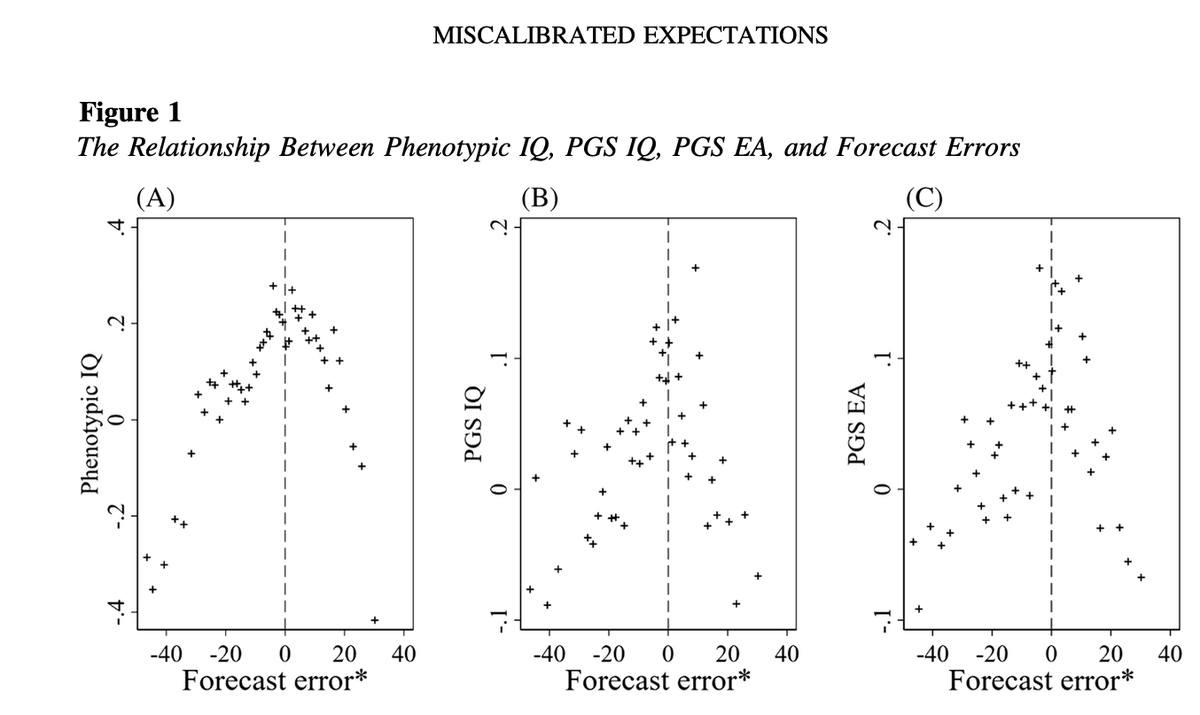
Forecasting is crucial for major decisions: Marry him/her? Accept a house offer? Invest in NVIDIA? Intelligent people make better forecasts, including having more accurate stereotypes. Now a new paper links these lower forecasting errors to high polygenic IQ scores: Nice inverted U, with smaller errors flowing from high polygenic scores:
Timothy Bates tweet media
English
7
37
347
24.7K
Thomas Coyle retweetledi
gen0m1cs
gen0m1cs@gen0m1cs·
New paper out today in @ICAJournal on age and sex differences in spatial and mechanical tilt during adolescence. It found that adolescents show a shift toward academic tilt with age for both sexes; mechanical tilt is a clear male-leaning profile that diverges with age; spatial tilt shows small/negligible sex differences with little age-by-sex change. A speed → g → tilt cascade helps account for the age trends.
gen0m1cs tweet mediagen0m1cs tweet mediagen0m1cs tweet mediagen0m1cs tweet media
English
1
5
45
5.5K
Thomas Coyle
Thomas Coyle@ThomasRCoyle·
@avidseries Gator here! UMass (SAT 25%/75%: 1330/1480), Stony Brook (1340/1480), Maryland (1410/1520), Rutgers (1270/1480) are fine unis. In the NE, good privates draw talent from publics. Consider ratio of good privates to publics in NE v. South (given pop density/geo spread).
English
0
0
0
116