Danny Marques | Investing Informant

16.9K posts

Danny Marques | Investing Informant banner
Danny Marques | Investing Informant

Danny Marques | Investing Informant

@Invst_Informant

Building world’s 1st ₿itcoin & AI IR firm @OGAdvisors | Research @Finblueprint | @VillanovaU ‘16

👇Institutional-Level Research Entrou em Ağustos 2021
368 Seguindo21.9K Seguidores
Tweet fixado
Danny Marques | Investing Informant
The bond market and US 10yr are nearing a breaking point yet equities are at an ATH with signs that this bull market still has much more room to go. Let me explain why high yields don't break markets. What we have here is the US10yr yield (now at 4.56%) vs the $SPX (S&P 500) over the last 30 years...The more I look at this, the more I think the right question is not simply “Are high rates bad for stocks?” The better question is what type of high-rate environment are we in? Because there is a major difference between what historically caused recessions and what historically confirmed them. Several of the worst market declines over the last 25+ years were not always triggered by yields being high. They often happened after the bond market started sniffing out a real growth problem and after yields had already started collapsing. In other words, the 10-yr breaking lower was not always the bullish “rates are falling” signal investors wanted it to be. Sometimes it was the market saying growth is cracking, capital is moving to safety, and the Fed is probably behind the curve. IF the 10-yr breaks down because inflation is cooling while earnings remain resilient, that can be bullish. That is the soft-landing version. Lower discount rate, still-good earnings, and risk assets can breathe. But IF the 10-yr breaks down because unemployment is rising, credit spreads are widening, consumers are weakening, and earnings revisions are rolling over, that is not bullish. That is the recession version. Same move in rates but a very different message. So what is happening right now? Right now, the 10-yr is sitting near a major multi-decade resistance zone, and the S&P 500 is making new highs. That combination tells me the market is pricing a world where nominal growth, fiscal spending, AI capex, and mega-cap earnings power are still strong enough to offset the drag from higher rates. THAT is the key point. In 2000, 2007, 2020, and even partially in 2022, the breakdown in the 10-yr yield was less the cause of the equity correction and more the market suddenly pricing economic deterioration, liquidity stress, or an aggressive policy response. Put differently, rising yields usually reflect nominal growth, inflation expectations, or economic momentum. Collapsing yields usually reflect fear, recession risk, or a liquidity event. And this is where today gets interesting. We are not living in the same macro structure as prior cycles. The US fiscal deficit is much larger. Treasury supply matters more. Inflation is structurally more sticky. And AI infrastructure spending has become one of the largest private-sector capex cycles in modern history. The AI capex boom is not just a tech story. It is flowing into so many different areas of the economy. Semiconductors, power, utilities, data centers, networking equipment, electrical infrastructure, and labor demand. That spending is helping hold up parts of the economy that normally would have rolled over faster under this level of rates. Index concentration matters too. The S&P 500 today is not the same S&P 500 from 2000 or even 2010. A huge portion of index performance is now driven by a handful of mega-cap technology companies with fortress balance sheets, enormous free cash flow, global monopolistic distribution, and secular AI-driven demand. That changes the transmission mechanism of higher rates. A regional bank, small-cap company, or heavily levered consumer company can struggle enormously in a 5% yield world. Microsoft, NVIDIA, Meta, or Alphabet do not necessarily struggle the same way because they internally finance growth through cash generation. So the market is not ignoring rates. It is saying “Show me the earnings damage.” And so far, at the index level, there hasn't been any. The major contributors to the indexes and the economy have the strongest moats and earnings strength has never been stronger. That is why traditional recession signals have looked “wrong” for longer than many expected. The economy is bifurcated. Tthe lower-income consumer looks stressed, housing affordability is weak, small businesses face pressure, refinancing risk is real (Commercial real estate is still digesting a much higher cost of capital) But at the same time, large-cap tech corporate earnings remain resilient because AI, software, cloud and infrastructure spending are offsetting broader weakness. I also think people are too quick to compare the AI capex cycle to the late 1990s telecom and internet bubble. There are major differences. Alot of the 1990s infrastructure buildout was funded by companies that NEEDED the capital markets to stay open (and it was largely driven by debt) Today, companies like Microsoft, Amazon, Meta, Alphabet, NVIDIA, Oracle are investing from a position of massive profitability. Yes, now they've begun tapping into the debt markets to accelerate the buildout, but they are doing it from a position of strength, not survival. Whether the spending ultimately becomes excessive or will generate adequate returns is another discussion. Will there be overcapacity or will all this capex spend eventually disappoint? We shall see. But, for now, the earnings impulse is real. Hundreds of billions are being deployed into compute, networking, power infrastructure, chips, and data centers. That spending is flowing through the economy and supports nominal growth even while parts of the consumer economy weaken. This is why the bond market matters so much from here. Technically, yields look like they are attempting a breakout from a 20+ year base. And if yields do decisively break above this range and sustain above ~5%, I think the market eventually has a much harder time maintaining current multiples. Not necessarily because growth collapses immediately, but because the discount rate regime changes. A sustained move above this macro resistance zone would tell me the market is repricing term premium, fiscal risk, or sticky inflation again, or some combination of all three. That would put pressure on long-duration assets and make the equity market far more dependent on earnings growth to justify valuations. On the other hand, as long as the 10-yr is not breaking down in a disorderly way and not breaking out above this long-term resistance zone, the market can still have legs. It gives equities room to keep climbing, especially if the earnings engine remains concentrated in companies with real cash flow, pricing power, and balance sheet strength. Remember, the market tends to break when the bond market suddenly realizes growth is deteriorating faster than expected. And right now, that is NOT what the bond market is saying. If anything, the bond market is currently saying the exact opposite. Nominal growth + inflation are more durable than people expected. Now does that mean there is no risk? Of course note. At some point higher rates matter. Private credit reprices (it already has shown signs of fracturing), refinancing risk increases, government interest expense explodes higher (which is currently not sustainable), equity risk premiums compress, and weaker balance sheets start to run out of time as liquidity conditions tighten materially. Higher rates work with long and variable lags. But the nuance is markets do not top simply because yields are high. They top when liquidity deteriorates, earnings roll over, credit spreads widen, AND THEN yields collapse because the market starts pricing recession. Right now, we don’t yet have that full sequence. What we have instead is sticky nominal growth, sticky inflation, resilient mega-cap earnings, AI-driven capex, and structurally large fiscal deficits supporting demand + keeping liquidity in the system. That combination can sustain higher yields and higher equity prices simultaneously longer than most people expect. The next move in yields does matter a lot. A controlled drift lower would likely help broaden the market. A breakout higher would pressure valuations. A sharp breakdown lower would probably mean the bond market is seeing something in growth that equities have not priced yet. Until the 10-yr breaks decisively one way or the other, my view is that the bull market can continue, but the macro margin for error is getting thinner. Commercial real estate, refinancing cycles, PE leverage, consumer credit deterioration, and government debt servicing pressure all compound slowly before they suddenly matter. Eventually there is a level where the cost of capital begins overwhelming even strong secular narratives. But the difficult part is knowing where that threshold actually is and frankly, the market itself may not know yet either.
Danny Marques | Investing Informant tweet media
English
5
18
83
14.6K
The Wheelie Investor
The Wheelie Investor@WheelieInvestor·
Can someone please explain how a $1 trillion company can go up 20% in one day?
The Wheelie Investor tweet media
English
631
134
4.6K
887.5K
Danny Marques | Investing Informant
@mikealfred What's disappointing is the continued display of hubris amidst all this Nothing wrong accepting that running a company is hard and that maybe you're not built for it. Few are but to continue pretending at the expense of shareholders is despicable
English
1
0
3
647
Justin Bechler #BIP-110
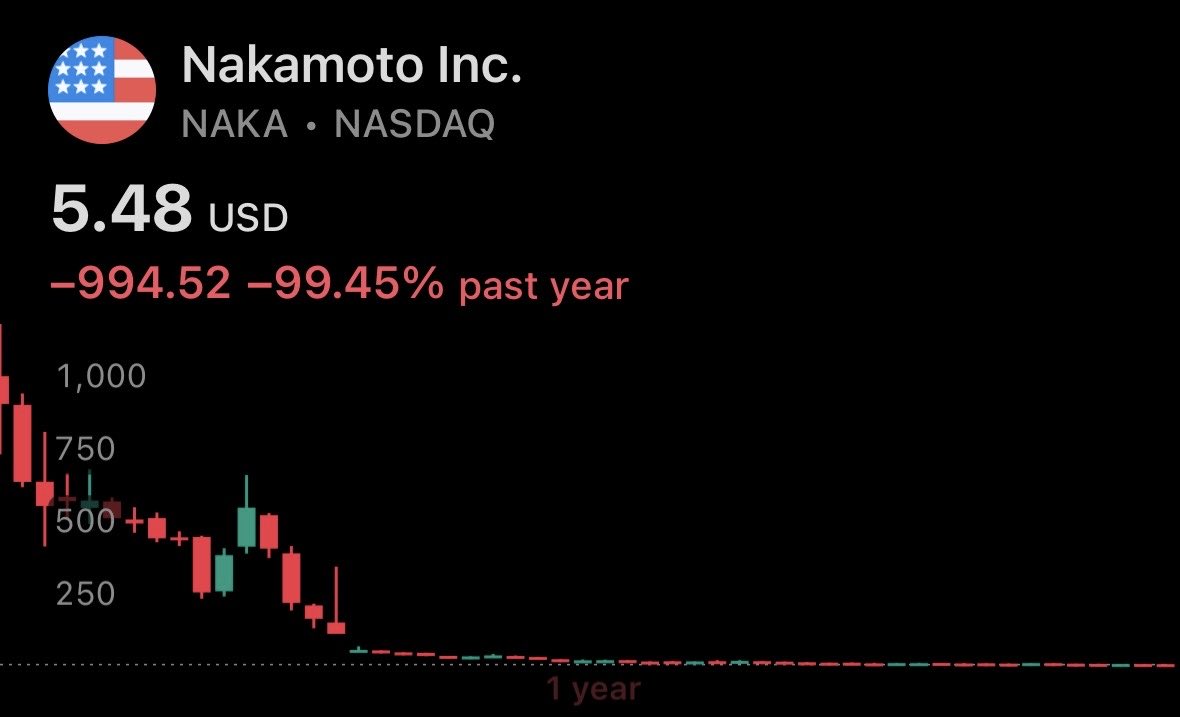
⚠️⚠️⚠️ Trading has been halted on $NAKA after plunging another 25% today. 💀
Justin Bechler #BIP-110 tweet media
English
83
46
550
80.2K
Bitcoin News
Bitcoin News@BitcoinNewsCom·
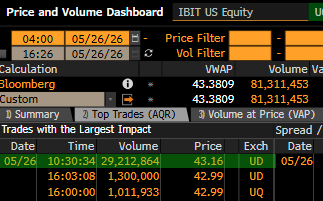
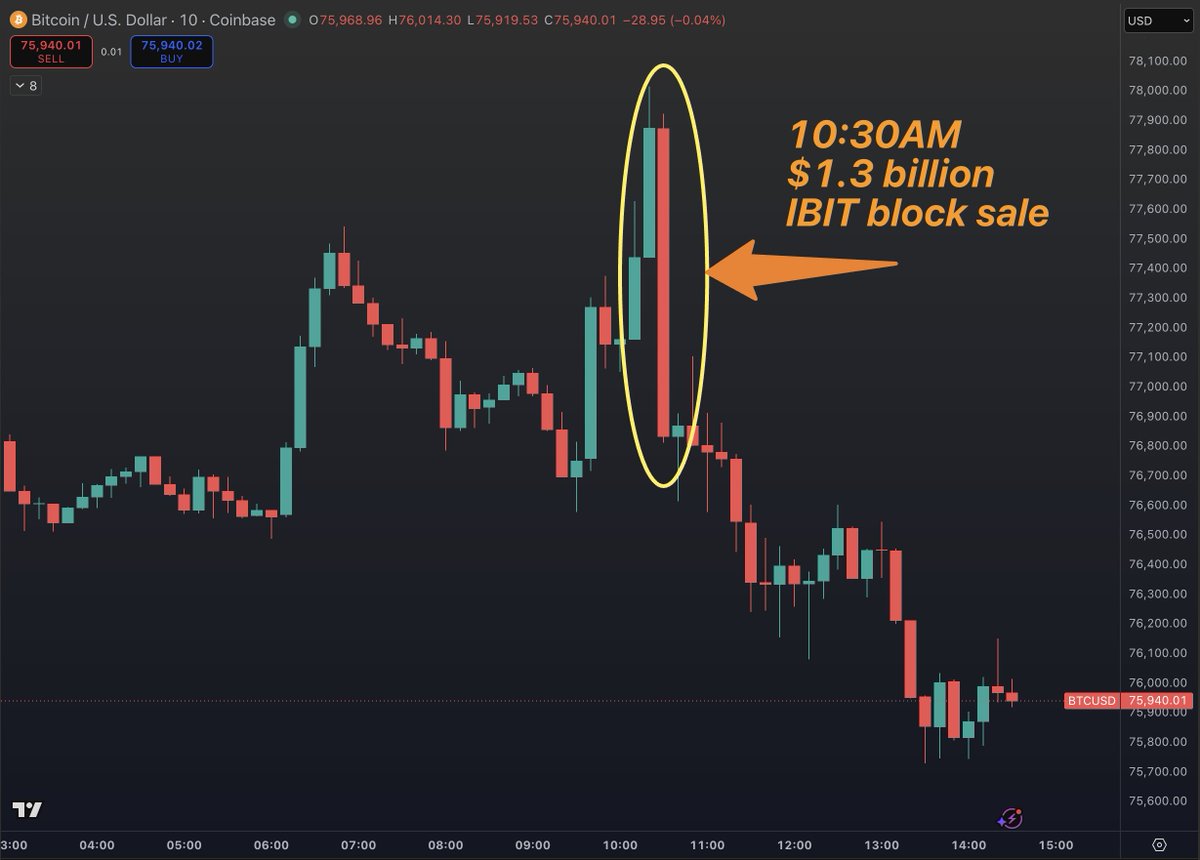
$1.3 BILLION IBIT DARK POOL DUMP SHAKES BITCOIN MARKET A massive $1.29 billion dark pool block trade hit BlackRock’s $IBIT this morning, marking what traders are calling one of the largest institutional Bitcoin ETF prints ever recorded. The trade reportedly crossed around 10:30am at roughly $43.16 per share, with the single candle exceeding IBIT’s average daily trading volume by itself. Traders say the block sale coincided with sharp downside pressure on Bitcoin’s price action. Dark pool tracking accounts noted the transaction dwarfed prior IBIT institutional prints dating back to March 2024. Rumors are now circulating that the move could trigger the largest single-day Bitcoin ETF outflow on record if confirmed. At the same time, institutional options flow showed nearly $1 million flowing into December 2026 $45 IBIT call options, suggesting at least some large players remain bullish longer term despite today’s apparent liquidation.
Bitcoin News tweet media
English
61
73
519
335.5K
Danny Marques | Investing Informant retweetou
Osemka
Osemka@Osemka8·
Just a reminder: this $BTC channel was also viewed as a bear-flag in 2023
Osemka tweet media
English
23
34
385
42.7K
Danny Marques | Investing Informant
Today is my 1 month wedding anniversary. My wife's company [bulge bracket Wall street bank] is forcing me to close my Robinhood $HOOD account as its not an approved broker Makes me very bullish on $HOOD long-term
English
3
1
30
4.1K
Danny Marques | Investing Informant
Recent adds to the portfolio over the last 1-2 months looking incredibly great and recently did some re-balancing: $RCAT $USAR $SMR $QS $RDW (sold out) $SEZL (sold out) $EOSE (sold out)
English
0
0
16
1.9K
Danny Marques | Investing Informant retweetou
Danny Marques | Investing Informant
Danny Marques | Investing Informant@Invst_Informant·
Might dip my toes in $USAR today....We're now in the buy zone of $17-20 Keep in mind this is a very volatile name
Danny Marques | Investing Informant@Invst_Informant

Company currently on my radar is $USAR As U.S.-China tensions persist, USAR's domestic production becomes indispensable for the long-term AI super-cycle. China dominates the rare earth ecosystem because it controls many parts of refining, separation, alloying, downstream industrial processing, etc. The West allowed that entire stack to consolidate inside China over decades because it was cheaper and environmentally easier politically. Scaled Western capability in samarium-cobalt refining and alloy production is extremely limited and samarium is especially important because samarium-cobalt magnets are used in fighter jets, missile systems, aerospace systems, and other high-performance military applications. Unlike some broader rare earth applications tied to consumer electronics, samarium-cobalt has outsized strategic defense relevance. This matters because when China tightened export controls and restrictions around critical rare earth materials and technologies, the market began realizing how little non-Chinese infrastructure actually exists. The US, Europe, Japan, and NATO-aligned countries are all now trying to build parallel supply chains that are not dependent on geopolitical rivals for mission-critical materials. Naturally, governments are increasingly willing to subsidize that process. Back in Jan 2026, $USAR signed a LOI with US Dept of Commerce for a $1.6B funding package ($277M in fed funding + $1.3B loan under the CHIPS Act). In exchange, US gov took an equity stake in the company...Look at what happened to $INTC On the technical front, what's constructive here is that the stock continues making higher lows off the broader trend support while defending that blue support zone around the high teens. It may want to consolidate a bit more after a failed breakout attempt but $17-20 is my area of accumulation You can see that waiting for OBV to lead and meet that trendline is also something to keep an eye on

English
0
1
22
10.3K
The Great Mattsby
The Great Mattsby@matthughes13·
People who think a 5-year consolidation for $ETH isn't healthy and is bearish are suffering from recency bias. They don't remember that $NFLX went through a very similar pattern from 2004–2009. Just look at the chart below—the similarities are quite impressive. Still bearish?
The Great Mattsby tweet media
English
48
35
378
45.3K
Danny Marques | Investing Informant
Latest prelim additions to the Russell 3000 CoreWeave $CRWV Galaxy Digital $GLXY IREN $IREN New Era Energy & Digital $NUAI Soluna Holdings $SLNH Bitmine Immersion $BMNR Every year, major equity indexes rebalance their constituents based on a defined set of eligibility requirements such as market cap, liquidity, float, listing history, and trading volume. The Russell indexes are among the most important benchmarks for US . small / mid-cap equities because they are widely tracked by passive funds, ETFs, institutional managers, and quant strategies. When a company is added to the Russell indexes, it effectively becomes part of a much larger institutional investable universe. Funds and ETFs that track or benchmark against these indexes are required to purchase shares in order to mirror the updated index composition. This creates a new source of structural demand for the stock that previously may not have existed. The impact is more about the long-term market structure effects that come with inclusion. Those can include: - Incremental passive ownership from ETFs and index funds - Increased daily liquidity and trading volume - Greater visibility among institutional investors and screening systems - Eligibility for additional quantitative and benchmark-driven strategies - Improved discoverability with small-cap portfolio managers and research platforms For smaller-cap companies in particular, these additions can matter disproportionately because even modest passive allocations can represent meaningful incremental demand relative to the company’s historical trading float and liquidity profile. That said, I wouldn't overestimate the immediate mechanical buying impact. Additions are generally well telegraphed ahead of the reconstitution, and much of the anticipated flow can be arbitraged or front-run by active traders before the official inclusion date. The actual passive demand varies significantly depending on the company’s final weighting, free float, liquidity profile, and which Russell indexes it enters. The broader takeaway is that index inclusion acts as a form of institutional validation. It does not fundamentally change the business overnight, but it can improve capital markets positioning and create a more durable shareholder base over time. What is becoming increasingly interesting is that many of the newer additions are infrastructure-oriented companies tied to AI compute, energy, digital assets, data centers, and next-gen financial infrastructure. That shift says something broader about where public market capital formation is beginning to concentrate.
English
0
2
22
2.7K
Sawyer Merritt
Sawyer Merritt@SawyerMerritt·
Ferrari has just officially unveiled its first ever all-electric car, called the Ferrari Luce. • Starting price: $640,000 • Interior co-designed with Apple's former head of design, Jony Ive • Range: 280 miles (expected EPA) • Peak charging speed: 350kW • 122 kWh battery • 1,050 horsepower • 0-60mph: 2.4s • 800v • Four-door four-seater • Four electric motors • OLED screens • Weight: 4,982 lbs • Front motors spin to 30,000 rpm, rears hit 25,500 rpm • Car uses an accelerometer to capture real vibrations from the electric motors & rear chassis. An algorithm filters out unpleasant frequencies and amplifies only the more “musical” sounds. This can be heard inside and outside the car. • Paddle shifter on steering wheel changes how aggressively torque is delivered, with five different levels • The trunk has 21.1 cubic feet of space, the largest luggage capacity the company has ever offered • 197.6 inches long, about as long as a Tesla Model S U.S. deliveries start in Q2 2027. More photos in the thread below:
Sawyer Merritt tweet mediaSawyer Merritt tweet mediaSawyer Merritt tweet mediaSawyer Merritt tweet media
English
6.8K
1.4K
11.3K
15.2M
Henrik Zeberg
Henrik Zeberg@HenrikZeberg·
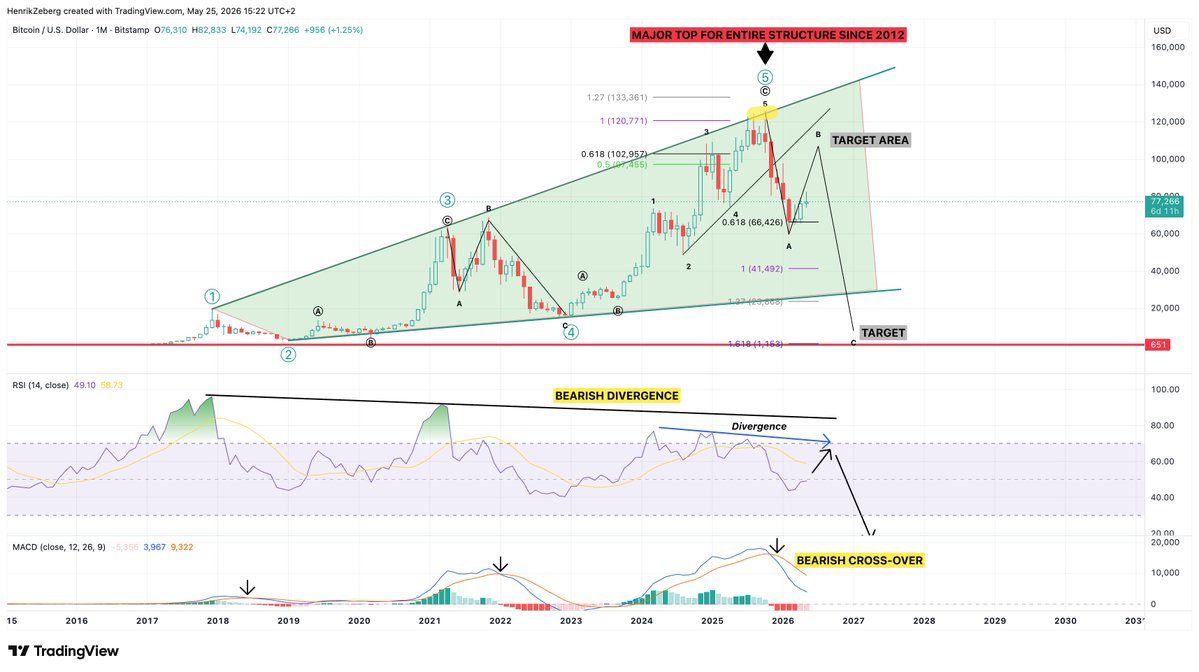
BTC Bounce = B-wave. Sentiment will be extremely Bullish! The Crash will be horrendous. Enjoy the Bounce! But get out in due time.
Henrik Zeberg tweet media
English
42
94
748
115.4K
TommyJR
TommyJR@tempocap2·
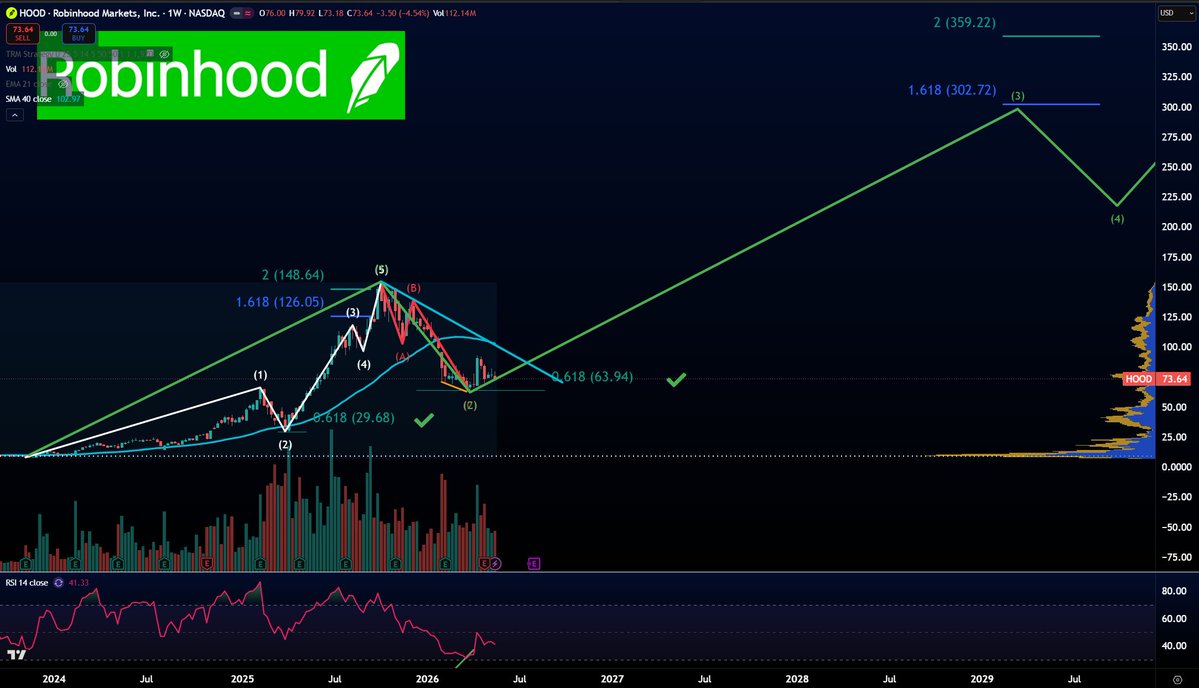
@Invst_Informant @matthughes13 $HOOD I think ABC is likely done however whilst it's under aqua suppression it will still consolidate further .. some chance of lower although the fib test was precise Once out obv won't be a straight line but there is a run to 300 to close out the decade
TommyJR tweet media
English
1
1
14
1.8K
The Great Mattsby
The Great Mattsby@matthughes13·
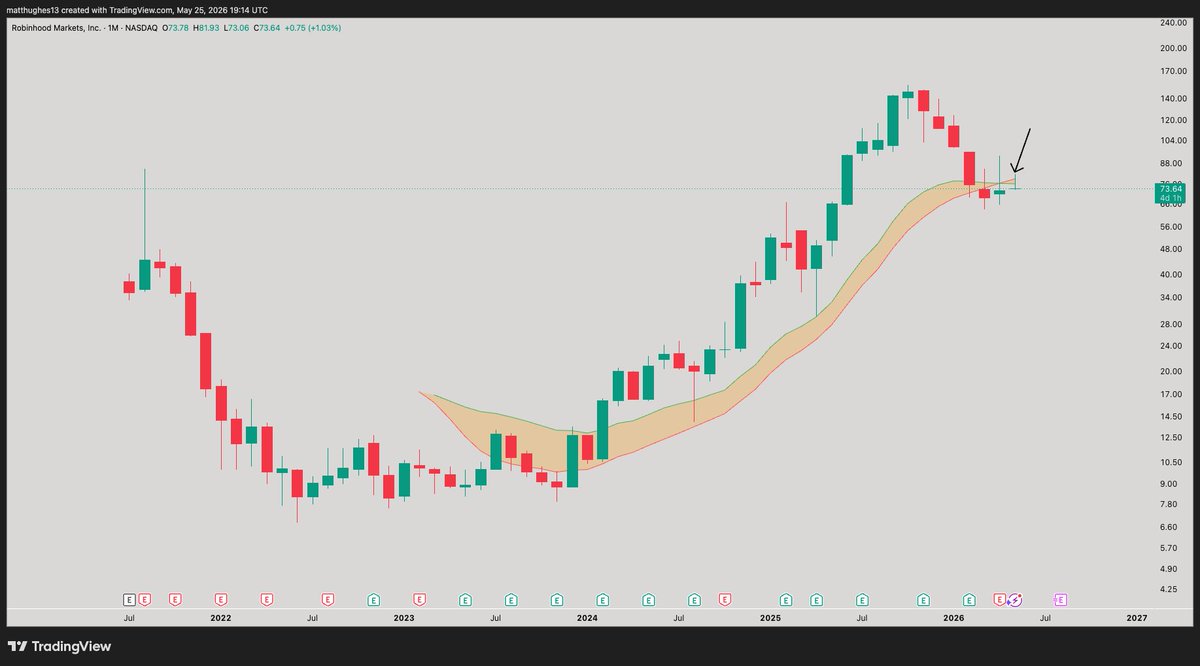
Is this a warning sign that $HOOD is flipping its monthly Bull Market Support band to resistance (21w EMA & 20w MA)?? Or is it just a normal deviation?
The Great Mattsby tweet media
English
16
5
99
12.6K
Danny Marques | Investing Informant
Understandably so there’s an extreme lack of interest in $HOOD right now 1) -50% correction from ATHs 2) Retail capitulated on Bitcoin + crypto 3) “already did a 10x” off the low 4) AI / semis / memory are the hotter themes But you’re looking at a future $200B+ company valued at $66B For context, Schwab $SCHW is $156B, Interactive Brokers $IBKR $138B That gap will close
Danny Marques | Investing Informant@Invst_Informant

I continue to think $HOOD is one of the most important consumer finance platforms being built for the next decade and the market still underestimates just how much behavioral and demographic change is working in its favor. People still mentally anchor the copmany HOOD to meme stocks, payment-for-order-flow controversy, and speculative retail behavior. Let them. But if you actually step back and look at what the company has quietly built over the last few years, it’s becoming increasingly obvious this is evolving into a full-spectrum financial operating system for younger investors. And honestly, the product velocity has been absurd. In a very short period of time they’ve: - scaled retirement accounts, launched credit products, expanded securities lending, - introduced futures, deepened crypto infrastructure, integrated prediction/event contracts, - rolled out global expansion initiatives and continued pulling in assets at a pace legacy brokers simply are not used to competing against The important thing is this isn’t happening because Robinhood is “cheaper.” It’s happening because they understand how the next generation wants to interact with money. Mobile-first, frictionless, integrated, real-time, and increasingly across multiple asset classes in one place. That’s why I think the long-term story here is much bigger than just a brokerage. $HOOD is not only a consumer financial super app, but a wealth platform, increasingly resembling a digital bank, and eventually a tokenized asset and global financial access layer. Especially if tokenization, stablecoins, and 24/7 markets continue evolving the way many expect. And technically, its a clean structure. You have: - a massive multi-year accumulation base, - a textbook cup-and-handle structure, - breakout + successful retest of the breakout, - and now consolidation above prior resistance After running aggressively near 1.272 fib, it’s now digesting the gains and holding structurally important levels (all healthy signs). If you zoom out, you see a stock that's spent years building a massive accumulation range while the market doubted the sustainability of the business, retail engagement, monetization durability, etc etc Meanwhile the company kept executing. The result is that the entire base built between 2021–2024 now serves as the foundation for a much larger secular move over time. Over a 5–10 year horizon, the projected target I have is ~$400 based on the 1.618 fib + projected move from the breakout of cup + handle. Robinhood is increasingly becoming the default financial interface for an entire generation that distrusts legacy financial institutions, prefers app-native experiences, wants access to multiple asset classes, increasingly participates in crypto, and expects markets to operate more like technology products than traditional brokerages. Legacy brokers still largely optimize around preserving incumbent relationships and older wealth demographics. HOOD optimizes around engagement, accessibility, speed, and financial participation. That’s a massive difference philosophically. And if capital markets continue evolving toward tokenized assets, 24/7 settlement, stablecoin rails, retail alternatives access, and globally accessible financial products, then Robinhood is arguably positioned closer to where the market is going than where it’s been. I think patience is probably required here near term. The stock had an enormous expansion phase and price likely needs to consolidate. All normal behavior after a large moves

English
4
4
34
5.1K
Danny Marques | Investing Informant
Overall I’m pretty comfortable with my exposure to BTC, alts + equity exposure across AI & crypto infra themes But little part of me feels like I’m still under allocated lol and i say this because of how confident i see some accounts talking about market top of the upcoming BTC low
English
1
0
5
714
Lourenço VS
Lourenço VS@lourenco_vs·
I would be second guessing me if I thought everyone was frothing with bullishness. But what I see here is a market still in deep fear, mostly sidelined or not interested, with bearish charts everywhere. Perfect, let me go for a nice relaxing sleep. Good things ahead.
English
4
2
100
3.5K