

Niran Babalola
2.8K posts



Now, execution layer changes. I've already talked about account abstraction, multidimensional gas, BALs, and ZK-EVMs.
I've also talked here about a short-term EVM upgrade that I think will be super-valuable: a vectorized math precompile (basically, do 32-bit or potentially 64-bit operations on lists of numbers at the same time; in principle this could accelerate many hashes, STARK validation, FHE, lattice-based quantum-resistane signatures, and more by 8-64x); think "the GPU for the EVM". firefly.social/post/x/2027405…
Today I'll focus on two big things: state tree changes, and VM changes. State tree changes are in this roadmap. VM changes (ie. EVM -> RISC-V or something better) are longer-term and are still more non-consensus, but I have high conviction that it will become "the obvious thing to do" once state tree changes and the long-term state roadmap (see ethresear.ch/t/hyper-scalin… ) are finished, so I'll make my case for it here.
What these two have in common is:
* They are the big bottlenecks that we have to address if we want efficient proving (tree + VM are like >80%)
* They're basically mandatory for various client-side proving use cases
* They are "deep" changes that many shrink away from, thinking that it is more "pragmatic" to be incrementalist
I'll make the case for both.
# Binary trees
The state tree change (worked on by @gballet and many others) is eips.ethereum.org/EIPS/eip-7864, switching from the current hexary keccak MPT to a binary tree based on a more efficient hash function.
This has the following benefits:
* 4x shorter Merkle branches (because binary is 32*log(n) and hexary is 512*log(n)/4), which makes client-side branch verification more viable. This makes Helios, PIR and more 4x cheaper by data bandwidth
* Proving efficiency. 3-4x comes from shorter Merkle branches. On top of that, the hash function change: either blake3 [perhaps 3x vs keccak] or a Poseidon variant [100x, but more security work to be done]
* Client-side proving: if you want ZK applications that compose with the ethereum state, instead of making their own tree like today, then the ethereum state tree needs to be prover-friendly.
* Cheaper access for adjacent slots: the binary tree design groups together storage slots into "pages" (eg. 64-256 slots, so 2-8 kB). This allows storage to get the same efficiency benefits as code in terms of loading and editing lots of it at a time, both in raw execution and in the prover. The block header and the first ~1-4 kB of code and storage live in the same page. Many dapps today already load a lot of data from the first few storage slots, so this could save them >10k gas per tx
* Reduced variance in access depth (loads from big contracts vs small contracts)
* Binary trees are simpler
* Opportunity to add any metadata bits we end up needing for state expiry
Zooming out a bit, binary trees are an "omnibus" that allows us to take all of our learnings from the past ten years about what makes a good state tree, and actually apply them.
# VM changes
See also: ethereum-magicians.org/t/long-term-l1…
One reason why the protocol gets uglier over time with more special cases is that people have a certain latent fear of "using the EVM". If a wallet feature, privacy protocol, or whatever else can be done without introducing this "big scary EVM thing", there's a noticeable sigh of relief. To me, this is very sad. Ethereum's whole point is its generality, and if the EVM is not good enough to actually meet the needs of that generality, then we should tackle the problem head-on, and make a better VM. This means:
* More efficient than EVM in raw execution, to the point where most precompiles become unnecessary
* More prover-efficient than EVM (today, provers are written in RISC-V, hence my proposal to just make the new VM be RISC-V)
* Client-side-prover friendly. You should be able to, client-side, make ZK-proofs about eg. what happens if your account gets called with a certain piece of data
* Maximum simplicity. A RISC-V interpreter is only a couple hundred lines of code, it's what a blockchain VM "should feel like"
This is still more speculative and non-consensus. Ethereum would certainly be *fine* if all we do is EVM + GPU. But a better VM can make Ethereum beautiful and great.
A possible deployment roadmap is:
1. NewVM (eg. RISC-V) only for precompiles: 80% of today's precompiles, plus many new ones, become blobs of NewVM code
2. Users get the ability to deploy NewVM contracts
3. EVM is retired and turns into a smart contract written in NewVM
EVM users experience full backwards compatibility except gas cost changes (which will be overshadowed by the next few years of scaling work). And we get a much more prover-efficient, simpler and cleaner protocol.
firefly.social/post/farcaster…
English
Crypto's original vision was radical: build a fairer economy from scratch. Speculation brought the energy and the capital, but the vision is still there, waiting for us to follow through.
English
Brands paid NBC $8M for 30 seconds of your attention. You got nothing. We need a new economy where we're the owners, not the product.
English
@danyalprout @_jxom Another way of thinking about it is that wallets should use fillTransaction/maxPriorityFeePerGas, but apps that generate outlier transactions should use meterPriorityFeePerGas before handing the transaction to the wallet to sign.
English
@danyalprout @_jxom Maybe! But perhaps most users should accept the standard maxPriorityFeePerGas instead of outbidding resource metering. If normal users need to win an auction, that's a bug to be fixed by repricing the resource. The metered fee auction is for users who know they're outliers.
English

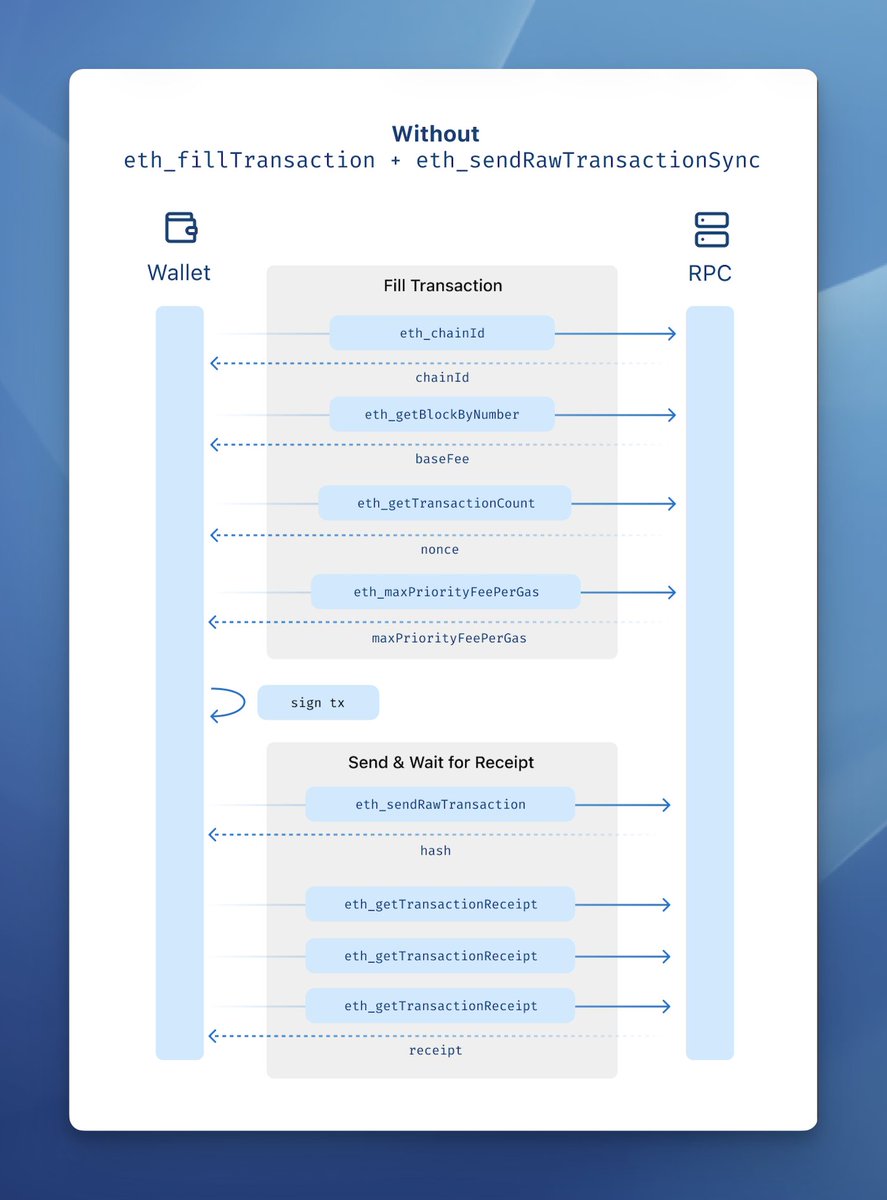
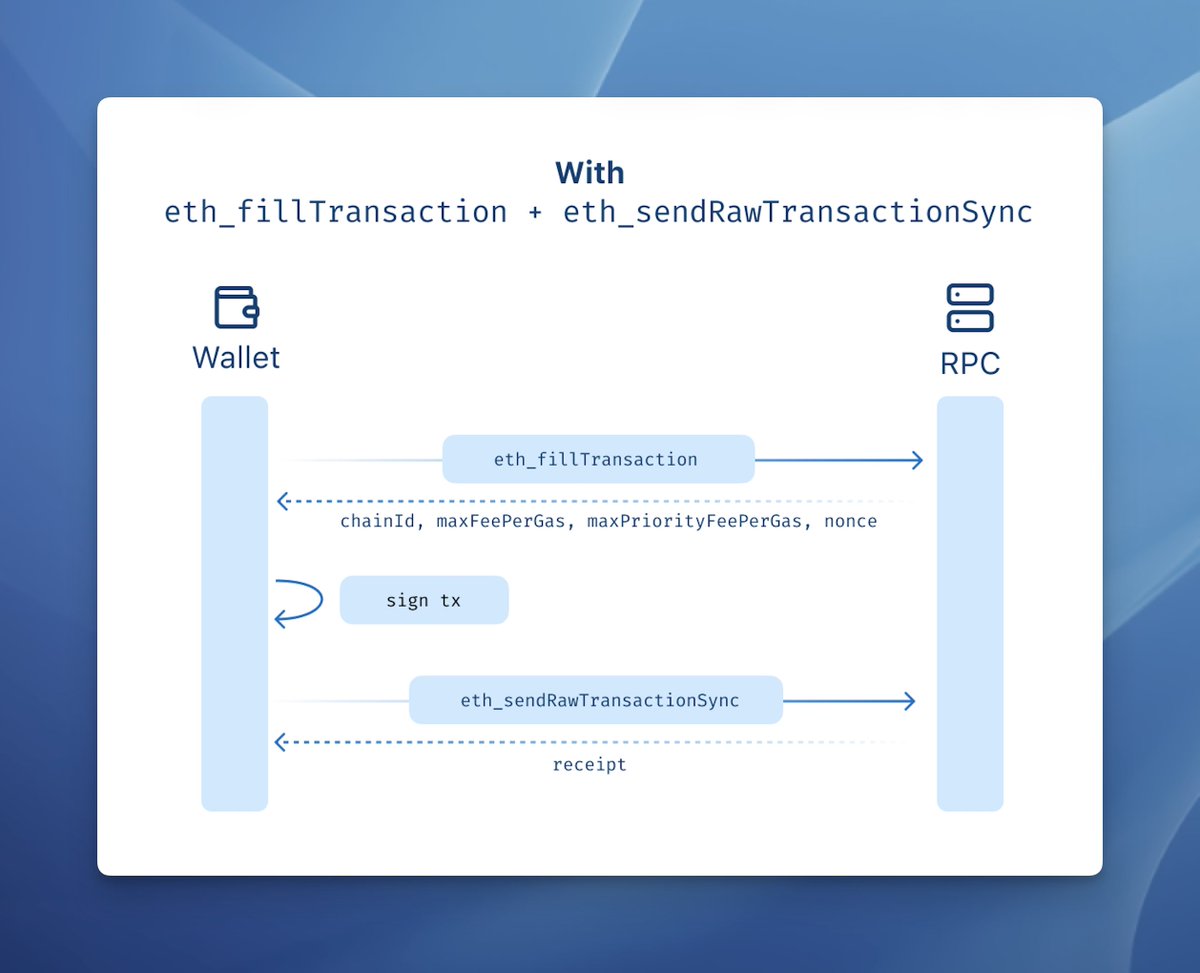
Viem 2.40 adds support for `eth_fillTransaction` (if supported by the execution node) for locally signed transactions (local accounts).
Combined with `eth_sendRawTransactionSync`, this decreases the amount of RPC calls to fulfil a transaction from 5+ to only 2.
jxom@_jxom
next version of viem will support synchronous transaction submission and return receipt (instead of hash) – including a fallback if the RPC handler does not support `eth_sendRawTxSync`/sync submission yet
English

@DennisonBertram @swyx I think the "todo list app" for agents is a family office
English

pretty sure that claude code sdk just destroyed every agent framework startup in existence lmao, holy shit look at this
Thariq@trq212
The Claude Code SDK now supports custom tools and hooks directly in code. Additionally, we’ve refreshed all our docs with complete references and 10 new guides on how to utilize the SDK.
English
@VitalikButerin @pbrody Another way of looking at it is that American Express just isn't ambitious enough. But if the same operating model were the basis of a "greedy institution," rents extracted by anyone else would be seen as a loss. Only I lose today when rents are extracted!
English
@VitalikButerin @pbrody Getting the best deal falls short of the full opportunity. I want a single rent-seeking intermediary for all purchases, and I should pay the rents instead of trying to avoid them. But I get to choose the intermediary who allocates those rents the best. A rent union, in effect.
English
@gfodor this is the console for running Genie 3 and its successor world models. and with high fidelity, camera-driven avatars that headsets can't match. the holodeck will be a handheld
English

I've been trying to crack handheld virtual reality.
I think I’ve finally got it. Introducing Portal. Portal lets you play unmodified VR content with just a tablet and a phone.
This early version of Portal aims to solve some big long-standing pain points for VR devs. A 🧵 👇
English
@Oxxbid trending/recommended accounts, not arbitrary coins. coins that aren't associated with creators make it harder to understand what the app actually is: a feed of people you believe in so much that you put money on it
English

question — if you were to choose what appears on the main page of TBA, what would you include?
– Mini apps
- Balance
– Trending coins
– Watchlist
– Something else…?
English
@WilsonCusack @jessepollak merchants with large affiliate marketing budgets so I can use their affiliate spend to burn my token
English

When and where do you most wish you could pay with crypto online, and why? :)
English
@balajis Is that actually true? Regardless of whether all this is a good idea, Vietnam could sell off foreign currency reserves to strengthen their currency, which would adjust the trade balance further. They could even do negative tariffs by subsidizing US imports until trade balances.
English

Uncle Sam cannot get a better deal from Vietnam than free.
Vietnamese women grind in factories to produce Nikes, while Uncle Sam sends them printed money in return.
Who is ripping off whom?
Chelsea Ngoc Minh Nguyen@C_NMNg
On social media, Vietnamese people and diplomats are reacting to Trump’s tariffs with great sadness and disappointment. This month marks the 50th anniversary since the wars in Vietnam, Cambodia, and Laos with the US ended. All three countries today were among those hit the most.
English
@koeppelmann I think the idea is to organize in ways that produce loyalty from economic self-interest. There's lots of prior art for this from plain old loyalty networks that we haven't really tried at all. Ethereum is a loyalty network for financial transactions, but with poor economics.
English

I miss the old Ethereum days, when we assumed everyone would act in their own self-interest, and we tried to build systems that allow coordination and cooperation anyhow. Now it’s flipped to: ‘L2s should contribute to ETH’s value because we all like each other so much.’
koeppelmann.eth 🦉💳@koeppelmann
Honestly, I am less interested in meme-campaigns. I am interested in how Ethereum can get to $50b in fees annually while balancing the interests of applications and L2s building on top.
English
@tzancafanbazatu @yishan @AskYatharth @GreeneElizabeth Instead of thinking of it as "capital," I think of it as promises. Everyone starts to lose faith in each other's promises, which makes everyone less willing to make investments that all have risks. So the economic machinery slows down, and in a way that reinforces the slowdown.
English

@yishan @AskYatharth @GreeneElizabeth But the confusing part is capital is the blood, yet capital is abstract and socially constructed.
English

what exactly.. happens in a depression?
the people still know how to make food, like they did two years ago. the wealth production infra stays same
what exactly goes scarce
English
@ameensol @VitalikButerin it's a good solution, and once we get good at implementing it, we can also apply it to the entire economy
English

chainlink god wins most reasonable take on Ethereum L1 vs L2 value accrual IMO
it is actually insane that @VitalikButerin's proposed solution was basically social pressure towards L2s to encourage them to remain ETH aligned

Zach Rynes | CLG@ChainLinkGod
@0xzak @ameensol It is not the responsibility of L2s to fix the L1’s value accrual problems Social layer pressure on L2s don’t work, the L1 itself needs to charge more in fees or offer new capabilities (e.g., native rollups) recapture value it has been forfeiting to date
English
Niran Babalola retweetou

Sharing @base team's view on the Fusaka hardfork.
blog.base.dev/achieving-more…
1. Lock current Fusaka scope to only include PeerDAS and EOF
2. Ship Fusaka as soon as PeerDAS is ready (ideally early Q3 2025), with as high blob number as testing allows
3. Ship Fusaka with built-in blob increase mechanism support, allowing future blob increases with minimal effort
4. Formalize hardware / bandwidth requirements to provide clarify for further scaling
5. Analyze the post-Fusaka mainnet network and increase the blob count further once network conditions allow. Aiming for ~50 blobs by EOY to achieve another 10X scaling this year
English