rich S

1.1K posts

rich S banner
rich S

rich S

@rscheipe

Sharing how I reversed pre-diabetes. Avoid alcohol, Avoid Sugar, Avoid processed carbs. Lots of protein, lots of veggies. Exercise! Keeping it simple - age 62.

Entrou em Şubat 2009
609 Seguindo248 Seguidores
Tweet fixado
rich S
rich S@rscheipe·
@stats_feed As much as possible - No Sugar, No processed carbs, No booze. Lots of lean protein, lots of veggies and lots of exercise. Keep it simple. It will pay off. You can cheat a little in your 30's but not too much. I'm 62 and have to keep it tight.
English

9
6
351
20.5K
rich S
rich S@rscheipe·
@hjluks yeah, it all(moslty) went away for me when I started lifting weights and switched to low impact cardio. I'd say 90ish% improvement. I'm 63 years old.
English
0
0
0
104
rich S
rich S@rscheipe·
@drterrysimpson I know. It's all the docs fault that I didn't take care of myself. Not my fault. If I took responsibility that might make me an adult....noooo....
English
0
0
0
40
Dr Terry Simpson
Dr Terry Simpson@drterrysimpson·
The idea that physicians “never told patients to curb sugar” is simply ahistorical. The American Diabetes Association has recommended limiting added sugars and refined carbohydrates for decades, along with weight loss, physical activity, and structured dietary patterns. Two of the most studied—Mediterranean-style diets and the DASH diet—have emphasized whole foods, reduced refined carbohydrates, and improved metabolic health for years. Low-carbohydrate diets are now one option in the ADA standards, but they are not the only evidence-based approach because multiple dietary patterns improve glycemic control and cardiovascular risk. And the fact that you didn’t read the literature does not mean it didn’t exist.
Bryan Krantz@bakrantz

@drterrysimpson You guys don’t get it. Where is your advice? The ADA took decades to come around to concept of low carb eating for diabetes management but it is not the first option clinically. It’s just medicate the hell out of patient never saying maybe curb the sugars.

English
19
20
114
4.3K
rich S
rich S@rscheipe·
@drwilliamwallac This just does not ring true with me personally. I sleep about 6 hours a night. I workout 90 minutes a day, 90%+ of my diet is low fat high protein, low sugar, carbs, veggies, fruit, etc. I feel great. I mediate everyday = and that is very refreshing. I'm 63 years old.
English
0
0
0
250
William A. Wallace, Ph.D.
William A. Wallace, Ph.D.@drwilliamwallac·
Controlled sleep restriction studies consistently show the same pattern: restrict healthy adults to 4-6 hours a night, and within a week, cortisol, glucose tolerance, insulin sensitivity, muscle protein synthesis, appetite hormones, and testosterone all move in the wrong direction. No single marker tells the story. The tax is cumulative. Leproult & Van Cauter, JAMA, 2011; Buxton et al., Diabetes, 2010; Spiegel et al., Lancet, 1999; Saner et al., J Physiol, 2020; Zuraikat et al., Diabetes Care, 2024
William A. Wallace, Ph.D. tweet media
English
24
216
926
228.6K
rich S
rich S@rscheipe·
@mcuban It's bigger than that. There are more disabilities than sight impairment. I'm sick of seeing dancing robots. How about a robot (or AI) that actual helps the people that need it the most. Not just the tech bros.
English
0
0
0
16
rich S
rich S@rscheipe·
Thanks for posting. But so what? I go almost every day for 90 mins, various exercises and intensity. I never think about living longer because of it. It just feels good during and after and I feel good and energetic most of the time. I'm 63, been doing this (or similar) since age 14. I just don't understand the longevity mindset.
English
2
0
4
2.8K
Ramez Naam
Ramez Naam@ramez·
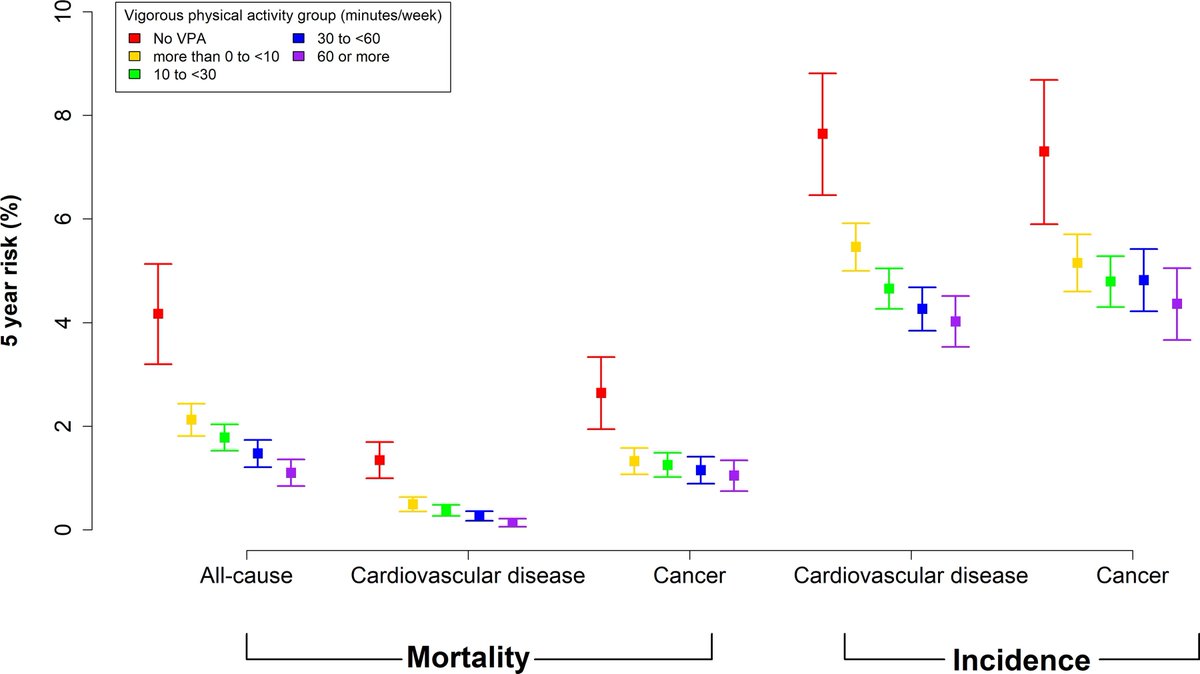
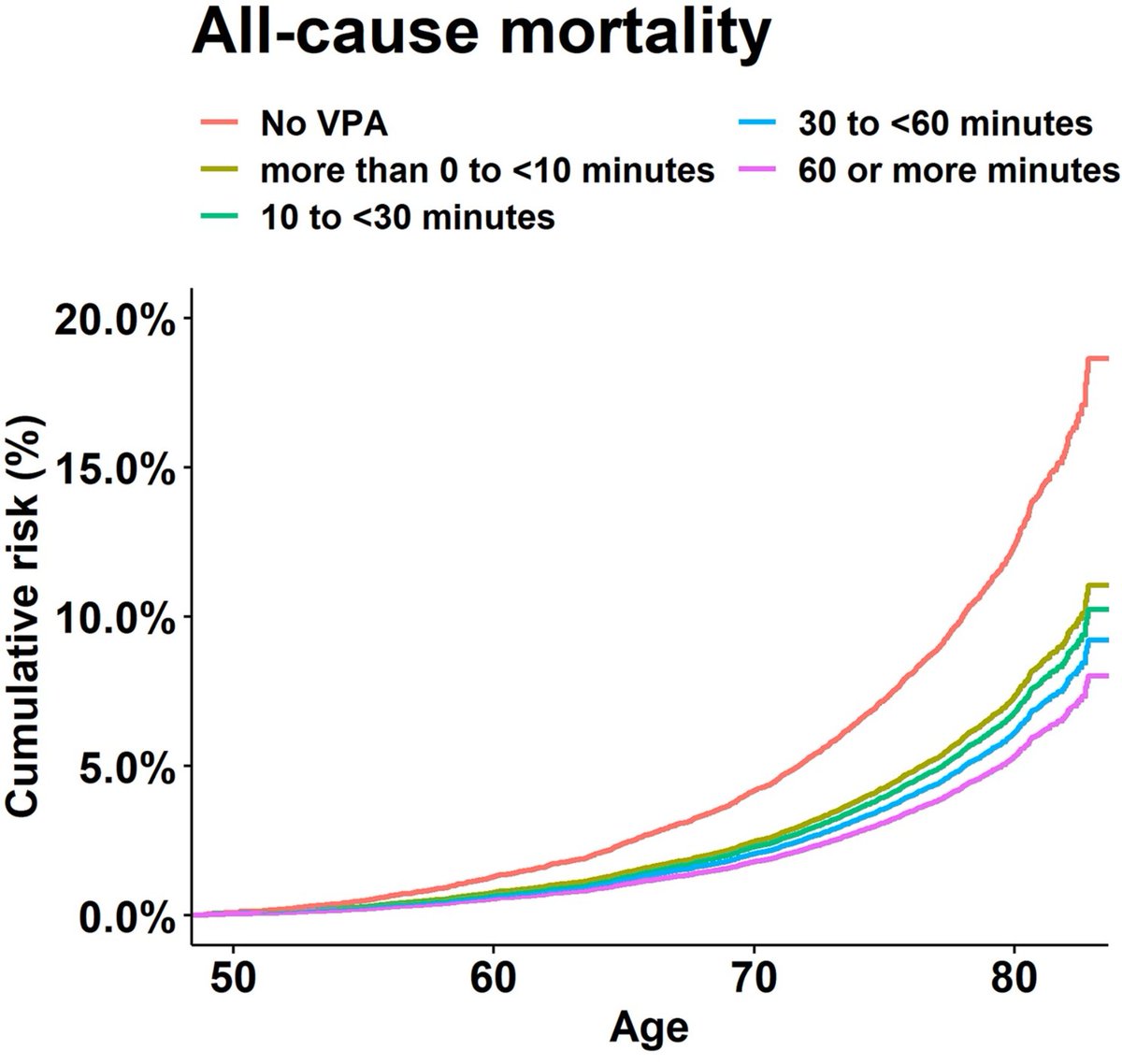
Small amounts of vigorous exercise provide the bulk of the benefits of all exercise. Exercise volume is really unimportant for fitness. This is true for cardio fitness, for mortality and longevity, and for strength. This particular paper shows that <10 minutes of vigorous exercise* per week (yellow) gets you more than half of all the longevity benefits of much longer periods. It's probably an even lower amount at higher intensity. * - Vigorous exercise here is defined as roughly 6 METs or above, which is jogging, moderate cycling, hiking, etc.. Sprinting is ~4x that intensity.
Ramez Naam tweet mediaRamez Naam tweet media
English
24
124
1.3K
258K
rich S
rich S@rscheipe·
That's a great story, with a good ending. You posted something the other day about squats are not bad for your knees, NOT doing squats is bad for your knees. Also a good one. I work out almost everyday, some days hard. I'm 63, I hear from friends, "At your age you shouldn't..." I stop listening at that point.
English
0
0
13
1.3K
Howard Luks MD
Howard Luks MD@hjluks·
The hardest conversation I have in my office isn't about surgery. It's about time. A 58-year-old sat across from me with knee pain. She’s otherwise healthy, but menopause has been rough on her. Her MRI shows some cartilage changes — age-appropriate, and a typical meniscus tear... basically, nothing that requires surgery. But she hasn't done any physical work in 15 years. She stopped playing tennis at 43. Stopped walking regularly at 50. Now the knee hurts when she climbs stairs. The knee isn't the problem. The knee is just the messenger. What has really happened is fifteen years of progressive capacity loss. Muscle mass has declined while tendon capacity has dropped. Her metabolic health shifted, and menopause has contributed to these changes. The knee was affected secondarily. The knee doesn't require my attention... that needs to be directed elsewhere. I can't give her those fifteen years back, but I can help her start from where she is. And starting from where she is still works. An 85-year-old can still synthesize new muscle protein after a single resistance-training session. The window of opportunity does narrow with age, but it never closes. Recovery takes longer. The risk of injury is likely higher. Progress is slower. But the biology of adaptation doesn't abandon you at 58, or 68, or 78. What changes is the cost of waiting. Every year of inactivity makes the starting point harder and the ceiling lower. The leverage you have at 40 is real and significant — and it's greater than the leverage you'll have at 60. That's not a reason for despair... It's a reason to start, wherever you find yourself now. 3 months later, after a solid strength/power program, she's walking daily with her weighted vest and is back on the tennis court.
English
35
77
732
100K
rich S
rich S@rscheipe·
This is an interesting post and I think about this often. I'm 63. Been exercising regularly since age 14. Do I feel better than my less active/sedentary friends/relatives? I feel great, no meds. By the numbers I'm probably 35-40ish. But it IS really about feeling good each day. Are WE better off in that respect? How can one tell?
English
0
0
4
1.3K
William A. Wallace, Ph.D.
William A. Wallace, Ph.D.@drwilliamwallac·
427 people. Same fitness at 16. Measured again at 23, 30, 37, 44, 51, and 63. By the end, the most and least active weren't even on the same chart anymore. Everyone's aerobic capacity peaks somewhere in their late 20s to mid-30s. After that, everyone declines. Slowly at first, then sharply after 50. That part is inevitable. What isn't inevitable is where you end up. The spread between the most and least active by 63 was enormous, and it wasn't explained by where they started. Here's the part that matters if you feel like you missed the window: people who were inactive early but became active later didn't just slow their decline. They reached their personal peak fitness later than the always-active group. If you weren't training at 25, your body can still be improving at 45. The caveat matters though. Your late-arriving peak will almost certainly be lower than it would have been if you'd built that base earlier. The ceiling is shaped by what you did in your 20s and 30s. But a lower peak you actually reach beats a theoretical one you never did. The fan in this chart isn't genetics. It's decades of accumulated decisions about movement, and those decisions compound in both directions. Westerstahl M, et al. J Cachexia Sarcopenia Muscle. 2025;16(6):e70134.
William A. Wallace, Ph.D. tweet media
English
13
84
629
47.5K
rich S
rich S@rscheipe·
@hjluks Where/how does a persons tolerance and acceptance of some pain/discomfort come into it for docs when working with patients/people? I accept/expect some pain/discomfort and move through and with it. It seems most I know want pain-free. I'm 63, been exercising most days since 14.
English
1
0
0
552
Howard Luks MD
Howard Luks MD@hjluks·
Here is the foundation of a message I have been repeating for decades: you are not broken. Aging tissues adapt and remodel. They accumulate structural changes that look dramatic on a screen or report but often function remarkably well in real life. When we frame every structural variation as pathology, we risk overdiagnosis and overtreatment. When we instead recognize that many imaging findings are common, or age-related phenomena, we can shift the focus back to capacity, strength, load tolerance, and resilience. open.substack.com/pub/howardluks…
English
7
21
186
24.8K
rich S
rich S@rscheipe·
@CoachDanGo Been doing that for years. Not a big deal.
English
0
0
0
456
Dan Go
Dan Go@CoachDanGo·
I’m doing an experiment: The next 30 days I’m taking 6 tablespoons of psyllium husk split into 3 servings/day. Will report back on what happens.
English
187
6
778
203.2K
rich S
rich S@rscheipe·
Good read. I'm 63 and started running when I was 14. About 55,000 total miles. I laughed out loud at this line because it was the story of my running years (and the reason I do low impact now and forever...). "Many runners' injuries are training errors."
English
0
0
2
1.9K
Howard Luks MD
Howard Luks MD@hjluks·
Yesterday, I said that if a new runner’s heart rate shoots above 150 within the first few seconds of starting, they probably shouldn’t be running. When someone who hasn’t trained consistently begins jogging, and their heart rate rapidly climbs into the 150s and stays there, that effort is not aerobic base work. It’s high-intensity work relative to their current conditioning. It may not feel “hard” in the way sprinting feels hard, but physiologically, it is well above the zone where foundational adaptations occur. True aerobic base development happens below the first lactate threshold. That’s where mitochondrial density improves, capillary networks expand, and fat oxidation becomes more efficient. That’s also where oxidative stress is manageable, and the recovery cost is low enough to repeat the effort frequently. If heart rate is immediately elevated, the body is operating in a more glycolytic state. Oxidative stress increases. Sympathetic tone rises. Recovery burden goes up. That may still improve fitness, but it’s not base building. It’s stress accumulation. There’s another layer that matters even more in midlife adults: the speed of tissue adaptation. This is my office hours every week. Many runners' injuries are training errors. The cardiovascular system adapts relatively quickly. Tendons, fascia, cartilage, and bone adapt slowly. When you combine high metabolic stress with repetitive impact load before tissues are prepared, the mismatch shows up as plantar fasciitis, Achilles pain, knee irritation, hip tendinopathy, or stress reactions. Most new runners don’t quit because they lack motivation. They quit because something starts to hurt. Brisk walking, incline walking, rucking, cycling, or structured walk-run intervals allow aerobic adaptations to occur with a lower oxidative and mechanical burden. As aerobic efficiency improves, heart rate at a given pace drops. As tissues strengthen, impact tolerance increases.... Then running becomes sustainable. Running is a phenomenal tool. But durability comes first. Base comes first. The ability to recover comes first. And yes... sprinting is fine. High HR is fine... don't come at me about this ;-). But... as @Alan_Couzens and @feelthebyrn1 and @inaki_delaparra and others will also tell you... Your base training is foundational. Take the time to build it and maintain it.
English
84
147
2.1K
529.1K
rich S
rich S@rscheipe·
@morganlinton Yeah, I've done a Hybrid Medical RAG. Ingest all your medical records locally and send anonymized queries to cloud LLMs. Then tune the prompts - It's an M.D. or a wellness practitioner or a combination of both.
English
0
0
0
33
Morgan
Morgan@morganlinton·
But here’s the sober reality. Local models are still behind frontier cloud models in reasoning and breadth. Smaller context, weaker long-chain logic, less world knowledge. That’s not ideology — that’s benchmark data. The magic isn’t “replace GPT-5.” The magic is: specialize. Use local models for: – Code completion – Embedding + search – Fast drafts – Structured extraction – On-device agents Use cloud models for: – Heavy reasoning – Multi-step planning – Large research synthesis Hybrid is the pragmatic strategy.
English
4
1
23
8.1K
Morgan
Morgan@morganlinton·
I’ve had a lot of people ask me about running models locally lately. So here’s essentially what I keep sending to all my friends, and thought why not share with all of you. And you honestly don’t need to know anything about how LLMs work under-the-hood to follow this. A running LLMs locally thread 🧵
English
22
37
581
93.5K
rich S
rich S@rscheipe·
@Brady_H The same can be said about many health related studies. The average American, eats poorly and gets little exercise.
English
0
0
1
3
Brady Holmer
Brady Holmer@Brady_H·
Most exercise/physical activity studies are flawed. Why? They’re comparing [X] level of activity to a *sedentary* control group. And sedentary isn’t normal. It’s pathological. So we’ve probably inflated the effects of “even low levels of activity.” Recreationally active should be the default to which higher levels of activity are compared.
English
15
11
119
11.8K
rich S
rich S@rscheipe·
@Brady_H wow. 63 years old. 50 mins of cardio and 20 mins of resistance 6-7 days a week. Should I cut it in 1/2?
English
1
0
2
363
Brady Holmer
Brady Holmer@Brady_H·
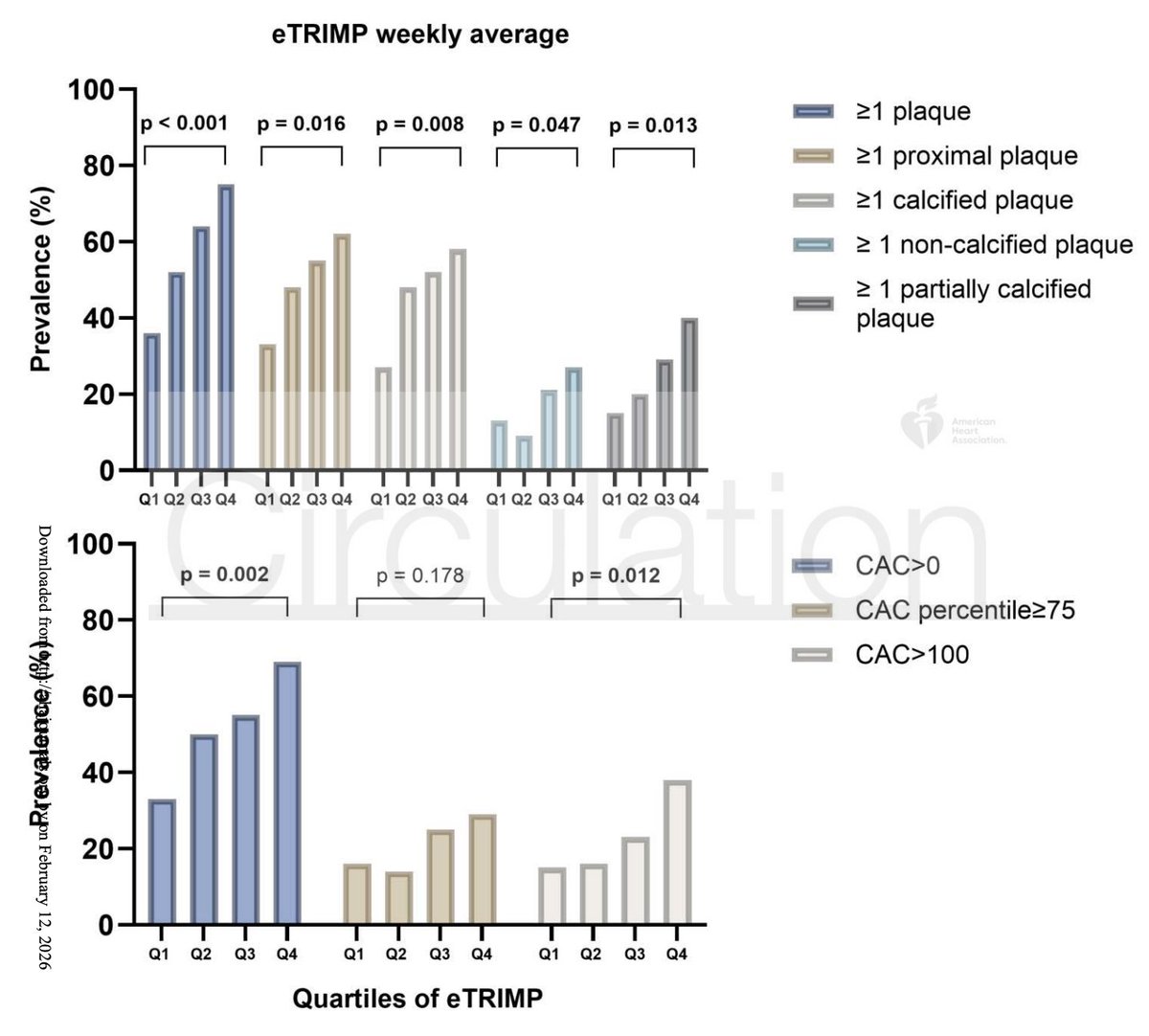
Higher objective training load = more coronary atherosclerosis in male master athletes. Highest training load (vs. lowest) had: 485% higher odds of ≥1 plaque, 403% higher odds of CAC > 0, and 250% greater odds of CAC > 100. Athletes with more training hours (9.2-26.5 hrs/wk) had higher plaque prevalence (70.9% vs 40.0%) and higher odds of plaque and calcified plaque features than low training volume (0.5-3.3 hrs/wk). No association of training intensity with plaque/CAC when separated from training load. New data from the Master@Heart study.
Brady Holmer tweet mediaBrady Holmer tweet media
English
28
18
163
24.9K
rich S
rich S@rscheipe·
@BradSchoenfeld I'm 63, been trying to figure this out since I was 14. My conclusion, moderate or higher cardio and simple strength tied for first, when that is a solid SOLID base, branch out.
English
0
0
1
133
Brad Schoenfeld, PhD
Brad Schoenfeld, PhD@BradSchoenfeld·
"Functional fitness" is an inherently flawed concept as commonly promoted. Simply getting stronger promotes greatest functional improvements, which can be obtained from a BB routine. Further benefits exist on a continuum c/w the principle of specificity. tandfonline.com/doi/full/10.10…
English
11
32
180
13.5K
rich S
rich S@rscheipe·
@hjluks I do 350 mins of medium to intense cardio a week. Also walk another probably 120 minutes - I don't usually count it but ok. Add on 20 mins x 6 days resistance training. So, all in, I guess I would be over the 500, but I have to be very careful to be able to keep this up.
English
1
0
0
30
Howard Luks MD
Howard Luks MD@hjluks·
@rscheipe I don’t agree;-). It’s all relative and depends on what you’re doing. If a meaningful part of that 500 min is walking, easy cycling, jogging etc where does the harm come from? Assuming you’re trained to handle that
English
1
0
1
100
rich S
rich S@rscheipe·
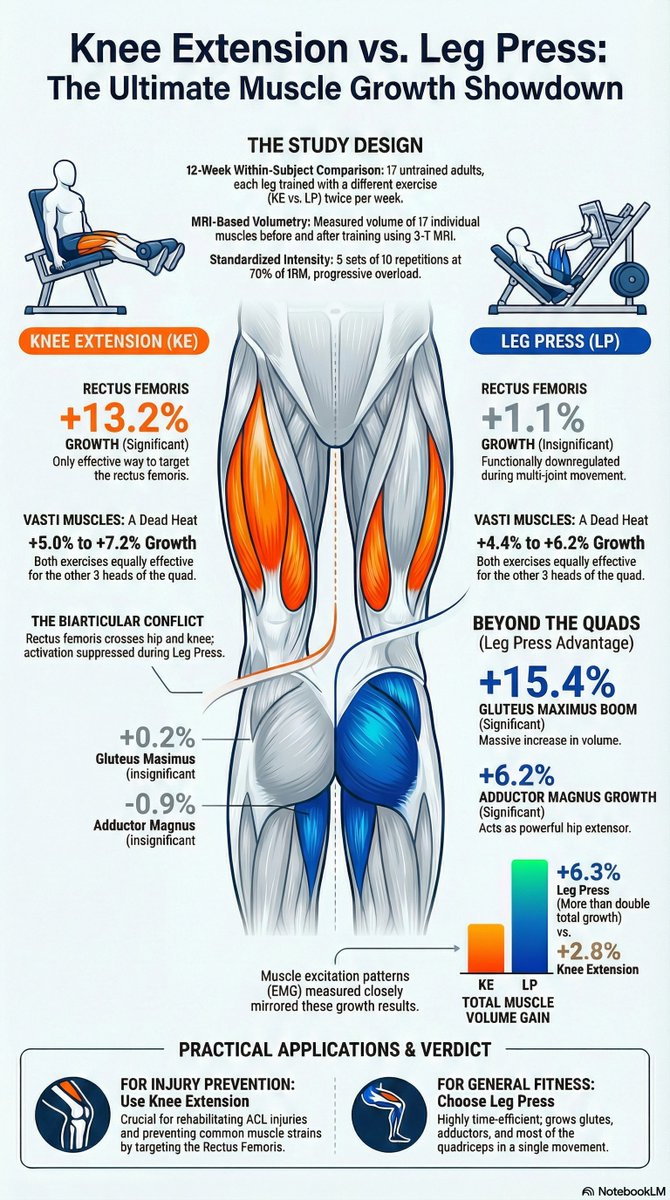
@PhysioMeScience this is really good. Would love to see the same type for upper body as well. Thank you for posting!
English
0
0
0
52
Physio Meets Science
Physio Meets Science@PhysioMeScience·
𝗛𝘆𝗽𝗲𝗿𝘁𝗿𝗼𝗽𝗵𝗶𝗰 𝗘𝗳𝗳𝗲𝗰𝘁𝘀 𝗼𝗳 𝗦𝗶𝗻𝗴𝗹𝗲- 𝘃𝗲𝗿𝘀𝘂𝘀 𝗠𝘂𝗹𝘁𝗶-𝗝𝗼𝗶𝗻𝘁 𝗘𝘅𝗲𝗿𝗰𝗶𝘀𝗲: 𝗔 𝗗𝗶𝗿𝗲𝗰𝘁 𝗖𝗼𝗺𝗽𝗮𝗿𝗶𝘀𝗼𝗻 𝗕𝗲𝘁𝘄𝗲𝗲𝗻 𝗞𝗻𝗲𝗲 𝗘𝘅𝘁𝗲𝗻𝘀𝗶𝗼𝗻 𝗮𝗻𝗱 𝗟𝗲𝗴 𝗣𝗿𝗲𝘀𝘀 pubmed.ncbi.nlm.nih.gov/41630124/
Physio Meets Science tweet media
English
4
108
477
21.1K
rich S
rich S@rscheipe·
@hjluks wow. 500 mins is tough. I do 50 everyday. x 7 days... wow... 500 might break me. Especially mentally, but also physically. Age 63 been doing this (mostly) since I was 14. wow, got me thinking...
English
0
0
0
60
rich S
rich S@rscheipe·
Using Claude as my 'programmer' I built an Air Gapped Medical RAG AI system. Indexed my wife's 30 years of cancer treatment and side effects history with a local LLM and now use it for ideas to help her heal. Due to system resource issues, added an option to send queries to the API w/ anonymized patient information. Really cool. It tells me much of what we already know (but some new), but we have been studying this information for decades and it figures things out in minutes. There are opportunities, no doubt.
English
0
0
0
162
Sahil Bloom
Sahil Bloom@SahilBloom·
@KenSchnetz Literally the easiest thing in the world right now. Reply to this tweet that you'll do this with some proof of capability.
English
9
0
51
13.2K
Sahil Bloom
Sahil Bloom@SahilBloom·
There's an opportunity right now to build a $100k per month side hustle as an AI Concierge. And you don't even have to be *that* technical to do it. Just high agency. There are probably millions of people out there who see all of the latest AI innovations like Claude Cowork, want to take advantage of them, but have no idea how to actually do that. I know, because I'm one of those people... I had dinner last night with the CEO of a multi-billion dollar tech startup. He was telling me about the full digital assistant/employee he just hacked together over the weekend. All of the things it's doing, how it's been an unlock for his workflows and life. I told him I'd gladly pay him $5000 to come to my house and spend the day building me one using the same approach. He laughed that he'd happily do that (though obviously won't given his day job). There's a real, high cash flow opportunity for a hustler to launch a services business as an AI Concierge for the tech curious. Ideally they would physically show up and build out a tool (or suite) to help an individual leverage the latest for their business and life. I bet you could charge $5-10k for the initial upfront work and then some low ongoing service fee to keep the thing up to date (if the person wants that and needs help with it). 5-10 clients per month and you have a meaningful cash flow engine. All comes down to the quality of what you deliver long term, but my guess is people would see a Month 1 positive ROI on the investment and referrals to their friends would drive the entire business. Just a thought...
English
351
190
3.8K
742.9K