MMD
7.1K posts

MMD
@ChadMMD
Financial Markets and Politics.
Ireland Присоединился Ocak 2021
2.6K Подписки411 Подписчики

% of people who think their culture is superior to others :
🇬🇷 Greece — 89%
🇹🇷 Turkey — 85%
🇦🇿 Azerbaijan — 85%
🇬🇪 Georgia — 84%
🇦🇲 Armenia — 84%
🇷🇺 Russia — 69%
🇦🇱 Albania — 69%
🇭🇷 Croatia — 69%
🇷🇸 Serbia — 68%
🇲🇪 Montenegro — 68%
🇷🇴 Romania — 66%
🇨🇾 Cyprus — 66%
🇧🇦 Bosnia and Herzegovina — 65%
🇧🇬 Bulgaria — 65%
🇲🇰 North Macedonia — 65%
🇳🇴 Norway — 58%
🇵🇱 Poland — 55%
🇨🇿 Czechia — 55%
🇦🇹 Austria — 50%
🇨🇭 Switzerland — 50%
🇲🇩 Moldova — 50%
🇫🇮 Finland — 49%
🇮🇹 Italy — 47%
🇵🇹 Portugal — 47%
🇲🇹 Malta — 47%
🇬🇧 UK — 46%
🇸🇮 Slovenia — 46%
🇩🇪 Germany — 45%
🇭🇺 Hungary — 44%
🇸🇰 Slovakia — 44%
🇩🇰 Denmark — 44%
🇮🇪 Ireland — 42%
🇧🇾 Belarus — 42%
🇺🇦 Ukraine — 41%
🇫🇷 France — 36%
🇳🇱 Netherlands — 31%
🇧🇪 Belgium — 31%
🇱🇺 Luxembourg — 31%
🇱🇹 Lithuania — 37%
🇱🇻 Latvia — 28%
🇸🇪 Sweden — 26%
🇪🇪 Estonia — 23%
🇪🇸 Spain — 20%
Source: Mapistics
English
@ChifoiCristian where is the 2026 bitcoin and stock bear market? I think it's time for slowly start accpeting that next don't put too much emphasis on "time" in your analysis. Next is SPX 8000 by 2027.
English

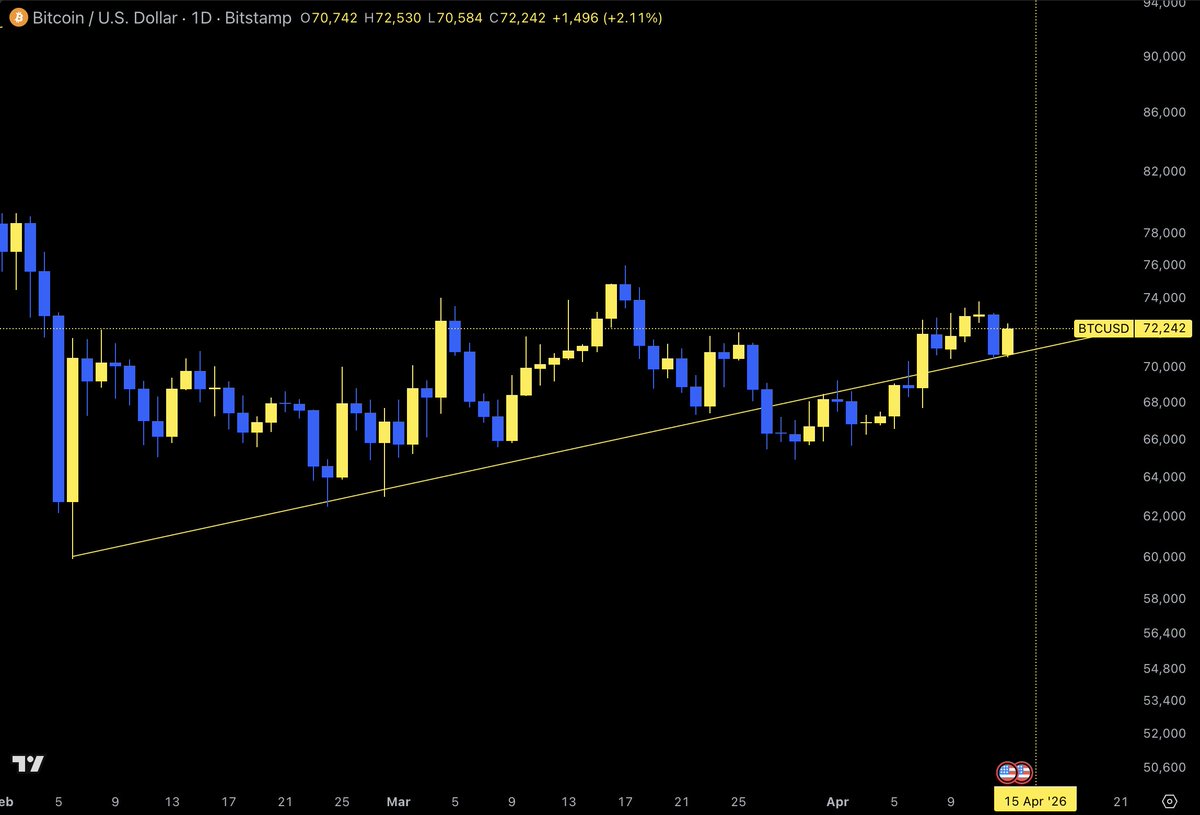
Great perspective, make it an average of 3T, we are looking at $600k in the next 5 years.
MartyParty@martypartymusic
$2-4 trillion of Stable Coin will be issued on chain by 2030 based on estimates from several large institutions. Bitcoin is $68k at $308b of Stable Coin. Current ratio: Bitcoin price / stablecoin market cap = $68,000 / $308 billion ≈ $0.0002208 per dollar of stablecoin (or equivalently, ~$4,529 of stablecoin supply per $1 of Bitcoin price). • If this ratio holds constant (i.e., Bitcoin captures a similar share of growing ecosystem liquidity), then future Bitcoin price = current price × (future stablecoin supply / current stablecoin supply). Using the $2–4 trillion range for 2030 stablecoin supply: • Growth multiple: $2T / $308B ≈ 6.49x $4T / $308B ≈ 12.99x • Implied Bitcoin price: • Low end ($2T stablecoins): $68,000 × 6.49 ≈ $441,000 • High end ($4T stablecoins): $68,000 × 12.99 ≈ $883,000
English
MMD ретвитнул
@ChifoiCristian Btc will not make new ath in q1 nor in q2.. q3 yes and no bear market in 2026...
English
I see a lot of retarded discussions about the 4 year cycle
If BTC does a new ATH into Q1 2026 and then rolls over to bear market lows in December 2026, is the 4y cycle still valid or nah?
Vote and share⤵️
English
@TradersMastery A raise in December is most likely the action from BOJ.
I remember you said recently that if BOJ raises, it changes the bull thesis significantly.
English

@ChadMMD I wouldn’t take the other side of that bet even if the BOJ is known for balking.
English
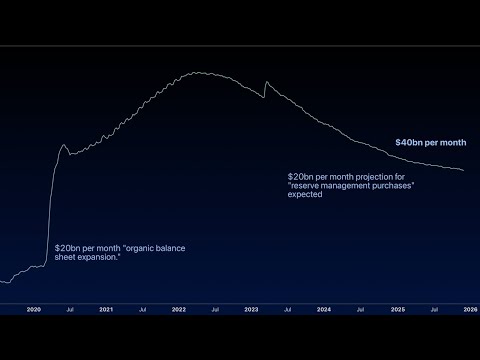
Highly recommend this one. Must watch.
The "Yen" Black Swan
youtube.com/live/bdGRz4aqd…
YouTube
English
@TradersMastery I think it was only Jordan who I know saying it can be upto 40B not just 20B. How Jordan does this? Please share the knowledge Sir!
English
My thoughts? Doesn’t matter what you call it.
It’s balance sheet expansion.
The new Fed cycle.
$40b monthly is higher than anticipated.
Risk should respond favorable as soon as liquidity stabilizes.
English
English
@Sonnysideup22 @AskCryptoWealth Fed expected to announce accommodations on Wednesday of $20b and as high as $45b monthly “reserve management purchases.”
Last Fed cycle Powell termed it “organic balance sheet expansion.”
It is accommodative and QE by another name.
English

@TradersMastery Jordan staying one step ahead as always... question is what part of Fed cycle does btc actually break the power law to the upside
English
Power law analysts beginning to release Bitcoin is actually going to break their models to the upside as $BTC is destined to grow exponentially out of the curve.
English
@TradersMastery I guess when the actual QE starts, the bear move comes. Before that in the anticipation of the QE, it's upside for risk?
English
QT officially ended yesterday, December 1.
The Fed’s projected $20 billion per month in reserve-management purchases aligns closely with its actions in 2019.
We’ve now entered a new phase of the Fed cycle, designed to extend the expansion for as long as possible before a return to outright QE.
During this part of the cycle, risk assets tend to outperform, with leadership typically beginning in Big Tech and then moving progressively down the risk curve.

English



They have no idea Japan just started running the printers and the rest of the world will follow.

English
@TradersMastery @PepeSimonsen Jordan if you check, IREN on 4Hr, it looks like Btc on 5D in 2021-22.

English
@PepeSimonsen This was a discretionary (not system trade) triggered long at $50.2
Stop loss @ $46.2
English

@OG_RogerTennis Question is how they are providing insurance cover upto 1mil? Does this also stand when the protocol gets fully hacked and can no longer function?
English

A brief rant on why Defi sucks!
Defi's primary adaption problem has long been UI. Ironically the industry running on superior rails than tradfi can't produce a simple UI that every-day people can actually use.
Defi is actually the worst user experience I have ever seen > ledgers, wallet extensions, dozens of gas tokens, bridges, chains, signing, approvals, non-stop hacks, phising, seed-phrases.
And 99% of protocols don't get it as they are probably focused on extracting VC-funds asap through their zero-value governance tokens. Many times it is a get rich quick scheme for non-serious people. So we see endless iterations of hot trends (CDP, CLP, perps, prediction markets etc...) instead of actual innovation that could help onboard, you know, the 99.9% of the population that will never use a Metamask and pay gas.
Aave App is the first Defi product I have ever seen that seems to actually bridge the gap.
Why?
- Trusted brand
- No Defi-crypto mentioned - no ledgers, no signing, no gas, no swapping, no Metamask
- Protection: $1mn deposit insurance
- Seemless on/off ramping from your bank account
It is that simple. Defi would be much more successful if protocols used blockchain as a seamless back-end, and built actual platforms that normal people can use.
That is why, I think tradfi/fintech is a huge threat to OG defi protocols that want to continue to build sandcastles in their little VC-sandboxes as opposed to build consumer-friendly apps, platforms that normal people outside of the 10,000 active users (sybill, bot, capital adjusted) we have in Defi can actually use.
Aave@aave
Introducing Aave App, a smarter way to save.
English
@TradersMastery Jordan you think bitcoin breaks powerlaw to the upside in the next 4-5 years?
English
Someone speaking my language.
This is it.
André Dragosch, PhD⚡@Andre_Dragosch
📌NOTE: #Bitcoin is a network and ultimately follows an s-curve exponential type of adoption. A power-law fit on Bitcoin’s past price implicitly assumes: •volatility drops •cycle peaks flatten •returns diminish •growth rate decreases But if a new acceleration occurs, you get: •higher-than-expected volatility •larger-than-modeled price expansion •faster network growth than historical trend •a vertical shift in the log–log regression This breaks the model in the same way that: •smartphones broke internet penetration predictions •broadband broke dial-up forecasts •mobile broke PC internet adoption curves The “outer forcing” of a new S-curve segment invalidates a single power-law fit. As @saylor used to say: „All your models will be destroyed.“
English
English
English