Last week I was on a “secret mission” in Egypt. I’d rather not get into that just yet—but honestly, I don’t even need to, because along the way I stumbled into so many fascinating oddities that just sharing those could keep me going for a year.
Take this, for example: about two years ago, @EgyptianPi drew my attention to the wall painting in the Tomb of Rekhmire, back when I was searching for that particular device that might have been used to etch granite surfaces in Aswan with molten natron.
The fresco itself is enormous—altogether around 100 square meters. This Rekhmire guy must have been something like a minister of industry, because the wall painting that documents his work includes everything from agriculture to jewelry-making to construction. On the right side of each multi-square-meter scene stands our hero, Rekhmire, depicted three times larger than the workers, overseeing whatever process is going on.
I’ve dealt with this painting before, because there’s a whole scene in the tomb illustration that’s officially labeled as metal casting—but it makes no sense at all. The metal is being melted on the floor, and even if it does melt (which isn’t impossible), you’d then have to scrape the molten copper up off the ground, which sounds like complete nonsense to me.
Anyway, I won’t dive deeper into that now—I devote an entire chapter to this “metal casting” in my book Natron Theory, so if you’re curious, you can check it out there.
What I want to show you now is another part of the painting.
Yes, I made it back to this tomb again—simply because the “secret location” I was heading to is accessible via Luxor, and, well, you’ve got the Valley of the Kings there, along with this other burial area where the tombs of nobles are located.
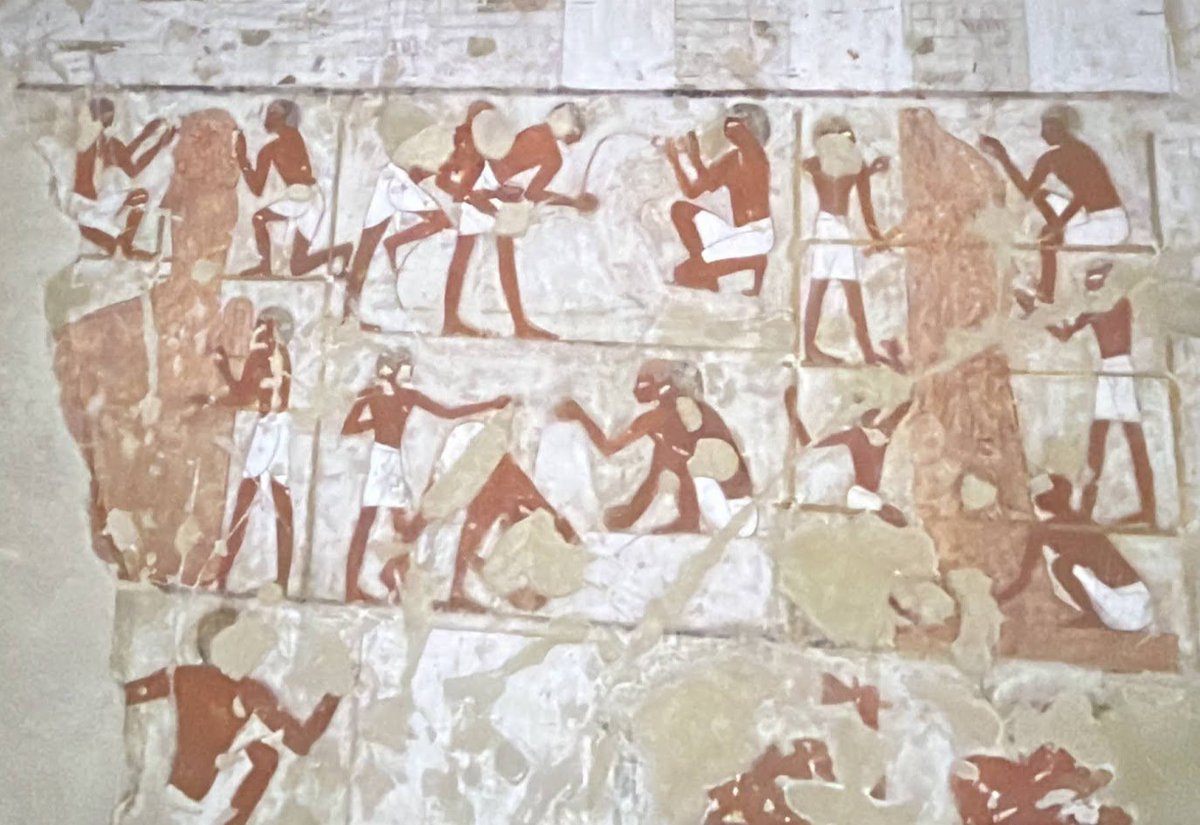
Now, among the many industries depicted, there’s something else I only noticed on this visit: statue-making. Or what.
The scene I’m talking about is located below and to the right of the construction scene, and although it’s in pretty rough shape, you can still make out that these little figures are working on statues.
Are they really making them?
Because if you look at the tools they’re using, you’ll notice something odd: not a single figure is holding a hammer or chisel. Instead, they’ve got what looks like some kind of sponge or dishcloth.
At this point, things start to get really interesting. It’s not like chisels are missing from the entire fresco—as if they hadn’t been invented yet or something. No, the chisels are missing only here… but why?
Could statue-washing have been some kind of major industrial activity in Rekhmire’s time? Obviously not.
Maybe it’s a religious ritual? BINGO! cries the indoctrinated archaeologist.
But there’s nothing like that anywhere else on this massive wall painting. It’s all about Rekhmire’s life, duties, and work. There’s entertainment too—music, dancing, the well-earned rest after labor—but I didn’t see any abstract ritualistic stuff anywhere.
Sure, you could say they’re polishing the statues. But then where’s the carving phase?
It’s strange enough on its own that statues seem to be made with dishcloths.
I’m not going to draw any grand conclusions here now. This piece of information is just one part of a puzzle that will come together someday. Just not yet.
For tens of thousands of years, Neanderthals roamed the cold, cloud-covered landscapes of Europe and western Asia, and at least some of them did so with fiery red hair and pale skin.
The discovery came in October 2007, when an international team of scientists published a landmark study in the journal Science, announcing they had successfully extracted and analyzed a pigmentation gene from the bones of two Neanderthals.
The scientists were led by Holger Römpler of Harvard University and the University of Leipzig, Carles Lalueza-Fox of the University of Barcelona, and Michael Hofreiter of the Max Planck Institute for Evolutionary Anthropology in Leipzig.
They extracted, amplified, and sequenced a pigmentation gene called MC1R from the bones of a 43,000-year-old Neanderthal from El Sidrón, Spain, and a 50,000-year-old individual from Monti Lessini, Italy.
The MC1R gene is the same gene that controls hair and skin color in all modern mammals, including humans.
The gene is responsible for producing a protein that helps regulate the balance between the red-and-yellow pigment pheomelanin and the black-and-brown eumelanin.
Modern people with relatively inactive MC1R receptors tend to have red hair and pale skin.
When the researchers analyzed the Neanderthal DNA, they found a variant that has never been observed in modern humans.
To figure out what this unique variant actually did, the scientists had to get creative.
They inserted the Neanderthal variant into human cells known as melanocytes, the cells that produce the pigment giving skin, hair, and eyes their color.
The team detected the exact same loss of function in the Neanderthal form of MC1R as is found in modern redheads that results in pheomelanin synthesis, providing strong evidence that the Neanderthals under study were indeed fire-haired.
Dr. Lalueza-Fox later described the find as like finding a needle in a genomic haystack, admitting he could not believe the results at first and asked his colleagues to repeat the experiment before accepting them.
The variant was ultimately confirmed in two separate Neanderthals across three different labs.
To rule out contamination from modern humans, the researchers took an additional step.
The scientists checked some 3,700 people, including those previously sequenced for the gene as well as everyone involved in the excavation and genetic analysis of the two Neanderthals, and none showed the mutation.
This confirmed the variant was entirely unique to Neanderthals and had not been accidentally introduced into the ancient samples.
Team member Michael Hofreiter of the Max Planck Institute noted that in modern humans, a variant with this low level of activity produces classically pale skin and red hair in individuals carrying two copies of the gene.
The researchers calculated that at least one in every hundred Neanderthals would have carried two copies of this variant.
The international team concluded that at least one percent of Neanderthals were likely redheads and that Neanderthal pigmentation may have been as varied as that of modern humans.
The evolutionary logic behind these traits makes considerable sense given where Neanderthals lived.
Anthropologist Nina Jablonski of Pennsylvania State University noted that the dark skin beneficial in Africa offers no advantage at high latitudes, and in cloudy Europe, pale skin facilitates vitamin D production, which would have been an evolutionary advantage.
Lighter skin increases absorption of the limited sunlight available, which is necessary for vitamin D production.
Perhaps the most striking scientific detail of the entire discovery was what the results revealed about the relationship between Neanderthals and modern humans.
The data suggest that Neanderthals and Homo sapiens followed different evolutionary paths to the same red-haired appearance, meaning each species developed this trait independently through separate mutations.
#archaeohistories
🚨 Breaking News: Mohenjo‑daro is far older than previously believed. Archaeologists have just announced.
This news feels less like a surprise and more like a confirmation.
From its indecipherable script to engineered water systems, Mohenjo‑daro has always behaved like a civilization with a longer history than the textbooks allowed.
A city like that, occupied from 2600–1900 BCE, doesn’t speak to a sudden emergence.
New dates pushing activity back toward 3300 BCE only confirm what the architecture has been telling us.
Things just keep getting older.
Ancient Egyptians are credited with building the Great Pyramid using copper tools. Copper is softer than the granite used in the King's Chamber.
You cannot cut a harder material with a softer one and achieve the precision found inside that structure.
Russia has one of the highest HIV, prostitution, divorce, alcoholism, substance abuse, and abortion rates in Europe, yet the MAGA crowd somehow deems it the last bastion of Christian values. Aren’t they cute?
To every MAGA who made Ukraine a scapegoat: congratulations, presumably all of your problems are now solved.
To so-called anti-imperialists who called this a ‘proxy war’: US has pulled all support and is aligned with Russian imperialism. As are you.
Most people don't realise the level of engineering they're looking at here.
These aren't just rough blocks stacked into place. Many of the stones are uniquely shaped, fitted without mortar, with joints tight enough that a razor blade won't fit between them.
Andesite sits at 6-7 on the Mohs hardness scale. Copper is 3. No one has ever replicated this precision with the tools we're told were used.
So how did the builders achieve it?
🚨 🇷🇺🇦🇷 BREAKING: Leaked documents reveal a major Russian disinformation operation against the Milei government.
Putin’s agents paid for hundreds of fake news articles in Argentine media to attack Milei’s reforms and his support for Ukraine.
@Cit_Reload Same, this timeline sucks but at least we got a huge big budget David Lynch scifi extravaganza like Dune. I just wish he'd been allowed to make his full 10 hour script in 2 or 3 epic movies
If you need inspiration: this man went from a failed, bankrupt businessman visiting Moscow in 1987 to a wildly successful Russian Asset dismantling NATO today! You got this.