Dominic Endicott

293 posts

Dominic Endicott banner
Dominic Endicott

Dominic Endicott

@KnowledgeTowns

ÜT: 42.657237,-70.618713 Присоединился Temmuz 2009
7.4K Подписки554 Подписчики
Dominic Endicott
Dominic Endicott@KnowledgeTowns·
@Curiousjorge65 @bhalligan @PropellerOcean I think PGH could and should be aiming for much higher growth. It is affordable and has top unis and has a frontier place vibe - like Austin 2010. It needs to create a compelling talent attraction strategy and parallel place and tech revolutions.
English
0
0
1
20
Miles Dieffenbach
Miles Dieffenbach@Curiousjorge65·
@bhalligan @PropellerOcean Discussions have been made like this for PGH as well. It’s tough, but good capital always finds best companies, regardless of location. In PGH, Duolingo (USV), Abridge (Bessemer/USV), Skild (Lightspeed/Sequoia) ect.
English
3
0
1
408
Brian Halligan
Brian Halligan@bhalligan·
I did a bunch of analysis of the AI 50 produced by Fortune this year (not perfect, but vaguely right). Of the 50 companies listed, 2 are Boston (actually Cambridge), Suno and OpenEvidence. OpenEvidence is headquartered in Miami. So, 1 out of 50 is actually in Greater Boston. Thank you @MikeyShulman! 17 of the 50 top ai companies have founders that went to school in Boston. The average age of those 17 founders was 28.5 years old when they started the company. We need to make Boston a great place to start a company. We need to make Boston an extremely attractive place for new grads to put down roots. There is a lot to like about Boston! A bunch of us are getting together on Wednesday night to talk about it. This is a problem worth solving. Lets continue discussing, debating, and engaging on how to improve the region. I'd like to see some of the elected officials who are DM'g me weigh in here.
Brian Halligan@bhalligan

I’m starting to worry about Massachusetts 1. Biotech is way off from a few years ago 2. Only 1 of the top 50 ai companies are in MA 3. The Fed research funding cuts hitting MIT, Harvard, Whoi are brutal. 4. The millionaires tax is working in the short run, but I know a lot of wealthy folks preparing for a FL move. 5. A glut of empty condos 6. It’s not “cool” for young folks 7. It’s expensive as sh-t. I honestly don’t think the MA/Boston govt can do that much about it as they are kind of macro issues. I give them big credit for working on building more housing and fixing the T, which will help. I’m trying to help w HubSpot, partnering w WHOI, teaching at MIT. I’d like to help more. Specifically I’d like to encourage and help more ai and climate companies in the state. I think ai and climate should be our dual growth engines.

English
77
14
268
97.7K
Dominic Endicott
Dominic Endicott@KnowledgeTowns·
@amandaorson Real estate follows productivity growth which will tend to be driven by tech company and SMEs that are both early adopters of AI - whereas large firms are so far lagging.
English
0
0
0
49
Amanda Orson
Amanda Orson@amandaorson·
Where are you actually putting capital in real estate if jobs disappear but rents can’t rise? Here’s the scenario I think plays out over the next 3–5 years: - Unemployment spikes esp in white collar service businesses, and white collar mid-career and entry-level roles (AI, offshoring macro trends) - Inflation stays elevated, esp in energy, food, housing - Real wages stagnate or fall & labor force participation drops This isn’t 2008. And it’s not the 1930s either, b/c during the Depression, at least prices collapsed. In this AI x inflation scenario, prices stay high while jobs vanish; stagflation with mass displacement. If you think this is even plausible, I’m curious how you’re thinking about the following: - Which real estate asset classes hold up when affordability collapses but shelter demand persists? - Which are structurally broken? - Do SF, LA, NYC permanently reprice lower; or does AI concentration increase the premium in certain hubs? - Which tenant profiles actually stay solvent through a prolonged downturn? - What are you avoiding, even if the yield looks attractive today? Not looking for “real estate always goes up” or generic long-term optimism. But I'd love to hear your specific asset class, specific market, and contrarian takes.
English
25
1
52
16.8K
Brian Halligan
Brian Halligan@bhalligan·
I’m starting to worry about Massachusetts 1. Biotech is way off from a few years ago 2. Only 1 of the top 50 ai companies are in MA 3. The Fed research funding cuts hitting MIT, Harvard, Whoi are brutal. 4. The millionaires tax is working in the short run, but I know a lot of wealthy folks preparing for a FL move. 5. A glut of empty condos 6. It’s not “cool” for young folks 7. It’s expensive as sh-t. I honestly don’t think the MA/Boston govt can do that much about it as they are kind of macro issues. I give them big credit for working on building more housing and fixing the T, which will help. I’m trying to help w HubSpot, partnering w WHOI, teaching at MIT. I’d like to help more. Specifically I’d like to encourage and help more ai and climate companies in the state. I think ai and climate should be our dual growth engines.
English
381
129
1.6K
876.3K
Dominic Endicott
Dominic Endicott@KnowledgeTowns·
@dbroockman Excellent work - this helps sharpen the approach to getting additional placemaking approved by better meeting the needs of the locals
English
0
0
0
8
David Broockman
David Broockman@dbroockman·
You can read the full paper here: osf.io/kz4m8 We look forward to hearing everyone's feedback!
English
6
2
35
3.3K
David Broockman
David Broockman@dbroockman·
NEW PAPER w/ @CSElmendorf & @j_kalla: An under-appreciated reason why voters oppose dense new housing, especially in less-dense neighborhoods: they think it looks ugly and want to prevent that, even in other neighborhoods. Some of what we think is NIMBYism might not be! 🧵
David Broockman tweet media
English
34
125
620
469.6K
American Affairs
American Affairs@AmericanAffrs·
Winter 2025 issue now online: -Antitrust and the rule of law -SBICs -H-1Bs -Solvency and security -The engineering state -A techno-nationalist elite -Nuclear energy -Nuclear weapons -Re-civilization -SF's revolt of the center -Race after liberalism & more americanaffairsjournal.org/issue/winter-2…
English
3
10
35
22.2K
Dominic Endicott
Dominic Endicott@KnowledgeTowns·
@bobbyfijan This is great (and disturbing analysis) showing how many key cities are ageing out and failing to provide a path for your families and children. We need to hear reverse course. This can not come incrementally but with a Big Bang approach.
English
0
0
1
96
Bobby Fijan
Bobby Fijan@bobbyfijan·
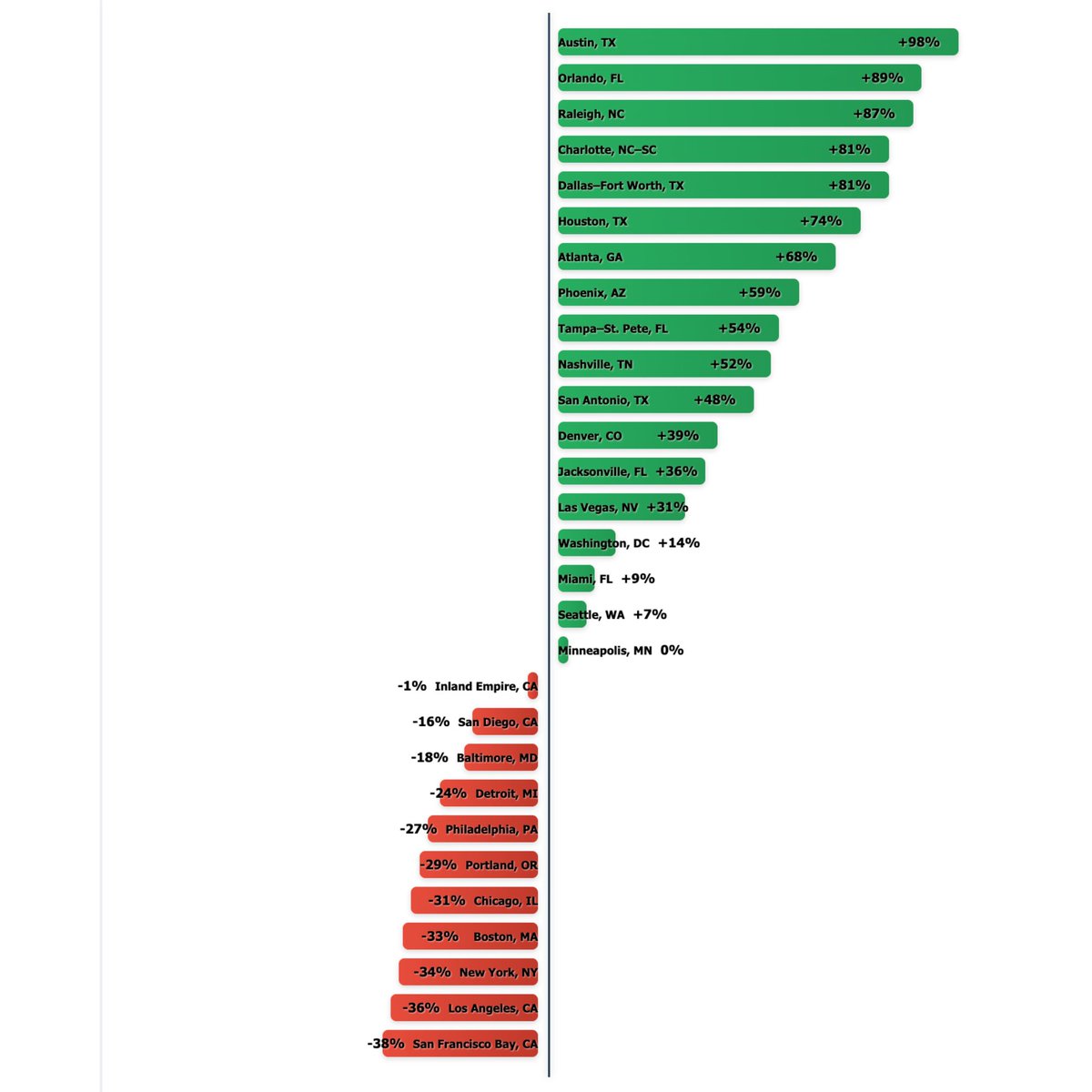
Look at the decline in population for young children (under age 5) in major cities from 2005 to 2024 This is catastrophic Austin +98% Orlando +89% Raleigh +87% Charlotte +81% Dallas +81% Chicago -31% Boston -33% New York - 34% LA -36% San Francisco -38%
Bobby Fijan tweet media
Jason Scharf@Jason_A_Scharf

They left off Austin 🤔 2005 the metro was 1.2M & by end of 2024 it’s 2.5M. The +1.3M jump puts us 6th in absolute growth, & the 104% increase would rank 1st in percentage growth by 10+ points. Stop sleeping on the frontier city.

English
862
768
4.7K
20.2M
Dominic Endicott
Dominic Endicott@KnowledgeTowns·
Knowledge Towns Harada - goal is to encourage 1,000 or more
English
1
0
1
89
Dominic Endicott
Dominic Endicott@KnowledgeTowns·
@garrytan I had developed a version of the Knowledge Towns framework as a way to encapsulate the key elements of a Micro Innovation District - am going to build a full version based on the Harada model which is more granular. The idea is to help places also achieve high purpose goals
Dominic Endicott tweet media
English
0
0
0
232
Garry Tan
Garry Tan@garrytan·
Stealing this idea for our next offsite You should do that too
Arpan Gupta@arpangup

When Shohei Ohtani was a high school freshman, he created a detailed "dream sheet" with one central goal: to be the #1 draft pick for 8 NPB (Nippon Professional Baseball) teams. It was a 64-cell roadmap based on a framework called the Harada Method. Here's exactly what Shohei did 👇 1. First, some history.... The Harada Method was created by Takashi Harada, a Japanese junior high track coach. He took a team ranked last out of 380 schools and, using his system, turned them into the #1 team in the region within 3 years. They held that top spot for the next 6 years. 2. You start by placing your main goal in the center of an 8x8 grid. For Ohtani, this was "be the #1 draft pick." 3. Next, you identify 8 critical supporting pillars needed to achieve that goal. These surround the main goal. Ohtani's 8 pillars were: • Body • Control • Sharpness • Speed • Pitch Variance • Personality • Karma/Luck • Mental Toughness 4. You then break down each of those 8 pillars into 8 smaller, actionable tasks or daily routines. This fills out the entire 64-cell grid, turning a massive dream into a concrete, daily action plan. To improve his karma, he listed tangible actions like: • Showing Respect to Umpires • Picking up trash • Being positive • Being someone people want to support 5. The method goes far deeper than just technical skills. It forces you to analyze your weaknesses and build confidence. It also has a highlight on service to others, emphasizing that humility and contributing to your community are essential for personal success. 6. The key to the system is daily execution and accountability. Once the 64-cell chart is complete, you turn the tasks and habits into a daily diary and a "Routine Check Sheet." It’s designed to transform abstract intentions into a measurable, daily practice.


English
52
200
4K
730.2K
liemandt
liemandt@jliemandt·
Calling all Boston families: A parent-led group is now assembling the 25 'founding families' needed to bring Alpha School to Boston. This is how it starts. (And as a lifelong Red Sox fan, I'm personally very excited to see it.) Learn more and join here: alphanorthboston.com
English
25
21
324
79K
Dominic Endicott
Dominic Endicott@KnowledgeTowns·
@abemurray @jliemandt Would like to work with anyone in MA to bring this - can bring some support from institutions with reach that can help scale
English
0
0
1
16
Dominic Endicott
Dominic Endicott@KnowledgeTowns·
@WillManidis We need a new status game that makes it super cool to reinvest back into the commons - kind of Carnegie 2.0
English
0
0
0
973
Will Manidis
Will Manidis@WillManidis·
over the next decade, trillions will be extracted from the markets by a new generation of technology industrialists yet not a single one of them will put those dollars back into the ground to preserve our collective human history like Rockefeller and many of his generation did
Will Manidis tweet mediaWill Manidis tweet mediaWill Manidis tweet media
Will Manidis@WillManidis

in 20 years, as a hobby, Rockefeller moved a medieval cloister from France to Manhattan and restored 400 buildings 1:1 at our nations first capitol in Williamsburg, VA. it is impossible to imagine our current elites turning this much ambition towards history today.

English
54
163
2.8K
202.1K
Dominic Endicott
Dominic Endicott@KnowledgeTowns·
@EricRWeinstein Reinvest 90% back into the Knowledge Commons = eg Carnegie used 90% of his $350B (in today’s $) into 2.5K libraries, plus universities and schools
English
0
0
0
32
Eric Weinstein
Eric Weinstein@EricRWeinstein·
Imagine you finally get all the power, control and wealth you dream of. You then buy all the stuff that you salivate over. Toys, homes, experiences. All of it. Okay. Tough Question: Now what? Seriously. After the party gets old: Now what?
English
12.9K
1.6K
21.3K
2.4M
Dominic Endicott
Dominic Endicott@KnowledgeTowns·
@pmarca The solution might be new $1 trillion+ markets with a hybrid model similar to Data Center. Several markets: - Reindustrialization of US: $3-5 trillion - Knowledge Towns (10m homes = $3 trillion) - Regenerative Ag for US carbon sink $500b
English
0
0
0
150
Wrath Of Gnon
Wrath Of Gnon@wrathofgnon·
What if we started building cities like we built university campuses, again? (photo: UChicago).
Wrath Of Gnon tweet media
English
20
75
850
23.1K
Dominic Endicott
Dominic Endicott@KnowledgeTowns·
@ProducerCities IMHO the term could be a Knowledge Town - including developing some form of higher Ed where it does not exist and upgrading a College-based town to be more resilient by building a surrounding ecosystem
English
0
0
1
32
Jim Russell
Jim Russell@ProducerCities·
"One thing I have noticed is the rise of what you might call 'the college town without a college' – the town that has walkability & attracts a college-type population even without a full-scale college" futureofwhere.substack.com/p/what-college…
Jim Russell tweet media
English
1
2
7
515
Dominic Endicott
Dominic Endicott@KnowledgeTowns·
@KTmBoyle Have you thought about a place-making revolution that could complement AD by attracting talent - this is the thesis of Knowledge Towns
English
0
0
1
31
Katherine Boyle
Katherine Boyle@KTmBoyle·
Flight delayed 2.5 hours ask me anything.
Katherine Boyle tweet media
English
79
1
279
36.8K
Dominic Endicott
Dominic Endicott@KnowledgeTowns·
@tunguz We wrote a book called “Knowledge Towns” with strategies for Town and Gown revitalization in response to these shifts
English
0
0
1
49
Bojan Tunguz
Bojan Tunguz@tunguz·
This could put many colleges, especially the smaller ones with very little to no endowment, in extreme jeopardy. I expect that hundreds of them will close this year. I expect they'll take those small college towns down with them. 5/5
English
6
2
62
3.7K
Bojan Tunguz
Bojan Tunguz@tunguz·
Over the years I've lived and worked in several small American college towns. The colleges in these towns are the source of employment for many people, source of revenue for many small businesses around, and the primary anchors of the relatively high property values. 1/5
English
4
4
107
14.2K