Закреплённый твит

ZXX
Touchy Funseeker
19.8K posts

@SupDenman
Not a serial killer

#BREAKING: An international panel of human rights experts has accused Canada of committing genocide against its Indigenous population. bit.ly/4wYMIrg

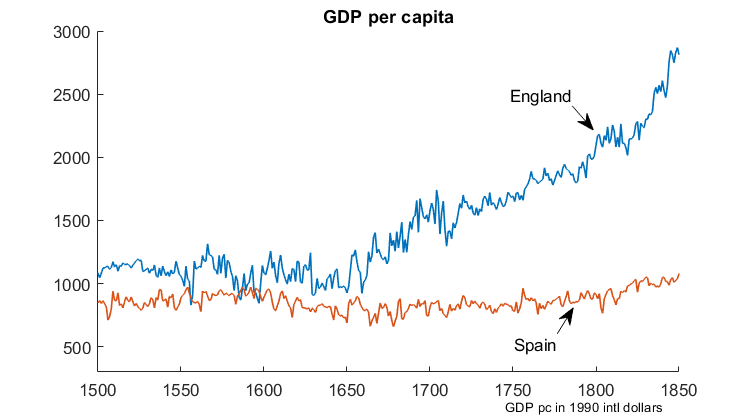
How has the Spanish economy performed over the very long run? To answer, I use Leandro Prados de la Escosura’s (@LdelaEscosura) data on real GDP per capita from 1277 to 2024. I express Spain’s figure as a ratio to Britain’s, since Britain was the first economy to achieve modern economic growth, from around 1660, and has been the leader, or close to it, ever since. Spain, within its present borders, was prosperous in the Late Middle Ages, well ahead of Britain, then a peripheral corner of Europe. The Black Death and its aftermath hit Spain harder, and by 1360, the two economies had converged. That parity held until 1600, when Spain began a long decline, in absolute terms (on the eve of the French Revolution, it was barely above its 1600 level, after a deep slump in between) and in relative terms (Britain pulled steadily away). The standard explanations, the Habsburg wars, and the serial bankruptcies run into one problem. They can account for the poor performance between 1550 and 1650, but not for the stagnation between 1650 and 1789. 140 years of stagnation is far more than wars and debt under the Habsburgs can explain. The series also shows that Spain did not benefit from its empire. That is a problem for every theory tying colonies to modern growth. At most, one can argue that colonies were a necessary condition for takeoff (I do not believe even that, but leave it for another day). One cannot argue that they were sufficient. The period from 1789 to 1936 was no kinder. The economy grew a little, and Spain built a modern but unfinished liberal state. Yet it never closed the distance to Britain. It is hard not to read the period from 1789 to 1936 as a national failure and the Civil War as its final consequence. The recent efforts of some historians to paint those years in brighter colors strike me as unfounded. Spain did not fail at modernization as badly as China, but it did not succeed. A deeply corrupt dynasty, closed and incompetent elites in Madrid, Barcelona, and Bilbao, and an economic policy built on intervention and protection (by 1920, Spain was the most protectionist economy in the Western world, so much for the friends of protection) together made the country a basket case. A cruel civil war left Spain at its historical low, with just 31% of the British GDP per capita. The foreign visitors who arrived in the early 1950s found a poor, backward country. Policy in the first twenty years of the dictatorship was awful. Autarky was not so much imposed by the Allies as chosen. Spain’s rulers, using their quasi-fascist Weltanschauung, believed growth would come from state intervention, closed markets, and unorthodox fiscal and monetary policy. Then, in 1959, policy changed. Spain adopted a more orthodox fiscal and monetary policy and opened to foreign investment and trade. The results were spectacular. For forty years, Spain grew briskly and became the modern country it is today. By 2001, it had reached 77% of British GDP per head. But the internal contradictions of two things eventually became binding: the growth model launched in 1959, and the political regime created by the 1978 constitution. By 2024, Spain had slipped back to 74% of British GDP per head. This is worse than it looks. Britain itself has done poorly over the past twenty years, and losing ground to a weak performer is a bad sign. Spain stands at a crossroads, economic and political. The country’s foundations no longer work, but its political and business elites have failed to understand this fundamental reality. A good grasp of its economic history helps make sense of its present predicament.


The Graham Platner story is landing because it confirms a bunch of his critics’ prior concerns: unvetted, history of poor decision-making, the kind of light misogyny that tends to go along with male bad decision-making. Those are all problems! But it’s worth asking if they’re problems that should be disqualifying for a senate seat and I think the answer to that is no.



We experienced an anomaly during today's hotfire test. All personnel have been accounted for. We will provide updates as we learn more.

One of the few declassified IDF drone videos from high altitude over Gaza. First 5-7 seconds: Watch Hamas rockets launching from right in the middle of civilian areas. The IDF then tracks the exact launch sites in real time and destroys them with precision strikes. This is the reality behind the “indiscriminate bombing” lie. Hamas hides among civilians, IDF targets the terrorists.



Ilana Glazer and I are both proud Jewish New Yorkers who believe unapologetically that our safety is inextricably bound up with that of our neighbors, including Palestinians. And that AIPAC and the candidates they support aren’t making any of us safer or freer.

I saw the film Palestine 36 last night, while in Beirut. It portrays how the British kept handing Palestinian land to Zionist settlers, and how indigenous rural Palestinians organised armed resistance to fight back. Two things. First, 'israel' clearly learned their brutal tactics for oppressing Palestinians from the British. Rounding up men, executing them, blowing up whole villages, setting fire to crops etc. etc. It is demonic that these same tactics are still being inflicted on Palestinians and Lebanese villages right now, and the world abandons them. Second, why can't we humanise Palestinian resistance fighters now? The film heroised the men who took up arms. It is a disgrace that so few are willing to stand up for, defend, or humanise the men who are taking up arms against the occupation now. Maybe they will make films about them in 100 years when there is nothing riding on it.
“No nazis. No oligarchs. No kings. Eat the rich.”

I saw the film Palestine 36 last night, while in Beirut. It portrays how the British kept handing Palestinian land to Zionist settlers, and how indigenous rural Palestinians organised armed resistance to fight back. Two things. First, 'israel' clearly learned their brutal tactics for oppressing Palestinians from the British. Rounding up men, executing them, blowing up whole villages, setting fire to crops etc. etc. It is demonic that these same tactics are still being inflicted on Palestinians and Lebanese villages right now, and the world abandons them. Second, why can't we humanise Palestinian resistance fighters now? The film heroised the men who took up arms. It is a disgrace that so few are willing to stand up for, defend, or humanise the men who are taking up arms against the occupation now. Maybe they will make films about them in 100 years when there is nothing riding on it.

BREAKING: Federal prosecutor leading the James Comey indictment over his seashells post resigns from the case. nbcnews.com/politics/justi…




Journalist: Did you see the evidence against Israel with your own eyes? UN: “No, that is not my job.” The rest is commentary.

Wemby was LOCKED IN for Game 6