Balakumar Sundaralingam
48 posts

Balakumar Sundaralingam
@balakumar_
Research @NVIDIA | CUDA + Robotics | Robot Manipulation


@maticrobots shipped its 10,000th robot this week. 🤖 Back in 2018, there was no product - just a small team, a lot of ideas, and an unreasonable amount of optimism. The photos below are from those early days: prototypes, experiments, customer interviews, design reviews, and plenty of things that never made it into the final product. We first started shipping in November 2024. Huge credit to the Engineering and Production teams that made the 10K bots happen! Great engineering gets you to the first unit. Great teams get you to the first 10,000! Still a lot more to be done. 🚀

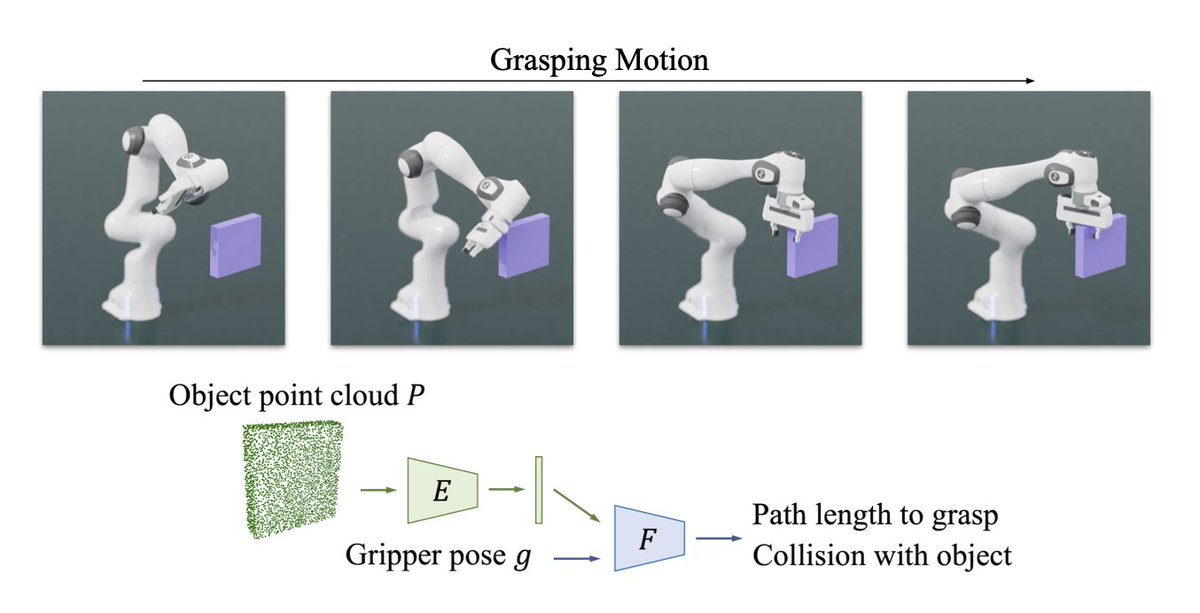
@NVIDIA is working on one of the hardest problems in Physical AI so you don’t have to: generalist robotic pick-and-place. We are excited to introduce GraspGenX at #CVPR2026—a foundation model for robotic grasping that works out of the box for unknown robots, novel objects, and unseen environments. Unlike Vision-Language-Action (VLA) models or dedicated grasp networks that require expensive, embodiment-specific training, GraspGenX is cross-embodiment and works zero-shot. You simply pass a "robot prompt" alongside an image of the object to generate actions. 🚀 Key Highlights: 1) Scaling: Trained on over 2 Billion 6-DoF grasp rollouts entirely in physics simulation—a dataset size practically impossible to collect via real-world teleoperation. 2) Zero-Shot Transfer: Works out of the box for several common robot grippers widely used across the research community and industry. 3) Built for the Agentic Era: Features native MCP support, client-server architecture, and skills.md, allowing seamless integration into LLM/Agentic robotics workflows. 4) Full Pipeline Integration: Pair it with other open foundation models (like SAM3) and advanced motion solvers like cuRoboV2 for full deployment in entirely unknown environments. If you are currently executing pick-and-place with a VLA or WAM, you can use GraspGenX to generate sim-verified trajectory data and inject it into your pipeline. No need to waste precious real-world engineering hours on data collection for standard manipulation tasks. 🌐Website: graspgenx.github.io 💻Code: github.com/NVlabs/GraspGe… 📄Paper: arxiv.org/abs/2606.00998 📍CVPR Booth: Poster 619 on Jun 6 1:45 session at ExHall F This work was led by the incredible @BeiningH (Princeton), in collaboration with a phenomenal team at NVIDIA: @erwincoumans, @yu_wei_chao, @balakumar_, @clembow, and Stan Birchfield #CVPR2026


What if we can simulate an *interactive 3D world*, from a single image, in the wild, in real time? Introducing PointWorld-1B: a large pre-trained 3D world model that predicts env dynamics given RGB-D capture and robot actions. 🌐 point-world.github.io from @Stanford @nvidia


Most capable generalist robotics models today are closed or at best, open weights. But robotics won’t reach its ChatGPT moment without real openness. That GPT moment was built on years of open tools and datasets such as Python, PyTorch, ImageNet and more, that let researchers inspect, reproduce, and build. Today, we’re introducing MolmoAct 2: a fully open-source action reasoning model for real-world robotics. We rethought and reshaped everything! 🧵👇

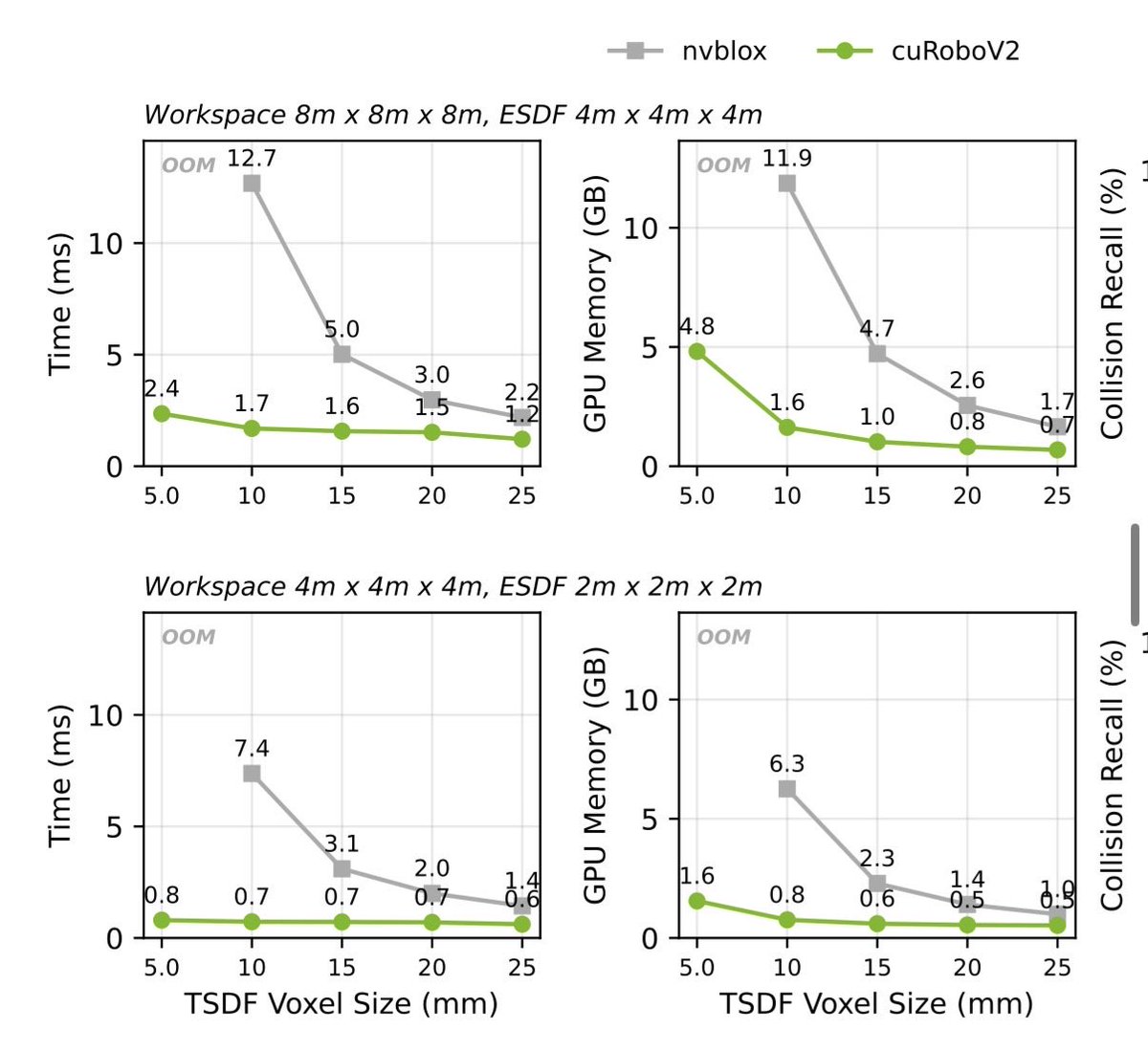
@pablovelagomez1 CuRoboV2 implements a TSDF mapper for manipulation (fixed workspace, 5mm voxels, multiple cameras). We designed it for performance (all ops on GPU) and memory efficiency (fp16). This leads to 10x faster rgbd->esdf while using 8x less memory (page 31).


Should legged robot use RL or trajectory optimization? #icra2024


🤖 cuRobo, a new #CUDA accelerated motion generation toolkit, can solve complex #robotics problems in milliseconds. ⚡ It includes implementations of kinematics, collision checking, numerical and trajectory optimization, and more. 👀 #NVIDIAResearch code nvda.ws/3MxDmNG