Igon Value

116 posts

Igon Value

Igon Value

@igon_value

Присоединился Mart 2022
43 Подписки4 Подписчики
Igon Value
Igon Value@igon_value·
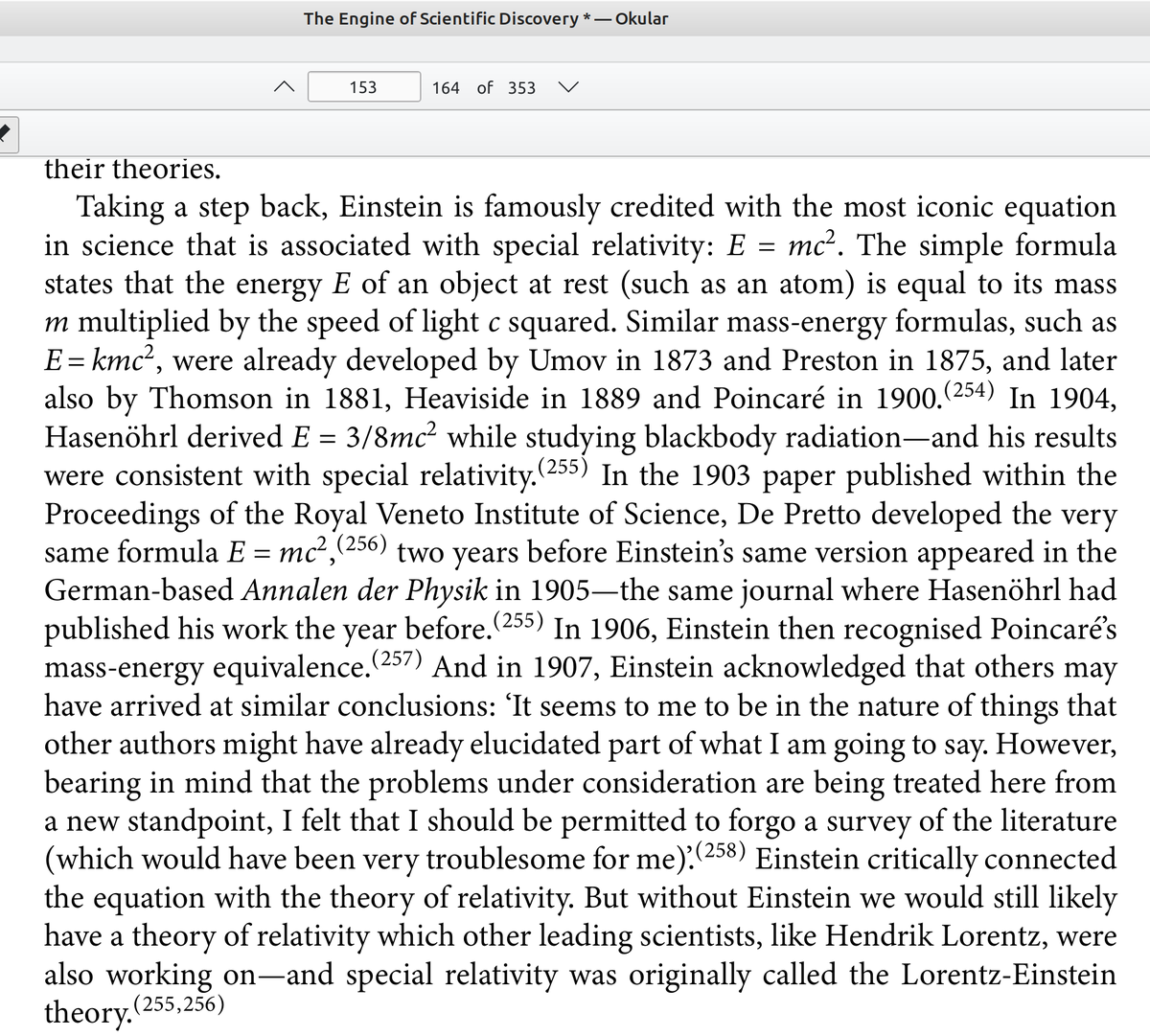
@KirkegaardEmil That's not true. Poincaré for ex didn't understand SR in his 1905 paper ("Physicists will have to add a force..."). De pretto is just silly, he thought that matter vibrates at the speed of light and therefore has the kinetic energy mc^2. It's not enough to have the right formula.
English
0
0
7
426
Emil Kirkegaard
Emil Kirkegaard@KirkegaardEmil·
Without Einstein, it seems safe to say someone else would have quickly come up with the same thing, more or less. It was 'in the air'.
Emil Kirkegaard tweet media
English
30
17
304
13.1K
Igon Value
Igon Value@igon_value·
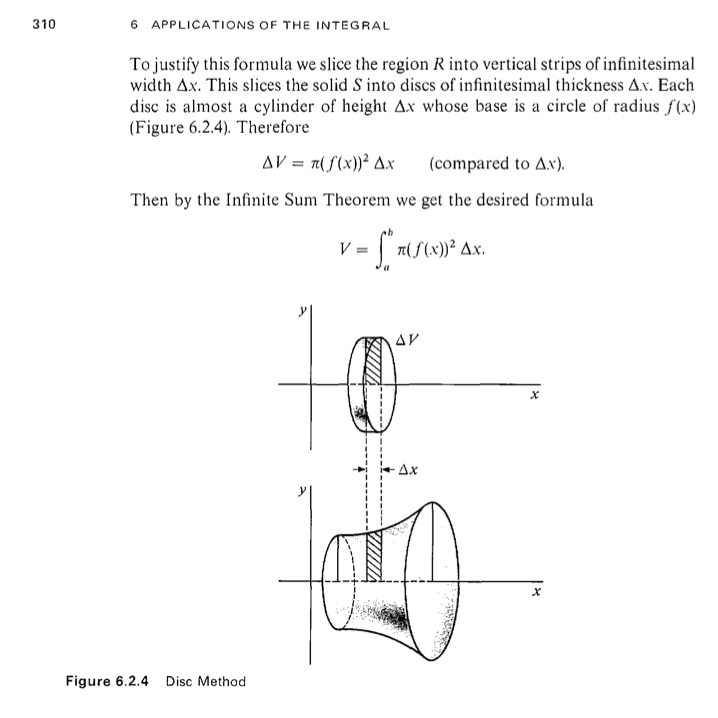
@antoniolupetti All physics/engineering students would be familiar with the method in the image ("disc method"), even though they would know nothing of hyperreals, etc. It is *already* how integration is taught at first.
English
0
0
1
50
Antonio Lupetti
Antonio Lupetti@antoniolupetti·
"Elementary Calculus: An Infinitesimal Approach" is an interesting introduction to calculus that presents familiar topics from a different perspective. The book covers limits, derivatives, integrals, and infinite series, but develops them using infinitesimals rather than the approach found in most standard calculus textbooks. Even for readers already familiar with calculus, it offers a fresh way of thinking about some of its central concepts. It is a worthwhile read for anyone interested in calculus, mathematical foundations, and alternative viewpoints on limits, derivatives, and integrals. people.math.wisc.edu/~hkeisler/calc…
Antonio Lupetti tweet media
English
6
43
347
11.9K
Igon Value
Igon Value@igon_value·
@unherd @ClarkeMicah I get the feeling that the Brits in the comments insisting defensively that Britain had won actually make Hitchens' point. Britain was crushed in 1940, like France, but the Brits would rather mock the French than accept it.
English
6
1
1
1.1K
UnHerd
UnHerd@unherd·
“In 1940, Britain was defeated. I think Winston Churchill knew it, and decided that he would do what he could to ignore the fact that we’d been defeated” Journalist @ClarkeMicah joins UnHerd to debate the concept of Anglo-Gaullism.
English
44
36
324
62.7K
Igon Value
Igon Value@igon_value·
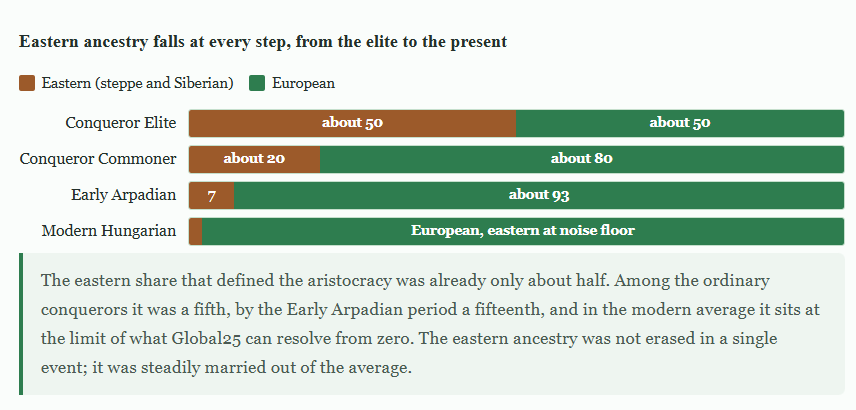
@lefineder Yep. A lot of what was known from linguistics has been confirmed with genetics.
English
1
0
1
421
LiorLefineder
LiorLefineder@lefineder·
The Magyar are a Finno-Ugric people who introduced the Hungarian language into the country from the steppe. Initially, the Magyar elites had substantial eastern ancestry that was, over time, diluted by marriage with the wider population (as seen in ancient DNA below).
LiorLefineder tweet media
English
16
27
288
14K
Igon Value
Igon Value@igon_value·
@ithacarising I can't wait. I hope it comes to the US, in "version originale", bien sûr.
English
0
0
2
27
ithaca rising 🇫🇷 🇬🇧
The sweeping two-part biographical epic called La Bataille de Gaulle (English title: De Gaulle) has finally come out in France. The second part comes out in July. I'm looking forward catching both in France. It stars the outstanding Simon Abkarian as Charles de Gaulle himself, leading a strong cast that includes Niels Schneider, Benoît Magimel, Mathieu Kassovitz, and Simon Russell Beale (as Churchill). The movie dives into the dramatic years from 1940 to 1945, following de Gaulle's defiant stand against Nazi occupation, the birth of the Free French Forces, and his transformation into a towering political figure. The film looks to blend political intrigue, action, and raw historical tension. It's based on Julian Jackson's acclaimed 2018 biography A Certain Idea of France: The Life of Charles de Gaulle, which the film adapts with a fresh, non-hagiographic edge. If you're into big, ambitious historical dramas, this one looks like a must-watch when the film is shown internationally. The first reviews are in and this judicious review by @larroumecj is well worth reading.
Joan Larroumec@larroumecj

J'ai donc vu La bataille de Gaulle hier soir. Grande salle de l'UGC des Halles quasi pleine. Côté pile : comme le faisait remarquer un ami, ce film semble refermer la parenthèse ouverte par Le Chagrin et la pitié en 1971, qui avait inauguré la déconstruction de la France gaullienne, et ouvert tout le champ idéologique de la critique d'une France peu glorieuse dont l'essence serait en grande partie dans la collaboration. Chez Baudry, c'est le grand retour du patriotisme résistant décomplexé. Les héros crient vive la France, les vichystes sont des traitres. Les Anglais sont calculateurs, les Américains des alliés de circonstance autant que des adversaires. Tout est à sa place. Baudry ajoute aussi au patrimoine national ce qui est je crois une des toutes premières représentations filmiques de la bataille de Bir Hakeim. Morceau de courage et d'abnégation pur, dans la grande tradition gauloise du petit groupe de guerriers sous-équipés qui fait face à l'empire qui veut le submerger. Bien sûr, il y a les petites touches post-modernes, un recul ironique inévitable, qui dépeint parfois De Gaulle à la frontière du grotesque. Mais cela n'entâche pas le constat : nous sommes culturellement passés de l'autre côté, le patriotisme a de nouveau sa place auprès du grand public. Simon Abkarian qui parle de De Gaulle la larme à l'œil devant Yann Barthès, c'est un nouveau monde/ Les raisons de ce retour me semblent limpides : la patriotisme contemporain avait disparu car il n'était plus existentiel dans le contexte de la pax americana, et était devenu un obstacle dans le contexte de la construction européenne. La fin de la pax americana et le risque concret de se faire géopolitiquement écraser redonne une pertinence instrumentale à la technologie sociale du patriotisme sur laquelle repose la défense farouche des intérêts de son pays. Le retour en grâce de la nation est-il là pour durer ? Tout dépendra de ce qu'il adviendra de la construciton européenne maintenant que l'Amérique a fait tomber le masque. Côté face maintenant : Baudry passe à côté du Général. Pourquoi De Gaulle a-t-il cette folie de rompre avec Pétain et d'aller à Londres. Pourquoi dit-il "je suis la France" à Chruchill, en le croyant profondément ? Et poruquoi certains le croient ? Pourquoi et comment cette aberration historique qu'est De Gaulle ? C'est très simple, et l'oubli de Baudry est d'autant plus dommageable que la clé est dans le titre même de la biographie qui a inspiré le film : "une certaine idée de la France." Plus précisément, il y a au XIXe siècle deux conceptions principales de la nation. 1. La version contractuelle, post-1789, à la Sieyès : la nation est l'agrégat des volontés et des intérêts présents, chaque génération peut la révoquer et la reconfigurer. C'est cette version de la nation qui sous-tend par exemple le concept de nouvelle France de Mélenchon. 2. La version historiciste de la nation, issue de Burke et en France incarnée par Barrès : la terre et les morts. La nation ne représente pas que les vivants, mais aussi les morts et ceux qui sont à naître. Ainsi les vivants n'ont pas l'autorité suffisante pour redéfinir la nation à chaque génération. Renan est célèbre pour avoir unifié ces deux visions de façon totalement explicite. "Une nation est une âme, un principe spirituel. Deux choses qui, à vrai dire, n'en font qu'une, constituent cette âme, ce principe spirituel. L'une est dans le passé, l'autre dans le présent. L'une est la possession en commun d'un riche legs de souvenirs ; l'autre est le consentement actuel, le désir de vivre ensemble, la volonté de continuer à faire valoir l'héritage qu'on a reçu indivis." De Gaulle lui appartient à une autre tradition. La France n'est pas pour lui un objet immanent, que l'on étende son essence à tous les Français passés présents futurs ou qu'on la restreigne aux contemporains. De Gaulle est péguysite. De Gaulle en 1964 à propos de Péguy : "Aucun écrivain ne m'a autant marqué. Dans les années qui ont précédé la guerre, je lisais tout ce qu'il écrivait, pendant mon adolescence et quand j'étais à Saint-Cyr, puis jeune officier. Je me sentais très proche de lui. Ce qui m'intéressait surtout chez lui, c'était son instinct." Payerefitte : "Lui aussi, il se faisait une certaine idée de la France, comme d'une personne vivante, pareille à la Madone des fresques. De Gaulle : "Oui, c'est évident." Péguy rompt avec les définitions immanentes de la France, et lui accorde la transcendance. La France est une essence dont les générations successives ne sont que les dépositaires. Une certaine idée de la France existant avant, après et au-dessus de tout Français particulier. Cette idée de la France anime les Français beaucoup plus que les Français animent la France. Et les intérêts de la France peuvent être en contradiction avec ceux des Français de toutes les générations. De Gaulle, c'est avant tout ça. Les pétainistes ne sont que des sieyèsiens qui se trompent. Mais fondamentalement, ils justifient leur comportement par leur objectif consistant à préserver les intérêts des Français. Éviter une nouvelle boucherie. Donner aux Français une place dans le nouvel ordre germanique. Pour De Gaulle, ce serait entâcher l'âme de la France. C'est pour cela qu'il peut dire être la France, son dépositaire légitime. Peu importe ce que disent les institutions, c'est celui qui est habité par la France qui porte sa légitimité. C'est parce que Roosvelt n'est pas péguyste qu'il ne comprend pas qui est De Gaulle et cherche à l'écarter. Et c'est parce que De Gaulle a fondamentalement raison qu'il réussit. En effet, sur quoi repose le succès de De Gaulle ? Sur le fait qu'en France, dans l'Empire, des Français reconnaissent la France en lui. Des Français pour qui donc la France est autre chose que les Français. Et c'est aussi pour cela que De Gaulle peut raconter le récit de la résistance. Si la France est autre chose que les Français, alors elle est aussi autre chose que Vichy et ses collabos. Les Français peuvent être indignes de la France, mais la France, elle, reste intacte, tant qu'assez de Français sont là pour protéger et perpétuer son âme. Sans cette clé de lecture, De Gaulle n'est qu'un excentrique qui a eu de la chance et du courage. Vision du personnage qui transparaît un peu trop chez Baudry. Avec cette clé de lecture, l'histoire de De Gaulle est une histoire quasi christique, où ce n'est pas Dieu qui s'est fait homme, mais une nation qui s'est faite Général.

English
2
3
14
3.7K
Igon Value
Igon Value@igon_value·
@AnecdotesMaths Si la cible est constituée d'une infinité (indénombrable) de points, il faut utiliser une densité de probabilité. La probabilité elle-même est densité fois surface, par exemple la surface du bout de la fléchette.
Français
0
0
1
652
AnecdotesMaths
AnecdotesMaths@AnecdotesMaths·
Si vous lancez une fléchette sur une cible, chaque point de la cible a une probabilité nulle d’être atteint par la fléchette. Pourtant, il y aura bien un point atteint par la fléchette.
Français
21
6
142
37.7K
Igon Value
Igon Value@igon_value·
@ithacarising I love these amusing vignettes. I'd "follow" again if I didn't already.
English
0
0
1
2
ithaca rising 🇫🇷 🇬🇧
ithaca rising 🇫🇷 🇬🇧@ithacarising·
« Gloire ! Dans le meilleur des cas, un malentendu. » - Albert Camus In 1946, when Stuart Gilbert's English version of The Stranger landed at Knopf, the publishers spotted a ready-made craze drifting across the Atlantic and promptly hitched their wagon to it. They launched a series called "Existentialist Novels," as if the label were a reliable French vintage. What had begun as journalistic shorthand hardened overnight into a marketing slogan. Camus, who kept insisting he was no existentialist, might as well have been shouting into the wind. For English readers the misunderstanding was almost inevitable. The Myth of Sisyphus did not appear in translation until 1955, so the public had to take their Camus from reviewers who kept copying one another's mistakes with clerical diligence. A courteous letter from publisher Gallimard's man in New York, politely pointing out that The Stranger was by Camus, not Sartre, and that the author had formally disowned the existentialist tag, sank without trace. By the late forties the caricature was fixed. Academia lacquered it, generations of students learned to admire the varnish, and now the caricature has completed its descent into the afterlife of the meme. Poor Camus: condemned, like his own hero, to watch the stone of his reputation roll back down the hill every time someone posts another black-and-white photograph with a quote he never quite said.
ithaca rising 🇫🇷 🇬🇧 tweet media
English
2
0
2
131
Arnaud Bertrand
Arnaud Bertrand@RnaudBertrand·
This is genuinely incredible and says SO SO MUCH about the perception of China in the West. This is the #1 news show in France, and the host - David Pujadas - asks the pundits around the table (a sample of the top media figures in France) if they can name 3 living Chinese people. That's it: they just need to say the names of 3 living Chinese people, anyone. This should be extremely easy. Yet not of a single one of them can name a single Chinese beyond Xi Jinping. They do not know a single living Chinese person beyond the president. That's the level of ignorance of China we're dealing with in the West today, in 2026. This is the source for the video: tf1info.fr/replay-lci/vid… Aired live yesterday 28th of May 2026.
English
730
1.9K
8.7K
1.1M
Igon Value
Igon Value@igon_value·
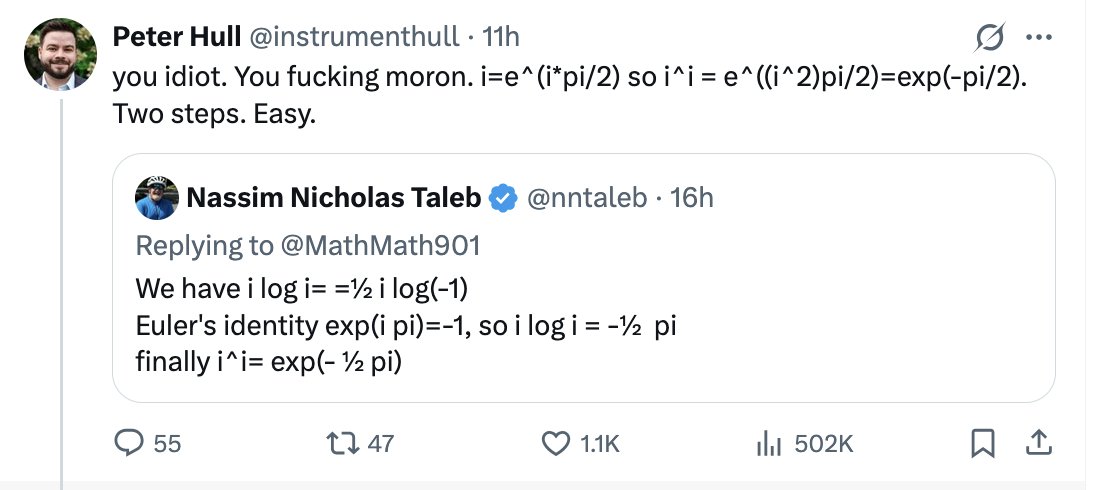
@nntaleb @pmarca Obviously, any proof depends on what is already known, but it is more likely that what you've already constructed includes i=e^(i*pi/2) rather than the log(-1).
English
0
0
2
4.9K
Nassim Nicholas Taleb
Nassim Nicholas Taleb@nntaleb·
When economists try to be "cute" they display their dimness. There is NO extra step when flushing out HOW i=e^(i*pi/2) flows from Euler's identity (this idiot takes i=e^(i*pi/2) as given picked up from math for econ textbook). @pmarca who spread this "cute" joke is clueless.
Nassim Nicholas Taleb tweet media
English
49
46
901
159.9K
Igon Value
Igon Value@igon_value·
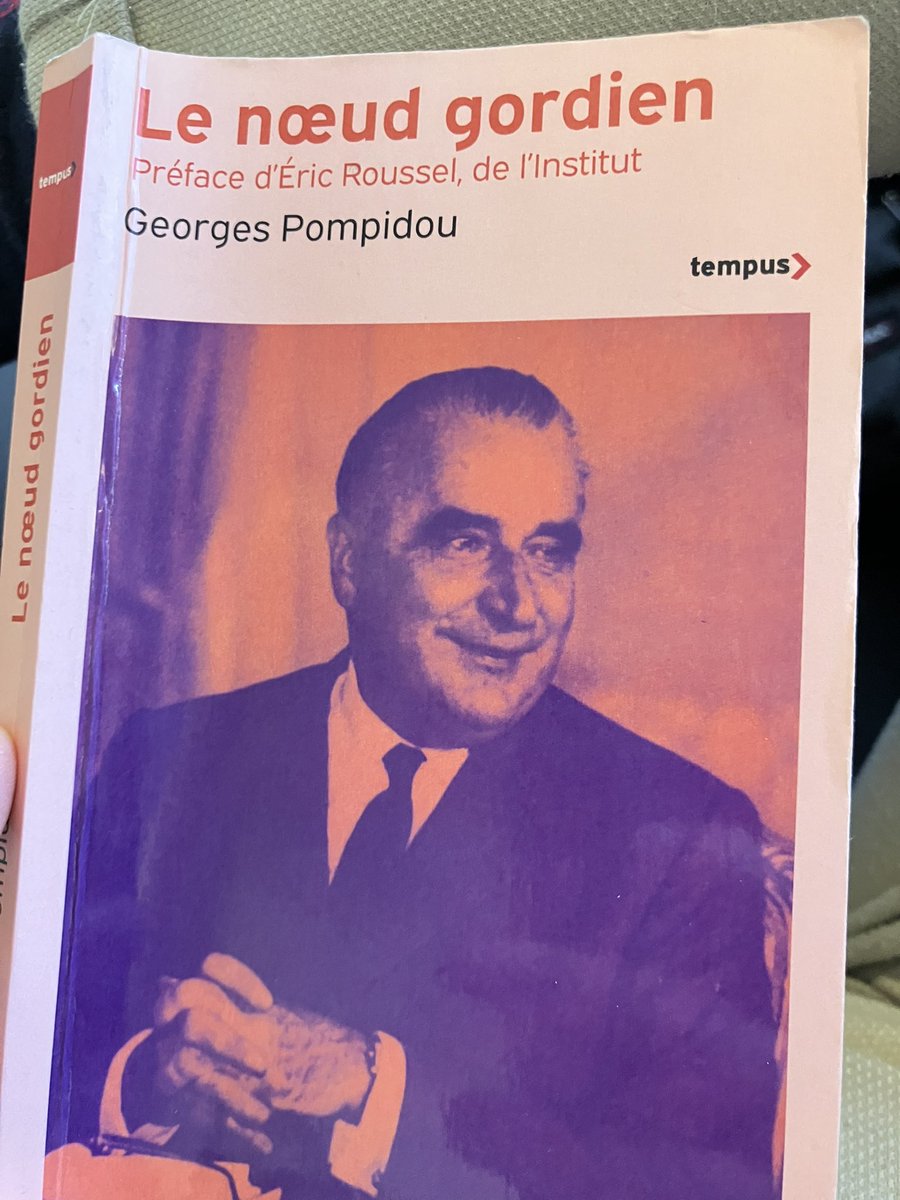
@ChicagoBoyFR « Quant aux communistes, ils ont leur doctrine, mais ils se gardent bien de l'exposer » LOL!
Français
0
0
8
351
Chicago Boy
Chicago Boy@ChicagoBoyFR·
Pompidou, Le noeud gordien, 1974. « Les tenants du socialisme sont, en France, des esprits superficiels, préoccupés en réalité non d'économie mais de redistribution des richesses. Préoccupation louable en elle-même mais qui devrait être précédée d'une interrogation sur la création de ces richesses qu'on désire mieux redistribuer. Aussi quand on en vient au programme socialiste, on s'aperçoit qu'il se résume à moins de travail, salaires plus élevés, retraites avancées et augmentées, avec, de-ci, de-là, une petite nationalisation pour rappeler qu'on est anticapitaliste, sans trop y croire. » Rien n’a changé en 50 ans…
Chicago Boy tweet mediaChicago Boy tweet media
Français
32
321
1K
24.5K
Igon Value
Igon Value@igon_value·
@ithacarising Counting the fraction is not trivial. If you count the entries in a dictionary, you miss the frequency of common words (the, a, and, over, up, this, what, etc.) all from Germanic. If you count spoken words by individuals, you need to account for register.
English
1
0
1
1.9K
ithaca rising 🇫🇷 🇬🇧
ithaca rising 🇫🇷 🇬🇧@ithacarising·
I was gifted a copy of this book by my French in-laws. It's delightfully tongue in cheek book. In his 2024 book 'La langue anglaise n'existe pas: C'est du français mal prononcé' ("The English Language Doesn't Exist: It's French Badly Pronounced"), the linguist Bernard Cerquiglini has taken an old Clemenceau zinger and turned it into a whole book. The title isn't meant to be taken too literally, but the central idea is pure fun: English is not so much a language as French that has been badly pronounced for a thousand years - ever since those Normans crossed the Channel and started mangling their own tongue with Germanic determination. Cerquiglini points out, with plenty of witty examples, just how massively English owes its vocabulary to French. After 1066 the English vocabulary was essentially looted by French. Law, government, food, fashion, love, and war: almost everything worth saying with a straight face comes sailing from across the Channel. Today, roughly 30-45% (or more, depending on how you count) of English words have French or Latin-via-French roots. Some might say that’s not borrowing, that's colonisation with better manners. 🇬🇧🇫🇷
Thomas Michelet OP ‏@ThMichelet

@ithacarising

English
15
15
312
51.3K
Igon Value
Igon Value@igon_value·
@ithacarising Yes, I clearly notice an accent. But I would have had a hard time determining the origin.
English
0
0
1
239
ithaca rising 🇫🇷 🇬🇧
ithaca rising 🇫🇷 🇬🇧@ithacarising·
Extraordinary. Hearing Albert Camus read the opening pages of his book 'L'Étranger' (1942). I would have thought it would be more raspy on account of his heavy chain smoking habit. He smoked Gauloises which is known for its strong, unfiltered tobacco made from dark Syrian and Turkish blends. Camus even named his cat 'cigarette' as a nod to his excessive smoking. But for all that his voice is clear and measured. I wouldn't have known this but my French wife points out that he still has a subtle Algerian accent (from his pied-noir roots).
English
13
74
225
16K
Igon Value
Igon Value@igon_value·
@ithacarising Who is Buckley today? Who is Kissinger? What would I give to see this level of discourse again. I can't escape the apprehension that we are indeed witnessing a profound and inexorable decline of the West.
English
0
0
1
17
ithaca rising 🇫🇷 🇬🇧
Not surprising since Kissinger wrote his Harvard senior honours thesis (1950) on Spengler (as well as Toynbee and Kant). It was an ambitious 400-page work titled 'The Meaning of History: Reflections on Spengler, Toynbee, and Kant' that was later published in full. The fascinating to note was the difference between the younger and older versions of Kissinger. For a young man whose family had fled Nazi Germany and witnessed Europe fall apart, Kissinger found Spengler's dark, poetic idea of civilisations as living organisms - born, blooming, then slowly rotting away - seductively powerful. It felt deeper and truer than all the sunny progressive theories everyone else was peddling. But the older Kissinger was too driven (too ambitious?), and too Kantian at heart, to buy Spengler's fatalism. He refused to accept that the West was inevitably doomed. Instead, he built his own tougher view. Yes, there are deep historical patterns and cultural forces at work, he believed, but statesmen with courage and vision can still shape events, exercise real moral choice, and change the course of history.
Dead Wrong History@deadwronghist

In 1975, Buckley asked Kissinger why he gave Nixon Spengler's Decline of the West to read. Kissinger's answer was about why statesmen who focus on day-to-day events are always looking at the wrong thing.

English
1
1
1
307
Igon Value
Igon Value@igon_value·
@Vidor1 @DastDn Not surrendering meant dying. The British only gave the option to hand over the ships, which the French wouldn't do. Those at Mers-el-Kébir were sunk by the British, those (later) in Toulon were scuttled by the French themselves. There was no other option.
English
1
0
6
142
Vidor
Vidor@Vidor1·
@igon_value @DastDn >What else could they do? Not surrender. Evacuate as many troops as they could. Sail the French fleet to other ports so it could continue to fight. There was a lot they could have done. Petain and Laval chose not to.
English
3
0
5
189
LoLNothingMatters
LoLNothingMatters@DastDn·
France gets a lot of (unfair but deeply entertaining) shit for its rapid surrender in WW2, when instead it should be mocked for mythologizing the practically non-existent "La Resistance" during the occupation.
English
200
503
11.2K
600.4K
Igon Value
Igon Value@igon_value·
@Vidor1 @DastDn Darlan was always very clear that he'd scuttle the ships if the Germans tried to get them, and in fact he did! Yes, the gov surrendered but the French didn't stop fighting. And 100,000 died in the Battle of France. What else could they do? Not so simple.
English
1
0
2
179
Vidor
Vidor@Vidor1·
@igon_value @DastDn I do know about DeGaulle. But the French gov't surrendered. The fleet wound up being sunk by the British **because France surrendered** in 1940 instead of fighting on and sailing to British ports.
English
2
0
7
440
Igon Value
Igon Value@igon_value·
@Vidor1 @DastDn You're obviously not well informed. The French did indeed fight from Africa, and the fleet was sunk by the British. De Gaulle fled to London, then Brazzaville, then reconstituted an army in Algeria and landed in Italy, etc.
English
1
0
21
476
Vidor
Vidor@Vidor1·
@DastDn The shit they get is totally fair. They didn't have to surrender, make an armistice. They could have fought from Africa. They could have sailed their fleet to British ports. They'd signed a solemn agreement with the Brits to *not* make a separate peace.
English
14
0
24
5.3K
Igon Value
Igon Value@igon_value·
@ithacarising Do you know if _A Spy Among Friends_, on Netflix, is any good?
English
0
0
0
98
ithaca rising 🇫🇷 🇬🇧
ithaca rising 🇫🇷 🇬🇧@ithacarising·
I used to lecture on the Cambridge Five. So I'll admit it: I was sceptical at the prospect of yet another book on Philby, Burgess, Maclean, Blunt and Cairncross. People may well wonder why we remain obsessed with them. But we need reminding that these five were not ordinary traitors. They were the golden generation - products of the very best public schools and Cambridge University, sons of the establishment who rose effortlessly into the Foreign Office, MI6, MI5 and the corridors of power. Recruited in the 1930s by Soviet intelligence while still idealistic undergraduates, they spent decades systematically betraying Britain from the inside. They passed atomic secrets, compromised operations, and sent agents to their deaths, all while remaining trusted insiders. Historians keep returning to them because their story touches something deep. How ideology can seduce even the most privileged. How class, education and social networks can blind institutions to betrayal. And how the British establishment was so confident in its own superiority that it failed to see the enemy within. The Cambridge Five lodged themselves deep in the British cultural psyche as well which is one reason why we still obsess over them. Alan Bennett's play A Question of Attribution (1988) gave us an exquisitely drawn Anthony Blunt, the art historian and Queen's picture-keeper whose double life became a masterclass in elegant equivocation. Julian Mitchell's Another Country, memorably brought to the screen by a young Rupert Everett as the flamboyant Guy Burgess, turned the public school crucible into a glittering parable of resentment and rebellion. And then there was fall out from George Steiner's 1980 essay "The Cleric of Treason," published in the wake of Blunt's public unmasking in 1979 by Margaret Thatcher in Parliament. Steiner delivered a devastating analysis that made the establishment hate him even more - as Steiner himself once chuckled to me over dinner, with that characteristic dry, donnish amusement. Cairncross never travelled in the same circles as the other four but he remains lumped in with the others. The truth is that the combination of elite access, ideological zeal and long-term deception makes all Five uniquely fascinating - even now, almost a century later. But I was wrong to think there are no new perspectives, and happily so. Brilliant interview between @spybrary and @Tonisenior. I'm genuinely eager to read Antonia Senior's 'Stalin's Apostles' now.
Spybrary@spybrary

This is not the familiar story of clubland betrayal, old boys’ networks and establishment embarrassment. In Stalin’s Apostles, @Tonisenior asks: what did Stalin actually want from his Cambridge spies and what was the human cost? New on #Spybrary links in the first comment.

English
10
21
61
16.2K
Igon Value
Igon Value@igon_value·
@sc_cath @AlecStapp @lyondataman Yes, the firms lie (misreport) to avoid the obligations triggered over 50 employees. The regulation is still distortionary, and I'm guessing that it becomes harder and harder to lie with increasing employee count.
English
0
0
2
181
Igon Value
Igon Value@igon_value·
@HusseinAboubak I know nothing about the guy, so maybe he deserves to be sent back. But this reads as punishment for what his mother did. In the West, we normally punish individuals, not families.
English
1
0
0
42
Igon Value
Igon Value@igon_value·
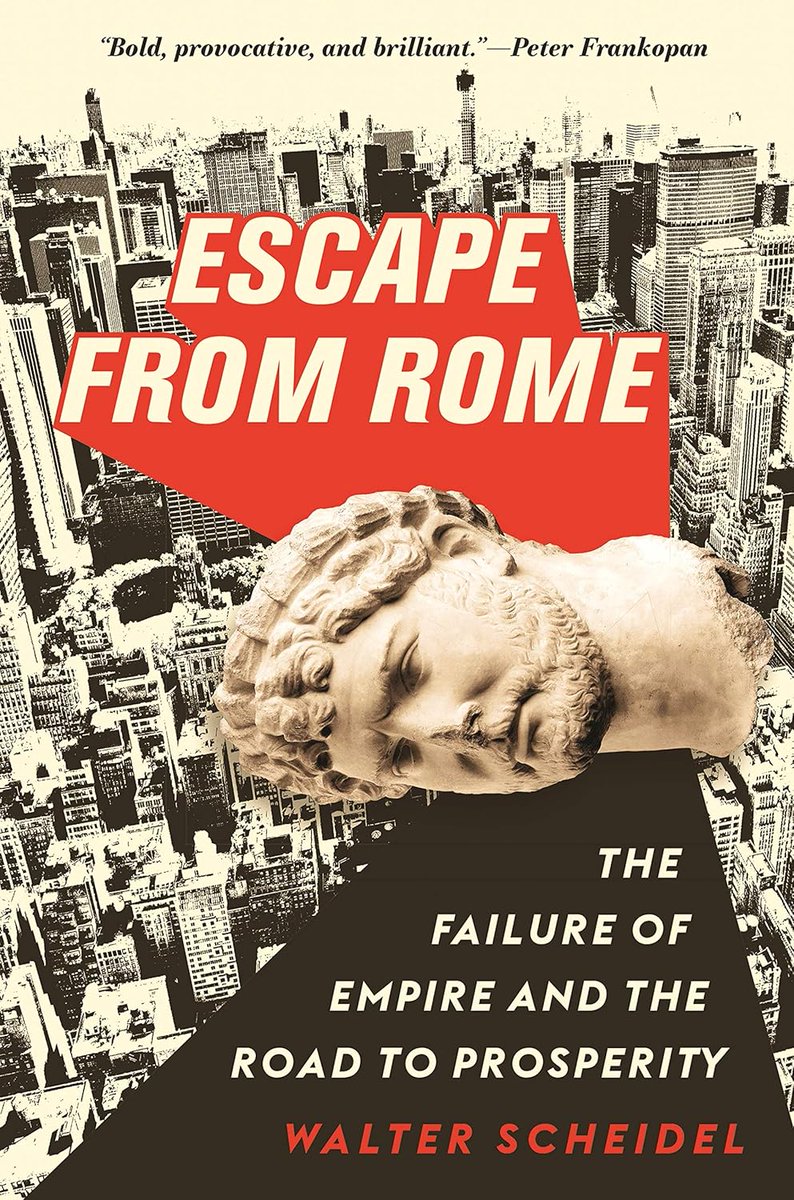
@Peter_Nimitz I feel people are missing an important element of Scheidel's thesis. He doesn't simply argue that Europe's fragmentation was good (duh), but that China was centralized because of the threat from steppe nomads, while E was more protected by distance & geography (except Hungary).
English
0
0
1
83
Nemets
Nemets@Peter_Nimitz·
four & half years later I still can't make up my mind about this book, which argues that our ancestors did indeed plunge western Eurasia into a dark age, but that in long run they laid the foundations of far more technopolitical progressive states than those of Rome & China.
Nemets tweet media
English
10
9
264
17.1K