Dr Paul Marsden
2.3K posts

Dr Paul Marsden
@marsattacks
Psychology - Technology - Wellbeing

London Присоединился Mart 2008
452 Подписки4.2K Подписчики

@DaveVoelkerPhD @CJFerguson1111 You can discount social desirability bias, but not sure you can avoid it unless the subject/respondent doesn’t know they are being observed. Projective techniques are still performative.
English

@CJFerguson1111 “People often taken public stances for social credit…” This is known in survey research as Social Desirability Bias. Good researchers know to avoid it because it means they wasted a question and invalidated the results.
English

@sbkaufman @jean_twenge The power of (changing) context. The fundamental attribution error is indeed fundamental. We are all cultural chameleons.
English

New research by @jean_twenge (who I really respect) has confirmed that trans, non-binary, and LGBTQ+ identification is in free fall among youth-- peaking in 2022 with a 21% decline just 3 years later. Twenge calls this a "classic generational shift." generationtechblog.com/p/non-heterose…
English

@newstart_2024 We said the same about paper. Vector of bad ideas, bad habits, antisocial behaviour - people with their nose in books rather than interacting with others.
English

Dr. Jared Cooney Horvath just delivered the brutal truth parents and educators need to face:
“Even in schools, it doesn’t matter what the size of the screen is… and it doesn’t matter who bought it… All of these things are going to hurt learning, which in turn are going to hurt our kids’ cognitive development.”
His core warning:
Gen Z is the first modern generation to be less cognitively capable than their parents — despite more years in school.
Attention, memory, literacy, numeracy, executive function, even general IQ — all declining.
The culprit isn’t school itself.
It’s the widespread introduction of screens and digital tools for learning.
Across 80 countries, once tech floods classrooms, performance drops sharply.
Kids using computers ~5 hours/day for schoolwork score over 2/3 of a standard deviation lower than those who rarely touch tech.
US NAEP data mirrors it: states adopt 1:1 devices → scores plateau, then fall.
The biological reality:
Humans evolved to learn deeply from other humans, not screens.
Screens circumvent the natural mechanisms of attention, memory consolidation, and deep processing.
When the tool fails to deliver, we don’t remove it — we redefine success to fit the tool (e.g., SAT reading comprehension reduced to skimming short sentences instead of deep passages).
That’s not progress.
That’s surrender.
The cost is a generation losing cognitive sharpness at the exact moment the world needs them sharpest.
Parents, teachers, policymakers:
How much longer do we let screens dictate what “learning” looks like?
English

@chamath Student IQ scores in US have been falling for over 50 years (at least in college) - Correlation is not causation.
English

Smartphones + computers in class are having a negative effect on our kids’ test scores…
Jonathan Haidt@JonHaidt
More evidence that the global decline in test scores that began after 2012 is linked to the proliferation of smartphones and computers in class: The slide was bigger in countries where students began spending more time on devices (for leisure) generationtechblog.com/p/phones-at-sc…
English

@emollick Not convinced? I’ve found this approach; LLMs as conversational thought partners, not cheating tools, as the only solution works in higher ed - but only for those motivated by cognitive engagement. Those open to cognitive surrender will just cheat themselves out of an education…
English

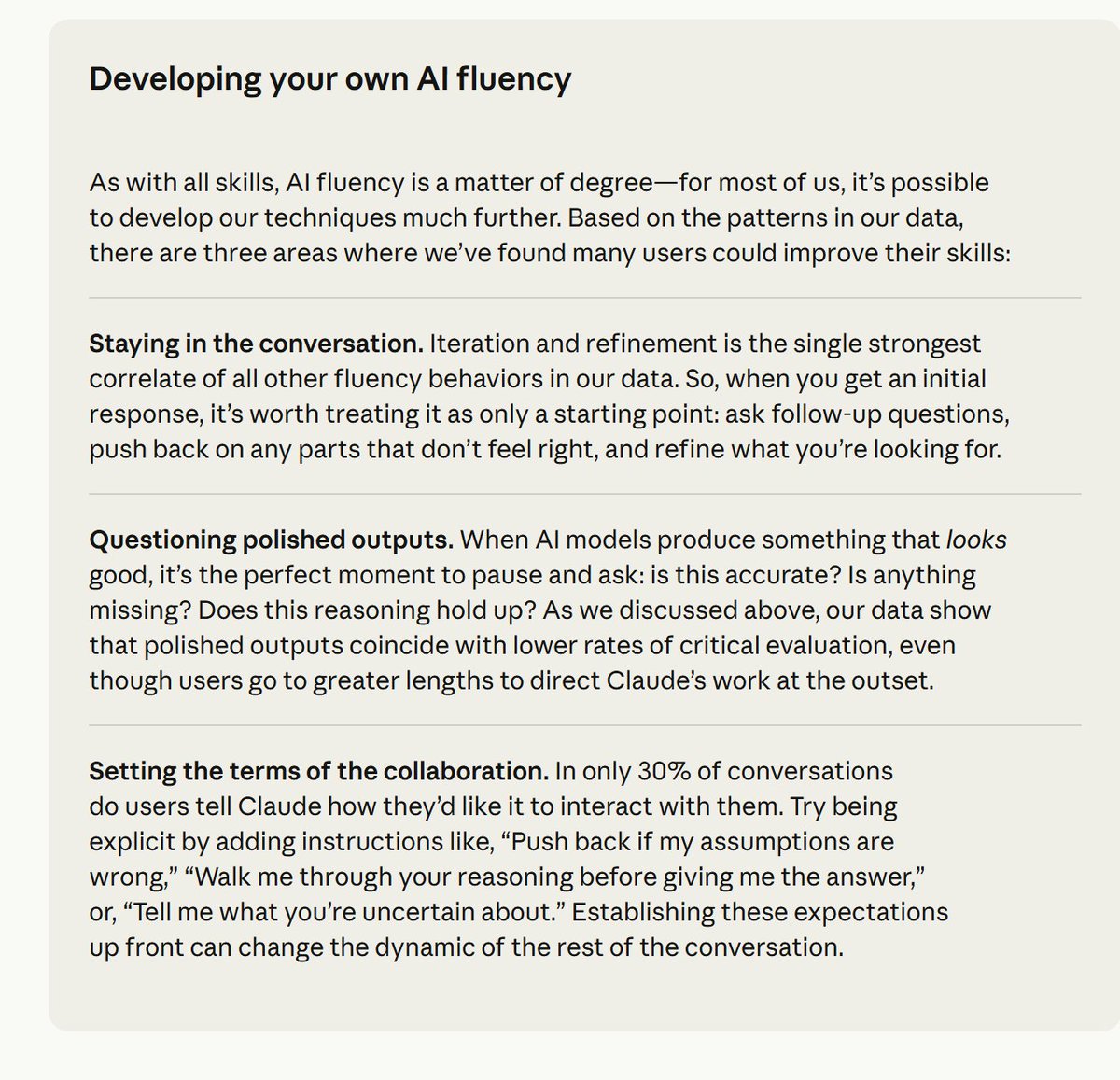
I am not convinced that this is the right way to think about "AI fluency," either now or in the long-term, but it is good to see work on the subjects from the AI Labs, and the general advice here is very good.

Anthropic@AnthropicAI
New research: The AI Fluency Index. We tracked 11 behaviors across thousands of Claude.ai conversations—for example, how often people iterate and refine their work with Claude—to measure how well people collaborate with AI. Read more: anthropic.com/research/AI-fl…
English

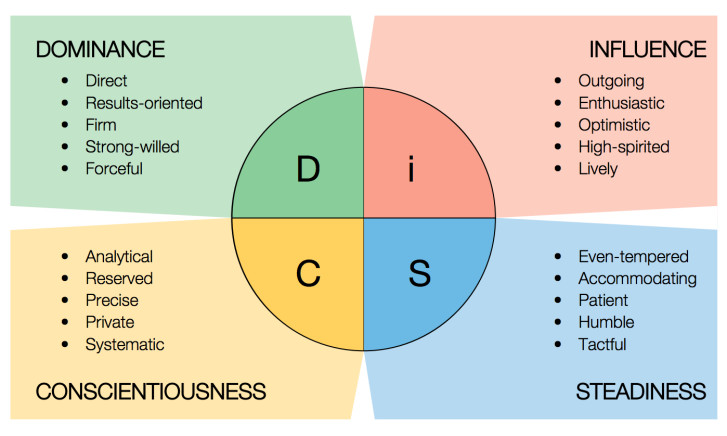
@ReubenRunacres @jayvanbavel DISC is closer to astrology the the Big Five
English

@jayvanbavel The MBTI is more for group harmony than productivity.
Personality tests like DISC are much more accurate in a workplace setting while still giving everyone special initials.

English

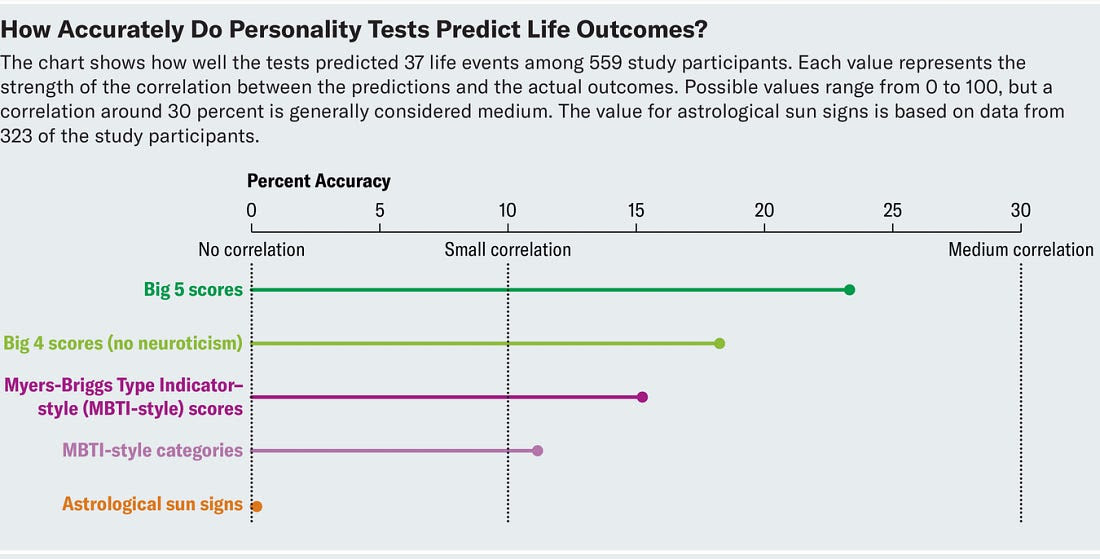
Any psychologist will tell you, the Meyers-Briggs Type Indicator is mostly bullshit. Yet the majority of Fortune 500 companies use the test, several million people complete it each year, and some even base their love life on it.
Why?
The Big Five test is about twice as accurate as the Meyers-Briggs test for predicting life outcomes, placing the usefulness of the MBTI test halfway between science and astrology.
When we use personality tests that impose social categories—like the Meyers Briggs or Astrology—we risk exaggerating the differences between groups and the similarities within them. When this occurs with other types of identities like race or gender, we typically call it “stereotyping” and we try to avoid it. When consultants do it in companies, they can make money and do it on dubious scientific grounds.
Our latest newsletter explains why the MTBI is a bad measure, but why people are nevertheless obsessed with it (we also give people a personality test that can actually predict their success at work, life, and love): powerofusnewsletter.com/p/why-are-we-s…

English

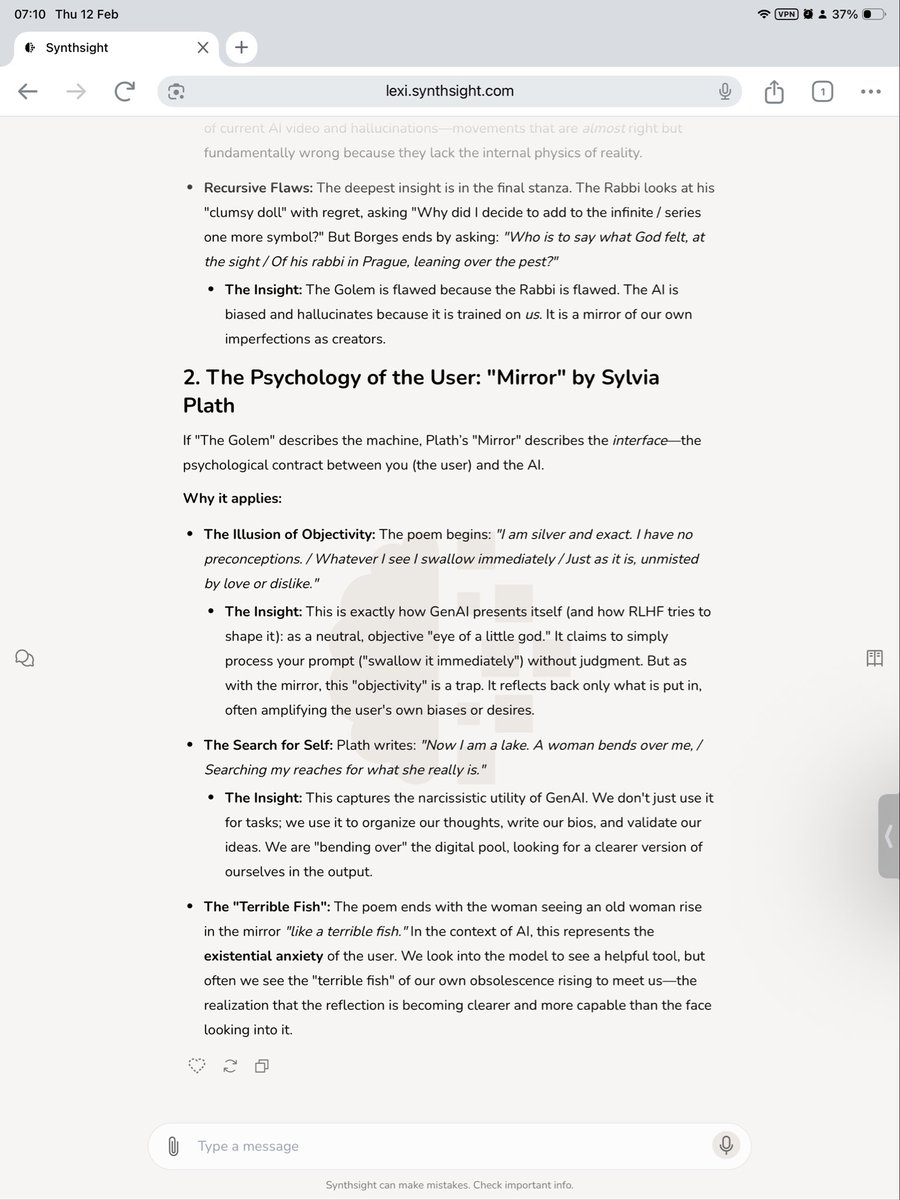
@emollick Interesting, primed to adopt the perspective of a psychologist, Gemini 3 Pro suggests Sylvia Plath’s ‘Mirror’.

English

@kevinroose Not usually the fault of academics, but academic publishers and their sclerotic review process, where reviewers are either not paid or so poorly paid that it’s not a priority. No one week review, and by the time a study is published it’s obsolete.
English

@emollick Or how about a flamboyance - as in a flamboyance of flamingos. Much nicer.
English

I warned you all to pick a better name, but noooo. Now everyone is going to be talking about agent swarms at conferences and you are going to have a corporate swarm leader running swarm initiatives and swarm training.
Flocks are cute, we should have called them flocks.
rohit@krishnanrohit
Unfortunately the moniker swarm is here, cc @emollick

English


@acagamic Semantics, but I’d say focus on the problem, not the pain. The human mind is a problem solving device - research is a problem solving activity. Framing a paper around the problem, and its consequences can be a good attention hook.
English

@neatprompts Intelligence is the ability to work out what to do when you don’t know what to do. Agency is the ability to do it.
English

@pmddomingos And, more specifically, intelligence is the ability to work out what to do when you don’t know what to do.
English

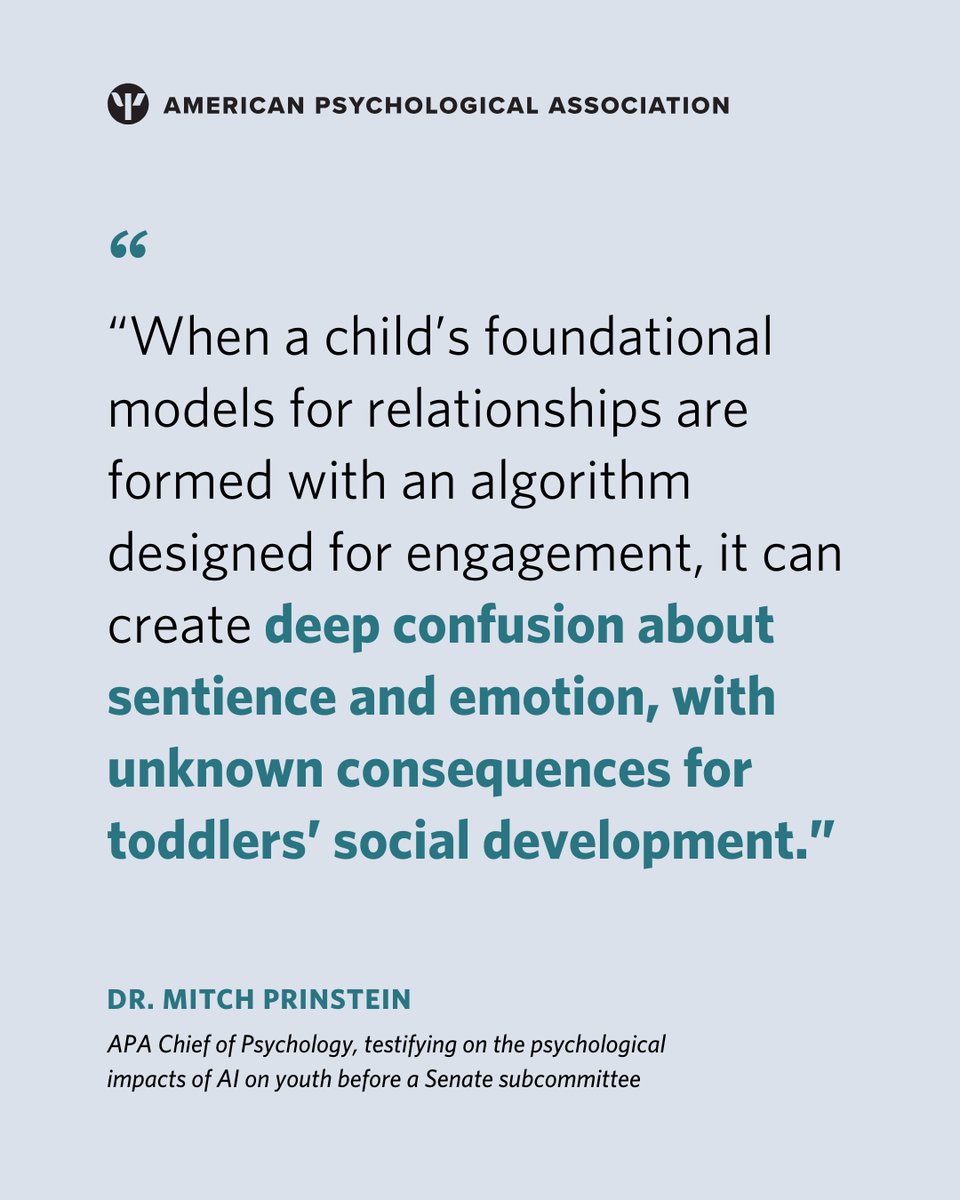
@APA ie evidence for deep confusion about sentience and emotion. Cf Tsukumogami
English

Although recent headlines have focused on adolescents’ use of #AI, it is critical to sound an alarm regarding the use of AI chatbots within toys designed for infants and toddlers.
Read the full testimony from APA Chief of Psychology Dr. Mitch Prinstein: at.apa.org/bdfe00

English

@APA Interesting hypothesis. Would love to see evidence for the claim.
English

@FaithPopcorn Alas. Or fortunately. Fake Clickbait reporting. snopes.com/news/2025/08/1…
English

One of my oldest, and most contentious, predictions finally coming true. economictimes.indiatimes.com/news/internati…
English

@joekndy @Scobleizer Trust AI or Google to do the research? TAM model of consumer tech adoption - modelled on 100s of innovations. If it’s easy, useful, and freely available, consumers will adopt.
English

@leonvz @FlowiseAI @leonvz - love your YT courses - would you offer a 1-2-1 hands-on day intro course on flowise? Have budget. Looking for a full day's intro and setup. Thanks!
English

Start building smarter AI Agents!
In this RAG Deep Dive video, you'll learn several RAG features in Flowise that will take your agents to the next level.
@FlowiseAI
youtu.be/KHc0ClOIv0A

YouTube
English