

JRdeucer
6.7K posts

True or False: You rank Tim Duncan higher than Bill Russell among the greatest players in NBA history.
English

Mike Vrabel literally has nothing to apologize for.
The only person who should be apologizing to the public here is Dianna Russini.
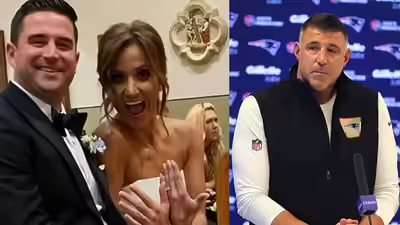
Vrabel stood at a podium at Gillette Stadium on April 21, 2026, and told reporters he had "difficult conversations with people I care about" in the weeks since photos of him and NFL reporter Dianna Russini at a Sedona resort were published by the New York Post. He said those conversations with his family, his coaching staff, and his players had been "positive and productive." He promised the Patriots would get "the best version of me going forward." By all accounts, he did not mention Russini by name. He kept it brief. And then he moved on.
That is all Mike Vrabel owes anyone. The reaction from certain corners of the media suggesting Vrabel needs to do more, say more, or face some kind of professional reckoning is absurd. Mike Vrabel is a football coach. His job is to win games, develop players, and run a football operation. Whatever happened or did not happen at a hotel in Arizona is between him, his wife Jen, and their family. The NFL already confirmed through spokesman Brian McCarthy that it is not investigating Vrabel under the personal conduct policy. The Patriots have not disciplined him. Robert Kraft has not publicly addressed it beyond reportedly trying to stop the Post from publishing the photos in the first place.
Vrabel's marriage is 27 years old. He and Jen met at Ohio State in the mid-1990s. They have two adult sons. What happens inside that marriage is not the business of anyone holding a microphone or a Twitter account. If he made a mistake in his personal life, the people who deserve answers are in his house, not in his press room. And by his own account, he already had those conversations. The idea that a head coach owes the public some kind of confessional because he was photographed at a resort is a standard that does not exist in professional sports, has never existed, and should not start now.
The person who owes an explanation is Dianna Russini.
Russini's entire career was built on credibility. That is not a side benefit of being an NFL insider. It is the whole foundation. When Dianna Russini reported that a trade was happening, or that a coach was on the hot seat, or that a front office was divided, the value of that information depended entirely on the audience believing she got it through legitimate professional channels. The moment those photos hit the internet, that foundation cracked. And everything she did after the photos were published made it worse.
The photos, published in early April by Page Six, showed Russini and Vrabel at the Ambiente resort in Sedona, a luxury adults-only hotel roughly two hours north of Phoenix, where the NFL's annual league meetings were being held the following week. The images showed the two of them spending time by the pool, sitting in a hot tub together, and in at least two photos, holding hands or interlocking fingers. Both Russini and Vrabel are married to other people. Russini married Kevin Goldschmidt in September 2020. They have two young sons.
Russini's initial response was to claim the photos "don't represent the group of six people who were hanging out during the day." She described the interaction as a journalist meeting with a source away from stadiums and other venues. Vrabel echoed this, calling the photos "completely innocent" and saying "any suggestion otherwise is laughable."
The problem is that when the New York Post gave both Russini and Vrabel the opportunity to provide evidence backing up their story before publication, they could not do it. The Post was reportedly open to changing the tone of the story or killing it entirely if the two could produce anything showing they were each on separate trips with friends. Text messages about an airport pickup. Screenshots of planning the trip. Photos from a hike with the supposed group of six. According to multiple reports, Russini could not provide any of it.
The Athletic, owned by the New York Times, launched an internal investigation on April 10 into the nature of Russini's relationship with Vrabel, her NFL coverage, and whether she had lied to the company about the meeting. This was not a tabloid outlet chasing clicks. This was her own employer, operating under New York Times editorial standards, determining whether one of its lead reporters had a conflict of interest that compromised her work and whether she had been honest about it.
Four days later, on April 14, Russini resigned rather than face the conclusion of that investigation.
She then played the sexism card, framing the situation as a female reporter being held to a different standard than her male counterparts. She has supporters in that argument, including Jemele Hill, who pointed out that male reporters have broken "cardinal rules" without losing their careers. There is a real conversation to be had about double standards in sports media. But that conversation does not apply here, because the issue with Russini is not that she was photographed with a source. The issue is that she was photographed in what appeared to be an intimate setting with a source she actively covered, that she could not provide evidence supporting her innocent explanation, that she coordinated her public response with Vrabel before responding to the Post, that she reportedly called a crisis communications expert to strategize before issuing a statement, and that her own employer launched an investigation into whether she had lied.
Male reporters do not get a pass for that either. Adam Schefter was criticized for years after it was revealed he emailed an unpublished story draft to a Washington front office executive for approval in 2011. The difference is Schefter could argue he was cultivating a source through a lapse in judgment. Russini's situation involves photos that suggest a personal relationship with a head coach she covered, a denial that fell apart under scrutiny, and a resignation that came before the investigation could reach its conclusion. Those are not the same thing.
Russini covered the Tennessee Titans for ESPN during Vrabel's entire six-season tenure as their head coach from 2018 to 2023. She was described by ESPN as the boots on the ground in Nashville for a significant chunk of that tenure. She then moved to The Athletic and continued covering the NFL, including the Patriots after Vrabel was hired as head coach in January 2025. Every story she ever filed about the Titans under Vrabel, every source she cited, every piece of information she reported about the Patriots this past year now has an asterisk next to it. Not because photos at a hotel prove anything definitively, but because a journalist's credibility depends on the absence of reasonable doubt, and Russini could not clear that bar when she had the chance.
Multiple outlets reported, based on sources close to the situation, that Russini's husband Kevin Goldschmidt may have hired a private investigator to follow her. If true, that suggests this was not a one-time meeting that happened to get photographed. That suggests a pattern that someone close to her suspected and wanted documented.
This is why the Vrabel comparison does not work. Vrabel's job performance is not affected by who he spends time with at a resort. He does not owe the public objectivity. He does not have editorial standards. He does not have a duty to maintain professional distance from the people he interacts with. His job is to coach the Patriots, and nothing about this situation changes his ability to do that.
Russini's job was to report on the NFL with independence and credibility. If she had a personal relationship with an active head coach she covered, that is not a personal matter. That is a professional failure. Every NFL insider report she filed, every scoop she broke, every bit of analysis she offered now comes with a question that cannot be answered: did she know this because she was a great reporter, or because she had a relationship with one of the most connected coaches in the league?
Vrabel addressed his team. He addressed his family. He addressed the media. He promised to be better. That is more than a football coach is required to do.
Russini resigned before her employer could finish investigating whether she lied, could not provide evidence for her own explanation, coordinated her response with the person she was photographed with, and then blamed the fallout on sexism. That is not accountability. That is damage control.
Vrabel does not owe anyone an apology for what happened in Sedona. Russini owes one to every reader who trusted her reporting, to every colleague at The Athletic whose credibility got dragged into her mess, and to the profession she claimed to represent. One of these people failed at their job. The other one just got photographed.
Game 7@game7__
Victor Wembanyama winning DPOY is gross. We're now just rewarding players for being unnaturally tall at this point. What a joke. Wembanyama just became the first unanimous Defensive Player of the Year in the history of the award. One hundred out of one hundred media voters gave him the first-place nod. Not a single voter looked at the rest of the NBA and thought someone else deserved it more. Not one. In the 44-year history of the DPOY award, nobody had ever achieved that. Not Ben Wallace, who came closest at 116 of 120 votes in 2002. Not Hakeem Olajuwon. Not Dikembe Mutombo. Not any of the truly transformative defenders who have won this award over four decades. And the reason Wembanyama got it unanimously is the same reason he should not have gotten it at all: the NBA cannot stop rewarding a player for being 7-foot-4 with an 8-foot wingspan. Wembanyama's defensive numbers this season were impressive on the surface. He led the league in blocks at 3.1 per game, which was 1.2 blocks ahead of the next closest player. He finished with 197 total blocks. He maintained a low foul rate relative to his block totals, meaning he was not recklessly chasing blocks. According to tracking data, the Spurs were significantly better defensively with Wembanyama on the court than off it, with his on-off differential estimated around 10 points per 100 possessions. Those are elite numbers. Nobody is pretending they are not. But here is what those numbers do not tell you: the San Antonio Spurs were not the best defensive team in basketball. They were not even the second best. The Defensive Player of the Year did not play on the top-ranked defense, and he got 100 percent of the first-place votes. Chet Holmgren, who anchored what multiple analysts called the best defense in the tracking era for the Oklahoma City Thunder, the team with the actual best defensive rating in the league, received zero first-place votes. Zero. That tells you everything about what this award actually was. It was not a defensive award. It was a Wembanyama award. Holmgren averaged 1.9 blocks per game this season on the team with the best defensive rating in basketball. The Thunder were the number one seed. Their defense was historically elite. Multiple analysts noted that in any other year, Holmgren would have been the runaway DPOY favorite. Instead, he finished second in voting with 76 second-place votes and not a single first-place vote, because the media had already decided this was Wembanyama's award before the season was over. The case for Bam Adebayo is even more damning to the narrative. By multiple on-off metrics, the Heat were a dramatically better defensive team with Adebayo on the court than without him. His on-off defensive impact was widely reported as one of the largest in the league this season, and by several estimates it exceeded Wembanyama's by a significant margin. Adebayo does it with versatility that Wembanyama cannot match. He switches onto guards, hedges ball screens, recovers to the rim, and plays passing lanes. He averaged over a steal per game while also being one of the best help defenders in basketball. Wembanyama had 1.0 steals per game. Adebayo's defense has no physical cheat code. He is 6-foot-9. He does it with footwork, positioning, and basketball IQ. He did not make the final three in DPOY voting. Ausar Thompson of the Detroit Pistons averaged 2.0 steals and 0.9 blocks per game on one of the top defensive teams in the NBA. He was a DPOY finalist and finished third. Thompson is a wing defender who disrupts offenses from the perimeter, which is arguably more valuable in the modern NBA than rim protection, because the league has shifted to a three-point-driven game where the ability to defend on the perimeter matters more than the ability to swat shots at the basket. But Thompson is 6-foot-7, so he does not get the same awe factor that Wembanyama does, and the voters treated him accordingly. The problem with Wembanyama's DPOY case is not that he is bad at defense. He is clearly an excellent defender. The problem is that the unanimous vote was driven by spectacle rather than substance. His blocks are spectacular. They go viral. They dominate highlight reels. A 7-foot-4 player with an 8-foot wingspan swatting a shot into the third row looks like the most dominant defensive player alive. But blocking shots is the most visible and most overvalued defensive statistic in basketball, because it measures one specific skill at the expense of everything else a defender does. The best defensive players in the modern NBA are not necessarily the best shot-blockers. They are the players who prevent shots from being taken in the first place. They are the players who funnel ball handlers into help, who rotate on time, who switch without getting cooked, who close out without fouling. Wembanyama does some of this. His length deters shots in ways that do not show up in the box score. But his perimeter defense is limited. His steal rate is average for a DPOY candidate. And when opposing teams adjusted to his tendencies during the season, they found ways to attack his aggressive shot-blocking style and force him into foul trouble and timing issues that were not part of the highlight reels. Then there is the offensive factor. Wembanyama averaged 25.0 points, 11.5 rebounds, and 3.1 assists this season. He was named an All-Star for the second time. He was in the MVP conversation. He is the most exciting player in basketball and the face of the league's future. The DPOY award is supposed to be about defense exclusively, but when you are the most famous player in the sport and you also happen to block more shots than anyone else, the voters are going to give you the award. The unanimous vote was not a reflection of unanimous defensive superiority. It was a reflection of how the NBA media has collectively decided that Wembanyama is the next transcendent superstar and every award he is eligible for should be his. This is the Rudy Gobert problem all over again, except bigger. Gobert won four DPOYs largely on the strength of rim protection and defensive rating, and he was criticized every single time for being a limited defender who benefited from his size and the Jazz's system. The difference is that Gobert at least played on teams that consistently had top-five defenses when he won. The Spurs were not even a top-two defense this year. If Gobert had won a unanimous DPOY on the third-best defensive team, the backlash would have been enormous. Wembanyama gets a pass because the narrative around him is bigger than the narrative around the award. The youngest DPOY in NBA history. The first unanimous selection. Those are the headlines, and they are designed to make you feel like you just witnessed something historic. You did. You witnessed 100 media voters collectively deciding that the tallest, longest, most physically gifted player in the league deserves the defensive award because he looks like a defensive player of the year rather than because he was clearly better than every other defender in the league. Chet Holmgren on the best defense in the tracking era says otherwise. Bam Adebayo's massive on-off defensive impact says otherwise. Ausar Thompson anchoring one of the best defenses in the league as a wing says otherwise. Wembanyama is a generational talent. He might win five DPOYs before his career is over. But this one was a coronation, not an evaluation. And the unanimous vote did not prove he was the best defender in basketball. It proved that the media had already made up its mind.
English
@GovernorVA The heavy Democrat counties spoke, not Virginia's schnozz
English

Virginia voters have spoken, and tonight they pushed back against a President who claims he is ‘entitled’ to more Republican seats in Congress.
As we watched other states go along with those demands without voter input, Virginians refused to let that stand. We responded the right way: at the ballot box.
English
@LevarStoney @realDonaldTrump The Supreme Court will have final say. And since every rule was broken to have this election it'll be struck down.
English


I just got back from Charlottesville, Virginia where I urged everyone to VOTE YES on today's referendum.
While in Charlottesville, I visited Heather Heyer Way, named after the young activist in the prime of her life killed by a neo-Nazi. It's important for us to reflect on those people we've lost in this struggle, and take from them the conviction and determination we need to defend democracy and freedom in America.
English

Buddy works for Chicago PD, just let me know they’re currently booking Carnell Tate for a DUI that occurred earlier this morning
About to be the biggest story of draft week. Buckle up
English
@ArmandoSalguero The NFL and the pats can sweep this under the rug now while russini gets a ruined career and a divorce. Seems fair.
English

More on Mike Vrabel addressing the photos with Dianna Russini in person for the first time.
Talked to team and family.
No public explanation about the episode.
No apology about anything.
Recognizes his actions a “distraction.” foxnews.com/sports/patriot…
English

EVERYONE FROM VIRGINIA THIS IS THE MOMENT!!! LOCK IN AND GO VOTE YES TOMORROW!!!! WE HAVE TO REMOVE THIS RACIST/FASCIST,RAPIST/BIGOTS POWER!!! TAKE HIM DOWN VIRGINIA DO NOT LET US DOWN LITTLE GIRLS!!!!
Pop Base@PopBase
Donald Trump warns Virginians that if they vote YES on the redistricting amendment tomorrow, he will lose power: “If the Democrats get additional House seats, they’re going to be making changes at the federal level.”
English
@MLFootball @jerrythornton @TitleTalkTCL @FitzyGFY @JumboHart @PatsBuzz @itmekaralee It was over before today.
English



Jack White had a message for Trump and his supporters:
"Anybody who 'normalizes' or treats this disgusting fascist, racist, con man, disgusting piece of s**t Trump with any level of respect is ALSO disgusting in my book."
What's your response to Jack White?

English
@SoftMutha @DaAngryOstrich Strange.....we were all fine 30 years ago before all you dumbfucks moved in.
English

@DaAngryOstrich Rural Virginia only wants Fairfax $$. NOVA subsidizes the entire Commonwealth.
English

@DaAngryOstrich Virginia actually allows for my rights as a trans individual especially with Medicaid
English

You're eating out and the bill is $74 - what are you tipping? Be honest, I'm trying to prove a point.
English

LEADER OF MEN! Let he who has not made a mistake or bad decision cast the 1st stone! We You can’t spell Vrabel without accountability! Proud to be a Patriot! An organization that does things the right way!
English


English


Ronald Curry could also hoop in college, starting 28 games at point guard while at UNC with the Tar Heels.
Here he is with the alley-oop to Julius Peppers
English

𝗕𝗥𝗘𝗔𝗞𝗜𝗡𝗚: Patriots HC Mike Vrabel makes a statement on the Diana Russini situation.
“I've had some difficult conversations with people I care about. With my family, the organization, the coaches, the players."
😳😳😳
English
@MLFootball @Xommanders @EBJunkies @HogsHaven @Commanders @CommandersRealm @Wale @JayD__5 Guess you've never heard of Sammy Baugh. What are you fan since 2019......
English
THE TOP-10 WASHINGTON #COMMANDERS/REDSKINS PLAYERS OF ALL-TIME:
1: Darrell Green
2: John Riggins
3: Joe Theismann
4: Sean Taylor
5: Trent Williams
6: London Fletcher
7: Jayden Daniels
8: Terry McLaurin
9: Ryan Kerrigan
10: Kirk Cousins
What would you change…?

English