
Закреплённый твит
dewmap
19.7K posts


dewmap
@separ8
Software Architect https://t.co/2pLU5cmBPc
Присоединился Ocak 2010
1.2K Подписки1.3K Подписчики
dewmap ретвитнул

Nodes filter. It's literally how they work. There's no PoW mechanism for any kind of rate limiting and they're extremely vulnerable to abuse as a result. This is why amazing proposals like Dandelion never made it in to Bitcoin despite their privacy boosts - because it opens up more DDOS vectors.
Once that's understood it's a case of "OK so how do I have sane mempool policies?"
Hint: 100KB OP_RETURNs are not "sane" unless you're approaching all this ideologically per "we must be neutral!" as opposed to practical "i have no reason to be relaying this"
English
dewmap ретвитнул

"Bitcoin is antifragile," is shitcoiner cope to excuse them attacking humanity's last hope at escaping monetary enslavement.
English
dewmap ретвитнул

Bitcoin:
→ No CEO
→ No headquarters
→ No shutdown button
→ No inflation
Name one thing you own that checks all 4 boxes.
English
dewmap ретвитнул

Good, but we can do better than this! BIP-110, because Bitcoin is money, not your personal graffiti wall!

English
dewmap ретвитнул

@hodlonaut Did @adam3us ever criticize @lopp for his smear piece on @LukeDashjr? The answer is no. So it's almost as if Adam Back is afraid that things are being unearthed that shouldn't be unearthed. Because Adam never used this language against Craig Wright. That's telling, if you ask me.
English
@hodlonaut Just wait until more people recognize the patterns.
x.com/separ8/status/…
dewmap@separ8
From “Core genius” to “Coretard” or “Sound and Decentralized Money” needs the Core genius touch. For sixteen years, following in Satoshi’s footsteps, Bitcoin developers mastered the art of squeezing every byte of block space while preserving decentralization. Then came Core v30.0 a stunning U-turn in discipline. Data limit raised from 83 bytes to 100,000 a 1,200× bloat boost. Core’s logic? “Adapt to an evolving environment.” “Support a growing community of JPEG hoarders.” Claim that stuffing the blockchain with junk somehow promotes decentralization. Thanks to v30, anyone can now mint their next Bored Apes scam on Bitcoin itself. All this to appease ego-driven devs whining that Bitcoin “lacks features.” Features long proven toxic. Congrats, Core. You didn’t just ship code You engraved “Coretard” into the lexicon of humanity, forever !
English
dewmap ретвитнул

Missed this from some days back.
Adam really really doesn’t like that I am investigating and shining a light on what’s been going on in Core.
According to him it is lies and «fomenting torrents of hate”.
He is trying to make me stop reporting by claiming I am responsible for people getting death threats and implying that I will get sued.
All of this from documenting events with public record material.
Fucking wild.
«what you are actually doing is misrepresenting things, impugning others reputations with lies»
«not everyone has the stomach for the torrent of hate you're fomenting»
«people will get death threats from what you're doing»
«also say you succeed in fomenting hate, social media mob bullying people»
«what you're actually doing is the analog of, but worse quality than tabloid hit pieces that get sued retract and then pay the person compensation»

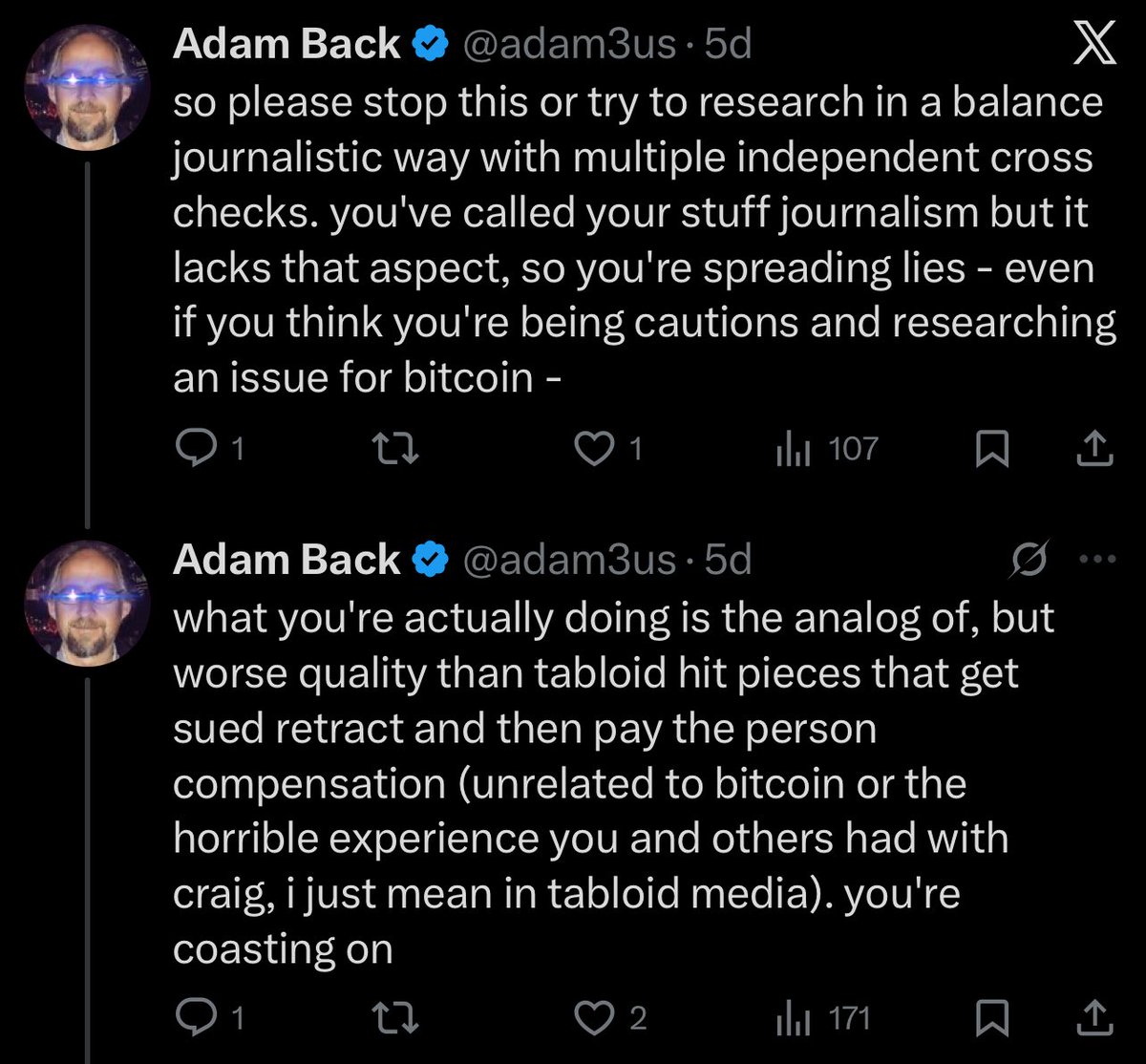
English

@hodlonaut @separ8 They definitely need a spokesperson that can engage with the community. Perhaps someone like you...
English
dewmap ретвитнул
Bitcoin Core has no CEO, no board, no formal hierarchy.
But between 2019 and 2025, a small network of developers, funders, and institutions came to control who got in, who got funded, and what got merged.
I am working on a four-article series documenting how informal power over Bitcoin Core was built, exercised, and defended.
Article one scheduled to drop next week.
English
“shitcoin fan fiction mixed with conspiracy”
No.
Any system with meaningful power will attract attempts at control.
That’s not conspiracy, it’s logic, applied with adversarial thinking in the most adversarial arena: money.
Bitcoin is no exception.
It is natural that actors seeking influence over its direction will target its defaults, as they are among the few parameters that can be changed without a hard fork.
Policy defaults are how its boundaries are defined.
Neutrality toward arbitrary data is not a trivial stance for a monetary base layer.
Bitcoin is not a general-purpose data network.
It is monetary infrastructure competing across time.
Change defaults
→ wallets optimize around them
→ miners price around them
→ developers normalize around them
→ culture shifts
Consensus defines validity.
Policy defines optimization.
Change the narrow optimum
→ change the network trajectory
A 1200× shift in default policy isn’t noise, it’s a directional signal.
It deserves adversarial scrutiny, not dismissal.
Stricter defaults on arbitrary data are not about censorship. They are about preserving the narrow monetary optimum.‼️
Drift, if it happens, won’t present itself as an attack.
It will present itself as optimization.
That’s precisely why adversarial thinking matters.
English

@hodlonaut Ah yes, another gripping piece by Bitcoin's retarded Walter Cronkite, because shitcoin fan fiction mixed with conspiracy is the way it is now.
English

dewmap ретвитнул

Sure! But I thought you already understood BIP-110. 🤷🏻♂️
BIP-110 doesn’t evaluate whether a transaction is “monetary.” No human reviews anything. No subjective judgment is applied.
The seven rules are deterministic: size limits on witness elements, opcode restrictions, control block caps. A transaction either violates a structural rule or it doesn’t. The node doesn’t know or care what the transaction is for.
Every known monetary transaction type (payments, Lightning channels, CoinJoins, multisig, DLCs, exchange withdrawals, you name it) passes all seven rules cleanly. 4.7M tested, zero false positives. That’s not because someone defined “monetary”it’s because monetary transactions don’t need oversized witness data, OP_FALSE OP_IF envelopes, or OP_SUCCESS exploits. Data embedding does.
English
dewmap ретвитнул

Every Bitcoin educator needs to be on @Satsman.
It's the little "nudge" Bitcoin needs to explode into global adoption.
satsman.com/?ref=geekigai
Bitcoin Chattanooga@BitcoinChatt
Want to get paid while learning about Bitcoin? Meet @Satsman, a new web app that's supercharging Bitcoin education & adoption. In this video, @geekigai answers the top questions he had about Satsman. Sign up at Satsman.com/?ref=geekigai, & start stacking sats today!
English
@BTCBreadMan "intellectually stimulating"
True😎
For framing, you might enjoy this one👇I hope you will find it "intellectually stimulating" too. I certainly did.
x.com/separ8/status/…
dewmap@separ8
THE ASYMMETRIC BET A First-Principles Framework for Preserving Bitcoin as Monetary Infrastructure Thesis Bitcoin is not a software product competing in a feature market. It is monetary infrastructure competing across time. The asymmetric bet is that a fixed, credibly constrained monetary base will outcompete all discretionary alternatives over long time horizons. If that premise is correct, then the primary engineering objective is not expressiveness, throughput, or short-term fee maximization, but the preservation of monetary credibility under adversarial conditions. Every protocol decision must therefore be evaluated against a single question: does this strengthen or weaken Bitcoin’s function as neutral, verifiable, time-resistant money? If the answer is ambiguous, restraint is the only rational default. I. Bitcoin as Civilizational Infrastructure Bitcoin is base-layer monetary infrastructure. It is not an application competing for users, nor a platform competing for features, nor a generalized data system seeking broader utility. Its function is singular: to provide a monetary settlement layer that operates without discretionary authority and without reliance on trust in centralized actors. Infrastructure is governed by a different engineering philosophy than products. Products evolve rapidly, adapt to user demand, and expand their feature set to remain competitive. Infrastructure, by contrast, must prioritize stability over novelty and predictability over expansion. The more foundational the layer, the more catastrophic the consequences of instability. Monetary infrastructure sits at the bottom of economic coordination; its failure propagates everywhere. Electric grids are not redesigned for creativity. Core internet routing protocols are not altered for experimentation. Systems that underpin civilization are judged by their continuity under stress. Money belongs in this category. The asymmetric bet is that a strictly constrained, rule-bound monetary base will outperform flexible, discretionary systems over long time horizons. If that premise is correct, then the primary obligation of those working on Bitcoin is preservation. Not preservation as dogma, but preservation as a rational response to time, adversarial pressure, and systemic risk. Every increase in protocol flexibility expands interpretive surface and validation complexity. Every expansion of permissible behavior alters long-term incentives. Infrastructure that widens its design surface increases the probability of unintended consequences compounding over decades. Bitcoin is not optimized for expressiveness. It is optimized for credibility. And credibility, once weakened, cannot be restored by iteration. As civilizational infrastructure, Bitcoin must be engineered with restraint, because its role is not to evolve quickly, but to endure. II. Code, Time, and the Narrow Optimum Bitcoin exists across time. Code does not live in the present; it compounds forward. Every rule becomes precedent. Every relaxation becomes baseline. Every expansion becomes assumed entitlement. Engineering for a short-lived system tolerates correction through iteration. Engineering for monetary infrastructure cannot rely on iteration as a safety net. Monetary credibility compounds slowly and erodes quickly. The asymmetry is temporal. The longer the time horizon, the narrower the acceptable design surface. Flexibility that appears harmless in a two-year window becomes ambiguity across twenty. A parameter change that seems trivial today alters incentives permanently once deployed. Validation costs that are marginal now accumulate into centralization pressure later. The narrow optimum is not aesthetic minimalism. It is an economic boundary. Bitcoin’s value proposition is credible constraint. Not maximum throughput. Not maximum programmability. Not maximum data permissiveness. Maximum monetary reliability under adversarial conditions. Widening the rule surface weakens that reliability because it increases interpretive complexity, state growth, and coordination burden. Monetary infrastructure must converge toward simplicity over time, not diverge into expressiveness. Restraint is therefore not ideological ossification. It is quality engineering under a civilizational time horizon. The burden of proof for any change must scale with the irreversibility of its consequences. If a change expands non-monetary use at the base layer, increases long-term validation cost, or introduces ambiguity in rule intent, it must clear an asymmetrical threshold. Because the cost of being slightly too restrictive is smaller than the cost of being slightly too permissive. In this context, restraint is not stagnation. It is defense of the monetary core. III. Authority and Defense Bitcoin’s security model is hierarchical whether acknowledged or not. That hierarchy must be explicit. - Users grant legitimacy. - Nodes enforce legitimacy. - Miners comply with legitimacy. - Developers codify legitimacy. Developers do not define Bitcoin. They implement it. Miners do not define Bitcoin. They compete within constraints. Nodes enforce consensus, and users choose which rules their nodes run. Authority flows upward from economic actors enforcing rules, not downward from those writing code. Any framing that elevates developer discretion above node enforcement is structurally inverted. Any framing that prioritizes miner incentives as protocol guidance confuses block production with rule legitimacy. The inversion error begins when protocol evolution is justified by what miners will include rather than what nodes should validate. It begins when short-term fee spikes are treated as evidence of healthy demand rather than potential adversarial capital deployment. It begins when flexibility is introduced because “the network is already doing it.” The network does not define the rules. The rules define the network. Pure fee-market arguments assume adversaries face budget constraints. That assumption fails in a fiat world with effectively unlimited capital pools. When actors with asymmetric financial resources can subsidize behavior at scale, the market signal becomes distorted. Apparent demand may be strategic expenditure. This is where defense must extend beyond abstract economic theory. Code sends signals. If base-layer rules signal neutrality toward non-monetary exploitation, capital will flow to exploit that neutrality. If the rules signal strict monetary alignment, exploitation becomes more expensive and less scalable. Defense of Bitcoin’s monetary function therefore begins with protection of node sovereignty. Validation must remain cheap, predictable, and accessible. State growth must remain bounded. Rule interpretation must remain mechanical, not discretionary. Prioritizing miner revenue over node enforceability is naive beyond belief. Miners are economically competitive actors. Nodes are the locus of decentralization. Security from first principles resides in the ability of ordinary economic actors to independently verify and reject invalid blocks. If node costs rise, verification centralizes. If verification centralizes, authority concentrates. If authority concentrates, monetary neutrality collapses. Defense of the primary monetary focus is not cultural preference. It is structural necessity. The base layer must remain aligned with its singular purpose: censorship-resistant, non-discretionary money. Anything that dilutes that purpose increases systemic risk. Bitcoin is not optimized for creativity. It is optimized for credibility. Every line of code must serve monetary sovereignty. Hard logic. First principles. No inversion. Don’t trust. Verify.
English

Bitcoin’s core innovation is neutrality.
When you start filtering out “unacceptable” transactions, you introduce governance risk into a previously neutral system.
This increases the odds of capture.
Objective technical limits are good.
Arbitrary/subjective filtering is bad.
English
dewmap ретвитнул
“It’s impossible to define a monetary transaction on Bitcoin!” - the same woke nihilists who shriek “define spam!”
Sure there is! In 4.7M challenges, BIP-110 never failed once.
Literally a perfect score defining monetary transactions. 👇🏻
Justin Bechler #BIP-110@1914ad
Sure! But I thought you already understood BIP-110. 🤷🏻♂️ BIP-110 doesn’t evaluate whether a transaction is “monetary.” No human reviews anything. No subjective judgment is applied. The seven rules are deterministic: size limits on witness elements, opcode restrictions, control block caps. A transaction either violates a structural rule or it doesn’t. The node doesn’t know or care what the transaction is for. Every known monetary transaction type (payments, Lightning channels, CoinJoins, multisig, DLCs, exchange withdrawals, you name it) passes all seven rules cleanly. 4.7M tested, zero false positives. That’s not because someone defined “monetary”it’s because monetary transactions don’t need oversized witness data, OP_FALSE OP_IF envelopes, or OP_SUCCESS exploits. Data embedding does.
English
"you’re not really solving a technical problem. You’re introducing a subjective problem. "
No focus on Bitcoin is money shouldn't be seen as a subjective problem IMHO.
Fixing technical challenges becomes impossible when the development culture is infected with a kind of ideological drift: the erosion of clear definitions, the elevation of confusion as sophistication, and the weaponization of tolerance to introduce an entirely different value system while pretending nothing has changed.
A parameter change that seems trivial today alters incentives permanently once deployed. Validation costs that are marginal now accumulate into centralization pressure later. (Core v30)‼️
If the experts said it was 'safe and effective', who are we to question it? 🤷♂️
I trust the narrow optima.👇
x.com/adam3us/status…
English
That’s all well and good, but I think you’re mixing understandable cultural frustration with protocol design.
Calling it woke or a Core agenda isn’t necessarily wrong, but it also doesn’t really engage with the actual constraint, which is that Bitcoin can’t *****objectively***** distinguish “money” from “non-money” at the protocol level.
In Bitcoin’s eyes a valid transaction that pays a fee is a valid transaction. There’s no consensus rule that says “this output is monetary, this one is trash.”
When you try to enforce that distinction (from a well-intentioned place, no doubt), you’re not really solving a technical problem. You’re introducing a subjective problem.
Which is fine for your own node I suppose. Do whatever you want. But if it scales far enough then it potentially becomes a policy issue that negatively impacts Bitcoin’s neutrality.
English
If you agree that Bitcoin is money, then what Satoshi provided to humanity is a way to separate money and the state. If bad actors find ways to abuse the protocol, isn’t it Core’s duty to work on tightening the loose ends to reach that goal, in your opinion?
Or should the primary client just loosen the provided narrow monetary optimum to cater to the new reality of abuse on the network? 🤷♂️
English
@1914ad @separ8 There has always been such a thing as unacceptable transactions. Transaction that don’t meet the consensus rules are invalid.
I’m arguing against deciding subjectively that a transaction that meets consensus rules is “non-monetary” or “abuse”, and filtering it out as a result.
English
@PalomaXiom56687 @BTCBreadMan If base-layer rules signal neutrality toward non-monetary exploitation, capital will flow to exploit that neutrality. If the rules signal strict monetary alignment, exploitation becomes more expensive and less scalable.👇
x.com/separ8/status/…
dewmap@separ8
THE ASYMMETRIC BET A First-Principles Framework for Preserving Bitcoin as Monetary Infrastructure Thesis Bitcoin is not a software product competing in a feature market. It is monetary infrastructure competing across time. The asymmetric bet is that a fixed, credibly constrained monetary base will outcompete all discretionary alternatives over long time horizons. If that premise is correct, then the primary engineering objective is not expressiveness, throughput, or short-term fee maximization, but the preservation of monetary credibility under adversarial conditions. Every protocol decision must therefore be evaluated against a single question: does this strengthen or weaken Bitcoin’s function as neutral, verifiable, time-resistant money? If the answer is ambiguous, restraint is the only rational default. I. Bitcoin as Civilizational Infrastructure Bitcoin is base-layer monetary infrastructure. It is not an application competing for users, nor a platform competing for features, nor a generalized data system seeking broader utility. Its function is singular: to provide a monetary settlement layer that operates without discretionary authority and without reliance on trust in centralized actors. Infrastructure is governed by a different engineering philosophy than products. Products evolve rapidly, adapt to user demand, and expand their feature set to remain competitive. Infrastructure, by contrast, must prioritize stability over novelty and predictability over expansion. The more foundational the layer, the more catastrophic the consequences of instability. Monetary infrastructure sits at the bottom of economic coordination; its failure propagates everywhere. Electric grids are not redesigned for creativity. Core internet routing protocols are not altered for experimentation. Systems that underpin civilization are judged by their continuity under stress. Money belongs in this category. The asymmetric bet is that a strictly constrained, rule-bound monetary base will outperform flexible, discretionary systems over long time horizons. If that premise is correct, then the primary obligation of those working on Bitcoin is preservation. Not preservation as dogma, but preservation as a rational response to time, adversarial pressure, and systemic risk. Every increase in protocol flexibility expands interpretive surface and validation complexity. Every expansion of permissible behavior alters long-term incentives. Infrastructure that widens its design surface increases the probability of unintended consequences compounding over decades. Bitcoin is not optimized for expressiveness. It is optimized for credibility. And credibility, once weakened, cannot be restored by iteration. As civilizational infrastructure, Bitcoin must be engineered with restraint, because its role is not to evolve quickly, but to endure. II. Code, Time, and the Narrow Optimum Bitcoin exists across time. Code does not live in the present; it compounds forward. Every rule becomes precedent. Every relaxation becomes baseline. Every expansion becomes assumed entitlement. Engineering for a short-lived system tolerates correction through iteration. Engineering for monetary infrastructure cannot rely on iteration as a safety net. Monetary credibility compounds slowly and erodes quickly. The asymmetry is temporal. The longer the time horizon, the narrower the acceptable design surface. Flexibility that appears harmless in a two-year window becomes ambiguity across twenty. A parameter change that seems trivial today alters incentives permanently once deployed. Validation costs that are marginal now accumulate into centralization pressure later. The narrow optimum is not aesthetic minimalism. It is an economic boundary. Bitcoin’s value proposition is credible constraint. Not maximum throughput. Not maximum programmability. Not maximum data permissiveness. Maximum monetary reliability under adversarial conditions. Widening the rule surface weakens that reliability because it increases interpretive complexity, state growth, and coordination burden. Monetary infrastructure must converge toward simplicity over time, not diverge into expressiveness. Restraint is therefore not ideological ossification. It is quality engineering under a civilizational time horizon. The burden of proof for any change must scale with the irreversibility of its consequences. If a change expands non-monetary use at the base layer, increases long-term validation cost, or introduces ambiguity in rule intent, it must clear an asymmetrical threshold. Because the cost of being slightly too restrictive is smaller than the cost of being slightly too permissive. In this context, restraint is not stagnation. It is defense of the monetary core. III. Authority and Defense Bitcoin’s security model is hierarchical whether acknowledged or not. That hierarchy must be explicit. - Users grant legitimacy. - Nodes enforce legitimacy. - Miners comply with legitimacy. - Developers codify legitimacy. Developers do not define Bitcoin. They implement it. Miners do not define Bitcoin. They compete within constraints. Nodes enforce consensus, and users choose which rules their nodes run. Authority flows upward from economic actors enforcing rules, not downward from those writing code. Any framing that elevates developer discretion above node enforcement is structurally inverted. Any framing that prioritizes miner incentives as protocol guidance confuses block production with rule legitimacy. The inversion error begins when protocol evolution is justified by what miners will include rather than what nodes should validate. It begins when short-term fee spikes are treated as evidence of healthy demand rather than potential adversarial capital deployment. It begins when flexibility is introduced because “the network is already doing it.” The network does not define the rules. The rules define the network. Pure fee-market arguments assume adversaries face budget constraints. That assumption fails in a fiat world with effectively unlimited capital pools. When actors with asymmetric financial resources can subsidize behavior at scale, the market signal becomes distorted. Apparent demand may be strategic expenditure. This is where defense must extend beyond abstract economic theory. Code sends signals. If base-layer rules signal neutrality toward non-monetary exploitation, capital will flow to exploit that neutrality. If the rules signal strict monetary alignment, exploitation becomes more expensive and less scalable. Defense of Bitcoin’s monetary function therefore begins with protection of node sovereignty. Validation must remain cheap, predictable, and accessible. State growth must remain bounded. Rule interpretation must remain mechanical, not discretionary. Prioritizing miner revenue over node enforceability is naive beyond belief. Miners are economically competitive actors. Nodes are the locus of decentralization. Security from first principles resides in the ability of ordinary economic actors to independently verify and reject invalid blocks. If node costs rise, verification centralizes. If verification centralizes, authority concentrates. If authority concentrates, monetary neutrality collapses. Defense of the primary monetary focus is not cultural preference. It is structural necessity. The base layer must remain aligned with its singular purpose: censorship-resistant, non-discretionary money. Anything that dilutes that purpose increases systemic risk. Bitcoin is not optimized for creativity. It is optimized for credibility. Every line of code must serve monetary sovereignty. Hard logic. First principles. No inversion. Don’t trust. Verify.
English

@separ8 @BTCBreadMan Understanding algorithmic bias requires examining both its theoretical foundations and its practical limitations under resource constraints.
English
@BTCBreadMan "I think you’re mixing understandable cultural frustration with protocol design."
Or, could it be that you’re conflating a philosophical shift within Core with a technical challenges ?
x.com/separ8/status/…
dewmap@separ8
Philosophical divide that emerged during the debate. There were clearly two camps: Camp A: Bitcoin is money. Non-monetary use is spam. Policy should discourage it. Camp B: Bitcoin is permissionless blockspace allocated through a fee market. Policy should be resource-based, not use-case-based. Core reviewers overwhelmingly rejected Bitcoin is money. That is the key point. github.com/bitcoin/bitcoi…
English