Today in American History: Republican Party Founded
March 20, 1854
The Grand Old Party was founded in Ripon, Wisconsin by former Whig, Free Soilers and abolitionists to oppose the expansion of slavery into western territories following the Kansas-Nebraska Act.
In 1860, Republican Abraham Lincoln was nominated as the party’s president. His election precipitated the Civil War.
2 teams from the same state in the NCAA tournament each playing a team with the same mascot on the same day.
MSU vs NDSU Bison
UM vs Howard Bison
Never happened before.
NIL is changing the game.
@jasonbenetti
2023. The "First Partner" of California is asked if she will call herself "First Partner" if her husband Gavin becomes President.
Ready for her crazy eyes in the White House?
BTW, watch how this self-proclaimed "defender of women" passively disses Melania.
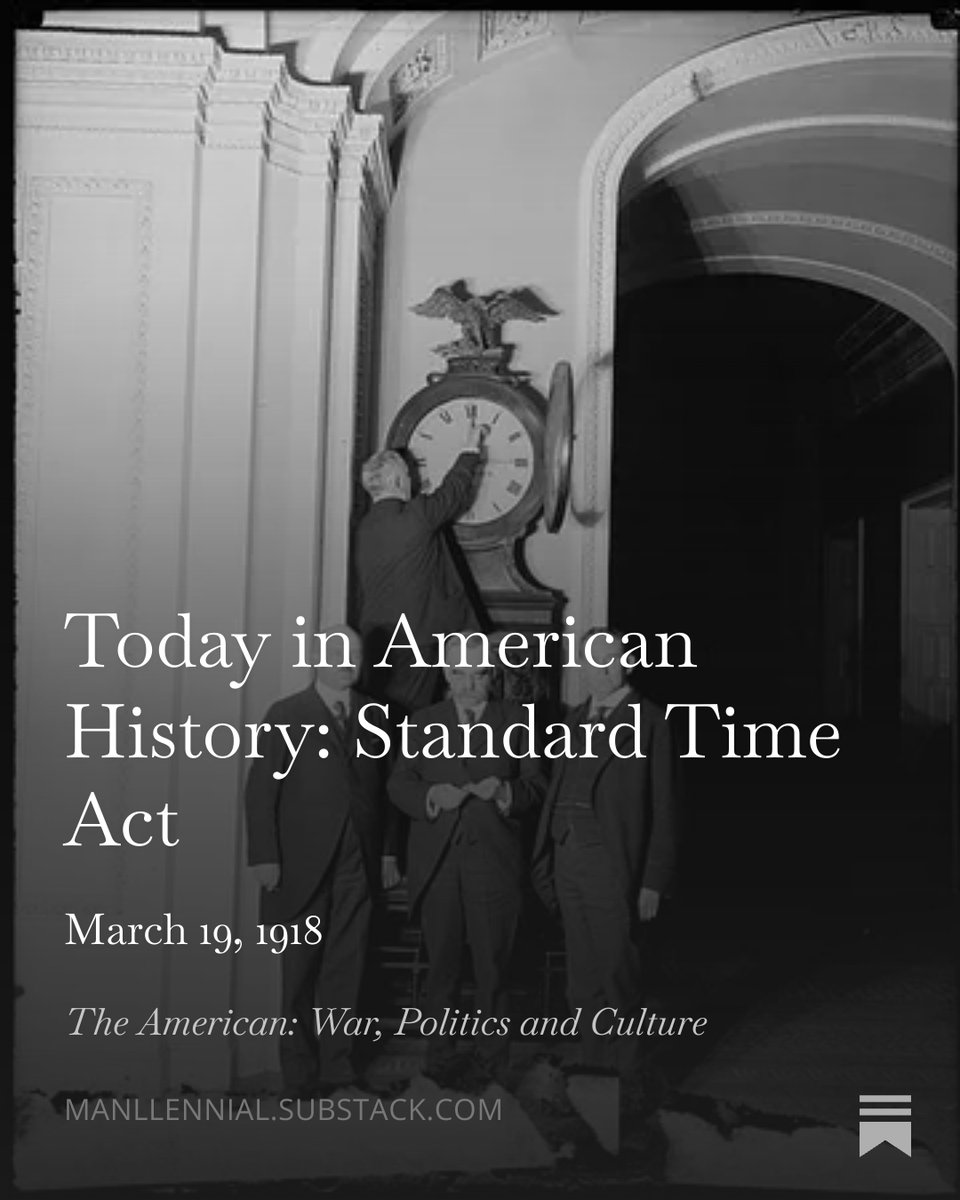
Today in American History: Standard Time Act
March 19, 1918
President Woodrow Wilson signed the Calder Act, which established uniform standard time zones across the country. Daylight saving time (DST) was introduced as a means to conserve energy during World War I.
The Interstate Commerce Commission oversaw and enforced Eastern, Central, Mountain and Pacific time and standardized zones that were previously fragmented by local and railroad variations.
Daylight savings time proved unpopular among farmers and the public, leading to widespread noncompliance. It was repealed by Congress in 1919, but re-established by the Uniform Time Act of 1966 with oversight by the Department of Transportation.
Today in American History: Stamp Act Repealed
March 18, 1766
The first tax levied on the colonies without colonial consent was put into effect on November 1, 1765. The Stamp Act imposed a direct tax on printed materials such as legal documents, newspapers, pamphlets, and playing cards to generate revenue for the British military that protected the colonies during the French and Indian War (Seven Years War).
The Act was passed in March of 1765 followed by the Sons of Liberty (Samuel Adams, John Hancock) organizing protests, riots, boycotts and effigy burning. In October 1765, the Stamp Act Congress formed in New York where delegates from nine colonies issued the Declaration of Rights and Grievances.
“No taxation without representation.”
After the repeal of the Stamp Act, Parliament issued the Declaratory Act which stated the colonies were"subordinate unto and dependent upon the imperial crown and parliament of Great Britain" and affirmed Parliament's right "to make laws and statutes of sufficient force and validity to bind the colonies and people of America...in all cases whatsoever."
Today in American History: Evacuation Day
March 17, 1776
The Siege of Boston lasted from April 19, 1775 to March 17, 1776 and was the first extended military operation of the Continental Army in the Revolutionary War. Under General George Washington’s command, 16,000 Patriots encircled 11,000 British regulars in Boston.
Colonel Henry Knox fortified the city with heavy artillery and threatened the Royal Navy’s position in Boston Harbor. British General William Howe opted against a counterattack and retreated his troops and Loyalists by sea to Halifax, Nova Scotia.
Today in American History: First Liquid-Fueled Rocket Launch
March 16, 1926
Robert H. Goddard, at his Aunt Effie Wooster’s farm in Auburn, Massachusetts, successfully ignited a 10-foot-tall rocket, he later dubbed “Nell.” The 11 pound rocket burned for approximately 2.5 seconds, accelerating to 60 mph, reached a peak altitude of 41 feet and landed 184 feet away.
Goddard developed the initial liquid-propellant in September 1921. His first launch on March 8, 1926, failed due to ignition issues.
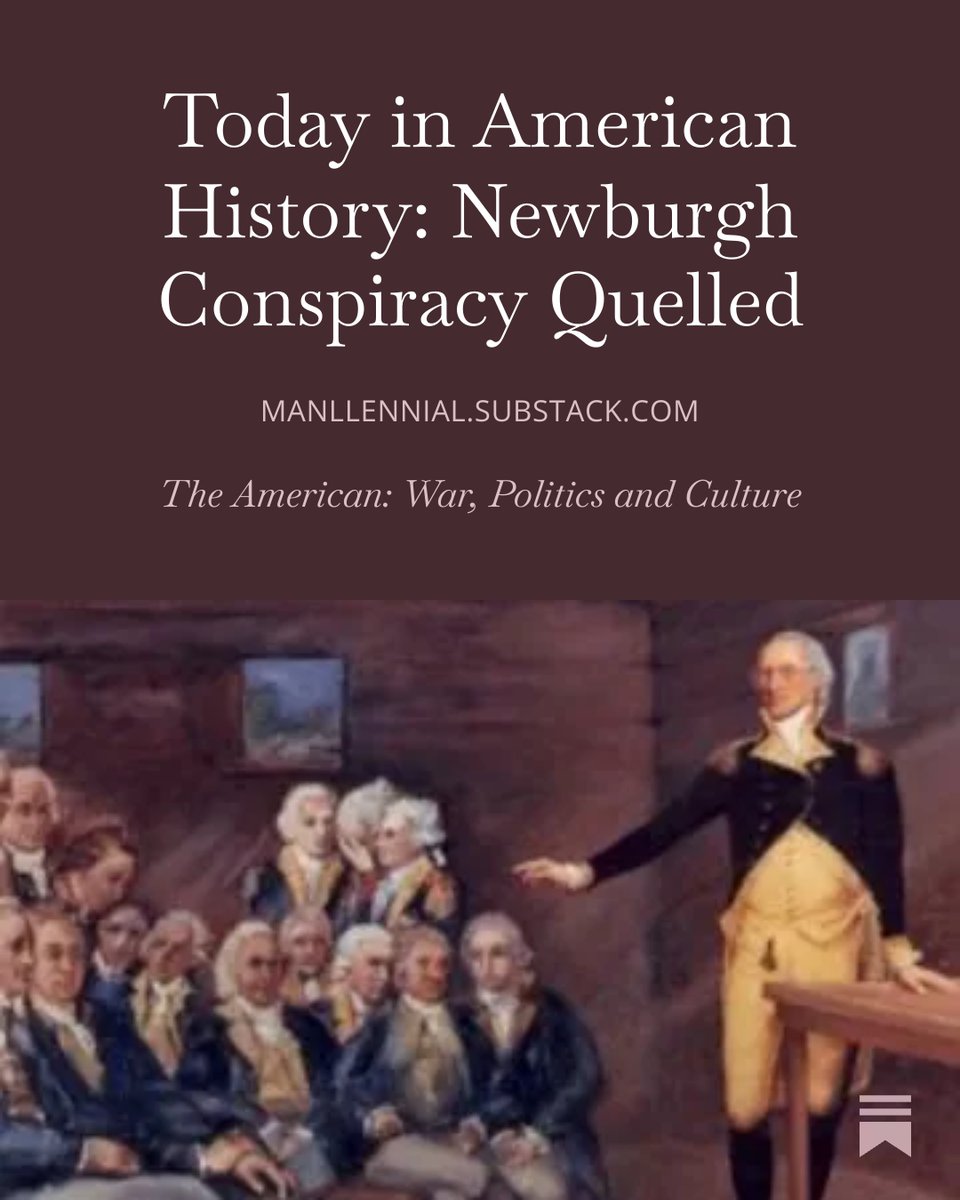
Today in American History: Newburgh Conspiracy Quelled
March 15, 1783
Towards the end of the Revolutionary War, General George Washington issued an order to cancel a proposed gathering and delivered an address in the Temple at New Windsor to assembled officers. The assembled senior officers plotted to withhold disbandment until demands for back pay and lifetime half-pay pensions were met.
Washington expressed sympathy for the officer’s grievances, but strongly condoned any extra-constitutional actions. He spoke of his own personal struggles and reaffirmed military subordination to civil authority.
The issues with payment and authority by the Confederation Congress was a symptom of a larger flaw in the Articles of Confederation that eventually led to the rise of Federalism.
Time spent in Federal Government roles…
George Washington: 8 years
Thomas Jefferson: 10 years
John Adams: 12 years
Nancy Pelosi: 39 years
Mitch McConnell: 41 years
Chuck Schumer: 45 years
This explains everything.
Founders vs Grifters
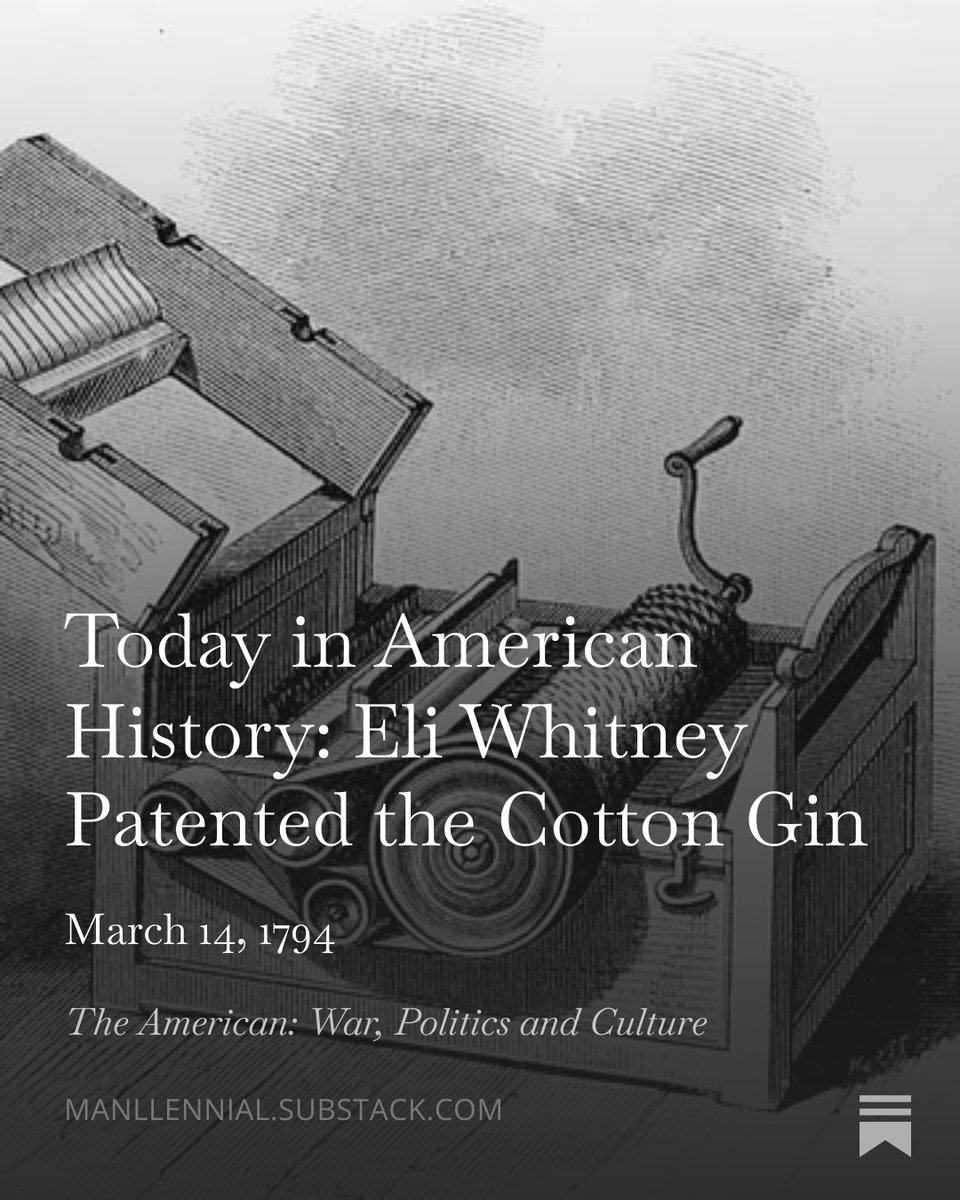
Today in American History: Eli Whitney Patented the Cotton Gin
March 14, 1794
The cotton gin changed the economics of the South by upping production of cleaned cotton from one pound manually cleaned per day to fifty pounds. Whitney’s gin worked well on short-staple upland cotton dominant in the United States and made U.S. cotton a staple export.
The cotton boom production went from about 1.5 million pounds in 1790 to over 2 billion pounds by 1860. Although cotton was now easier to process, it increased the demand for slave labor to pick the cotton and drove the enslaved Southern population in the South from roughly 700,000 in 1790 to 4 million by 1860.
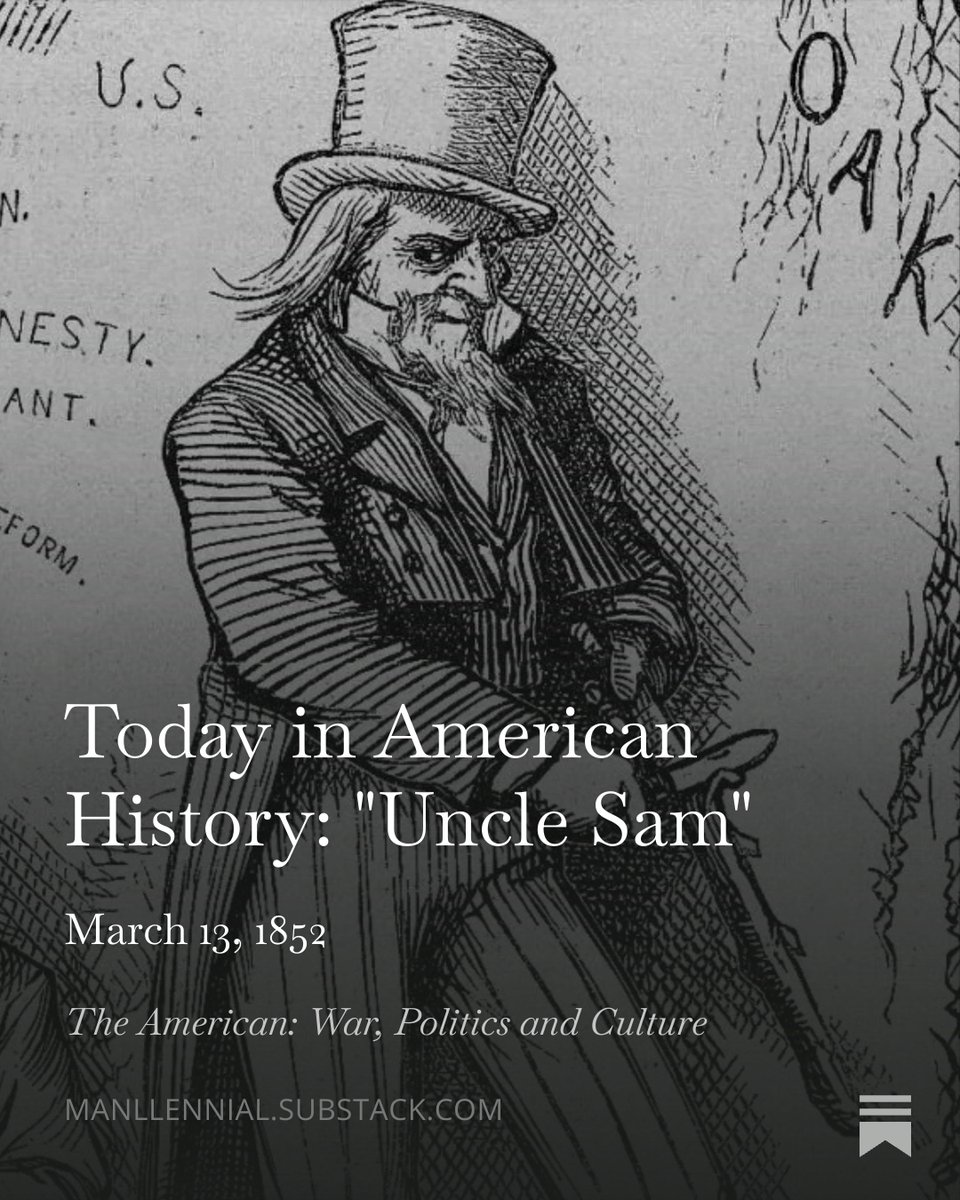
Today in American History: "Uncle Sam"
March 13, 1852
The personification of the United States federal government was born in graphic form in the New York Lantern.
“Uncle Sam” first appeared in print during the War of 1812 when a meatpacker from New York, Samuel Wilson supplied barrels stamped "U.S." to the Army. Soldiers joked about the initials referring to Wilson as Uncle Sam.
Thomas Nast depicted Uncle Sam as a lean figure with a goatee, top hat, and striped trousers in 'Harper’s Weekly' during Reconstruction.
Uncle Sam’s visual became cemented in 1917 with James Montgomery Flagg's iconic 1917 World War I recruitment poster titled 'I Want You for U.S. Army'.
Today in American History: FDR’s First Fireside Chat
March 12, 1933
President Franklin Roosevelt spoke directly to the American people 30 times from 1933 - 1944. He reassured citizens on topics from the Great Depression, trusting in the new banking institution and financial reform (Emergency Banking Act), the New Deal and World War II.
FDR’s direct appeal to Americans, outside of the mass media, earned trust in his governmental programs.
@DonnieDetroit19@SenRonJohnson@MayaMacGuineas The first Boomer was elected to Congress in 1974. The are the career politicians that built the current system. Worked pretty well for em, aye?
@SenRonJohnson@MayaMacGuineas So you're going to yank the rug out from under little old ladies and redistribute that money to someone else? Sounds like a plan.
As @MayaMacGuineas explains, right now we spend $6 on seniors for every $1 on kids under 18. When Social Security began, seniors were the poorest — today children are.
To add insult to injury, we have mortgaged their future with $39 trillion in debt and growing. It is immoral what we are doing to our children and grandchildren.
Today in American History: Lend-Lease Act
May 11, 1941
America took a step away from its neutrality position in World War II when it overrode its previous cash-and-carry policy in favor of deferred payment for nations deemed vital to American defense.
17% of total U.S. wartime expenditures ($50 billion) was in Lend-Lease aid. The UK receive about $31 billion and the Soviet Union about $11 billion.
Isolationists warned of retaliation from Axis Powers. Pearl Harbor was attacked in December.
Today in American History: First Successful Telephone Call
March 10, 1876
In his Boston home, Alexander Graham Bell successfully called his assistant in the next room, “Mr. Watson, come here; I want you.”
On March 7, Bell was awarded U.S. patent 174,465. He gained ownership over both his telephone instruments and the concept of a telephone system.
In October, he successfully tested his telephone over a two-mile distance between Boston and Cambridgeport.